
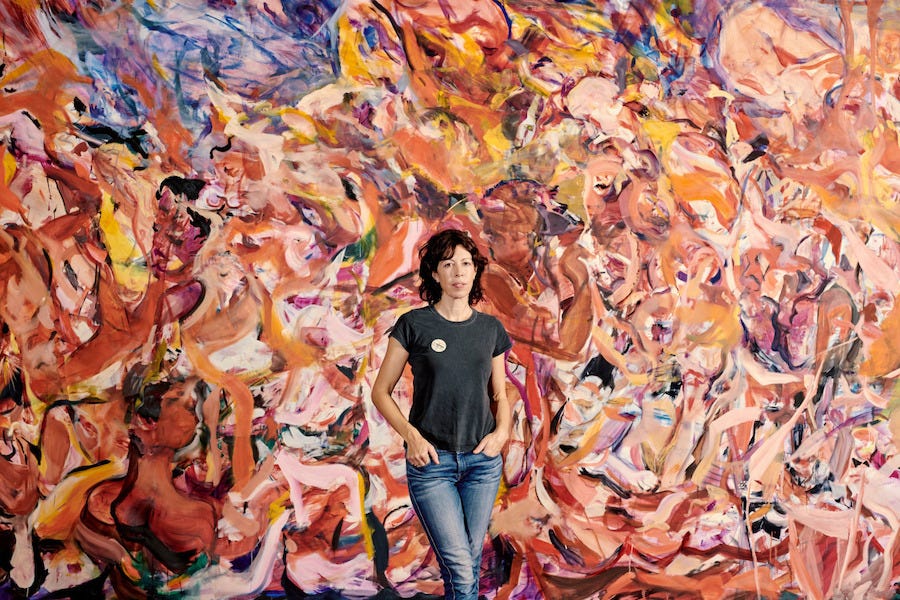
Cecily Brown’s work operates in a space of constant instability, where the image is never fully fixed. Her paintings oscillate between abstraction and figuration, revealing fragments of bodies, erotic scenes, and historical references that seem to emerge and dissolve simultaneously.
This instability is not accidental—it is central to her practice. Brown builds her canvases through layers of rapid, gestural brushwork, allowing forms to appear and then be partially erased or overwritten. The result is a surface that feels alive, almost in motion, as if the painting were still in the process of becoming.
Her engagement with art history—particularly with painters like Rubens or Fragonard—is filtered through this contemporary sensibility. Instead of quoting directly, she absorbs their dynamism and transforms it into something more chaotic and visceral. In Brown’s work, the body is never stable; it is always slipping into paint, becoming inseparable from the act that produces it.
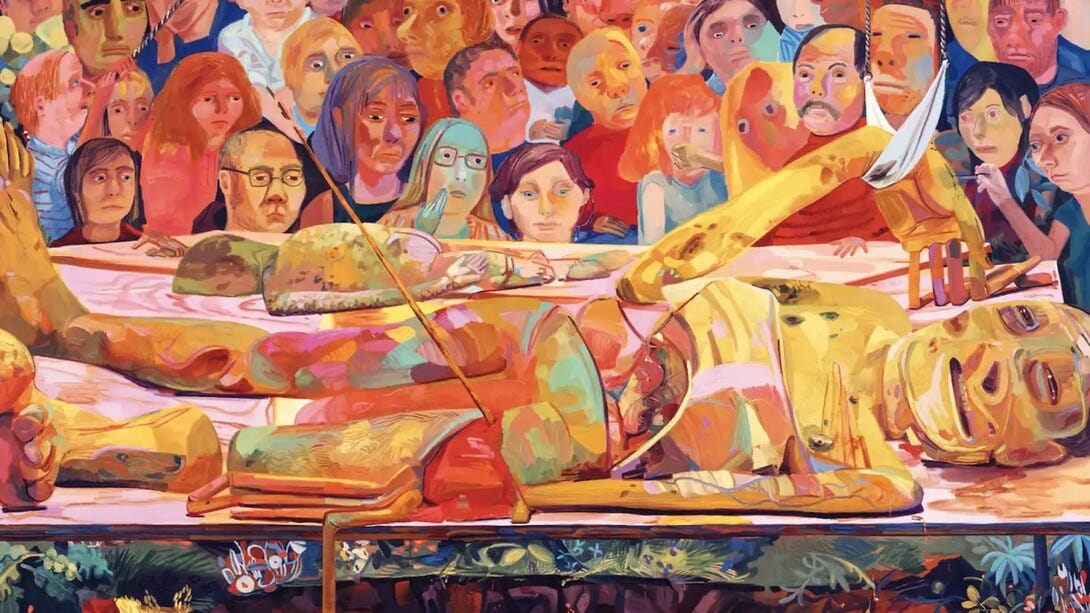
Dana Schutz approaches painting through invention. Her figures are not observed from life but constructed through imagination, often resulting in bodies that are stretched, compressed, fragmented, or placed in improbable situations.
This distortion is key to her exploration of how painting can generate meaning beyond realism. Her compositions often suggest narrative—scenes of tension, absurdity, or transformation—but these narratives remain unresolved, open to interpretation.
Materially, Schutz’s work is thick, tactile, and assertive. The paint itself becomes part of the storytelling, with exaggerated gestures reinforcing the instability of the figures depicted. There is often a tension between humor and discomfort in her work, as the grotesque and the playful coexist.
Through this approach, Schutz expands the possibilities of figuration, demonstrating how the body can function as a flexible, expressive structure rather than a fixed form.
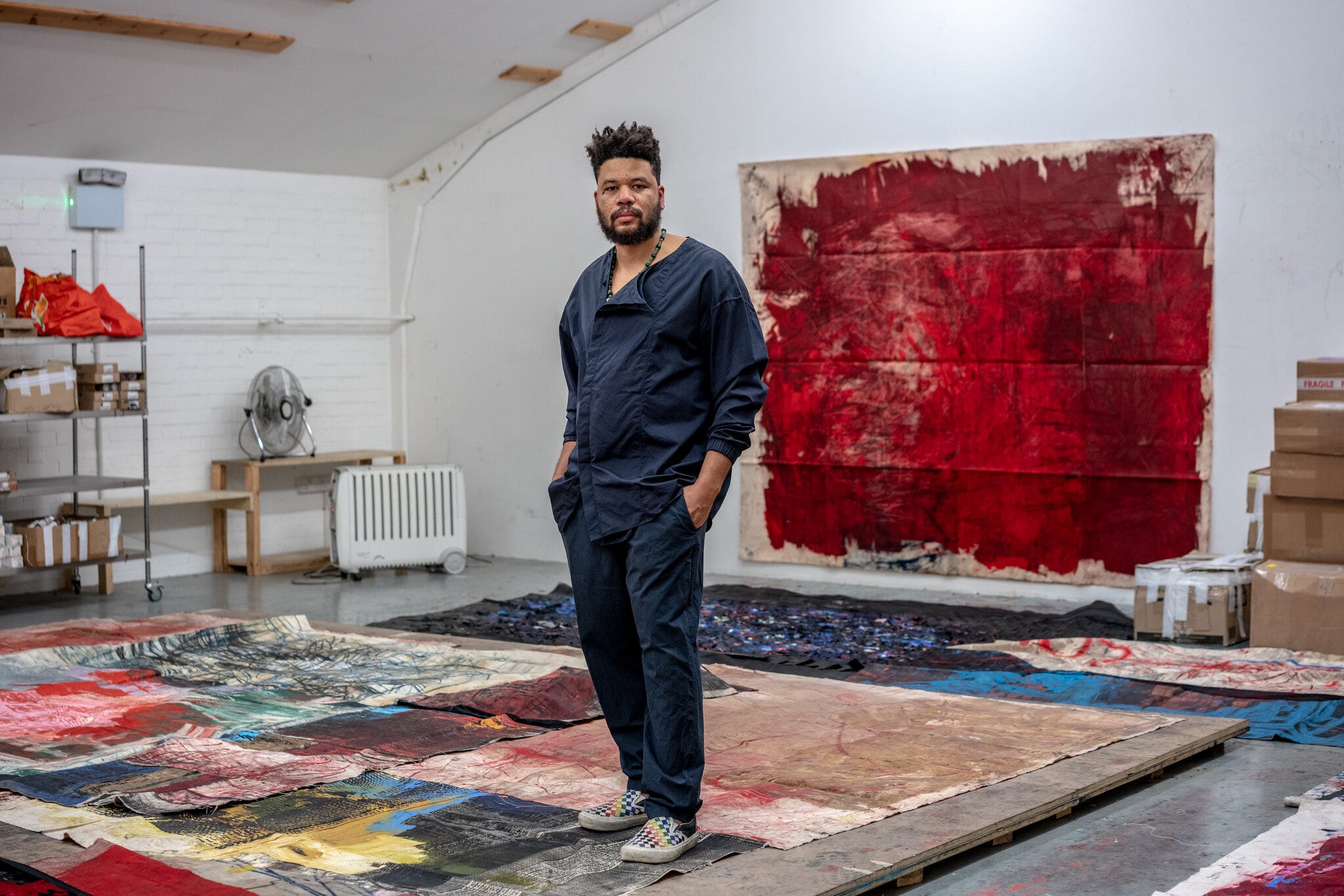
Oscar Murillo’s paintings resist the idea of a single, contained act of creation. Instead, they are built over time through accumulation, movement, and often collaboration. His canvases are folded, transported, stitched together, and exposed to different environments, absorbing traces of each context.
This process-oriented approach transforms painting into something closer to a record of lived experience. Marks are not just visual decisions; they are residues of action, labor, and time. The surface becomes an archive of gestures rather than a composed image.
Murillo’s work is also deeply connected to questions of migration, global labor, and identity. The materials he uses—often raw, industrial, or repurposed—carry social and economic implications.
In this sense, the “body” in Murillo’s work is not only the artist’s own, but a collective body—embedded in systems of production, movement, and exchange.
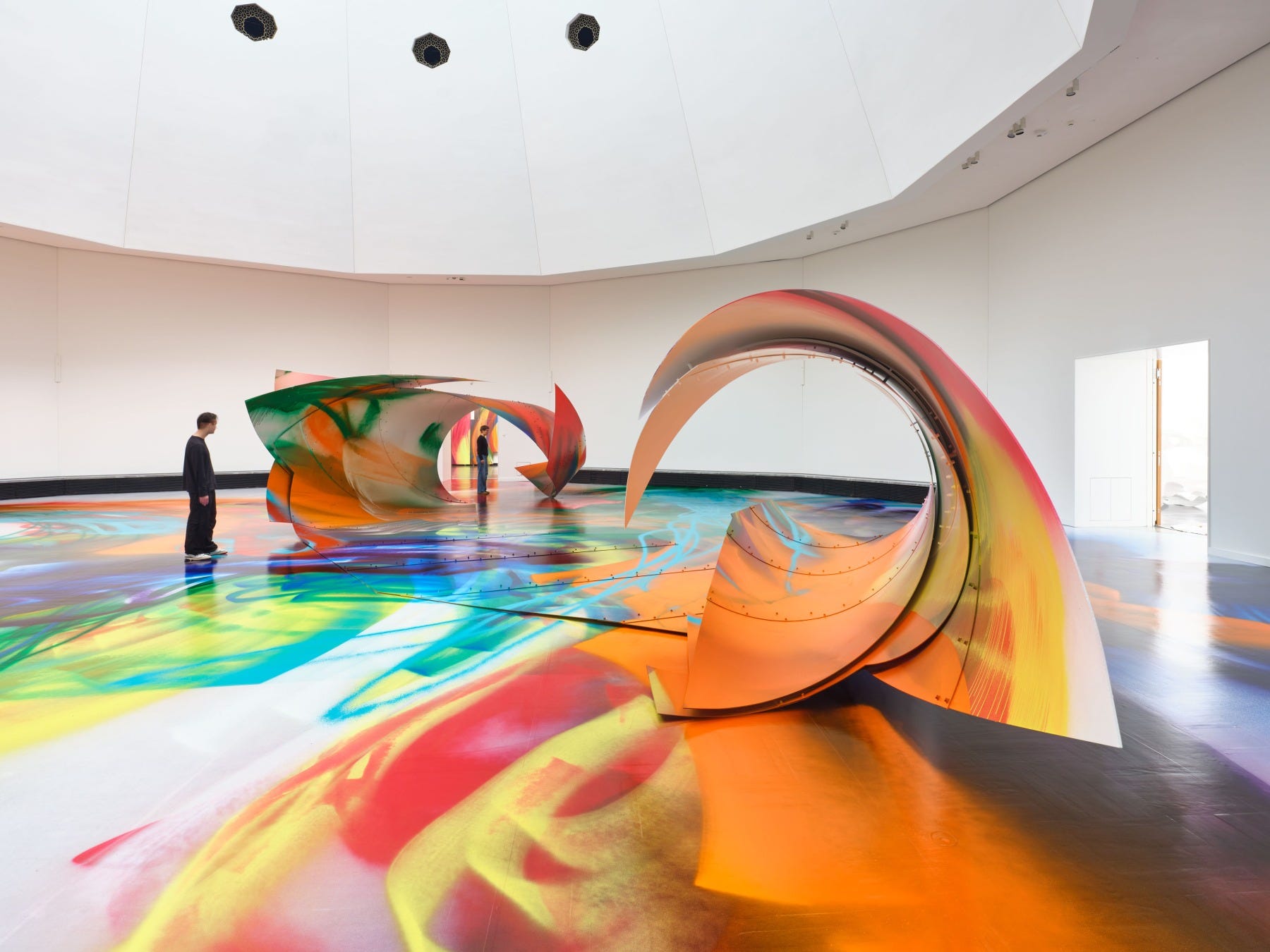
Katharina Grosse radically expands the field of painting by removing it from the traditional support of the canvas. Using industrial spray guns, she applies color directly onto architecture, landscapes, and objects, creating large-scale environments that engulf the viewer.
Her work emphasizes speed, scale, and physical immersion. The gesture is no longer confined to the wrist or arm; it involves the entire body moving through space. This shift transforms painting into an environmental experience rather than a framed object.
Color in Grosse’s work is not descriptive—it is spatial and physical. It reshapes how we perceive depth, surface, and orientation. Walking through her installations, the viewer becomes aware of their own body in relation to color, movement, and space.
By dissolving the boundaries of the canvas, Grosse redefines painting as something that exists in real time and space, inseparable from bodily experience.
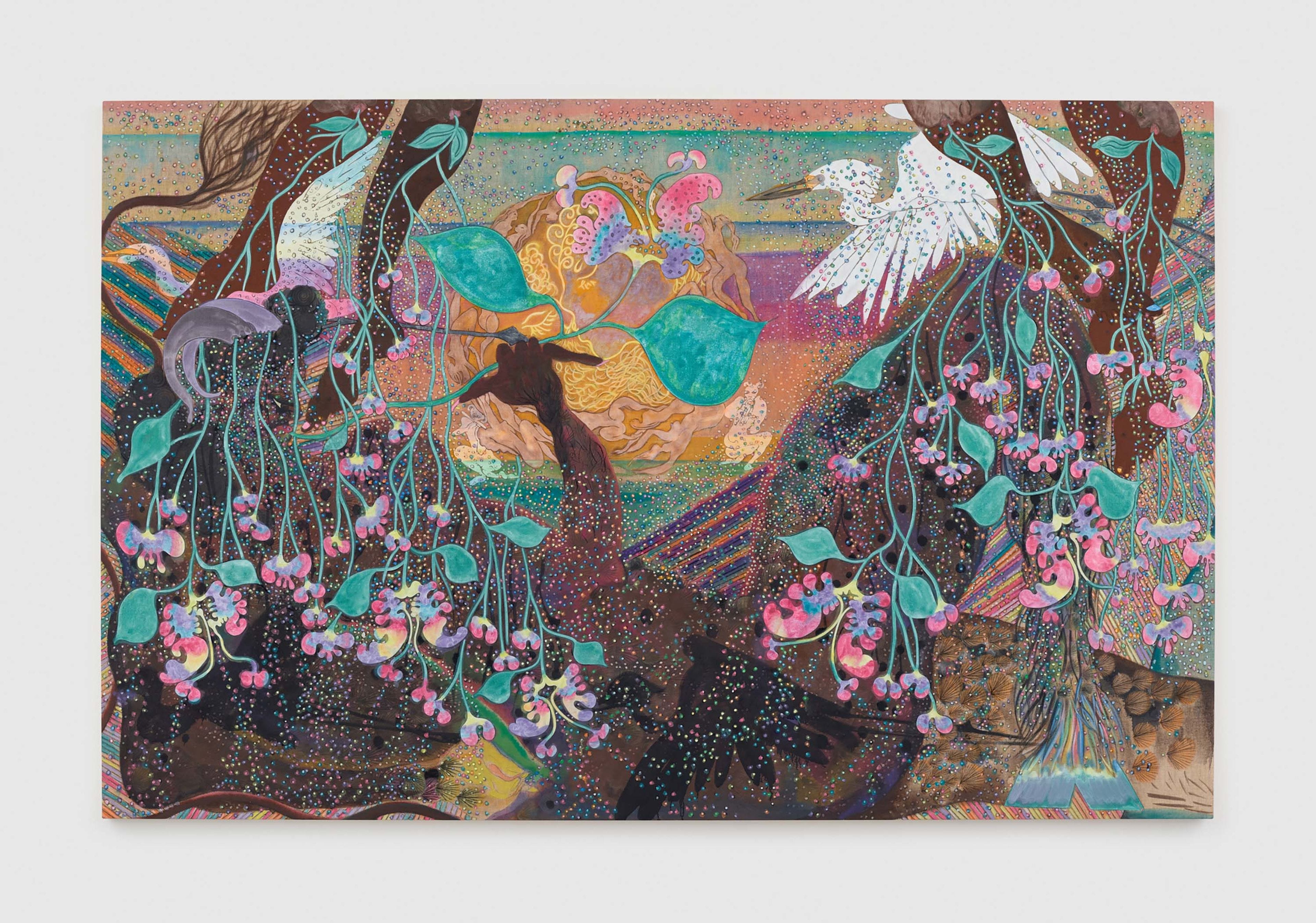
Chris Ofili’s paintings are built through a process of layering that is both material and symbolic. His surfaces are dense and luminous, incorporating paint, resin, glitter, and unconventional elements such as elephant dung, which functions both structurally and conceptually.
This accumulation of materials creates a tactile, almost sculptural presence. The painting is not just an image to be seen, but an object to be experienced—its surface carrying weight, texture, and depth.
Ofili’s imagery draws from a wide range of sources: mythology, religion, Black diasporic culture, and personal narrative. These references are not presented linearly but woven together into complex visual systems.
There is a ritualistic dimension to his practice. The repetition of marks, the layering of materials, and the slow build-up of the surface give his work a sense of time and devotion. Painting, in this context, becomes an act of transformation—where material and meaning evolve together.
No posts
Comments
Nothing yet. Say the first thing.
Sign in to join the conversation.