
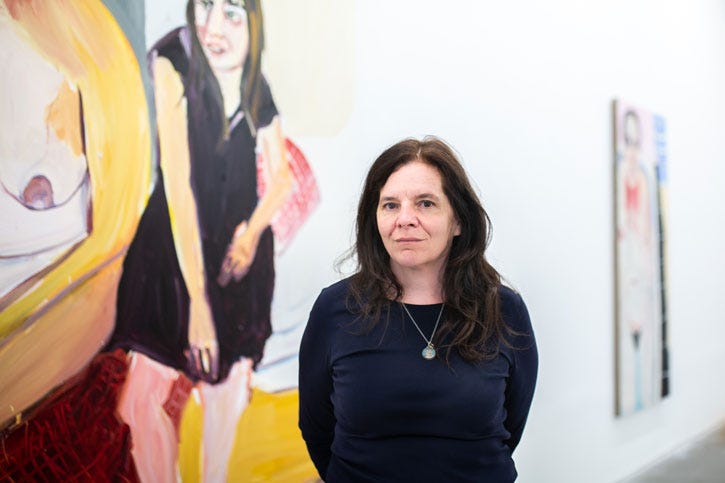
Chantal Joffe’s paintings often begin with subjects drawn from her immediate world—friends, daughters, family members, women in states of rest, waiting, or self-containment. Yet her work is not fundamentally about portraiture in the traditional sense. It is about the unstable emotional terrain created when one person looks closely at another over time.
Her brushwork is central to this. Joffe paints quickly but not casually. The looseness of her marks is not a sign of spontaneity alone; it is also a refusal of polish, a refusal to resolve the figure into something closed or fully knowable. Faces may remain slightly unsettled, limbs elongated, surfaces left visibly unfinished. These formal instabilities carry emotional meaning. They allow vulnerability to remain present in the work.
There is often something profoundly intimate in the way Joffe handles presence. Her figures do not perform for the viewer. They often appear absorbed in themselves, unaware of being observed, or simply resistant to easy readability. This creates a subtle but important ethical shift: the painting does not consume the subject. It remains aware of the distance between seeing and understanding.
In this sense, Joffe’s paintings are not simply portraits of people but portraits of relationships—of affection, uncertainty, familiarity, and the impossibility of fully grasping another person even when they are close to you.
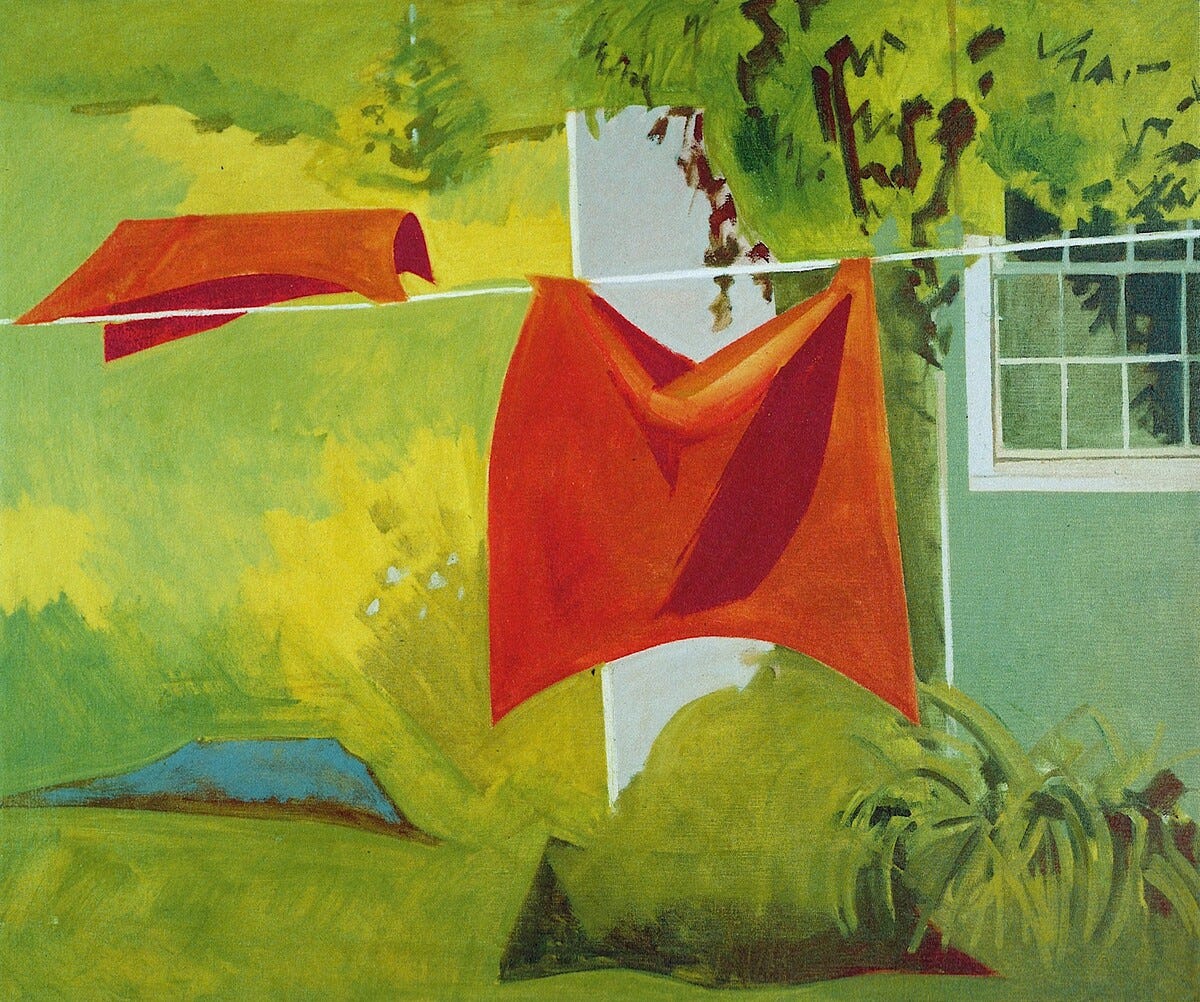
Lois Dodd’s work can seem almost modest at first encounter. A window at night. A roofline. A tree branch. A door left slightly open. Yet this modesty is deceptive. What Dodd has pursued over decades is nothing less than a sustained inquiry into what it means to truly look.
Her paintings emerge from direct observation, but they are never merely descriptive records. What interests her is the moment when a familiar space becomes perceptually charged—when light alters a wall, when darkness flattens distance, when a threshold suddenly feels emotionally loaded.
Dodd does not dramatize these moments. Her compositions remain restrained, her surfaces relatively spare. But this restraint is precisely what gives the work its force. She trusts that attention itself can generate intensity.
There is also a subtle phenomenological dimension to her paintings. They are deeply concerned with how perception unfolds in time—how the eye moves, pauses, registers relationships between inside and outside, near and far, open and closed. A window is never just a window. It becomes a site where looking itself becomes visible.
In an age dominated by acceleration and visual overload, Dodd’s work feels increasingly radical. She reminds us that slowness is not passivity. It is a method of seeing.
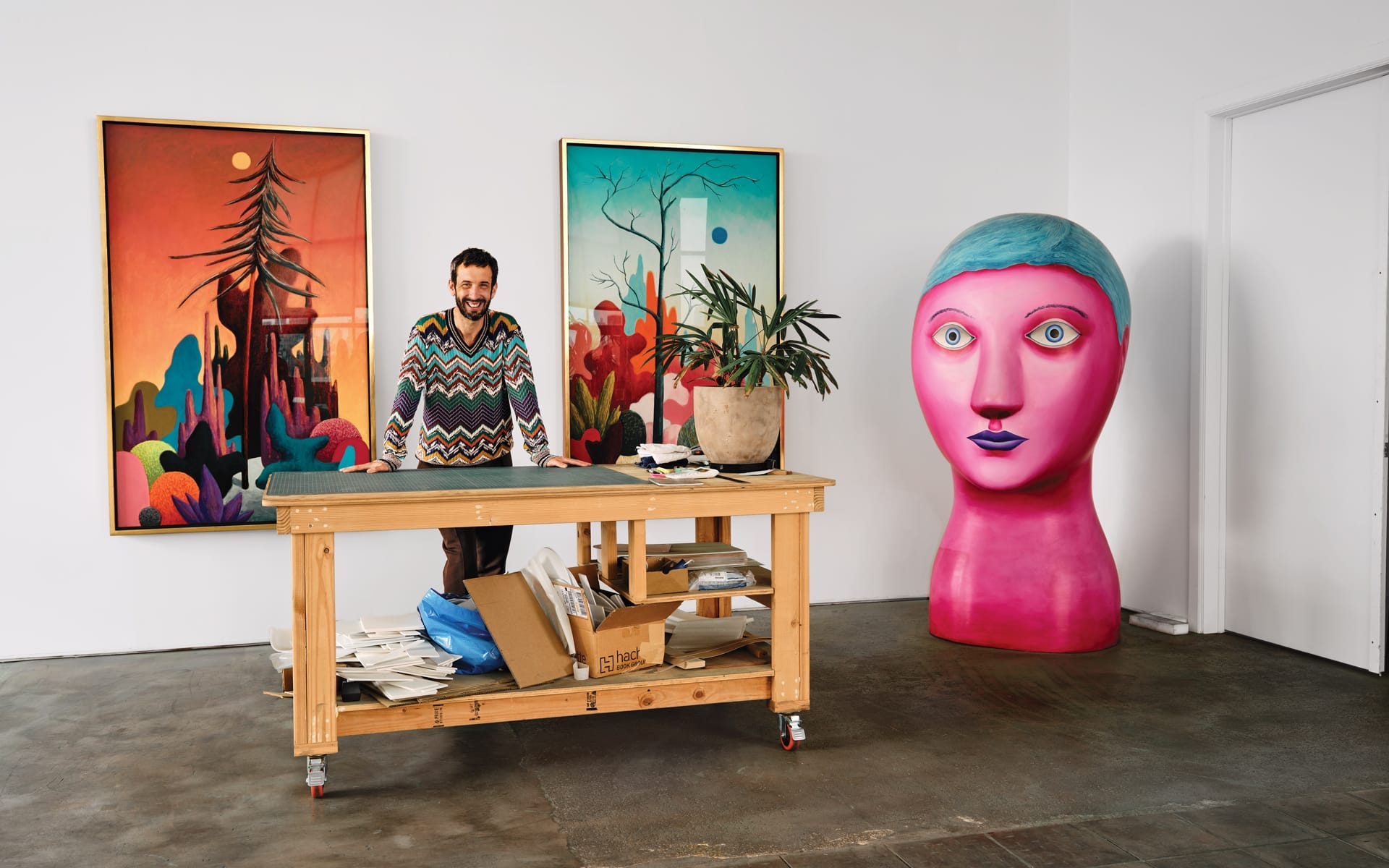
Nicolas Party works with genres that have been central to painting for centuries—portraiture, still life, landscape, interior. But what makes his work distinctly contemporary is the way he strips these genres of narrative certainty and transforms them into carefully constructed atmospheres.
His pastel surfaces are key to this effect. Pastel carries a peculiar material presence: soft, powdery, immediate, yet strangely detached from illusionistic depth. Party uses it to create images that appear lucid and highly controlled, but never entirely stable.
At first glance, his paintings can feel serene, even decorative. Yet the longer one spends with them, the more their artificiality becomes psychologically active. Colors are heightened beyond naturalism. Shadows become theatrical. Objects seem both solid and strangely suspended. The familiar world is subtly estranged.
What Party understands deeply is that painting has always been an artificial construction. Rather than hiding this, he foregrounds it. His interiors and still lifes do not pretend to be windows onto reality; they operate more like perceptual stages, spaces in which vision itself becomes stylized.
This is what gives his work its peculiar emotional charge. It is not expressive in a dramatic sense. Instead, it creates a state of suspension—a moment held so carefully that it begins to feel uncanny.
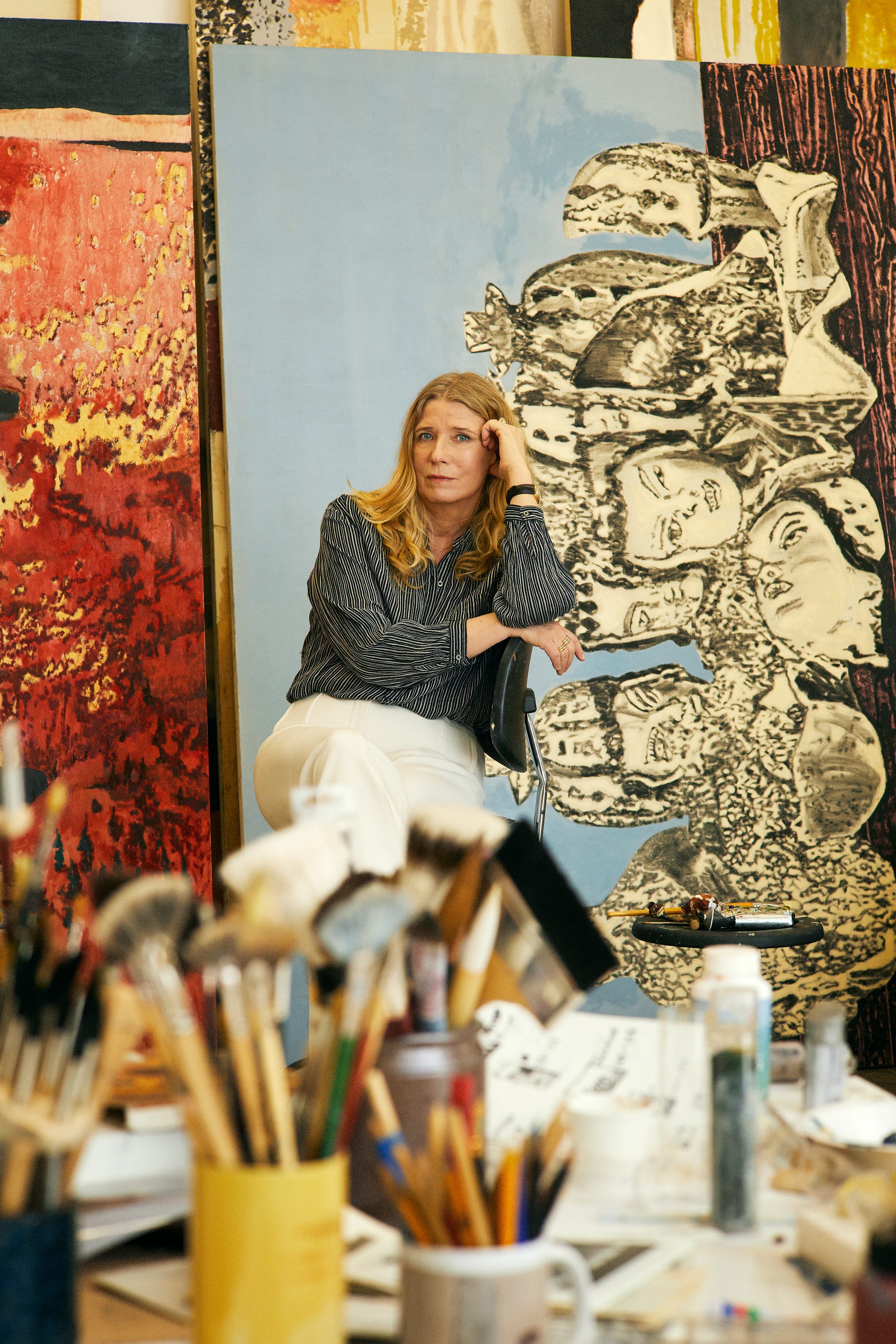
Mamma Andersson’s paintings are among the most psychologically resonant contemporary explorations of interior space. Her works often depict rooms, curtains, furniture, windows, fragments of landscape—spaces that feel familiar yet strangely detached from immediate reality.
What distinguishes Andersson is the way she treats space not as architecture but as emotional structure. Her interiors often seem to carry memory rather than function. Objects do not simply occupy a room; they seem to hold traces of absence, of prior presence, of things that have happened but remain unspoken.
Her painterly language reinforces this. Perspective may tilt, flatten, or subtly shift. Areas of paint may feel dense and material in one place, thin and almost ghostly in another. These variations destabilize spatial certainty. The viewer is never entirely sure where they stand.
This instability is not merely formal—it mirrors the logic of memory itself. Memory does not preserve spaces accurately. It rearranges them, intensifies certain corners, obscures others, compresses time into atmosphere.
Andersson’s paintings do not narrate stories. They evoke conditions of recollection. They allow space itself to become emotional, carrying melancholy, hesitation, and quiet psychic weight.
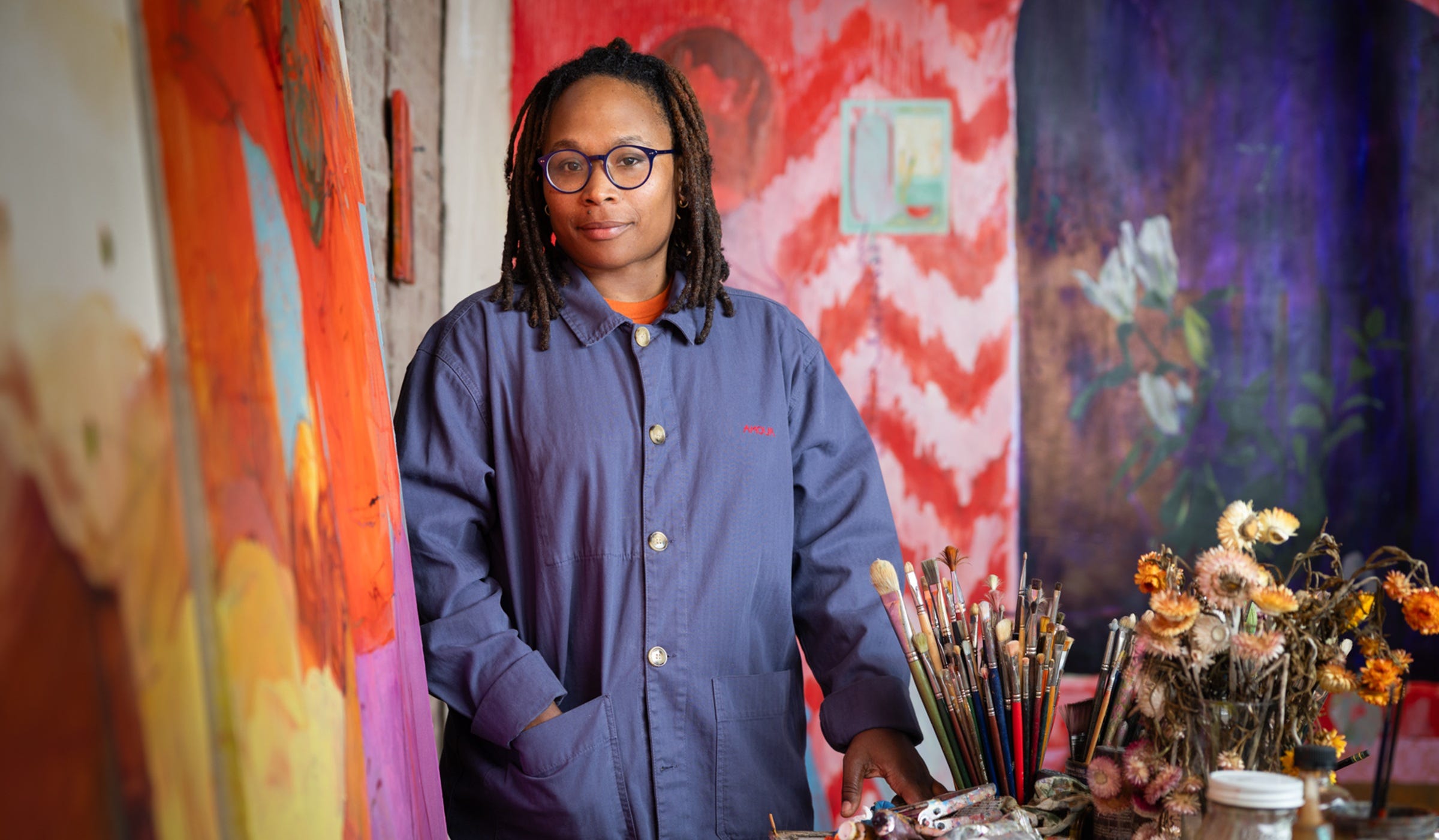
Jennifer Packer’s paintings possess a rare emotional density. Whether painting a friend, a bouquet of flowers, or an interior, she treats the canvas as a place where presence can be held but never fully secured.
Her brushwork is essential to this tension. Figures emerge through accumulations of color and gesture, yet they are never fully stabilized. Certain passages may be acutely articulated—a cheekbone, a shoulder, a hand—while others remain open, dissolved, almost atmospheric. The figure appears and recedes simultaneously.
This instability gives the work extraordinary emotional complexity. Packer does not offer the viewer a complete, possessable image. Instead, she stages presence as something fragile—something that must be approached with care.
Her portraits are particularly powerful in this regard. They are not exercises in likeness but in relational attention. One senses that looking, here, is never neutral. It carries responsibility. The paintings ask not only what do we see? but how do we look? and what does it mean to hold another person within the frame of vision?
That is why intimacy in Packer’s work feels so profound. It is not sentimentality. It is an ethics of attention—an acknowledgment that painting can be a form of care precisely because it refuses to dominate or fix what it sees.
No posts
Comments
Nothing yet. Say the first thing.
Sign in to join the conversation.