

For this year’s Art’s Open Door Advent Devotional, “Advent Songbook,” I’ll share rich examples of Christmas art and pair each piece with a devotional reflection and a practical spiritual posture to shape this season of waiting and wonder.
What to do: take time to listen and/or view the music discussed for each post. When you’re ready, read through the devotional. At the end of the written portion, there will be an invitation: something for you to try or consider in response. Listen again to the music before ending your reflection time.
Does it sound different? How is God speaking to you today through art?
Jot down anything you heard in your journal….or tell us all in the comments!
A shoot shall come out from the stump of Jesse,
and a branch shall grow out of his roots.
2 The spirit of the Lord shall rest on him,
the spirit of wisdom and understanding,
the spirit of counsel and might,
the spirit of knowledge and the fear of the Lord.
Isaiah 11:1-2
A spotless Rose is growing,
Sprung from a tender root,
Of ancient seers’ foreshowing,
Of Jesse promis’d fruit;
Its fairest bud unfolds to light
Amid the cold, cold winter,
And in the dark midnight
The Rose which I am singing,
Whereof Isaiah said,
Is from its sweet root springing
In Mary, purest Maid;
For through our God’s great love and might
The Blessed Babe she bare us
In a cold, cold winter’s night.
Halfway through my twelve-year stint in college for music, I was in a graduate theory class when my professor laid a bright yellow marker across my Brahms Requiem score and tasked me: “Find every leading tone.”
If you’ve learned the basics of harmony and part-writing, you know—every note in the Western classical style has an “expected” resolution. Scale degree two resolves to one. Four to three. Seven to eight—this is the “leading tone” action the professor spoke of, by the way! I can confidently report that of the hundreds (?) of D’s and A-naturals in that epic Brahms movement, every single leading tone resolved “correctly.”
I put many of those words in quotes because, as my professors often said, music theory is, after all, just a theory.
Don’t get me wrong, tonal music, with all its rules and hieroglyphics, is a theory I love. As a perfectionist (ahem, control freak), it's deeply satisfying to put basically every note in its place. We start in one location and move to another, and with many green, pink, and yellow scribbles later, the music shimmers with a rightness, a clean sink in a tidied kitchen. Oh, that’s what the composer was doing! Got it!
What we long for most in life is fulfilled (at least on a small scale) in many forms of art, whether we understand how it works or not. The highlighter’s lines confirm one of our most profound longings: consonance, peace—every dissonance, explained.
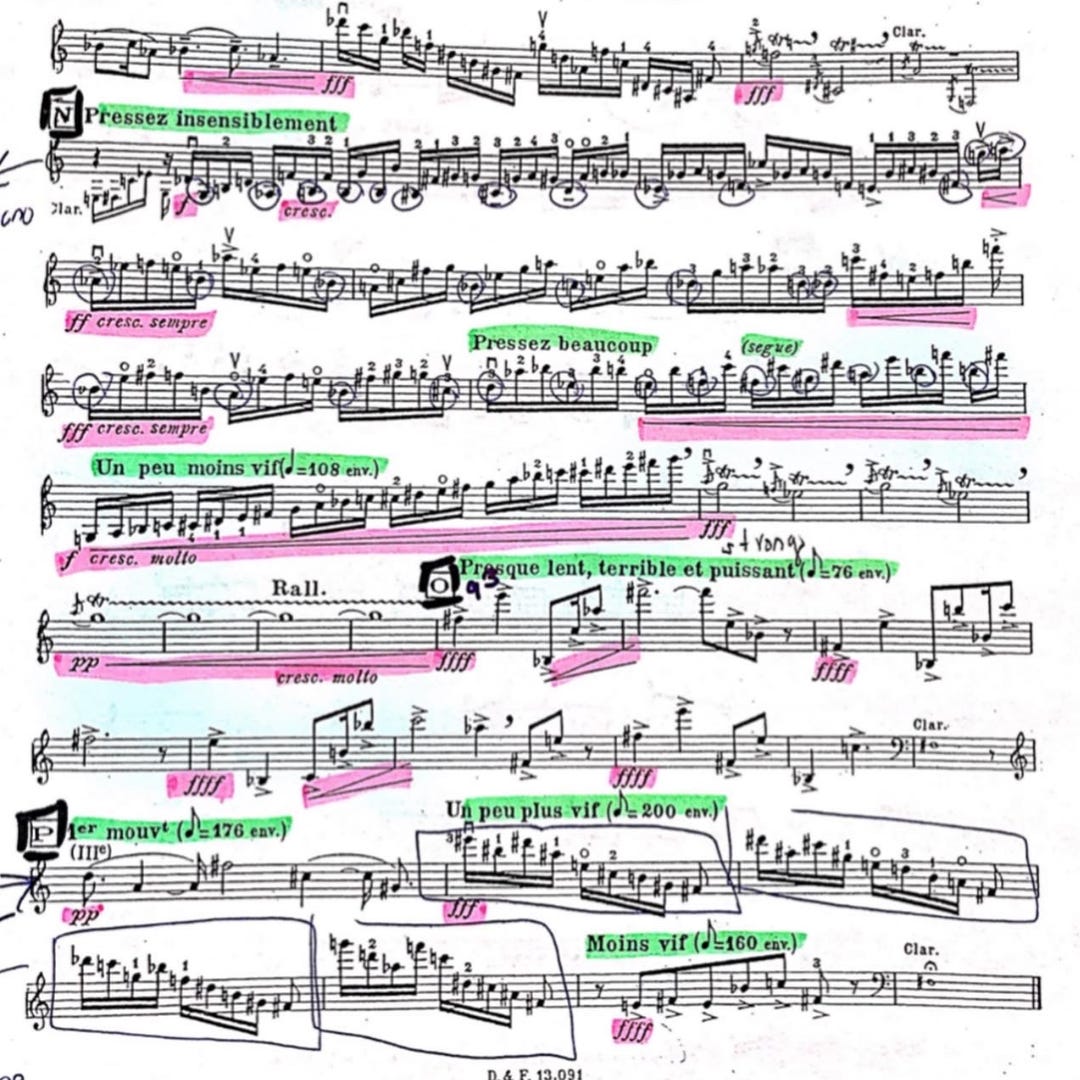
This week, I turned 42. I had the distinct pleasure of returning to New York City, a place I called home in another decade of my life. In a post about returning to teach a workshop at Juilliard twelve years after graduating, I used the word “full circle.”1 On the flight home, I put in my headphones, and Paul Mealor’s “Spotless Rose” came up on my Advent playlist. When this music hit me in that moment, I realized it all over again—I was still looking for resolutions, as if my life were in sonata form.
I have taken more than one highlighter to my life’s score, I will say that. I’ve stood silently screaming at the sky, asking God for answers when things fell apart. I’ve memorized the cracks in my bedroom ceiling like it was some barely tonal symphony of Shoenberg. I’ve been unable to enjoy the current gig I'm in for fear it might be my last. I longed for some confirmation that I was ______ enough— to be loved by God, but also to earn some official praise from the world that would stick and once and for all, give me lasting joy or at least contentment.
Sure, I knew life would include some non-harmonic surprises. Who doesn’t love an occasional deceptive cadence? But as I sat on the plane home from NYC, in these first frigid days of being 42, I realized that one gift of this decade is the full-on dissipation of the theory that life has tidy answers, that our Maker owes us them, that joy will come from some external confirmation or resolution.
This Advent, I’m consciously trading in my highlighter and this theory of tidy recapitulations for something more wholehearted and real—a holy mystery that, it turns out, is far more beautiful.

Paul Mealor’s “Spotless Rose,” the final movement of a four-part set of madrigals (a genre that usually features an unaccompanied choir), is based on four different texts about roses. “Spotless Rose” sets the Christmas text “Lo, How a Rose,” and meditates on the miracle of the incarnation, through the metaphor of a rose blooming in the winter. Paul Mealor, whom I had the pleasure of meeting in person when I was teaching at the University of Delaware, has taken this fifteenth-century text and written in a style of “spectralism” or what some call “holy minimalism.” This tonal language is lush and angelic, and, to my surprise, not built on my beloved theory of “good” part-writing and Roman numeral harmonic analysis.
Instead, Mealor creates clusters of sounds, focusing on timbre and tone color more than voice-leading. If I tried to use all my old analysis tools to figure out each chord vertically, it wouldn’t always make sense.
What does make sense, to even a listener with no music theory knowledge, is the way the chords bloom. Notes that seemed to not belong in the chord before hold over into the next sound, shimmer with an otherworldliness. Even the dissonance, the notes that do not “go together,” shine with a brightness that is hard to explain. Mealor plants seeds, notes that sustain and build, and then “blossom” into the eight-part divisi (divided) voices across the choir.
See what he did there? The text speaks of Christ, “fairest bud unfolds to light/ amid the cold, cold winter/ And in the dark midnight.” Like a note that seems to make no sense in one chord, a subtle, mysterious resonance waits in the texture to bloom. From chord to chord, like a seed in the frigid ground, the tender root of Jesse, tucked into time, this note, at Christmas, blooms—Christ, the spotless rose.
Maybe you are like me and have spent your life looking for some through line, angry at moments when no analysis tools can answer your asking why. Maybe your faith has been challenged when the music seems to fall off the page into some dissonant cacophony that even a Doctor of Musical Arts could not explain. This lush and beautiful movement, “Spotless Rose,” nudged me gently this week. It reminded me that while full circles are lovely, the God of Christmas is less theorist, more botanist.
We get to believe, even when life feels out of control, that God has already planted seeds in us that our Creator plans to cultivate, to nurture and love into life. We can trust that the leading tones of pain or passion are ways we are being led toward or away from who we are called to be. We may wait, like a note hidden within the texture, unresolved for decades, or in Jesus’ case, millennia, but through him, God with us, we do not wait alone.
God is doing something bigger than you can see now. We want it to make sense. And I believe one day it will, that our longings will be satisfied, our joy will be made complete, that creation will ring with a harmony we’ve never heard, that all will be made well. But, while we wait, this Advent, I’m learning that it will look less like a perfectly designed chord-by-chord analysis and more like watching the ground, trusting in God’s seeds.
If we attempt to find our full circles or temporary peace of mere half-cadences too quickly, we may miss the mysterious musical language of God, the seeds planted that are still yet to bloom, that holy mystery “through God’s great love and might, the spotless rose is blooming in the cold, cold winter night.”
We may not know what our Composer is doing; sometimes that is painful, like a dissonance we long to hear resolved.
I believe it is more beautiful than anything we could ever expect or plan.
Instead of demanding a tidy recapitulation, this Advent invites us to rest in the glorious uncertainty of the divine score, trusting that the mysterious grace of Christ, the Spotless Rose, is already radiating the harmony of a promise kept.
As you prepare for the week, I invite you to put on Paul Mealor’s “Spotless Rose” one more time (it’s a short, stunning listen!).
As the beautiful, unresolved chords shimmer around you, take a moment to put down your mental highlighter. What “seeds” might God be tending in you right now that still feel incomplete, mysterious, or even dissonant? We can trust that these nascent gifts and longings, though seemingly hidden in the cold ground of this season, are precisely what our divine Botanist intends to nurture and love into glorious bloom.
Share any thoughts in the comments, I’d love to hear them.
The Advent Songbook will come out in twice-weekly installments to bookend your week. You can subscribe to the Monday Substack emails via the button below and find Friday’s posts on Artists for Joy podcast, via Apple, Spotify, or our website.
No posts
Comments
Nothing yet. Say the first thing.
Sign in to join the conversation.