
Buckle up, we’re speaking in metaphors here!
Most strategy conversations feel like moving furniture around a room we already know too well. I’ve seen it, and you’ve seen it, too. A well-meaning, and well-experienced (and probably well-paid) team of professionals will change the seating plan, add a lamp, argue about the angle of the rug, then congratulate themselves on having refreshed the space. Which is OK, but that’s not strategy, that is tactics, and tightly defined tactics, at that – working within an established set of parameters. In other words, a box. Yes, there’s a box, you’re in it, and the team’s decisions are based on a keenly established understanding of what the box is, where the walls are, and what else is in it. Another way of perceiving reality will get you peering out of it.
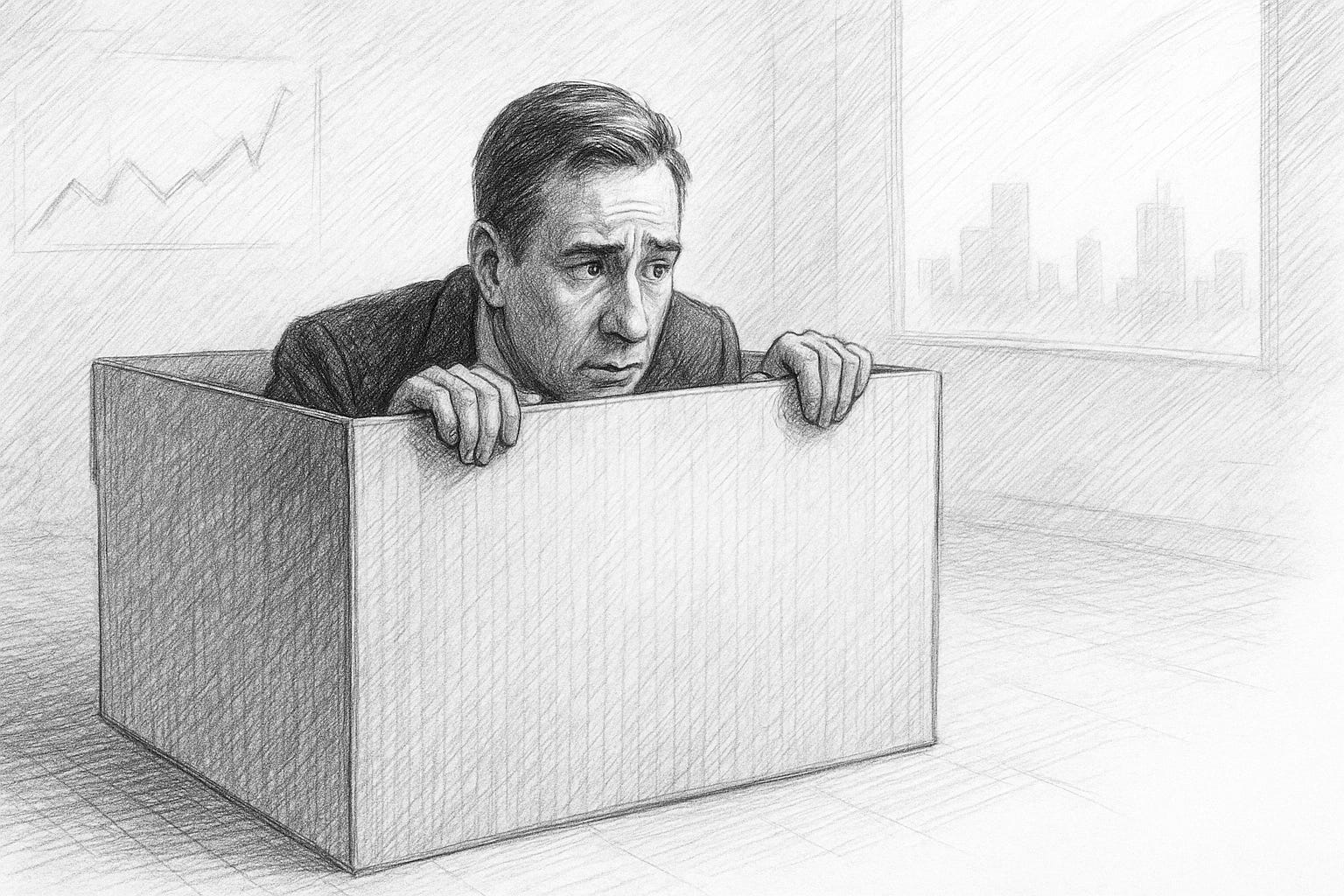
When an artist walks in, they tend to open a window, pull up a floorboard, and ask why it was decided this was the right room in the first place. This offers a shift in how people may perceive what they are doing together, which is the precondition for any innovation worth the name. It is not being contrarian for the sake of being difficult.
Managers often tell me they want “creativity,” usually in the same tone that one orders coffee, and it ought to arrive hot, in an attractive cup, preferably with the company logo on it. What they actually want is to see more and to see differently, but often fall into the trap of asking for the familiar, instead.
What they may be looking for is a way for people to notice the thing everyone has learned to ignore, to step back two paces from a familiar problem, to wrestle with uncertainty long enough for a better question to emerge. Artists are good at this because their practice is built on it. They peep above the edge of their own box, then jump out into the unknown to see what they can make of what they find.
That is simply because their cultural code is different – artists relish approaching the unknown from a perspective of discovery and wonder. Where management culture prizes planning, prediction, and instrumentality, artistic culture lives comfortably with ambiguity, tries things before naming them, and searches for form by making, and trying new things if the old things don’t quite work as desired. Bring that into a company and the furniture starts to move.
The first effect is disruption, which sounds rude until you experience the warmth that often comes with it. I mean the quiet shock of being asked to notice stuff that otherwise just sits around the office, like wallpaper.
An artist might watch a production line and sketch the rhythm of its stoppages rather than the average throughput. They might ask the call centre team to record the weather noted in customers’ voices. Such actions may look like detours and a bit of a waste of time precisely because they interrupt the grooves we have worn into our days. Very quickly, however, those detours start to reveal what the grooves were hiding. People discover that a “bottleneck” is not where the numbers say it is but where a handover just feels awkward. A procurement rule becomes visible not as a line item in a benchmark paper but as a habit in the body. Once you can see it, you can consider it. Once you decide to consider it, you may wish to alter it, if it feels like there might be a better way.
Seeing more is not a mystical skill but a set of different muscles. One is focal vision, the discipline of looking harder and longer at the thing in front of you until complexity appears. Turns out, the familiarity of the familiar has been obscuring other layers of meaning within that familiar thing. No wonder Leonardo (da Vinci, not DiCaprio) waxed long and lyrical about the mind-expanding power of observing ordinary things such as clouds in the sky or paint stains on a wall.
Another is peripheral vision, the practice of scanning the horizon for small signals you trained yourself to ignore because they slowed you down. Weak signals are a whole key discipline of strategic paying of attention. I have written about them in the past, and will do so again, soon.
The third is what I think we could call bifocal vision, the ability to step back and hold two scales in your mind at once, the immediate task and the larger frame. The ability to instantly, or rather concurrently, zoom in and out of a question or a situation is so natural for an artist, they will find it strange that more people don’t function that way. Why is a thing the way it is, really? What for? Who says it needs to be that way, really? Where does it fit in the scheme of things?
These ways of looking are taught not through lectures but through doing. A team that animates a “working wall” full of notes, collages and stick figure drawings will notice different patterns in their own logic than a team that writes a report, because their understanding of the issue at hand will have become visceral, rather than being simply intellectual. Nothing wrong with intellectual. It’s what separates us from thoughtless brutes, or ought to, but the visceral is also important, and offers perspectives and insights that can / may be turned into intellectual positions or at least interventions.
A group that rehearses a presentation as if it were a scene in a play discovers where the meaning leaks out. When that switch flips, managers often say they feel oddly relieved, as if someone gave them permission to stop pretending they knew the answer, and to start finding the real question. Asking “five times why” is just the beginning of that process, not the culmination of it. There always are more “whys.”
Which brings us, neatly, to problem-finding. Organisations, certainly those that have been successful over a decade or three, or five, are optimised for solutioneering. Of course they are. The people in them are highly trained specialists, excellent at their jobs. The clock is always running, budgets are always exacting, and showing progress means producing answers.
After time spent with an artist, that pressure does not vanish, of course, but it becomes negotiable. Artists spend a great deal of time learning how to frame a question tightly enough to work on it, and loosely enough to allow surprise. They prototype meanings before they prototype features, since the end goal may not become fully formed until a good long while into the process – and even then it is always up for revision or even scrapping altogether. They ask whether the question we are answering is the one that really ought to be answered at this time.
In practical terms this means a team might rewrite a brief several times before building anything, or at least before presenting that “perfect PowerPoint.” That can feel slow to the executive eye but then the value of “the prelude” becomes apparent when the work begins to run downhill rather than struggling uphill, because the framing allows for many magical things to happen, not least that elusive gut feeling is given space to emerge – that intuition which the more experienced team members have had about the given issue, but had neither the time nor the opportunity to voice, let alone explore.
The second effect is a change in how people handle uncertainty. A favourite corporate superstition says that risk disappears if you produce enough numbers. If only... The numbers do help, but the real work of learning to deal with risk is learning how to move while the ground is shifting under your feet. Artists do that every day – they build on incomplete information, test ideas in public and iterate in front of others, and treat constraints as scaffolding for scaling new heights.
When you borrow those habits, uncertainty becomes less of a threat and more of a material. A technology team that sketches the feeling of a service before building the components will waste less time producing great code that may only get discarded as the feeling is fine tuned. A hospital unit that rehearses a shift change like a dance troupe rehearses a complicated passage will drop fewer balls. None of this is about being whimsical. It is about adopting practices that name the unknown and thus make it something to work with - and it offers a breath of the kind of air that is by definition fresh, not stale, not recycled through many pairs of corporate lungs before. Nothing wrong with it, per se, it contains oxygen and nitrogen, and all that, but it is not, you know, fresh.
The third effect is energy. Not the forcibly manufactured variety that comes from away-days and foosball tables, but the long-lasting sort that comes when people feel invited to act on their curiosity. Encounters with artists tend to wake up the parts of ourselves that want to know how to pay attention. People who have been quiet in meetings start offering sharper questions. Leaders find that they can talk about values without feeling like they have wandered into a poster campaign. The tone of conversation shifts from protective position building to exploration. You can tell an artistic intervention is working because people begin to borrow phrases from the artist’s practice. They start to say things like, let us try a rough first draft and bounce it off people, or, can we look at this from the audience’s perspective. Language changes, then behaviour follows. This works easier in that direction than the other way.
If you are thinking this sounds fluffy, you are in good company. Many executives do, right up to the moment they notice that the “soft” work has produced hard outcomes. A team that learns to look and observe differently can bring to the surface one or two misaligned processes that have been quietly costing a lot of money for a while. A department that learns to rehearse rather than give a forcibly polished presentation will catch errors before they harden into products. Yes the typeface selection on the screen (if there is a screen) will not be perfect and the illustrations may not fall within the corporate guidelines but the ideas will be more exciting. A leadership group that practises problem-finding will stop funding projects that were only ever answers, even great answers, in search of a question.
None of this shows up as a single heroic deliverable. It all shows up as a shift in the organisation’s option set. You have more ways to act, and your people are less brittle when the world moves.
I should also be clear about what an artist is not there to do. They are not there to be a walking brainstorm machine or to fix your culture on Tuesdays. Before lunch, if at all possible. They are not consultants in disguise, and they do not succeed by being mapped to key performance indicators before they have even met your teams.
Artists offer a paradox, and it is a simple one. If you invite an artist and tell them exactly what to deliver, you will get what you asked for, but that is a commission and not collaboration. Again, nothing wrong with commissions, as they make sure the artist’s wheels are greased, and staff enjoy some decent new art on the company HQ wall. If, however, you invite them to investigate a question with you, with interesting and poorly defined edges and no set outcomes, you create a genuine chance that useful new methods and ideas emerge. Boundaries focus attention, here, and help to get down the rabbit hole faster. Artists love boundaries. There’s nothing worse than the “open brief.” Trust me. I’ve seen those.
Time constraints are practical, and artists expect them. Stories of moody divas with a built-in disdain for deadlines may be passed around like well-worn paperbacks, but the truth is, most artists treat their work with professionalism and their clients with respect.
A dedicated space, even a modest one, signals that this process is not an afterthought, and a producer or facilitator keeps the work connected to reality and helps land the learning.
What should you expect to happen if you, metaphorically speaking, invite an artist into your strategy room? Expect a few awkward silences at the start, because people are not used to being asked what they notice rather than what they think. Expect some mild irritation when rules of thumb are questioned. Expect a new vocabulary to creep in and, with it, new habits. Expect to find places where the official process and the lived process disagree. Expect small prototypes that look childish at first and save you months of labour later. Expect laughter, often the slightly nervous kind that accompanies honest discovery. If you commit for long enough, expect to look back and realise that several of your current practices were born in that odd little interspace where you suspended business as usual.
It helps to start small and real. Pick one thorny issue that stubbornly resists slide decks and status meetings. Give the artist and a cross-section of your people a clear frame: here is the boundary of the problem, here is the time available, here are the constraints we cannot break. Ask them to show, and discuss, their workings not just their conclusions.
The languages they speak may be subtly different, though the vocab and syntax may be the same. That is just fine as it will encourage people to use forms of making that are unfamiliar to the office, whether that is sketching, rehearsal, sound, or movement. If you hear “we’re not sure how this will look when it’s done, but...” you will know they are on the right path, since offering up a perfect prototype on the end of day one of the engagement will only answer the questions you have known for a long time. Not quite the purpose, or the approach, we’re looking for here.
The point is not to turn your staff into artists. Sure, those so inclined may improve their drawing skills, but the point is to borrow the ways of working that make artists useful in complex situations and to let those habits seep into your existing expertise. Your engineers stay engineers, your clinicians stay clinicians, your warehouse staff stay warehouse staff, and your lawyers stay lawyers. They just learn to look with different eyes, and that is enough to open new paths.
The question I hear often is, “will this produce a product?” Sometimes it will. Especially if the point of the engagement is to produce a particular object. More often it produces a method, a process, or a change in culture that then produces products, and quite often continues to produce them for a good long time. That makes it harder to photograph and wrap up in a presentation, which is inconvenient in a world that runs on case studies, but no less valuable. If you insist on a trophy at the end, you will get a trophy and probably a bit extra. If you look for an expansion of your organisation’s perceptive and improvisational capacity, that is what will come, and you will find that the tangible outcomes take care of themselves.
There is a final, practical benefit that is easy to miss. This work humanises technology. In labs and R&D settings, the presence of an artist has a way of bringing the human question back to the centre. Not as sentiment, but as data, since feelings are information, and meanings are – or at least can be – features. In fast moving fields, it is strangely radical to ask what this will be like for the person who encounters it for the first time. Artists are good at that because they spend their lives making experiences for people. When that lens is applied to your prototypes and your policies, awkward truths appear. It is a gift, if you are willing to take it.
If you have read this far and you feel intrigued rather than defensive, you are the right audience. You do not need to become a patron of the arts, though you are most welcome to do so. We need more of those. You need to become a patron of better questions. Invite someone in who is practised at asking them, give them edges to bounce against, and protect a sliver of time and space where new ways of working can appear. It will feel unusual – and that is precisely the point. We do not get new futures by rearranging the furniture. We need to re-examine the box they’re in. The box you’re in. (We’re all in boxes. Don’t feel bad.) Sometimes we need to throw the box away to find that there is a bigger and better one just outside.
Try this next week: pick a live issue, gather three colleagues, hire my friend Paul Bargetto - or another theatre director - and run a 90-minute rehearsal instead of a meeting. Even virtually. First, frame the question as a one-sentence prompt. Second, make a rough first draft of the answer in a form you can show, not tell. Third, perform it for one another and ask only what you noticed. Do not fix anything, just notice. Then do a second draft. Do this often enough, and it becomes a working method.
No posts
Comments
Nothing yet. Say the first thing.
Sign in to join the conversation.