
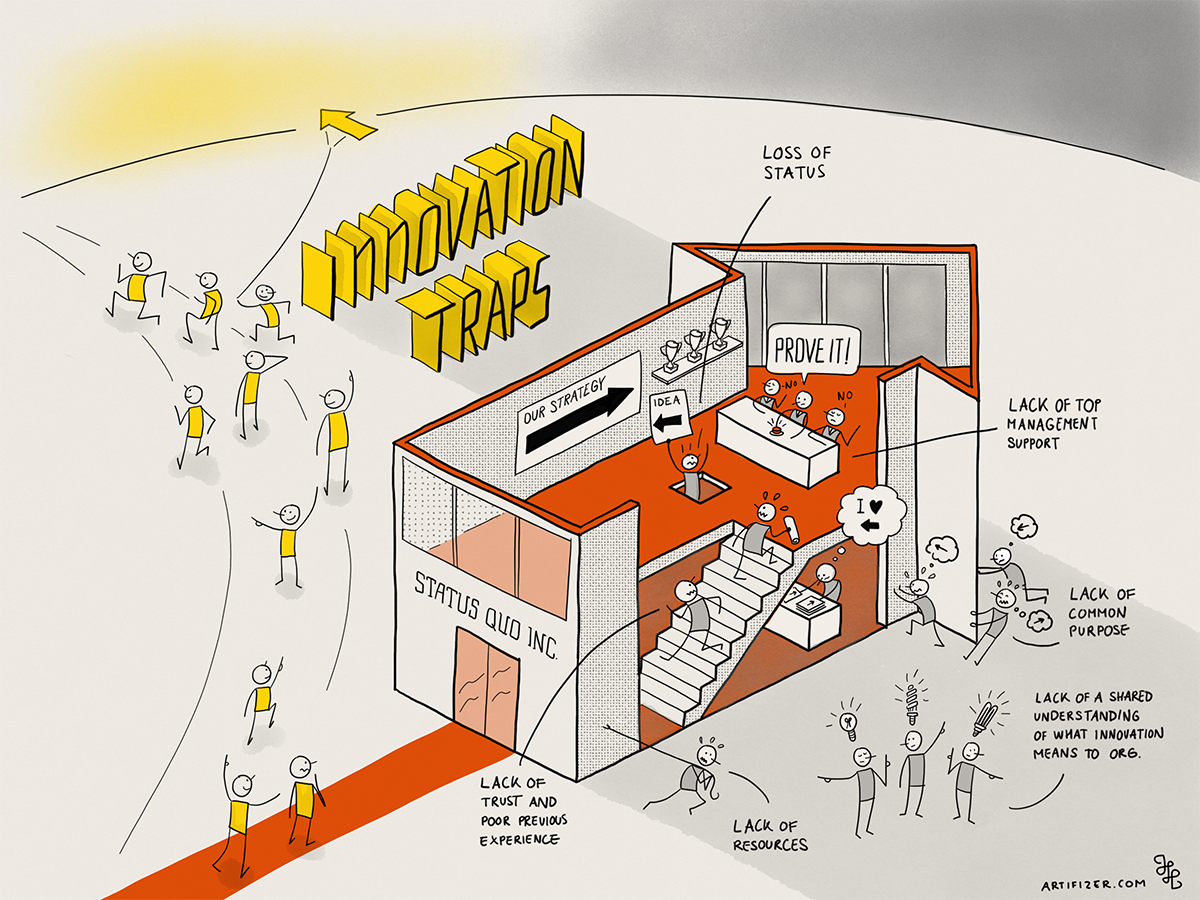
Everywhere you look, innovation is held up as the key to success. Businesses claim to be innovation-driven. Governments promise innovative solutions. Schools prepare students for an innovation economy. But what does it mean? Too often, it’s an empty word slapped onto strategies and press releases to signal progress without real change.
Organizations talk about innovation as if it’s a switch they can flip, but they rarely create the conditions for it to thrive. If everything is labeled as innovative, then nothing truly is. Real innovation requires more than vision statements and brainstorming sessions—it needs structure, alignment, and execution.
While companies declare their commitment to innovation, their cultures and processes often work against it. Common barriers include:
Lack of common purpose – Innovation efforts become fragmented if teams don’t share a clear vision.
Fear of failure – When every idea must be risk-free before testing, innovation stalls before it starts.
Endless debate over execution – More meetings and discussions do not equal progress.
Innovation as an afterthought – Without dedicated resources, it remains a side project, not a strategic priority.
These barriers create an environment inside many organizations where ideas must be "proven" before being explored. This paradox kills momentum. Meanwhile, the people who want to push boundaries either give up or take their ideas elsewhere.
Innovation isn’t a declaration—it’s a practice. Organizations need to shift from talking about innovation to making it happen. This requires:
Testing first, proving later – Instead of demanding certainty, start with small pilots and iterate.
Creating alignment – If innovation is everyone’s job, it’s no one’s job. Make responsibilities and purpose clear.
Breaking the perfection mindset – Fast learning beats slow, risk-averse planning.
Making strategy visible – When teams see the bigger picture, they move from debate to action.
Too often, innovation fails not because of a lack of ideas but because of clarity. The best teams don’t just generate new ideas; they create the right conditions to turn them into action.
Innovation is a word that gets thrown around a lot, but what makes it work? What’s one small shift that has helped drive innovation forward in your team or organization?
No posts
Comments
Nothing yet. Say the first thing.
Sign in to join the conversation.