
This is the second post in a short series exploring how behavioural science and AI are being brought together in the current literature. In the first post, I examined how different papers frame the relationship between these two fields—whether as a tool, a subject of study, or a form of collaboration. Here, I take a different approach by asking: What problem is the work actually trying to solve?
The literature is often discussed as if it describes a single, emerging field. In reality, it doesn’t behave like one. Work that appears similar on the surface is often organised around fundamentally different questions. For some, AI is a way to scale behavioural interventions -for others, it’s a sociotechnical system that demands analysis and governance. Some focus on shaping user behaviour, others on formalising behavioural knowledge, and others still on defining the boundaries of the field itself.
This creates a specific challenge: different kinds of work are described using the same language, making it harder to spot the real differences and easier to assume that distinct projects are addressing the same problem.
What helped me make sense of this was a shift in perspective. Instead of starting with how a paper describes the relationship between behavioural science and AI, I began by asking: What problem is this work organised around? This changes the question from what is being claimed to what is being done.
Most of the variation in the literature can be traced to two underlying questions:
What is being studied? Is the focus on human judgement and behaviour, AI systems themselves, or the wider sociotechnical environments in which they operate?
What is behavioural science being asked to do? Is it being used to design and intervene, to explain and evaluate, or to organise the field itself?
These questions provide a straightforward way to navigate a space that often appears more unified than it is. The orientations that follow represent different answers to these questions. They don’t resolve disagreements, but they make it easier to see when distinct kinds of work are being conflated.
In simple terms, it looks like this:
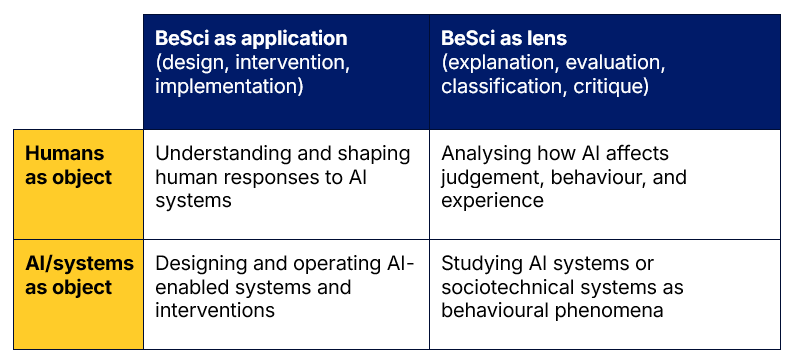
This is a deliberately stripped-down framework. It doesn’t capture the full complexity of the field, and many papers move across these boundaries. But it does clarify how work that seems similar can be organised around different problems—and how those differences arise from what is being studied and what behavioural science is being used for.
The orientations that follow are more specific ways of occupying this space. They represent different answers to these two questions and, as a result, make different things visible.
When you read the literature in terms of the problems it’s trying to solve, recurring orientations begin to emerge. Below is a simplified way to group them. Each group contains more specific orientations, which are explored in detail in the full guide.
This group focuses on making AI systems function in real-world settings through design, intervention, or iterative adaptation. It includes orientations like implementers, intervention-scalers, designers, complementarians, and behavioural-risk analysts when their focus is on practical outcomes. The emphasis is on whether systems work when they encounter users, workflows, and organisational constraints.
Here, the focus shifts from users to systems themselves - either as individual entities or as part of broader sociotechnical environments. This includes machine-behaviour and agent scholars, as well as work examining collective or emergent dynamics. The goal is to describe and analyse how systems behave in context, rather than directly shaping behaviour.
This group centres on how behavioural knowledge is structured and made usable. It includes infrastructure builders and related work on taxonomies, ontologies, and computational representations. The core problem is one of scale and consistency: how to formalise behavioural concepts and embed them in systems in a way that can be operationalised.
Work in this group is concerned with how the space is organised conceptually. It includes field-cartographers and theory-protectors, who focus on classification, conceptual clarity, and standards of explanation. The emphasis is on distinguishing and evaluating different kinds of work.
This group addresses questions of scope and responsibility. It includes field-builders, expansionists, and more normative strands like humanisers. The focus is on defining what role behavioural science should play in relation to AI, and how the field itself should be shaped.
One reason the literature can appear more coherent than it actually is comes from how work moves across these orientations.
Research often expands from a specific problem into adjacent ones. A question about behaviour in use might evolve into claims about design, governance, or the broader role of behavioural science without always clearly separating these roles. There’s also movement in the object of study, shifting from individual users to systems, and from systems to wider sociotechnical arrangements. This changes the level at which explanations operate.
At the same time, behavioural concepts are frequently formalised into taxonomies or models to make them usable in systems. This makes them easier to apply at scale but also locks in particular interpretations.
Alongside this, there are repeated attempts to unify the space through shared frameworks or definitions. While this can facilitate communication, it can also create the illusion that different approaches are addressing the same problem even when they’re not.
These patterns don’t make the orientations less useful. Instead, they help explain why the field can feel both fragmented and oddly coherent at the same time.
Seen in these terms, “behavioural science and AI” is less a single field than a set of partly overlapping problem orientations, held together by shared language. What changes when you read it this way isn’t the content of the literature, but how it’s organised. It becomes easier to see what a piece of work is trying to do, what it brings into focus, and what it leaves in the background.
This post has only sketched that structure. The full field guide explores the orientations in more detail, including the specific questions they’re organised around, how they relate to one another, and where they begin to break down as a simple map..
This guide doesn’t evaluate which orientation is “correct.” Instead, it distinguishes the problems each orientation revolves around, because those differences determine what each perspective highlights and what it overlooks.
As a practical tool, the guide helps you:
Locate the problem a paper or argument is organised around.
Identify what that focus illuminates.
Notice what it tends to leave unexamined.
This approach doesn’t resolve disagreements, but hopefully it will become easier to recognise when different kinds of work are conflated and to engage with each on its own terms.
N.B. This is version 1.0 of the guide so I’d love to hear your feedback for version 2.0! (Anonymous form here)

Comments
Nothing yet. Say the first thing.
Sign in to join the conversation.