
A few months ago, I was asked to jury an exhibition for Site Brooklyn on the theme “Landscape Natural and Urban.” After reviewing hundreds of remarkable applications, I’m excited to announce that my selection is now live, along with my writing to accompany the works.
I have lots of thoughts on the process that I will share with you all soon. In the meantime, here is my curatorial essay along with my statement for the first group of work (there are five groups, or “walls” in total). I’ll share the complete exhibition here over the next few weeks.
For now, I’ll just say: this process made me completely reevaluate my relationship with landscape as a genre. I hope it does the same for you.

Curatorial Statement:
It’s odd—although I’ve spent a considerable amount of time over the last month with these works, I couldn’t with any confidence tell you the landscape from which any were made (save for Deborah Kennedy’s ominous outline of the Statue of Liberty heroically battling a waterspout). Instead, these works float above place. They’re of nameless towns, uncharted forrests, anonymous hills, scenes from an idealized past, or unrealized futures.
It would make sense to think that landscape art is solely about the place that it depicts. That is what I always assumed. It turns out I was wrong: landscape is about how we relate to the physical world around us. It doesn’t matter where, so much as why or even how. Do I see the world in a series of vignettes, as Janet Stafford does? Or from the impossible angle of a bird like Gerrit Von Ommering and Tom Crawford? How is the landscape of a city impacted by the threatening forces of police presence, as it is in Alex Clark’s painting, which looks like a space invasion, the beams from a police helicopter rendering those below lifeless. Why is it that an abstract painting can sometimes better capture the way a landscape feels than realism? Why depict the world around us at all?
The last question is a bit tongue-in-cheek. Depicting the world around us has been a central obsession of art since its formation on the cave wall. In the many years since, the medium has expanded. Here, we have depictions of the world from every vantage point, medium, imagination, and timeframe. Depictions not of what we see, but what we feel and know of the world outside our door.
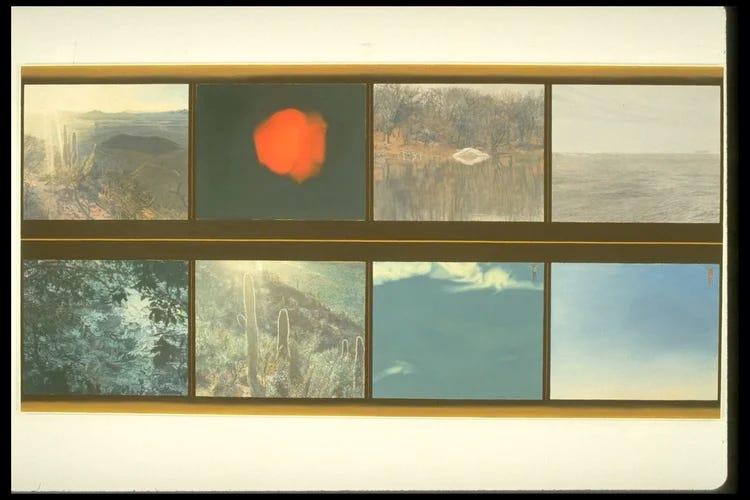
Group 1:
These works encompass all that a landscape can be. A trompe l’oeil, a moment of abstraction, a darkroom photograph. Each work in this series exists with a spectrum: what can be seen and what is unseen; what is known and what remains a mystery. These works transcend physical location, offering insight into a moment in time.
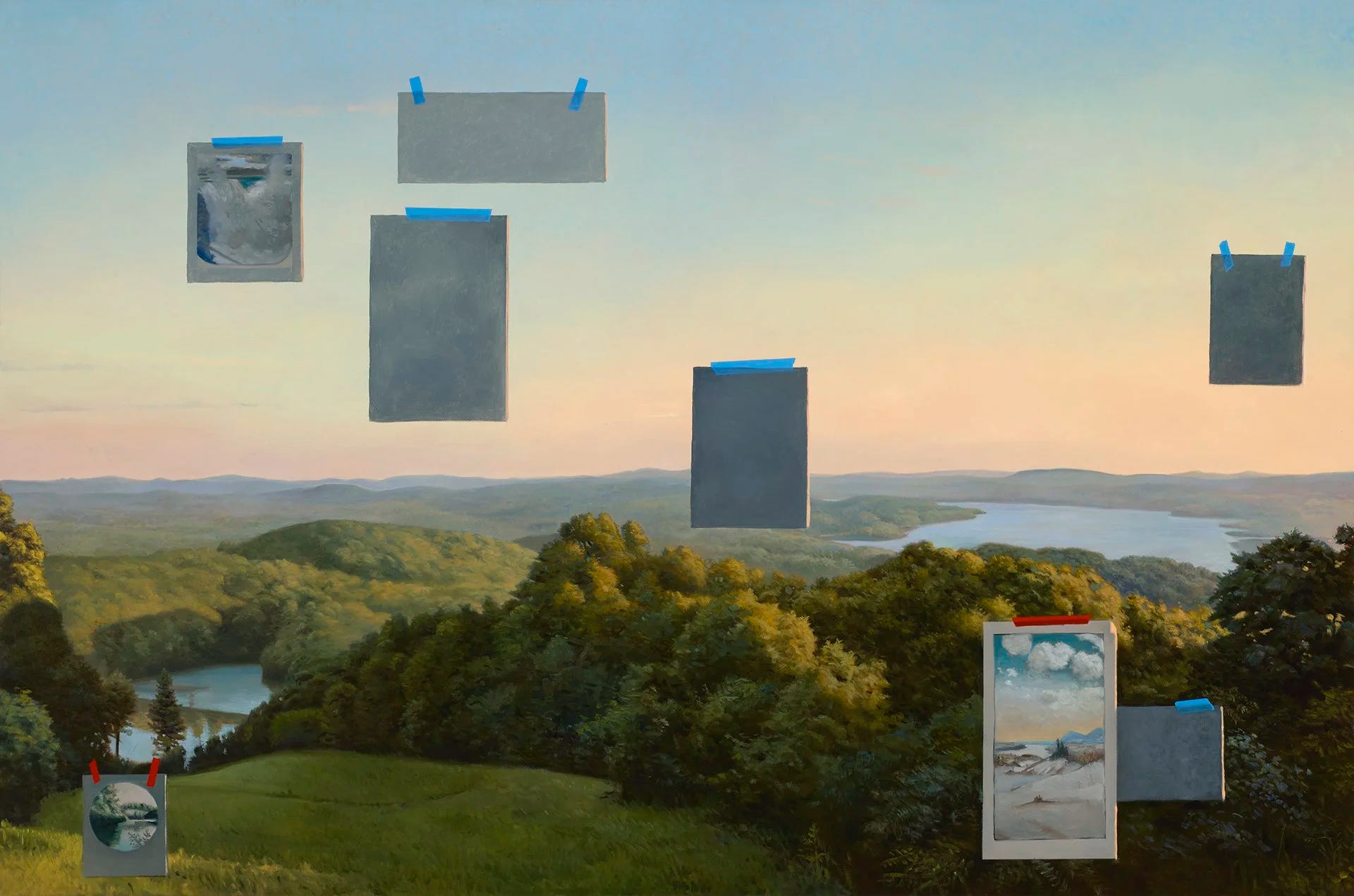
James Mullen creates a trompe-l’œil of photographs and pieces of paper taped over a traditional landscape painting, drawing attention to the painting’s various planes. “In this relationship I am compelled by photography’s ability to document, witness and construct visual meaning, and painting’s ability to reflect an accretion of experiences, time, and the human touch,” writes Mullen. This visual representation shows the way a landscape can be accumulated through layers of making and looking.
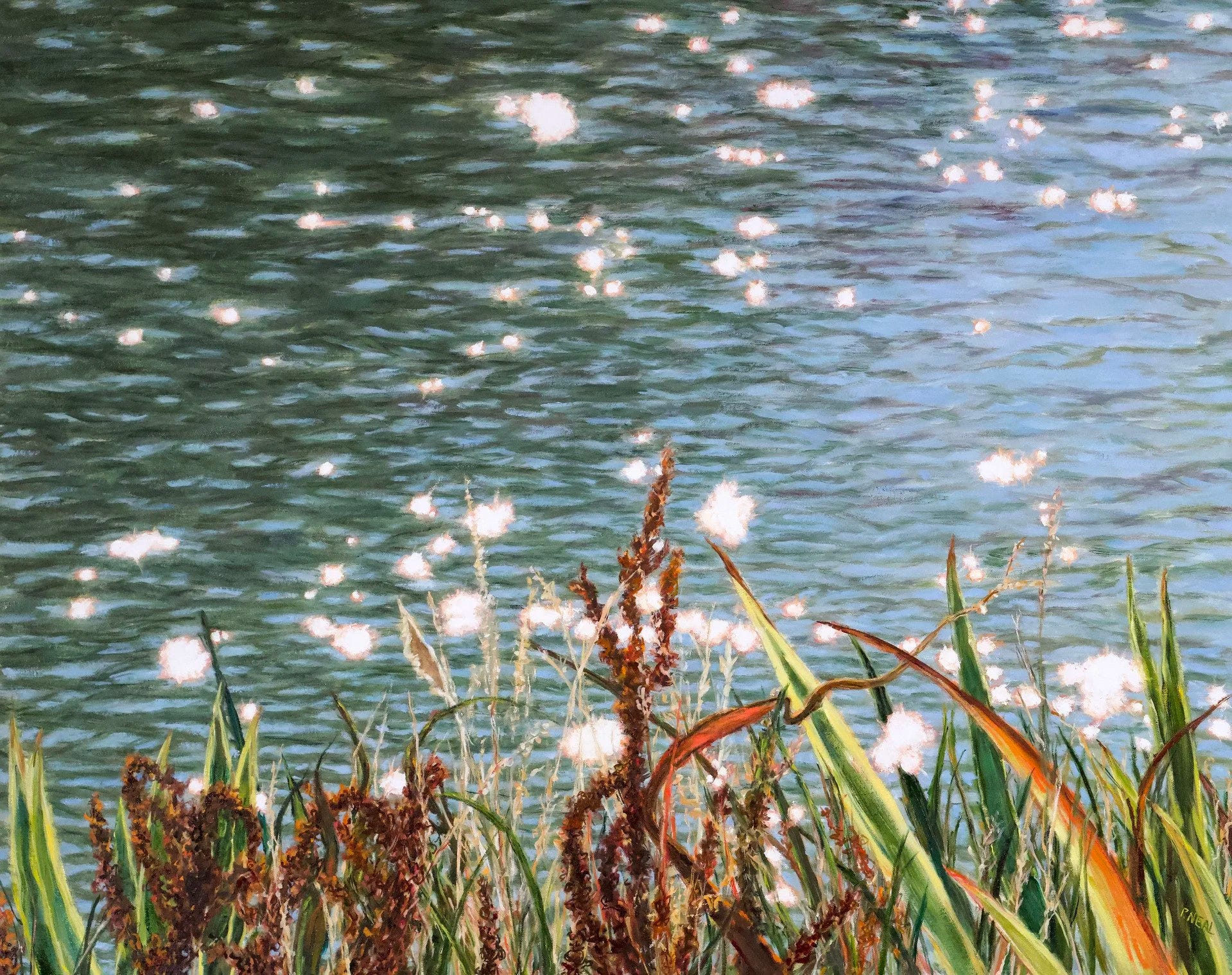
Speaking of photographs: Seen as a small tile on my screen, I was convinced that Patty Neal’s work was one— I kept returning to it because of the quality of the light. It wasn’t until I really looked that I realized my mistake: this is an oil painting. Despite knowing better, my brain kept looking at it as if it were a photograph. This perhaps has something to do with Neal’s source material: her own photography, which she often collages into a final composition.
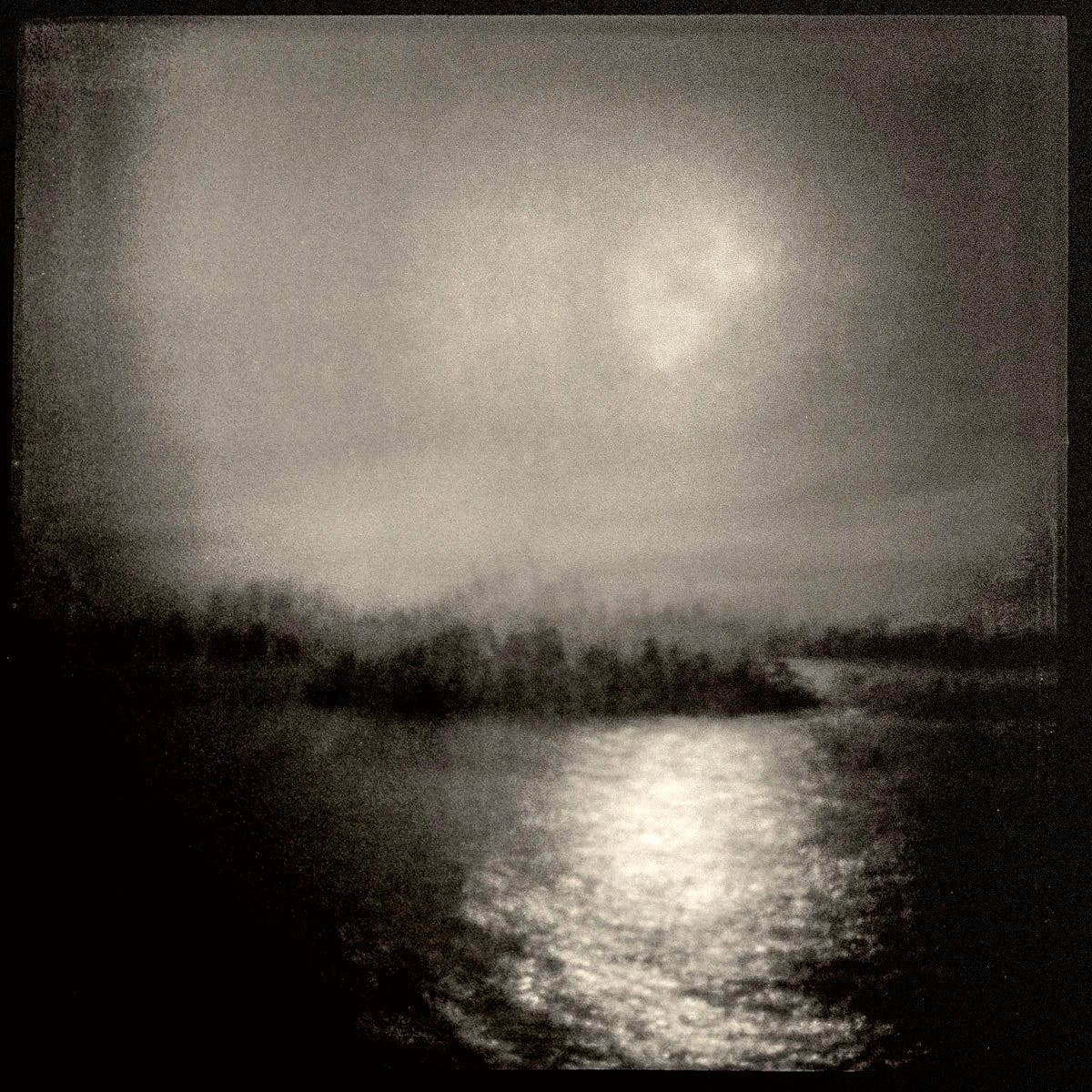
I don’t mean to suggest that a work’s worth is elevated by being a painting rather than a photograph. Photographs have their own merit, as seen in Stan Schnier’s dreamy photograph that reaches back into the past. “I was thinking about what the harbor looked like in the late 1800’s when many of my ancestors arrived in the harbor and what it might have looked like, assuming it was not necessarily all bright and sunny and warm like in the movies,” writes Schnier.
Comments
Nothing yet. Say the first thing.
Sign in to join the conversation.