
Leonardo da Vinci’s entire legacy as a painter amounts to, at best, twenty surviving works.
And even this might be an overestimation - with some scholars claiming that there are actually only eight paintings which we can be 100% certain come from Leonardo’s hands.
However, when it comes to his output of drawings, the story is very different.
In fact, just in England’s Royal Collection alone, there are at least 550 works which we are certain come directly from the Leonardo’s hands (not to mention the vast quantity of other codices and sketches which exist around the world in both private hands and academic / cultural institutions)
Although for todays work, we will be focussing specifically on a drawing housed in the Royal Library of Turin instead.
A portrait of a young woman, which is surely up there with the most beautiful portraits in Leonardo’s entire oeuvre.
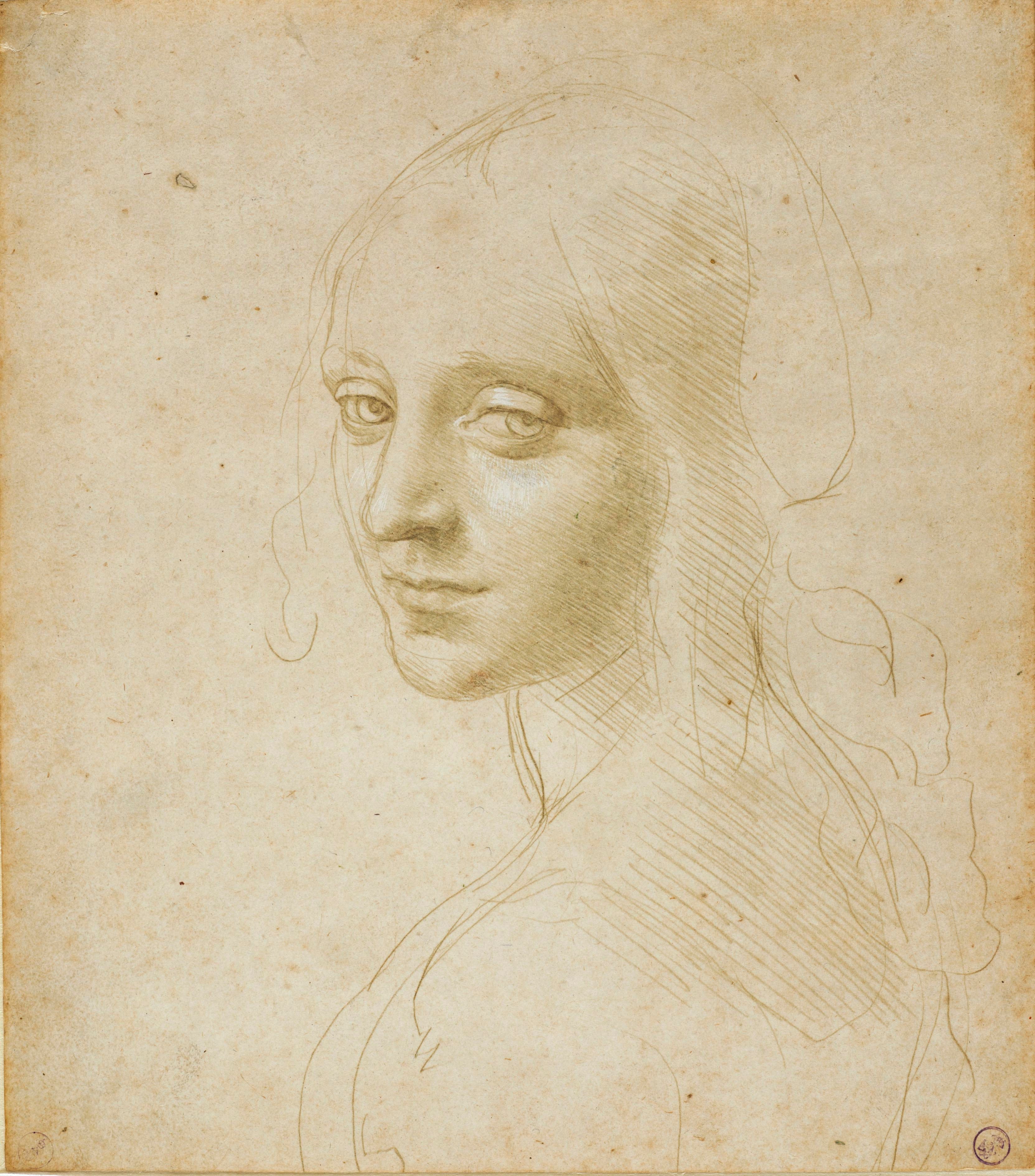
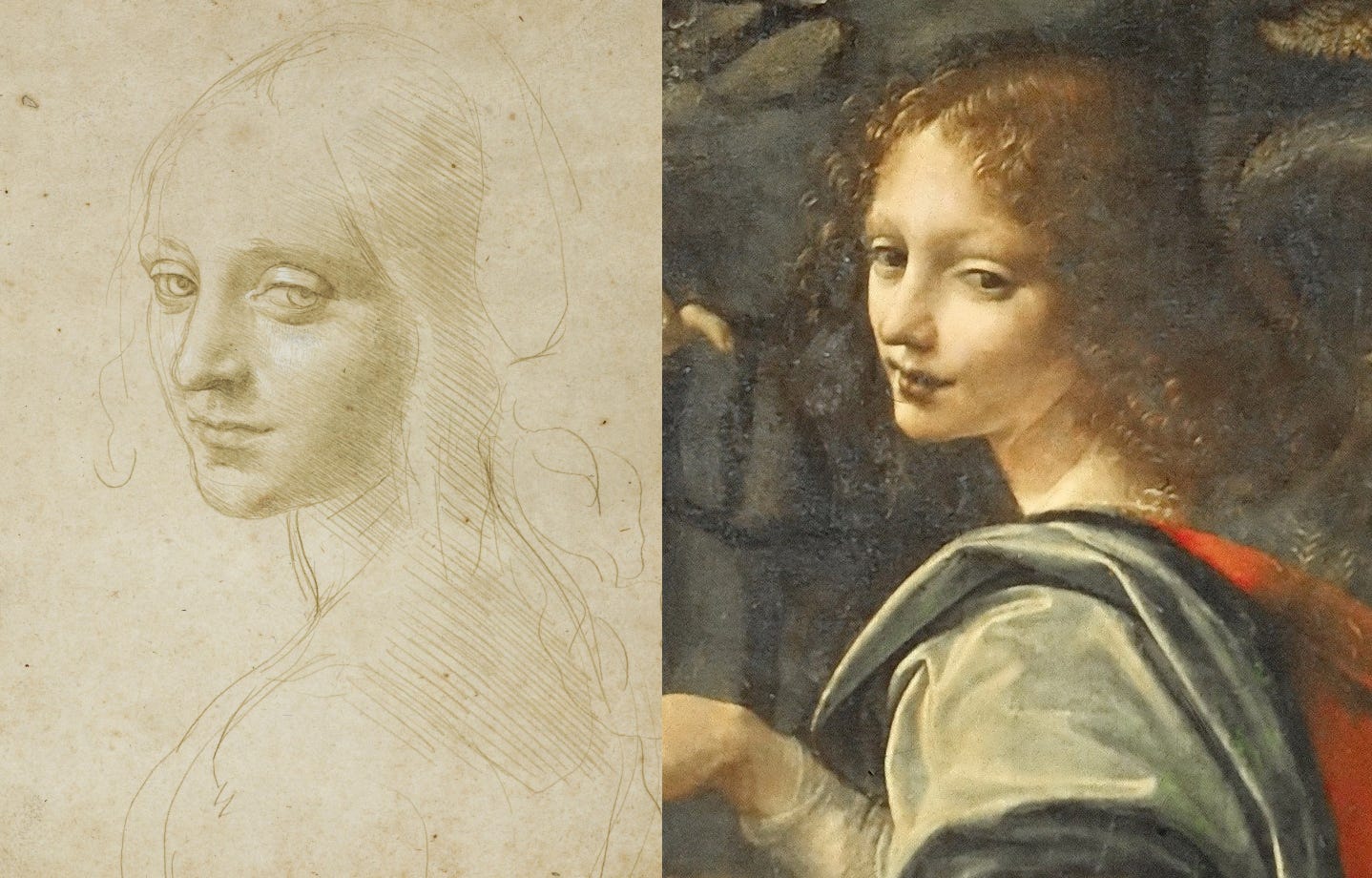
Created in Silverpoint (which is renowned as one of the most difficult mediums, as it involves an artist drawing directly onto a specially prepared piece of paper, using a piece of silver instead of charcoal or graphite etc) . . . many scholars believe that she was created as a study for the angel we see in his larger scale painting “The Virgin of the Rocks”
However, as is always the case with Leonardo, that theory is not certain. 1
And given the extraordinary care and precision the great man is clearly using here (not the mention the fact that he was one of the few artists of his era to consider drawing as a bona fide art form in its own right, with no less value than paintings) . . . there is every possibility that Leonardo did in fact consider this as a full work in its own right.
Sadly, we will likely never know know whether this young woman was modelled on a real person, or is simply a figment of Leonardo’s imagination.
But either way, she is no less beautiful. And even the way Leonardo has left her in this apparently “unfinished” state, just seems like a stroke of pure and utter perfection.
_
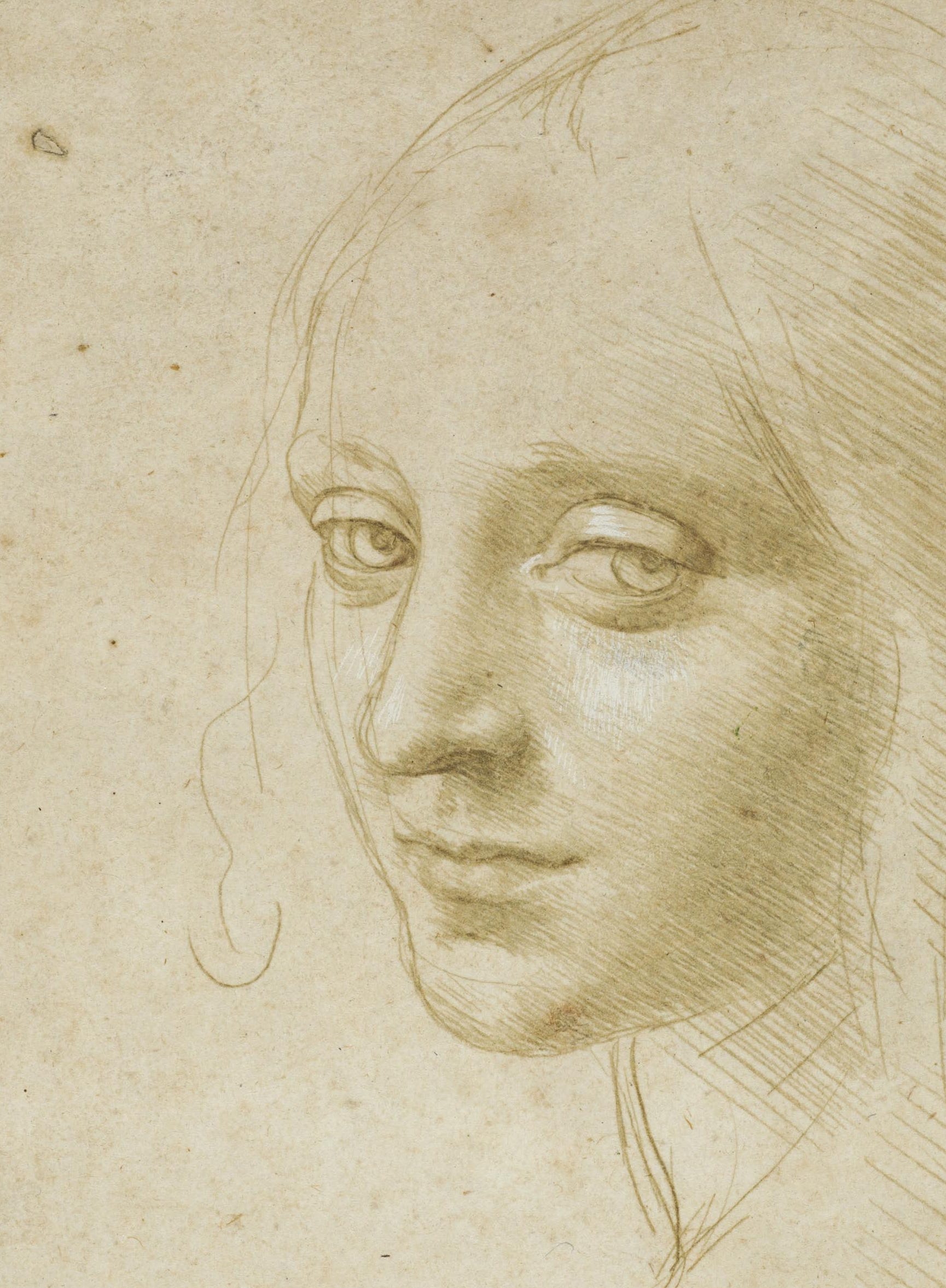
In those eyes alone, we find endless depths of emotion. And in that enigmatic “half smile” - we are left with so many questions over just what the young woman might be thinking.
Is she happy to see us? Or inviting us to come closer?
Does she seem worried about something? Or suspicious? Or insecure?
Is she captivated by some unknown sight in the distance?
Is she glancing over he shoulder to offer a friendly hello? Or, is this more a case of one last look back instead. And a reluctant goodbye. And that strange mix of gratitude and sadness that may come when we part ways for the final time with someone who has meant so much to us.
As always, these are just some of the many options of interpretation here.
And I suppose just like the Mona Lisa too - Leonardo’s young woman will forever seem as is she is in possession of a secret that she is not quite ready to reveal to us.
But still, for a relatively small drawing of a single figure to be this spellbinding really is yet another testament to Leonardo’s astonishing talent.
And on one last technical point too, it’s worth remembering that when working in Silverpoint, it is impossible for an artist to erase a line once it has been drawn.
Thus, anyone attempting a drawing with this medium has to be so sure of their own hand, and so confident in their own ability, as a single slip of the finger or a moment’s loss of concentration can entirely ruin a drawing.
Although fortunately, as we can see here - when he is at his best, Leonardo da Vinci doesn’t make mistakes.
Thank you for reading Art Every Day!
To support my work, please do consider becoming a free or paid subscriber. Prices start at only $5 per month (or $50 for the entire year) - and paid subscribers also gain access to all past archives.
Quick note on the link with the Virgin of the Rocks: Personally, I must admit that I do not agree with the ideas of there being a direct link between the silverpoint drawing and the figure in the painting.
Though their pose is similar - I can’t help thinking the facial features are just too different. And additionally, if it were a preparatory study, we would definitely have expected Leonardo to spend much more time on the hair in the drawing too, as all those curls on the angel in the painting are such a prominent feature.
So, my own opinion is that Leonardo completed the drawing as a portrait in its own right. (essentially, as a kind of character study which Dutch artists of the 17th century would call a “Tronie”) But after this, he may well have used the general pose loosely as inspiration for the figure in the painting, albeit with a different face this time.
Comments
Nothing yet. Say the first thing.
Sign in to join the conversation.