
It’s a beautiful Wednesday ☀️🌻, and 365 days since The So What launched in 2025! A year of based takes, unequivocally invaluable musings, and, of course, 🤠 LINKS ROUNDED UP 🐎 by yours truly. Join in at today’s curious cowboy campfire as we SLAM and BLAST bland ads. THIS is Link Lariat.
Monday marked the 130th running of the pinnacle of marathon racing. The Boston Marathon, every runners’ dream race qualification and the signal for a massive athletic return from hibernation, came and went, with LOTS of fitness advertising in tow.
Of course, that’s hardly a surprise these days. Most large, popular races are mini conventions of sorts for running brands. Whether they’re established players or aspiring ones, the endless expo tents, run club gatherings, brick-and-mortar pop ups, finish-line activations, and freebies all scream: “PAY ATTENTION TO US!! WE’RE THE KEY TO YOUR ATHLETIC SUCCESS AND OPTIMIZATION!! 💖✨”
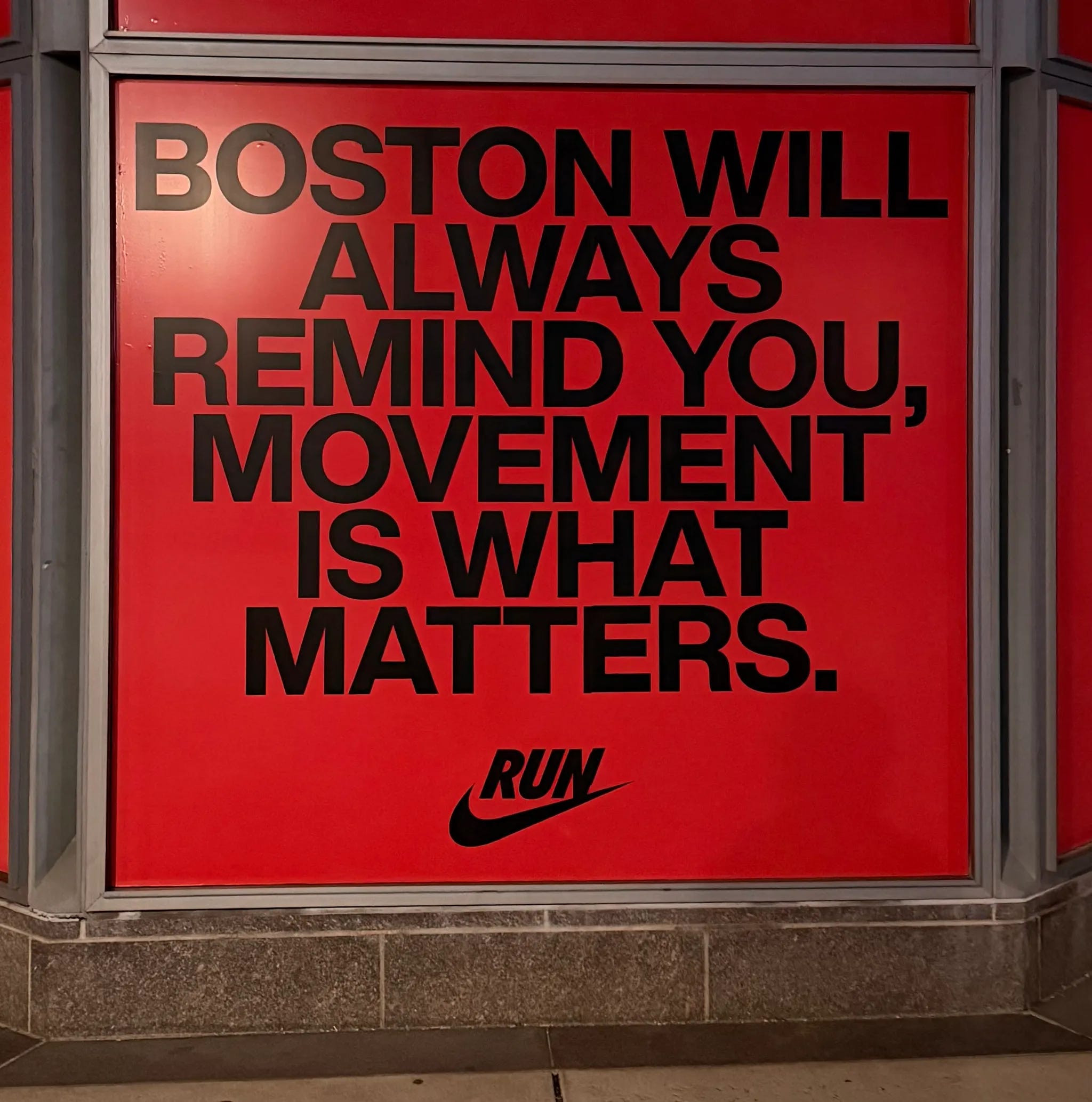
Which is probably why Nike decided to put up this sign in their Newbury Street flagship store, a few blocks away from the finish line:
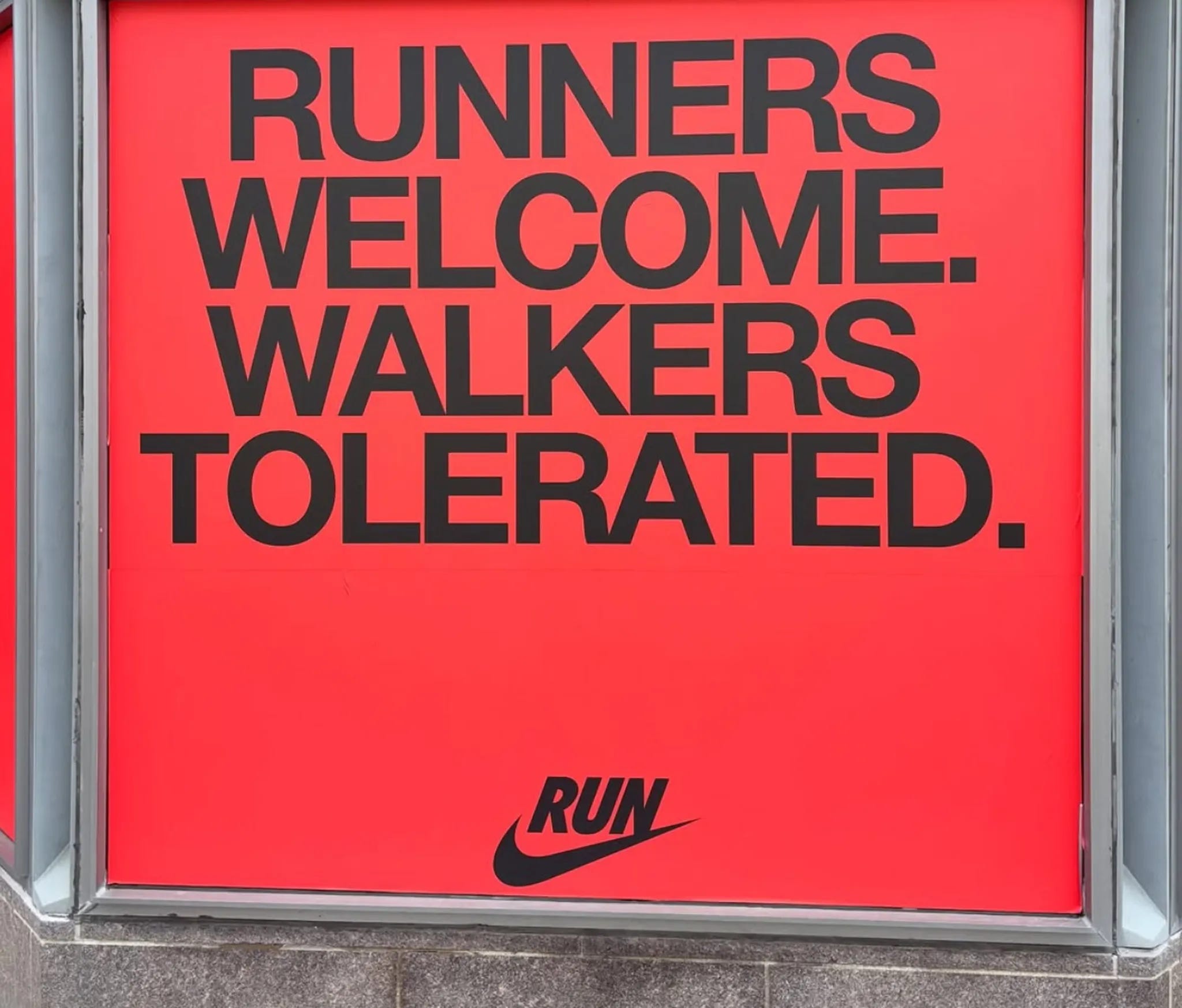
RUNNERS WELCOME. WALKERS TOLERATED.
👹 The reaction? Immediate online backlash for being elitist and anti-inclusive, leading Nike to pull the sign and issue an apology.
Moments like these are why, as an agency, we’re constantly receiving RFPs and briefs that reflect the following phenomena:
🙋 Audience Indecision: Instead of identifying a specific persona, niche, or demographic group to target, brands will either give us a laundry list of various groups to speak to within a single campaign or simply ask us to made ads that reach the general population
🚩 Fear of Backlash: Guardrails, checks, and flags galore, wincing at the slightest whisper of risk or provocation
This isn’t happening without reason. As corporate budgets shrink and consumers’ pockets tighten, many marketing teams (and their agencies, to boot) are being asked to do more with less. And while the algorithm helps brands reach broader audiences, it also means that there’s a record of every missed-the-mark post, and any consumer’s ire has the possibility to ignite a fire that burns with legitimate financial and legal consequences.
But trying to make magical work that speaks to everyone and pleases them all is not the solution. On the contrary, it mostly just results in boring creative. Here’s the recipe for 🥀 totally torched work: (1) avoid committing to saying anything remotely unexpected, or having an identifiable point of view (2) blindly co-opt trends of the moment once they’re already popular and (3) fail to dig any deeper into who is most important to reach and what drives them emotionally.
As always, the answer is in the audience. But the audience can’t just be gen pop, and, if it is, there must be a good reason for it. When possible, it’s always better to get more specific, understand the context of where your creative will be seen, and find the human truth instead of the business truth. But that’s not easy, and there are a plethora of traps that lead to failure…which is why I’m so interested in this Nike sign.
Sure, the copy was a miss in general. Every great marathoner started somewhere (probably involving walking), and nobody’s immune to a bad day. But the real fatal flaw was the placement of the message: a public storefront on Newbury Street, one of the most heavily trafficked retail avenues in Boston. Yes, Nike’s brand voice has always been about high standards, elite exclusivity, being at the top, and doing what others fail to do. Yes, they were likely trying to speak directly to the crowd of Boston qualifiers, extending that “not for everyone, only for the best” mentality. And that’s a strong POV! But when you broadcast a 1% message to a 100% space, you’ve misread who you’re speaking to and how it will impact them emotionally. The message was less of the problem; the medium was the culprit.
The ad also tripped across the fine line between an eye-catching, unexpected, resonant POV and ragebait. The argument for the unexpected does not equate to “any publicity is good publicity.” As mentioned above, there are real consequences to employing offensive language for attention.
Take Burger King for example. When the company posted “Women belong in the kitchen” for Mother’s Day in the UK (and…eventually followed up with a discussion on gender disparity in restaurants), viewers were upset. Few believed that Burger King was actually expressing a bigoted belief, but the use of bigotry to deliberately offend for attention alone read as a cynical bait-and-switch.
On the contrary, when Burger King posted a video featuring a time-lapse of a Whopper slowly rotting — and in the process, emphasized its lack of artificial preservatives — the company divided audiences, and certainly provoked some EWWWWs, but ultimately made a highly effective ad with a specific, authentic, emotionally resonant message without weaponizing anger.
For today’s links, take a spin through a few more of our favorite good and bad ads:
What happens when you have something to say, and say it right:
Don’t Buy This Jacket — from Patagonia
Be a Forever New Yorker — from StreetEasy, and also my favorite subway ad that I’ve seen recently
Hiring a Graphic Designer — from the City of LA
Our Blades Are F***ing Great — from Dollar Shave Club
What happens when you misread the room:
Live Louder with Kendall Jenner — from Pepsi (remember this one?)
The Unity Hoodie — from Gap
We Are All Investors — from Robinhood
The Gift that Gives Back — from Peloton
The So What
Great creative requires the bravery to accept that not every ad should be for every person. If you want your message to effectively grab a group of people, you must be willing to accept that others might not “get it.” The difference between a brand with a devoted group of followers and a brand that’s mildly interesting to a vague blob of people is the willingness to take risks in communication.
Which would you rather be?
✉️ If you haven’t yet subscribed, smash that button below so you don’t miss the next one with the brilliant Quinten Rosborough.
Read more from this author:
And don’t miss last week’s post:
Comments
Nothing yet. Say the first thing.
Sign in to join the conversation.