
Whaddup y’all. I’m Quinten, writer at The So What and senior director of content at Artemis Ward. Welcome to my column, where I break down what’s happening in culture and explain what it means for your creative work. Read on for the “so what.”
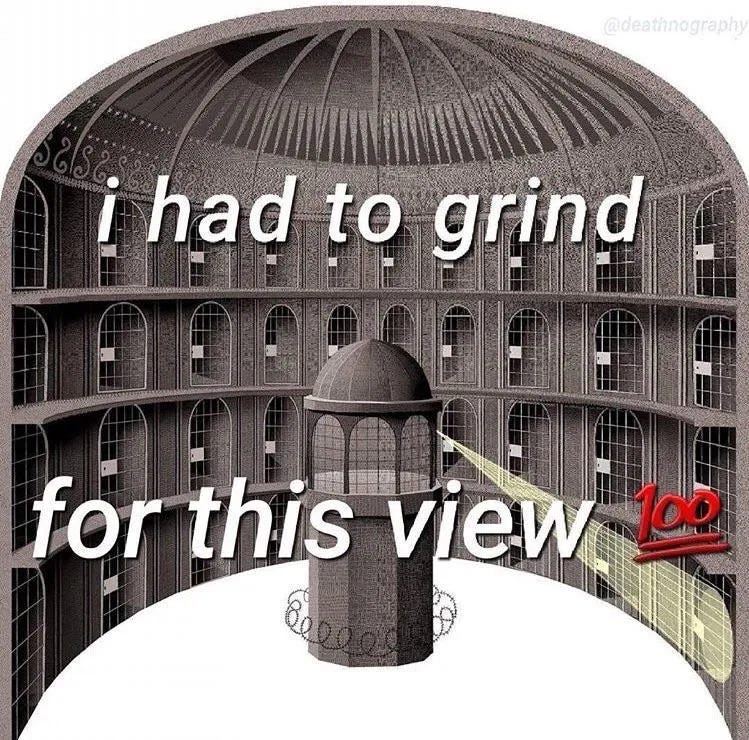
Last year, I wrote about the phones-free listening party Tyler the Creator held for his album Don’t Tap the Glass. Inspired by the fear of being filmed that kept his friends from dancing in public, the session offered a brief escape from the digital panopticon we find ourselves in, a place where people could — quite literally — dance like no one is watching (or filming, as it were).
Around the time of Tyler’s listening party, similar conversations were happening in dance music, as DJs around the world began seeing fewer people dancing and more people crowding DJ booths to capture content. Over the course of the last year, the conversation around cell phones and live music has only gotten louder, reaching its apex this month at Coachella, where video after video of the festival’s seemingly lifeless crowds went viral.
For olds like myself, who can remember getting same-day Lollapalooza tickets for 80 bucks (and have the confirmation email prove it), the scenes from Coachella are particularly jarring. Keepsakes have always been an important part of concert-going. Merch, photography, live albums, ticket stubs — all ways people have memorialized the time they got to see their favorite bands. However, for us memorializing was secondary to singing, dancing, and otherwise enjoying the music. If the dispatches from Coachella are to be believed, it seems that memorialization has become the point entirely.
The videos coming out of the festival are reflective of a shift in the way audiences of any event — from community gatherings to multi-million dollar brand activations — are participating in culture. If you’re reading this piece, you’re probably involved in the creation of cultural events in some capacity. The Gen Z Stare has come for General Admission. What’s your game plan?
It’s no coincidence that the music festival’s recent growth in popularity occurred alongside the growth of Instagram. Coachella is the preeminent music festival precisely because of its grammability. The desert, the celebrities, the kitsch of Palm Springs — you’d be hard-pressed to find a better place from which to post.
However, zombified crowds aren’t exclusive to Coachella. Rachel Grace Almeida describes a similar scene in her exploration of mainstream club culture, The Great Regression.
Perhaps it’s debatable whether the dominating dance scene was ever a progressive force that truly broke free from the conventions of society. But what’s clear is that electronic music has increasingly become an attraction rather than an active practice of liberation. Instead, we’re drifting further into a state of neutrality, a cultural void where detachment is being generously rewarded. Nowhere is this more apparent than in the seismic rise of Keinemusik.
...when footage of Keinemusik’s Hï Ibiza set went viral in 2024, it sent all corners of the dance music community into hysterics. In it, a torrent of phones engulf a room full of frozen bodies, a flatlined vibe that not even Port’s mammoth 2024 hit “Move” could resuscitate.*
Personal recordings have always been a nuisance to the live performer. But only recently has its use bordered on the anti-social. It takes a cursory internet search to find stories of people recording an artist’s entire set, clearing sections of the floor to record TikToks, and even FaceTiming with friends. From Indio to Ibiza, more and more people are beginning to see concerts not as events to experience but as moments to capture. At the same time, we’re seeing artists bristle at their shows becoming conduits for generating content. At clubs like Berghain, door staff put stickers on the front and back of everyone’s phone. At the recording of his live special for Netflix, Harry Styles banned all cellphones and handed out 20,000 disposable cameras. And in borrowing from the world of stand-up comedy, many artists have begun partnering with companies like Yondr to have fans lock their phones away during their sets.
How did we get here? What compels us to take terrible videos of incredible experiences? Why are we spending hundreds of dollars to watch a concert through a six-inch screen?
In his book The Tourist Gaze, the sociologist John Urry describes how photography — being seen and recorded, and seeing others and recording them — became intertwined with modern-day tourism.
*Photography gives shape to travel. It is the reason for stopping, to take (snap) a photograph, and then to move on. Photography involves obligations. People feel that they must not miss seeing particular scenes since otherwise the photo-opportunities will be missed.… Indeed much tourism becomes in effect a search for the photogenic; travel is a strategy for the accumulation of photographs and hence for the commodification and privatisation of personal and especially of family memories….
What is sought for in a holiday is a set of photographic images, which have already been seen in tour company brochures or on TV programmes (see Selwyn, 1996). While the tourist is away, this then moves on to a tracking down and capturing of those images for oneself. And it ends up with travellers demonstrating that they really have been there by showing their version of the images that they had seen before they set off.
To the traveler, photography serves as an act of validation: validation that you did what one is supposed to do in a space. Validation that the experience you had matches the one you imagined sharing before setting off. Validation that you actually went there, and it was worth it. And as the philosopher Agnes Callard puts it in The Case Against Travel, validation that “you are doing many exciting and edifying things: you are experiencing, you are connecting, you are being transformed, and you have the trinkets and photos to prove it.”
In a world where its not unusual for a concert ticket to cost as much as international airfare, and online posting has become “a smorgasbord of aspirational boasting,” it’s not surprising then that the live event has come to resemble the tourist attraction. As with contemporary tourism, the live event, too, has become “a strategy for the accumulation of photographs,” a place where people can track down and capture for themselves the images, videos, and TikTok trends seen on their feeds. How else would you prove that you were actually there? If the reason for going to the concert is to later prove that you had went to the concert, why let something inconsequential like dancing get in the way of a video?
Perhaps, then, we cringe at these videos from Coachella for the same reasons we cringe at the archetypical “tourist” — they both suggest you can capture the entirety of a moment, of a culture, as a digital keepsake. That what something looks like can be a faithful approximation of what it is.
In the world of tourism, this superficiality is often destructive. It’s what the writer Henry Wismayer calls “tourism’s intractable contemporary paradox.”
Here is tourism’s intractable contemporary paradox — that the democratization of our geographical and cultural riches too often precipitates their ruination. Again and again, tourism sacralizes the objects of its gaze, then desecrates them with footprints.… Each revolution designed to make travel more accessible and convenient seems, in time, to exact lamentable collateral costs. Airbnb-style rentals hollow out the very neighborhoods their users profess to cherish. Google Maps, online translators and internet reviews diminish host-visitor interaction and nullify the process of getting lost that is a non-negotiable precondition of serendipitous discovery.
While Wismayer is writing about the tourism here, his analysis rings true for cultural consumption as well.
It’s no wonder then that we (hopefully) find the Coachella vids so jarring. We’re watching a throng of people flatten a thing we love into a pixelated mess. It’s no different than those images of the piles of trash at the basecamp of Mt. Everest or the giant cruise ships parked in the Venetian Lagoon.

Which brings me back to that Tyler the Creator listening party. In many ways (but in fewer words) he was grappling with the same questions artists are asking at the festival stage, the arena show, and the DJ set. The same questions brands need to be asking with every partnership and activation. How can we make this a space where culture is celebrated and not consumed? How do we create moments that people can meaningfully enjoy and not mindlessly appropriate? At what point does user-generated content go from the thing that amplifies your message to the thing that cannibalizes it?
I’d suggest the answers to all those questions can be found in the very title of the album Tyler played on that night last summer:
Don’t Tap the Glass.
✉️ If you haven’t yet subscribed, smash that button below so you don’t miss the next one with Colin Moffett.
Read more from Quinten:
And don’t miss last week’s post from Ryan:
Comments
Nothing yet. Say the first thing.
Sign in to join the conversation.