
Everyone wants it.
Almost no one has it.
You hear it at family office conferences.
You hear it from wealth advisors pitching their “exclusive network.”
You hear it from platforms that promise “access” but deliver glorified pitch decks.
Deal flow. Deal flow. Deal flow.
It sounds strategic.
It sounds connected.
It sounds like something sophisticated investors say.
But the truth is that most people who talk about deal flow cannot explain, in simple terms, how to source quality opportunities consistently, why proximity matters more than introductions, and how to convert conversations into allocations before the round closes.
And speed is the game.
If you are sitting on capital but missing the best deals, the problem is rarely your conviction.
It is your access architecture, your room selection and how fast a great opportunity moves from someone’s radar to someone else’s term sheet.
Fix that, and exceptional returns become inevitable.
Layer 1: Public Deal Flow
This is what most people call “deal flow.”
Pitch decks sent cold via email
Conference introductions from mutual connections
LinkedIn messages with “unique opportunity”
Fund marketing materials
Reality check:
If you are seeing it through these channels, 50+ other allocators already passed.
The best deals do not need mass distribution. They close in private rooms before the deck is even finalized.
Layer 2: Curated Networks
This is what most clubs and platforms promise.
Vetted founder introductions
LP circles and syndicate groups
“Exclusive” demo days
Quarterly investor dinners
Better, but:
You are still competing with everyone else in that room. The deal is already priced for multiple bidders. Your edge is minimal.
Layer 3: Proximity Architecture
This is what Artemis Privé builds.
Not introductions.
Not access.
Proximity.
You are in the room when:
A shipping magnate mentions their daughter is building maritime AI
A family office CIO shares frustration about finding real blue-economy exposure
A founder casually discusses their next raise over a third glass of wine at 35,000 feet
The deal has not been packaged yet.
The valuation has not been set.
The “official” round has not even been announced.
That is Layer 3.
And it requires engineered environments, not random networking.
Let’s be precise:
Most high-net-worth gatherings optimize for:
Attendee count (to justify ticket price)
Brand partnerships (to subsidize costs)
Social proof (to fill Instagram feeds)
They do not optimize for:
Decision-maker density
Pre-vetted capital alignment
Post-event conversion
You attend. You meet people. You collect cards.
Three months later: zero allocations.
Why?
Because the room was built for optics, not outcomes.
If everyone in attendance can write a check but no one shares investment thesis overlap, you have created a cocktail party, not a capital environment.
Artemis Privé operates differently.
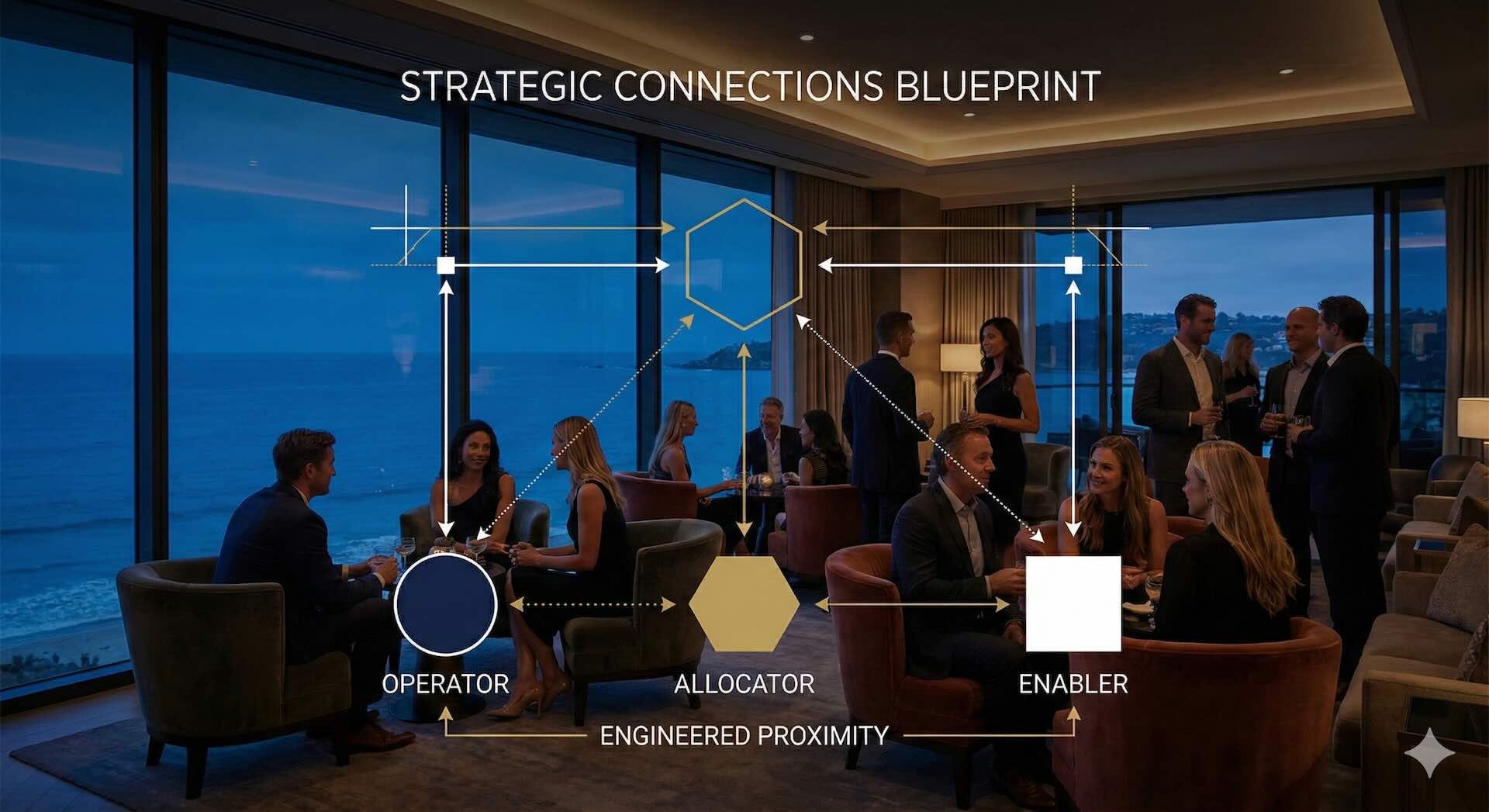
We treat member composition like portfolio construction:
33% Operators
Founders, CEOs, builders actively in-market.
They bring deal origination and operating intelligence.
33% Allocators
Family offices, principals, fund managers who can move capital without 12-week committee cycles.
They bring conviction and speed.
33% Enablers
Industry experts, domain specialists, strategic advisors.
They bring validation and insight that de-risks diligence.
The result:
When a conversation starts, all three parties are already in the room.
The operator explains the opportunity.
The enabler validates the edge.
The allocator structures the terms.
By the time you leave the yacht, the WhatsApp group is already discussing allocation sizes.
Scenario 1: Traditional Networking
You meet a founder at a conference
Exchange details, promise to “stay in touch”
Three weeks later, you schedule a Zoom
The deck gets forwarded to your investment committee
Four more calls, two months, and a site visit later
The round is now oversubscribed at a 30% higher valuation
You pass or take a smaller allocation than planned
Scenario 2: Artemis Proximity
You spend a race weekend next to the same founder
You observe how they handle pressure, relationships, and details
You meet their technical co-founder over dinner
An LP you respect is also in the room and shares diligence notes
By Sunday evening, you have seen enough signal to commit
The wire goes out Monday morning at the original valuation
You secure your full allocation before the “official” round announcement
Time saved: 6-8 weeks
Valuation advantage: 20-30%
Allocation access: 100% vs. 40%
This is not luck. This is architecture.
If you control allocation decisions and want to outperform, the question is no longer:
“How do I get better deal flow?”
The questions are:
Which rooms consistently put me next to founders before they need capital?
Where do my diligence conversations happen naturally, not transactionally?
Which environment treats my time, expertise, and relationships as compounding assets?
Artemis Privé is betting that answer can be one place.
If you are allocating to real assets, AI-enabled infrastructure, or blue economy opportunities, and you want your “networking” to show up as IRR, it may be time to stop collecting introductions and start engineering proximity.
The best deals do not find you at conferences.
They find you at altitude, on deck, or in a room where everyone can say yes.
No posts
Comments
Nothing yet. Say the first thing.
Sign in to join the conversation.