
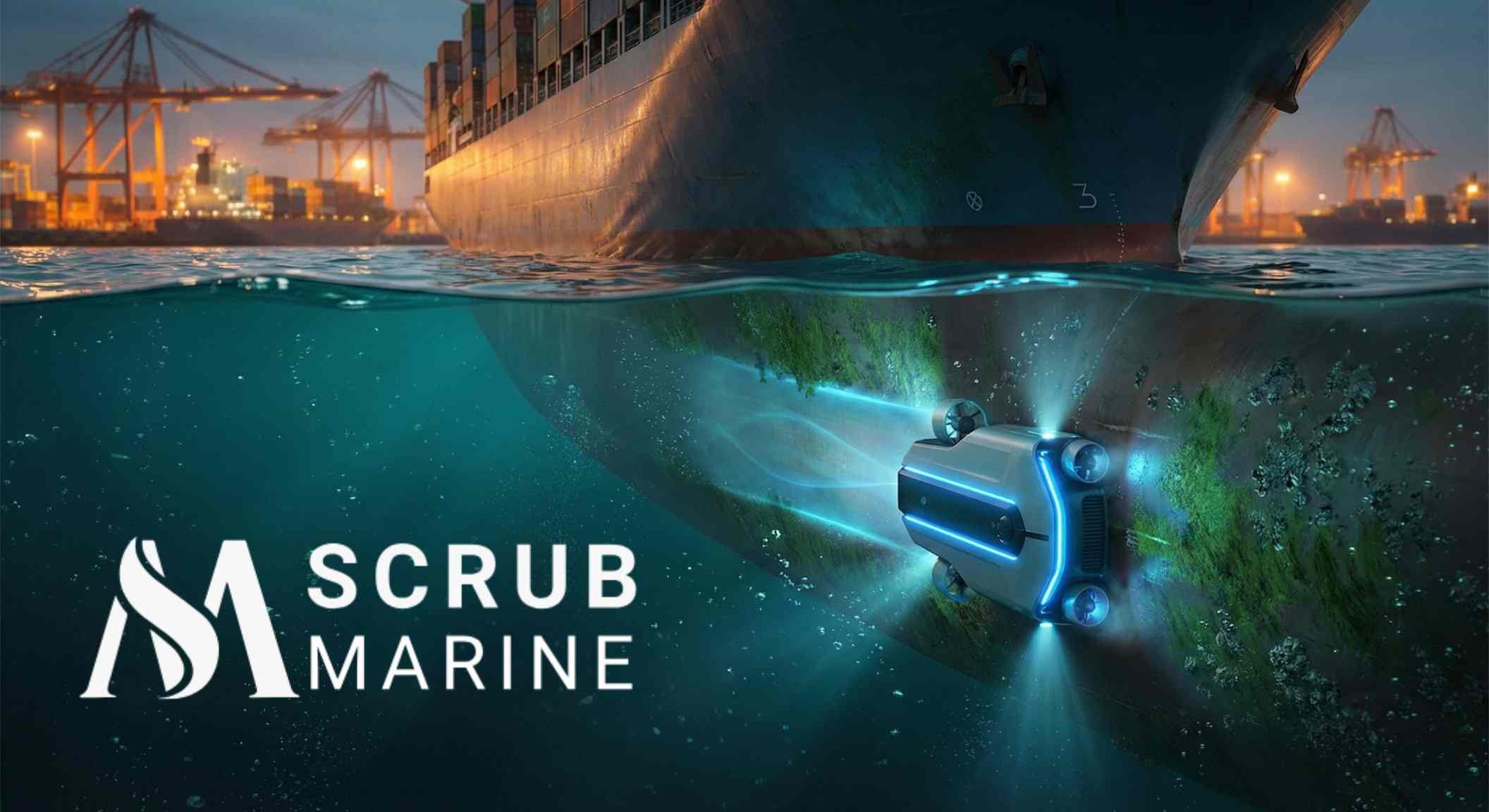
The ocean doesn’t care about spreadsheets - it cares about drag, friction, and the hard physics of moving steel through water. Every extra millimetre of slime and barnacles on a ship’s hull is invisible on a P&L… until fuel bills spike, emissions targets are missed, and a vessel quietly becomes uncompetitive. That “boring” layer of biofouling is a 100‑billion‑dollar problem hiding in plain sight.
Today on Artemis Privé, we’re not talking about another SaaS dashboard or AI slide deck. We’re going under the hull. Into the ports. Into the cold water where divers still do dangerous, manual work so global trade can keep moving. And we’re asking a simple question: what happens when that work is handed over to intelligent robots instead?
Biofouling - the buildup of algae, slime, and marine growth on hulls - can increase a vessel’s fuel consumption by up to 40%, costing the shipping industry more than $100 billion a year and driving avoidable emissions. The current fix is a mix of dry‑dock visits and diver teams: expensive, episodic, and inherently risky. You only “see” the hull a few times a year, and you hope nothing nasty is growing down there in between.
ScrubMarine is treating that status quo as a legacy process, not a law of nature. Their core insight: hull cleaning and underwater inspection shouldn’t be special events, they should be continuous, autonomous infrastructure — like upgrading from quarterly meter readings to real‑time telemetry.
Instead of divers, ScrubMarine fields a compact subsea robot nicknamed the Turtle. It adheres to the hull, scrubs away biofouling, and simultaneously collects inspection data as it moves - turning what used to be a cost centre into a data‑rich maintenance pass. That robot is deployed and recovered by an autonomous surface vessel, the Whale, which means no specialised port infrastructure and no humans in the water.
On a practical level, that changes the economics:
Ships can stay in the water and on schedule while being cleaned and inspected.
Operators get continuous data on hull condition, not just snapshots from the last dry‑dock.
Ports and owners reduce diver risk, operational downtime, and compliance headaches in one move.
Under the hood, this is a robotics and autonomy play: navigation and control systems that can hold station on a moving fluid surface, manage complex geometries, and stream inspection data into a cloud analytics layer. It’s subsea robotics reimagined as a service.
ScrubMarine is a young British deep‑tech company, built out of the Heriot‑Watt ecosystem and now anchored between Whitehaven and Edinburgh. Founder‑CEO Rohith Devanathan and his team have just closed a €849k (about $1m) pre‑seed round led by PXN Ventures and SFC Capital, with ex‑Apple executive Colin Greene and former UK Chamber of Shipping president Graham Westgarth joining as strategic angels.
If you sit on the capital side of the table, ScrubMarine is not “just” a robot story; it’s a new underwriting lens for the maritime world. Cleaner hulls, continuous inspection data, and less downtime are not marketing lines — they’re variables that can reshape how you price risk, structure charters, and value fleets.
Over the next decade, expect three things:
Regulators and financiers will increasingly demand verifiable data on hull condition and emissions.
Ports will favour low‑impact, high‑efficiency maintenance methods that minimise disruption.
Operators who adopt autonomous cleaning early will quietly compound an efficiency edge that others only notice years later.
ScrubMarine is building for that world: one where robots do the dirty, dangerous underwater work, and the output is not just a clean hull — it’s a cleaner balance sheet and a more investable asset.
Comments
Nothing yet. Say the first thing.
Sign in to join the conversation.