
I never really thought much about Artemis at Olympia, if I’m being honest.
The first time I visited Olympia was in 2010 with my mother. I remember running the ancient stadium with members of our tour group, laughing as we crossed the same finish line where athletes had competed for centuries. Like so many visitors, I thought of Olympia as belonging to Zeus. It was his sanctuary, his games, his story. If someone had asked me then which goddess I associated with Olympia, I probably would not have had an answer. I certainly was not thinking about Artemis, and, if I am honest, I was not even thinking very much about Hera.
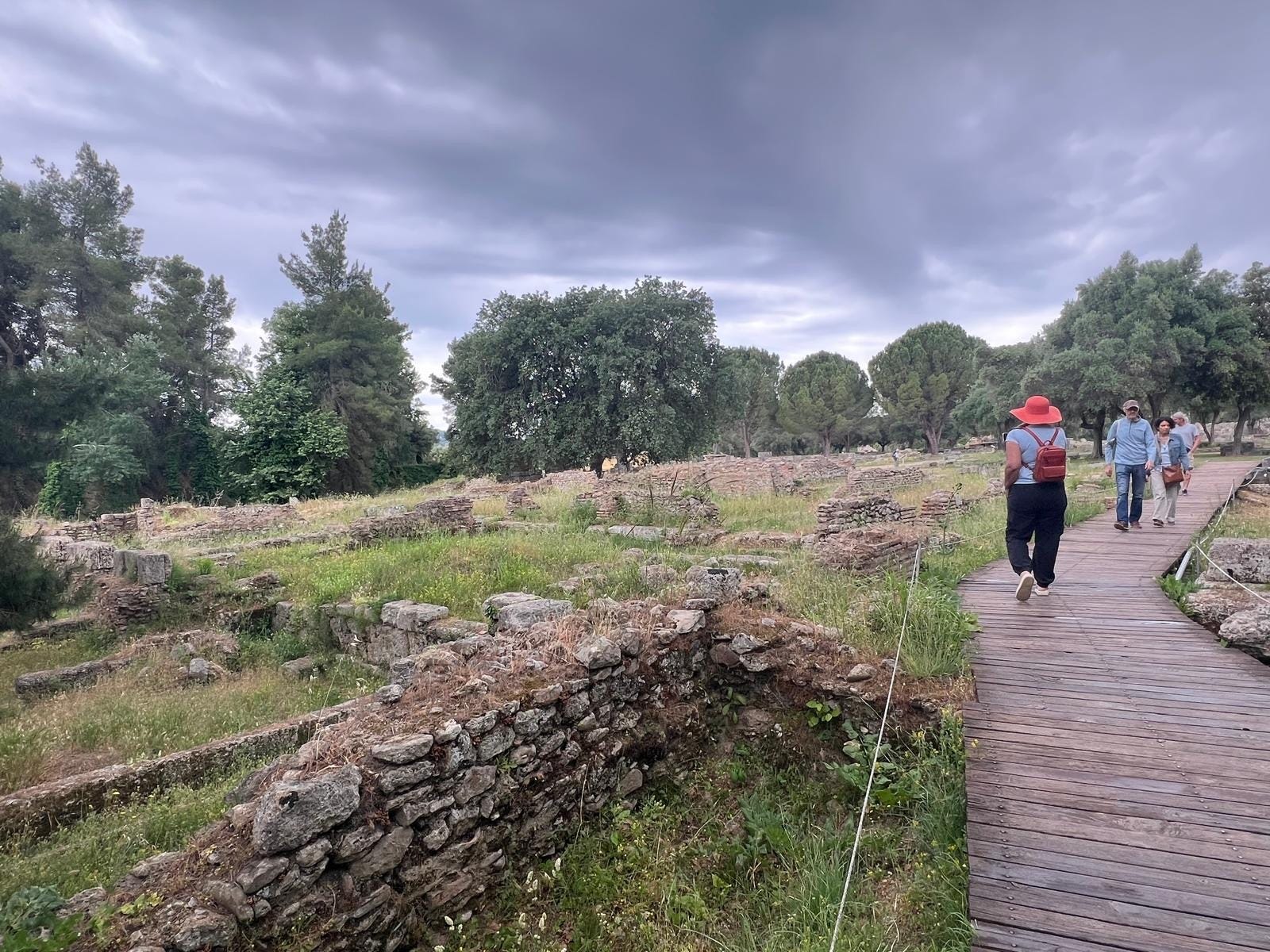
Returning years later as part of the Artemis Mapping Project, I arrived expecting to look for traces of Artemis, but I was still surprised by what greeted me. One of the first things that struck me was the Heraion itself. Hera’s temple stands immediately beside the Temple of Zeus, substantial and commanding in its own right, and every visitor walking toward the ancient stadium passes between these two great sanctuaries. It was an immediate reminder that even at one of the most famous sanctuaries of Zeus, divine female presence was never absent.
When Sandra and I woke up that morning and saw that clouds and rain were in the forecast we hoped the weather would keep some of the crowds away. Our goal was quite specific. We wanted to locate the area where Nero had later built over the remains associated with an altar of Artemis, one of the few places where I knew I might be able to photograph something tangible for the mapping project. I expected to spend the day chasing the faint traces of one goddess.
Instead, I found many.
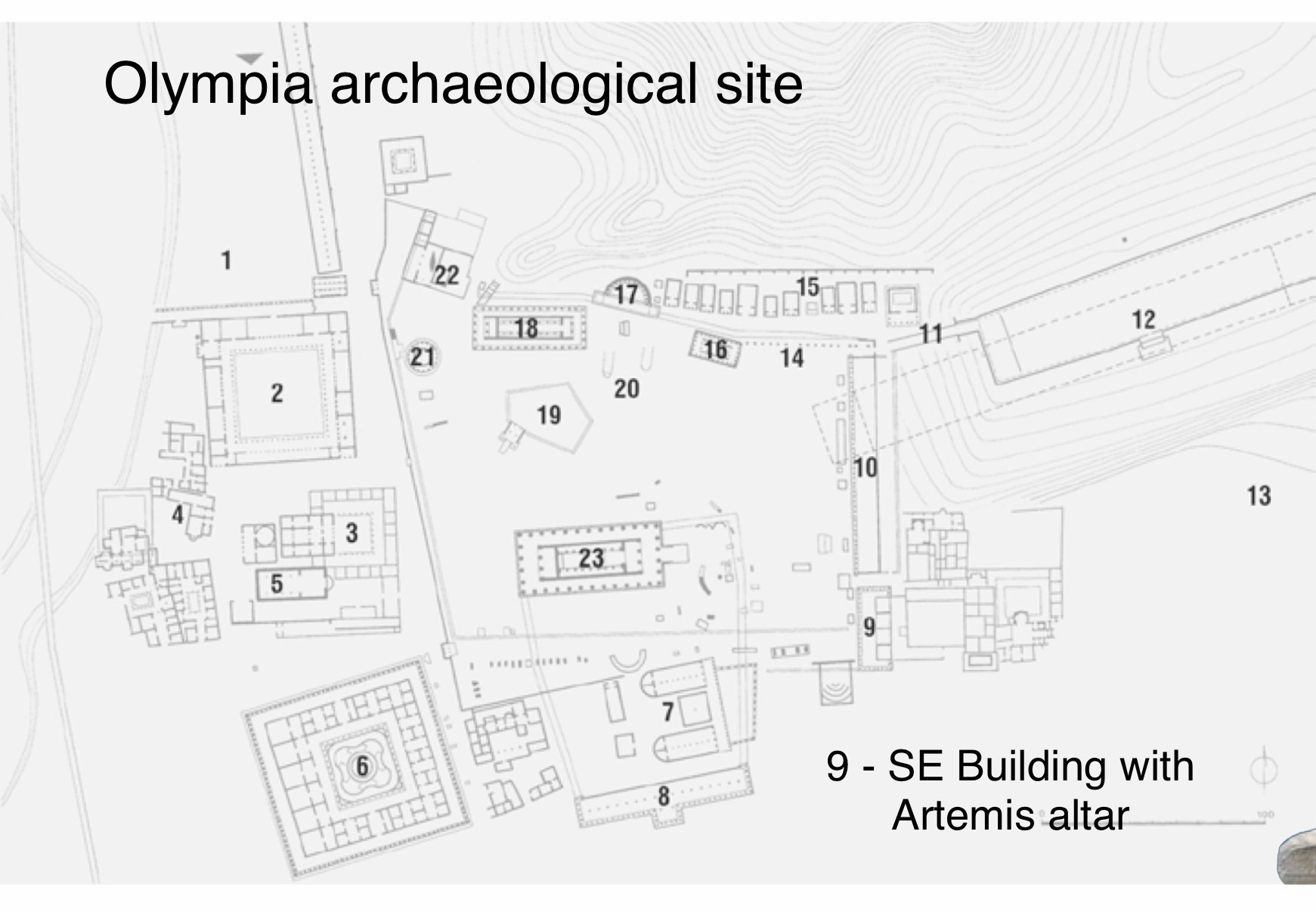
As we wandered through the site, it became impossible to ignore how many goddesses were woven into the sacred landscape. Hera was there, the Mother of the Gods (Kybele) was there, and if her altars/sanctuaries were labelled, Artemis would’ve appeared repeatedly across the sanctuary as well. Standing there, looking at the site map, I realized how deeply I had absorbed the modern tendency to think of Olympia as an exclusively masculine place. Academically, of course, I knew that women celebrated their own games at Olympia and that female divinities were worshipped here. Yet somehow those facts had remained separate from my emotional picture of the sanctuary. Like many of us, I had unconsciously reduced Olympia to Zeus, victorious athletes, and heroic men.
Walking through the sanctuary changed that.
It reminded me that although ancient Greek society was undeniably patriarchal, its sacred landscapes rarely erased the divine feminine. Even here, in what many people imagine as the ultimate symbol of Greek masculinity, pilgrims paused before the goddesses. They offered sacrifices to them, invoked their protection, and made space for them within one of the most important Panhellenic sanctuaries in the ancient world. I began to wonder, not for the first time, whether we have inherited an image of Greek religion that is far more exclusively masculine than the archaeological evidence itself suggests.
When rain began to fall, visitors hurried beneath trees and sheltered beneath the surviving ruins (some left the site altogether) while Sandra and I waited for the downpour to ease. Eventually we made our way to the southeastern corner of the sanctuary, where the remains connected with Nero’s imperial building still survive.
I was genuinely excited to stand among the foundations that preserve the memory of Artemis’ cult here, even if the modern site label identifies the area primarily with the Sanctuary of Hestia (more on this below).
Olympia Before Zeus Became the Whole Story
Today, Olympia is almost synonymous with Zeus. Mention the site to almost anyone, and they immediately think of the Olympic Games, the colossal gold and ivory statue of Zeus, one of the Seven Wonders of the Ancient World, and generations of victorious athletes competing beneath his watchful gaze. It is an association so deeply rooted in our collective imagination that it can be difficult to picture Olympia as anything else.
Yet the sanctuary was never devoted to Zeus alone.
Long before modern guidebooks reduced Olympia to a story about athletics and the king of the gods, this was a living sacred landscape where many deities were worshipped together. Pilgrims did not arrive to honour Zeus in isolation. They moved through a sanctuary filled with temples, altars, treasuries, statues, processional routes, and sacred groves, encountering a rich religious world that reflected the complexity of Greek polytheism itself.
The earliest evidence for activity at Olympia reaches back into the Late Bronze Age, but it was during the Early Iron Age that the sanctuary began to develop into an important place of worship. By the eighth century BCE, as communities across the Greek world became increasingly connected, Olympia was emerging as a Panhellenic sanctuary, a place where people from different regions gathered to worship, compete, and negotiate relationships that extended beyond their own cities. The Olympic Games, traditionally dated to 776 BCE, were only one part of this larger religious landscape. Athletics were never separate from worship. Every competition, procession, sacrifice, and dedication unfolded within sacred space.
Zeus eventually became the dominant deity of Olympia. As protector of oaths, hospitality, justice, and kingship, he embodied many of the ideals that the sanctuary sought to express. The Temple of Zeus, completed during the 5th century BCE, became one of the defining monuments of the Greek world, while Pheidias’ massive cult statue transformed Olympia into one of antiquity’s greatest pilgrimage destinations.
Finding Artemis at Olympia
Unlike many of the sanctuaries I have visited for the Artemis Mapping Project, Olympia does not preserve a monumental Temple of Artemis rising above the landscape.
The most important guide to Artemis’ presence here is the 2nd century CE traveler Pausanias. As he walked through Olympia, carefully describing the monuments and altars that lined the sanctuary, he mentioned Artemis repeatedly. His account reveals that rather than occupying a single dominant building, Artemis appeared in several places throughout the Altis, each reflecting a different aspect of her worship.
Near the Heraion, Pausanias records that, “after re entering the Altis by the processional gate there are behind the Heraion altars of the river Kladeos and of Artemis; the one after them is Apollo’s, the fourth is of Artemis surnamed Kokkoka...” (Description of Greece 5.15.7). Earlier in his description of the sanctuary, he mentions “a square altar of Artemis” standing beside an altar of Athena near the Temple of Zeus (5.14.5). He also describes a joint altar where sacrifices were offered to both Alpheios and Artemis, reflecting the close relationship between the goddess and the natural landscape surrounding Olympia (5.14.6). Continuing through the sanctuary, he notes “an altar of Artemis on the right as you return from the Stoa of Agnaptus” (5.15.6), followed by an altar of Artemis Agoraia, “Artemis of the Market,” situated outside the Altis near the Leonidaion (5.15.4). Finally, in front of the Prytaneion, or Town Hall, Pausanias records an altar dedicated to Artemis Agrotera, Artemis the Huntress (5.15.8).
Taken together, these references reveal something about how Artemis was knitted into the fabric of Olympian worship. Pausanias encounters Artemis repeatedly as he walks through the Altis, her altars appearing beside temples, rivers, civic buildings, and processional routes. By the end of his account, it becomes difficult to think of Artemis as a peripheral deity. Although she never possessed a monumental temple comparable to those of Zeus or Hera, her presence was woven throughout the sacred landscape of Olympia itself.
Rather than basing her worship within a single temple, the people of Olympia encountered Artemis throughout the sanctuary. She appeared beside rivers, near processional routes, behind one of the oldest temples in Greece, and in spaces connected with civic life. Her presence was dispersed across the landscape, almost as though she accompanied the pilgrim from one sacred place to another.
The Altar Beneath Nero's Palace
One of the places I was most determined to visit at Olympia was the area connected with Nero’s palace.
At first glance, it seems like an unlikely destination. Most visitors make their way toward the Temple of Zeus, the stadium, or the magnificent Heraion. Few stop at the ruined foundations in the southwestern part of the sanctuary, yet this relatively quiet corner preserves one of Olympia’s most intriguing archaeological puzzles.
According to the Hellenic Ministry of Culture, Emperor Nero constructed an elaborate residence within the Altis between CE 65 and 67 when he travelled to Greece to participate in the Olympic Games. The palace was not built on empty ground. It was erected over earlier Classical buildings, including the Sanctuary of Hestia, fundamentally reshaping this part of the sacred landscape (Hellenic Ministry of Culture, House of Nero).
Yet the story does not end there.
The official archaeological guide to Olympia preserves another important piece of evidence. In its description of the South-east Building, the guide notes that this fourth century BCE structure once contained an altar of Artemis before Nero’s imperial construction covered the earlier remains (ODAP, Olympia Site Guide, p. 52). It was this reference that first drew me to this corner of the sanctuary during our fieldwork.
When I finally stood among the foundations, I understood why modern visitors can easily become confused. The site signage emphasizes Hestia, while the archaeological guide highlights Artemis. This makes sense when we think about how sacred landscapes were rarely static. Buildings were repaired, expanded, demolished, and rebuilt over centuries, while different cults often occupied neighbouring spaces or successive phases of the same area. What survives today is the final chapter of a much longer history.
Ancient sanctuaries were living places that evolved over hundreds of years, responding to changing political circumstances, new architectural programs, natural disasters, and the ambitions of powerful rulers. Nero’s intervention at Olympia represents one of the most dramatic examples of this process. His palace inserted imperial Roman authority into one of Greece’s most sacred Panhellenic sanctuaries, permanently altering the appearance of the Altis while simultaneously preserving traces of the earlier landscape beneath it.
Standing there in the rain, looking across the surviving foundations, I found myself thinking less about what had been lost than about what had survived. The buildings themselves may have disappeared, but the literary sources, archaeological reports, and scattered remains still allow us to recover something of Artemis’ presence here. Even after nearly two thousand years of rebuilding, destruction, and excavation, the goddess has not vanished entirely. She simply requires us to look a little more carefully.
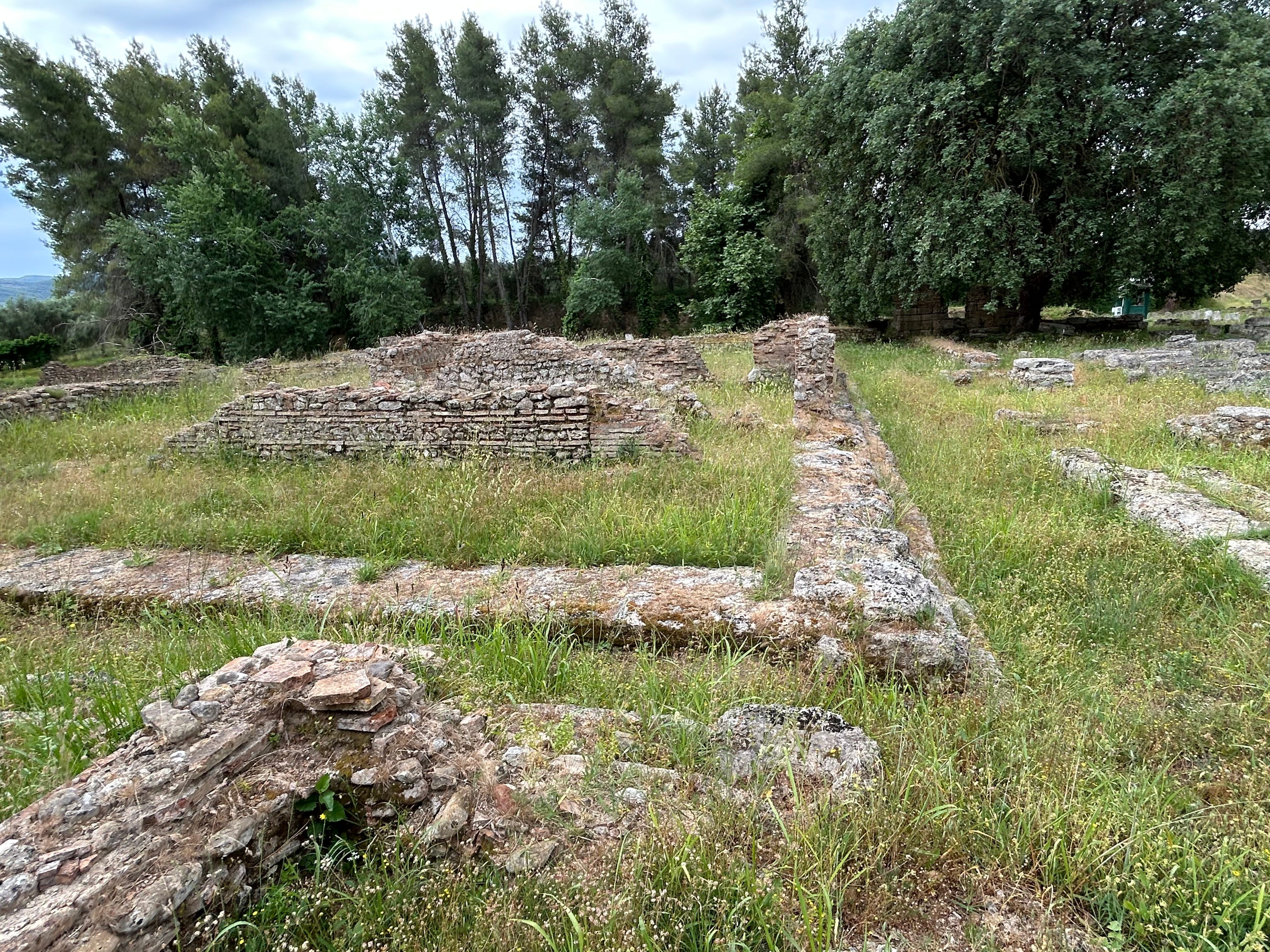
Perhaps that is one of the enduring lessons of Olympia. Artemis is not announced through a towering temple that dominates the skyline. She appears instead through fragments, overlapping traditions, and careful archaeological reading. Finding her requires patience, but once you begin following the evidence, her presence becomes impossible to ignore.
Closing Thoughts
Looking back on that afternoon, I realized how unusual the entire experience had been. Most of my fieldwork takes place under a blazing Mediterranean sun, or alone on mountains, or driving from one monument to the next. Olympia offered us something entirely different.
For a little while, the rain emptied the sanctuary. People hurried toward shelter or waited beneath the trees, and we found ourselves with an unexpected window of quiet. We walked slowly through the ruins, filming, photographing, and lingering wherever we wanted. In one of the busiest archaeological sites in Greece, we were suddenly almost alone.
There was something deeply moving about finally reaching the area associated with Artemis. At first glance, it is not a place that invites visitors to stop. The grass is left to grow over much of the area, the remains themselves are modest, and the modern signage directs your attention elsewhere. Most people pass by without ever realizing that this corner of Olympia preserves an important chapter in the story of Artemis. I found that both beautiful and a little heartbreaking.
Perhaps that is fitting.
So much of the Artemis Mapping Project has become an exercise in looking beyond what first presents itself. Again and again, I have found her in places that are overlooked, poorly marked, or hidden beneath later layers of history. Even so, these places still matter. They deserve to be remembered.
As we stood there with our cameras, the sanctuary felt unusually quiet, and I had the unmistakable sense that we had been given the time we needed to do this work well. Every so often, while documenting these ancient sanctuaries, something unexpected happens that quietly reminds me why this project matters. Olympia became one of those places.
Members’ Field Notes
The work of recovering Artemis’ sacred landscape is far from finished. Beyond this point, I’ll take members deeper into Olympia as we explore her epithets, including Artemis Agoraia and Artemis Agrotera, examine the passages of Pausanias in greater detail, and visit the additional locations where traces of her worship can still be found. I’ll also share more of the footage we captured throughout the day, including those quiet moments between the rain and the returning crowds that made this visit one I won’t soon forget.
Comments
Nothing yet. Say the first thing.
Sign in to join the conversation.