
Today we’re adding another sanctuary to the Artemis Mapping Project: the Temple of Artemis at Thermos in Aetolia.
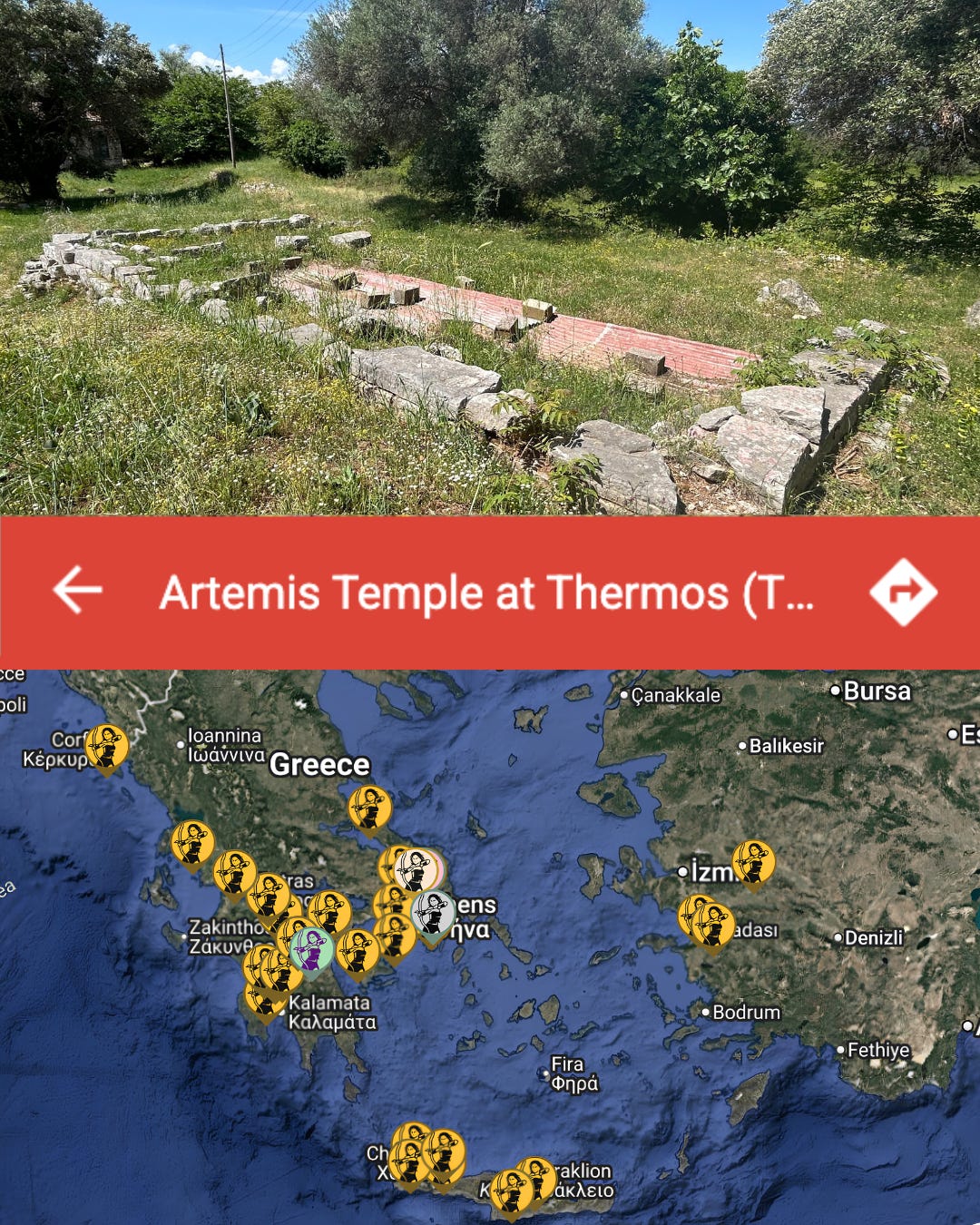
Thermos is one of the most important archaeological sites in western Greece, with a history stretching back to the Bronze Age. The site contains Mycenaean megarons, Archaic temples, Hellenistic stoas, a council chamber, fortification walls, and a sacred spring that remained important for centuries. It is a remarkable place to visit, and surprisingly easy to access. When we arrived, the site was almost completely empty. We spent hours walking through the sanctuary, following the ancient pathways and trying to understand how the various sacred and civic spaces related to one another.
One of the things that struck me almost immediately was how little attention is given to Artemis. Her temple is clearly marked on the archaeological plan of the site, and yet there is very little information available about her sanctuary. The museum displays contain beautiful finds from other parts of Thermos, but I found no artifacts identified as coming from the Temple of Artemis itself. The guidebooks offer only brief references. Most of the scholarship focuses elsewhere. As someone who has spent years tracking Artemis across the Mediterranean, I’ve become accustomed to this pattern, but it is always a little disappointing to encounter it again.
And yet the temple is there.
Standing beside the foundations of the sanctuary, I found myself thinking about how much of Artemis’s story survives not through inscriptions or museum displays, but through landscape. Her temple stands near the Sacred Fountain, a spring chamber that formed an important part of the sanctuary complex. The connection caught my attention immediately because one of the few scholarly discussions devoted specifically to the cult is J. H. Croon's classic article Artemis Thermia and Apollo Thermios (1956), which explores the relationship between the two deities and their connection to the local landscape and springs.
As Croon observed, “the cults of Artemis near hot springs were much more numerous (and varied too) than has been supposed hitherto.”
The more I thought about that statement, the more Thermos began to look different. The Sacred Fountain is not an incidental feature of the sanctuary. It occupies an important position within the sacred landscape, and Artemis’s temple stands nearby. Croon went even further, arguing that Artemis’s association with springs and thermal waters may preserve a very ancient layer of her worship. In his words:
“The worship connected with hot springs was in origin chthonic worship par excellence. And on the other hand it is generally assumed that the prototype of Artemis was one of the pre-Greek chthonic mother-goddesses. The connexion with thermal waters forms, if we adopt this line of thought, a special aspect of her general character as a nature-goddess.”
Whether or not every aspect of Croon’s argument is correct, I think he is asking exactly the right questions. Thermos was already a sacred place long before the monumental sanctuaries of the historical period were constructed. The site preserves evidence of ritual activity reaching back into the Bronze Age. It contains one of the oldest sacred landscapes in western Greece. And within that landscape sits a sanctuary dedicated to Artemis beside a sacred spring.
We cannot reconstruct exactly what rituals took place there. We don’t have the inscriptions, or the dedicatory material that would allow us to tell that story in detail. But the relationship between Artemis, water, and ancient sacred landscapes appears again and again throughout the Greek world and Thermos belongs within that broader pattern.
What made this visit especially meaningful for me was the opportunity to put another sanctuary on the map. Every time we visit one of these sites, ask about Artemis, document a temple, or record a location, we help make her visible again. The lovely site guard who greeted us seemed genuinely pleased that someone had come to visit Thermos. When we explained that we were there specifically to see Artemis’ temple, I saw the familiar look of surprise that I encounter so often during these expeditions. It always makes me wonder whether simply asking for her, speaking her name, and drawing attention to her sanctuaries might help shift the conversation, even in small ways.
For those who would like to explore Thermos in greater detail, here’s the link to the article I wrote previously (including site photographs) on the sanctuary, the Temple of Artemis, the Sacred Fountain, and the archaeological history of the site.
Artemis Outside the Walls: Field Notes from Thermos
If you’ve enjoyed following these expeditions and learning more about Artemis, I’d love to invite you to join me this Saturday, June 13, for a free live workshop exploring one of the most fascinating and misunderstood myths connected to the goddess: the story of Artemis and Callisto.
What if the story of Artemis and Callisto is about more than divine punishment? Together we’ll explore the many versions of the myth, from Archaic Greece to the Roman world, tracing how ancient authors reshaped the relationship between Artemis and her beloved companion. We’ll examine themes of female community, desire, transformation, and power, while exploring the symbolism of bears in the cult of Artemis and the deeper connections between women, wilderness, and initiation. Through mythology, archaeology, ancient literature, and cult practice, we’ll ask whether the myth preserves traces of ancient relationships between women and what Callisto’s transformation into a bear might reveal about Artemis herself.
If you can’t join us live, don’t worry. A recording will be sent to everyone who registers.
Register here: ARTEMIS AND KALLISTO: Bears, Women and Sapphic Love
I’ve included a short BTS video below for paid members who would like to walk through the site with me. You’ll see the Temple of Artemis, the Sacred Fountain, and the broader sanctuary landscape as we add another pin to the Artemis Map.
Thank you for making these journeys possible. Every sanctuary we document brings us one step closer to understanding the scale, complexity, and importance of Artemis’s worship across the ancient world.
Comments
Nothing yet. Say the first thing.
Sign in to join the conversation.