
A forgotten lesson from American history: At the time of the Revolutionary War, smallpox was believed to pose a bigger threat to America than the British Army.
The story begins with one of the early pivotal battles of the war, the Battle of Quebec on December 31, 1775. The British won a decisive victory over the Continental Army. There were several factors involved in the U.S. loss, but smallpox clearly played a role. Almost 40 percent of the U.S. troops at the Battle of Quebec – 1,200 of the 3,200 men brought to meet the British in Quebec – were ill with smallpox on the day of the battle.
General George Washington, Commander-in-Chief of the Continental Army, understood smallpox. He became infected with it at age 19, while visiting Barbados with his brother, Lawrence.
Facing a mortality rate of one in three among those who contract smallpox, Washington struggled through a life-and-death battle for survival for more than a month. It could not have been easy. The disease produced high fever, vomiting, painful pus-filled blisters, severe headaches, and extreme tiredness. Ultimately, however, Washington survived.
Smallpox did provide a substantial gift for its survivors. Washington would have lifelong immunity from smallpox, a definite advantage in leading the U.S. Army against a foe that was heavily infected and spreading the disease generously everywhere it went.
The fight against smallpox at the time involved a highly controversial preventive therapy – the transfer of pus from a smallpox blister to an uninfected person, using the blade of a knife to implement the transfer. The process was called variolation.
The underlying concept – that introducing a small amount of a disease in an uninfected person would build immunity against that disease – had been around for a long time, perhaps as far back as 200 years before the common era. Smallpox, which is believed to have originated some 12,000 years ago in northeast Africa and had killed millions, became the first human disease to be targeted in this manner.
The practice evolved slowly over hundreds of years. In China in the 1500s, smallpox scabs were removed from those who had the disease and ground up to be blown through a pipe into the nostril of an uninfected person. The use of knives for the transfer of smallpox pus came into practice in Europe in the early 1700s.
It often was effective, but there were occasional fatalities among those treated in this manner. It was a radical approach, in terms of both the underlying idea and the means of implementing that idea. As a result, the controversy surrounding variolation was substantial. The people who believed in it, believed in it strongly. Those who objected to it, objected strongly.
Washington, in part because of his own experience, and in part because his wife, Martha, chose to undergo variolation in the summer of 1776 and tolerated the procedure well, became an unyielding supporter of variolation.
At about the same time, with the war growing in intensity and smallpox among the troops a growing concern, an additional problem emerged. The fear of smallpox began impeding enlistments in the all-volunteer U.S. Army. In New York, U.S. General Philip Schuyler reported that potential recruits were “extremely apprehensive of being infected with the smallpox and not without reason, as it proves fatal to many of them.”
By early 1777, Washington felt he had no choice. He had concluded that without a mass immunization program, the U.S. might lose the war.
On February 5, 1777, he issued an order in a letter to John Hancock, president of the Continental Congress: The smallpox inoculation would be administered to all U.S. troops while in training in Philadelphia so that they could recover from the process and be assured that they were immune before joining troops on the battlefield. By the end of that year, about 40,000 U.S. troops had been immunized against smallpox – some of them held down by force for the process.
The death rate among those immunized was one percent; tragic, but a fraction of what it might have been in this group had the men gone untreated and left to face random exposure to a disease that was ravaging the U.S.
Washington’s decision is regarded as one of his most important decisions of the war; perhaps, even a definitive factor in U.S. victory. The British death rate from disease among its troops would be twice that of the U.S.
Moreover, Washington’s action in regard to smallpox set the standard for how the U.S. has dealt with contagious disease in the military for the past 250 years, mandating vaccination to create immunity to a wide range of diseases over the years. When new diseases and pandemics arose in foreign countries, the U.S. contracted with pharmaceutical companies to develop preventative vaccines.
Until now.
This past April, Secretary of Defense Pete Hegseth (who likes to envision himself as Secretary of War) ended mandatory vaccinations against influenza in the military, calling it “absurd, overreaching.” He further framed his decision around religious freedom.
His action resulted in almost 300 cases of influenza, some of them leading to hospitalization, at Lackland Air Force Base in San Antonio, Texas.
At the same time, Health Secretary Robert F. Kennedy, Jr., has been leading a similar effort to abandon mandatory vaccinations against multiple diseases among the general public.
All of which runs counter to science, and easily could lead to increased death rates.
Part 2: A safer smallpox vaccine, administered by injection
Dr. Edward Jenner was a British physician in the 1780s and ‘90s with an intense interest in biology and medical research. For a number of years, he had heard stories of dairymaids who had become protected against smallpox after having been exposed to cowpox, a disease in cows that is similar to smallpox, but milder.
In May 1796, he happened to encounter Sarah Nelms, a milkmaid, who had fresh cowpox lesions on her hands and arms. He took a small amount of matter from these lesions and transferred it by knife to James Phipps, an 8-year-old boy who was the son of Jenner’s gardener. That his parents bought into this plan is a testimonial to the high regard in which Dr. Jenner was held by those who knew him well.
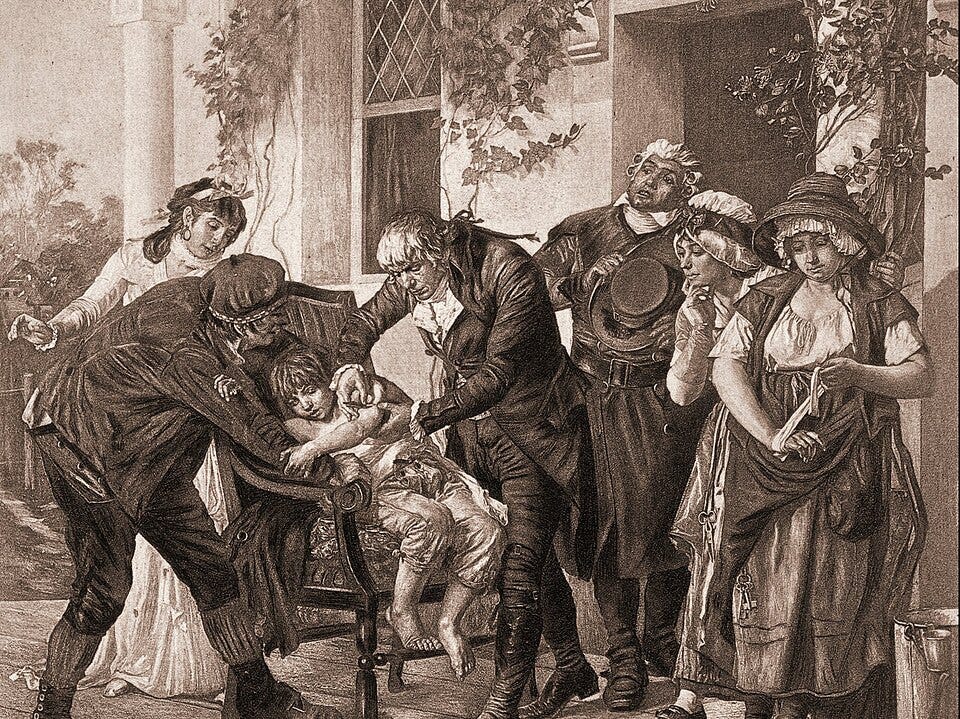
The boy developed mild smallpox symptoms about a week later, but this lasted no more than 24 hours. In July, Jenner repeated the procedure using matter from a fresh smallpox lesion, a dosage that should have infected anyone not immune to the disease. The result: nothing; no symptoms, no smallpox.
Subsequently, Phipps would be injected with the smallpox virus more than 20 times over the course of his life with no adverse reactions. In later years, Jenner provided a free residence for Phipps and his family on his estate. Phipps died in 1854 at age 66.
Jenner died at age 73 in 1823. His life is commemorated with statues at Gloucester Cathedral and Kensington Gardens in England.
The discovery of a preventative for smallpox was only the first step in the ultimate eradication of the disease. It would be the mid-1800s before Jenner’s discovery began to result in worldwide action to get large numbers of people vaccinated.
The invention of the hollow needle with a plunger to eject the fluid to inject vaccines, a major piece of the equation, did not come along until 1853. Its arrival eliminated the knife blade from the process. Also, communication between countries and across the ocean was slow, dependent on letters and travel. It took decades for new information to become widely known in distant places, something that now takes only moments.
Massachusetts became the first state to enact a compulsory smallpox vaccination law in 1809. But broad acceptance of such a law came slowly. The Massachusetts law finally was upheld by the U.S. Supreme Court in a landmark decision in 1905.
Smallpox was eradicated in the U.S. in 1949, and in the world by around 1980.
Samples of the virus have been kept for research, however, in laboratories in the U.S. and Russia.
Nothing to worry about in this day and age, don’t you think?
Arnold Garson, Second Thoughts is . . .
. . . part of the Iowa Writers’ Collaborative, which represents more than 60 professional writers with Iowa roots. My goal today was to provide an enjoyable, informative, or worthwhile reading experience – ideally, two or three of these things. Although my subject matter is widely varied in an increasingly specialized Substack world, I hope you may view this diversity as an added value that promotes thought about a wide range of issues. But I digress. This newsletter is free. Which makes me all the more appreciative of those who choose to purchase a paid subscription. I am deeply grateful for such entirely voluntary financial support. In response, I will contribute net proceeds to nonprofit organizations that promote freedom of speech or cover local news in the Midwest. As a paid subscriber, you are thus encouraging me to continue writing so that both of us may effect some overall good for our society. Best wishes and happy reading. You can subscribe or upgrade to paid with the button below.
Comments
Nothing yet. Say the first thing.
Sign in to join the conversation.