
The Berman family’s decision to relocate to Sioux City, Iowa, in 1912 might have been unlike any such family decision before it or after.
David and Clara Berman and their three children had emigrated from Odessa, Russia, settling first in the tiny, remote, and climatically inhospitable Ashley, North Dakota. Five years later, financially desperate and with one more child in tow, they relocated to Sioux City, Iowa.
The relocation decision was highly unusual in that it did not originate with David or Clara; it came from their third-born child, Davie, then 9 years old. He introduced the idea to his parents, and then sold them on it.
Sioux City, situated about 365 miles southeast of Ashley, North Dakota, had a lot going for it at this time. It was a sizeable, growing community with daily railroad service, riverboat access, and prospering businesses, especially its stockyards. Importantly, Davie noted, in presenting his idea, it also had one of the largest Jewish communities in the Midwest, which meant synagogues, rabbis, and, at age 13, bar mitzvahs for Davie and his younger brother, Chickie.
David and Clara were desperate, and thus, open to their son’s reasoning. The family literally was having trouble putting food on the table. Their two-room clay cabin – bedroom and kitchen – and all of their belongings had been destroyed in a fire. Their homesteaded farm was situated on relatively poor land. Davie, meanwhile, had heard from children at school that jobs selling newspapers on street corners in Sioux City were available to boys his age.
Davie was an unusual boy at age 9, with traits and characteristics that already were clearly visible. He was decisive, driven, fearless, and intelligent. He would become a loving husband and father – as well as a workaholic. Unfortunately, however, his moral compass was flawed; seriously flawed.
Davie Berman would be a candidate for the title of the biggest Mobster/gangster/thug Sioux City – and perhaps, Iowa – ever would produce.
He had gone to work selling newspapers in Sioux City almost immediately upon arrival. His mother awakened him every day at 4:30 a.m. to walk the 18 blocks from his home to the newspaper offices, where he bought papers for a penny each, and sold them for two cents or three for a nickel. On Saturday nights, he would sleep at the newspaper office so he would be the first boy on the streets with the Sunday paper.
Decades later, one of Davie’s Jewish classmates recalled, “All our families were poor, but the Bermans were poorer. He turned every cent over to his mother, and they needed it for food.”
During the summers, Davie ran concessions at local fairs around Iowa – Onawa, Mason City, Waverly, Toledo. On the hottest summer days, he would bring pillows to a park in Sioux City, line them up and sell resting spaces to the locals.
Once, when he and some other Jewish carrier boys were at a drugstore drinking sodas, two farm boys walked in and one of them pronounced, “For a penny, I’d kill a Jew.” Davie dropped a penny in front of the boy, who was much larger than he: “I’m a Jew. Take me on.”
Soon, both farm boys and the four Jewish boys were rolling on the floor, fighting viciously, kicking, biting. One of the Jewish boys had a chair broken over his head, and Davie got kicked in the stomach. Suddenly, Davie attacked the boy who had started the fight, and there was blood all over the floor. The farm boys ran out of the store. Davie flashed his knife for the other Jewish boys to see. “You’ve got to use what you have,” he told his friends.
Sioux City at this time had ties to Chicago. The Chicago Mob would retreat to Sioux City when the heat was on at home. Davie watched in awe as the Chicago gangsters, dressed in fancy clothes and driving large new cars, flashed rolls of large bills and set up gambling operations in the basement of a Sioux City hotel. By age 14, he had decided that gambling would become his life. Before long, he was running games and then rigging games with marked cards and tiny mirrors in the palms of his hands when he dealt, and loaded dice in crap games.
He made friends with the professional gamblers, becoming a torpedo, the guy they sent to work over someone who had not paid a debt. Expanding this work, he assembled a gang of tough Sioux City teenagers to do the dirty work for the professionals. Soon, the threat, “We’ll send Davie and his friends to see you,” was enough to get a debt settled.
Davie had his own apartment in Sioux City by the time he was 15; Prohibition had begun, and bootlegging became his game. He drove cars with hidden compartments beneath the trunks for transporting booze from illegal stills. At 16, he took over the illegal booze trade in Sioux City, running booze into town from more than 20 stills. Constantly growing and forcing even small competitors out of business, he ended up running the biggest bootleg operation in Iowa. He paid off politicians to stay out of his way.
Al Capone got word of Davie’s work and asked him to join the Capone operation in Chicago. Davie declined; he was determined to be his own boss, always.
Bootlegging soon led to a bigger criminal venture – armed robbery; banks, poker games, and post offices. He organized his own gang for this when he was 18. Targeting small towns near Sioux City, Davie would drive his big, black Cadillac into a town with one of his trusted gang members at his side. They would drive around until they spotted the town policeman – there always was just one of them. They parked and waited for the officer to approach, pleading car trouble. They captured the officer, bound him, and put him in the back of their car. On to the local bank, where they used a sledgehammer or crowbar to break in. They grabbed the money, and left the officer tied up inside as they sped out of town.
In 1922, Davie held up a poker game in Watertown, South Dakota. Two of his men arrived in advance and organized a game for local farmers, telling them to bring cash. With the game in progress, Davie and one of his men arrived, captured the town police officer, and robbed the locals who had come to play. The policeman soon got loose, however, and chased them as they fled town. Davie was captured and went to jail for the first time; eight months behind bars.
When he got out, he was a hero among his crowd in Sioux City for not having yielded to pressure to identify his accomplices. He also was ready to move on: bigger banks in bigger cities with bigger takes: LaPorte, Indiana, $180,000; Milwaukee, Wisconsin, $287,000; Superior, Wisconsin, $80,000 from the local post office.
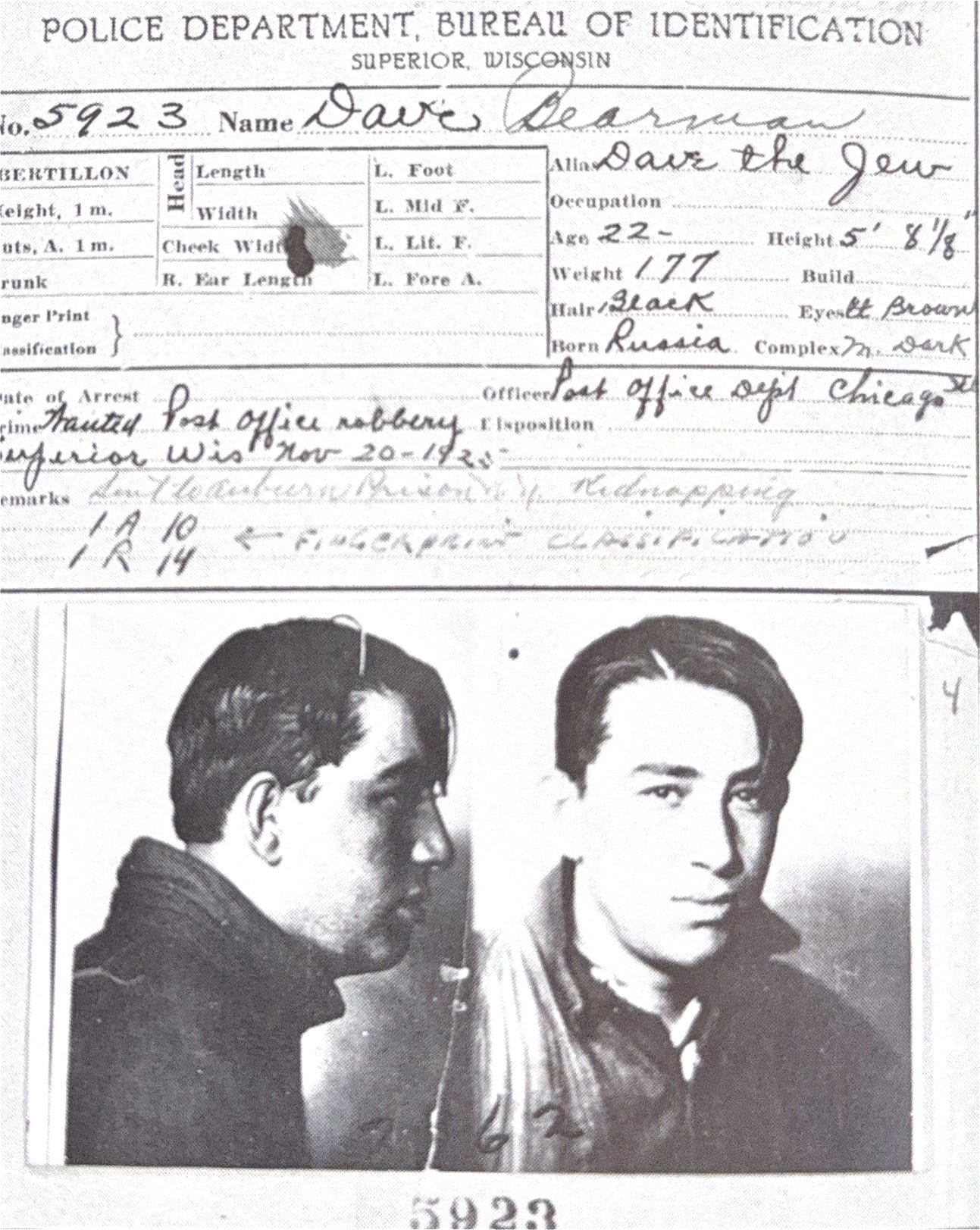
He soon was ready for even bigger-time locations and targets. From an FBI report: “[He] came to New York from Chicago, equipped with high-powered automobiles, a liveried chauffeur, death-dealing machine guns, hand grenades and tear bombs with the purpose of kidnapping wealthy men engaged in illicit activities who would not readily complain to the police.”
In May 1927, an attempt to kidnap a bootlegger for ransom went bad. Davie and his partner were trailed by New York police into Central Park, where a shoot-out ensued. The partner was shot dead by police, and Davie was arrested. He ultimately served seven and one-half years of a 12-year sentence at Sing Sing, refusing to name any of his accomplices or mob bosses, despite endless questioning – 72 hours straight at one point.
His early release stemmed from a successful effort to befriend and impress the warden. The warden personally asked the Parole Board to free Davie, citing his exemplary behavior, high I.Q., and “total rehabilitation.”
The mob bosses rewarded Davie for his silence. They took him to an office in Midtown Manhattan where a large safe was opened for him to gaze at $1 million in cash. Told that he could take all or part of it, he declined. Instead, he asked for “Minneapolis” – the authority to run all illegal gambling operations in the Twin Cities.
It was 1934 in the midst of the Depression. With Las Vegas not much more than a tiny, new town, Minneapolis-St. Paul was the de facto capital of illegal gambling in America. Local politicians and law enforcement were on the take and stood aside as the speakeasies and illegal gaming rooms – and their operators – prospered.
Upon arrival, Davie opened numerous new gaming rooms and bookmaking locations. It was a gambling empire, so lucrative that Al Capone showed up one day in an apparent attempt to seize control from Davie, by murder if necessary. Davie left his gun behind when he went to meet Capone. He spent five hours with him and returned to his men, telling them only, “I told them to keep their greaseballs out of my town.” The next day, Capone made it known that he would retreat from the Cities, but added that if Davie ever showed up in Chicago, he would be a dead man.
World War II was a timeout from gambling for Davie. Rejected for service in the U.S. for reasons of age and felony convictions, he enlisted in Canada and almost died at Anzio in Italy, where he was one of three survivors in his unit – albeit with serious injuries that kept him hospitalized for months.
He was back at work in Minneapolis in 1944, as Hubert Humphrey was elected Mayor of Minneapolis and began closing down the illegal clubs and gambling operations. Davie’s interests quickly shifted to Las Vegas. It was the only place in the U.S. where gambling was legal, and was rapidly becoming a gambling colossus.
Davie had first visited Las Vegas in 1940 with Mobster Bugsy Siegel. They loved what they saw. Among other things, the casinos held promise of being the perfect way to launder money from illegal activities.
And so, after 20 years in Minneapolis, Davie set out for Las Vegas with $1 million in cash in his suitcase. He would join hands with a Mob group that included Meyer Lansky, Frank Costello, and Lucky Luciano in literally running the city.
He made a deal to acquire and operate the El Cortez downtown and would soon acquire ownership or significant holdings in several more hotel/casinos.
In 1947, following the gangland murder of Siegel at his home in Beverly Hills, Davie and two other Mobsters walked into the hotel/casino Siegel had built and opened six months earlier, the famed Flamingo, and announced that they were taking control. The murder of Siegel, who was widely disliked among the Mob, never was solved.
Davie was at the height of his career. He went to the counting room three times a day, seven days a week, to tally the money – enough to make himself and a bunch of his Mobster friends wealthy beyond anything they had imagined.
In 1955, he moved to the relatively new Riviera Hotel, the first high-rise in Vegas, which had lost millions of dollars in its initial months of operation. From his position as owner and manager, Davie soon turned it around and made it his most profitable venture yet.
One of his hallmarks as a hotel operator was his compassion for the biggest losers. Those who had lost everything they had brought to Vegas would receive a $100 bill from Davie (the equivalent of more than $1,300 today). Then, they would find an anonymous large basket of food at their door – enough to feed a family for a week.
He also never forgot his roots in Sioux City. He would organize junkets to bring his long-time friends to his hotel. He kept track of each one and if they lost money, how much. When they checked out to go home, Davie presented each of the losers a check from the hotel to cover their losses and his instructions for how the money was to be used: “Spend it on your family.”
In the end, Davie Berman was a portrait in complicated contradictions – a sometimes vicious Mobster with a heart, a religious Jew who eschewed his religion’s reverence for life, a patriotic American and decorated war hero who disregarded the laws of his country.
He died in 1957 at age 53, of a heart attack the day after major surgery in Las Vegas.
This story is based on newspaper articles and, especially, information in the 1981 book, Easy Street, The True Story of a Mob Family, by Susan Berman, the daughter and only child of Davie Berman and his wife, Gladys. Gladys Berman died two years after her husband from an overdose of barbiturates; it might have been a suicide, or it could have been a mob hit. Susan Berman died in 2000 at age 55 from a single gunshot to the back of her head at her home in Beverly Hills. A long-time acquaintance and likely serial killer was convicted of the murder in 2021.
. . . part of the Iowa Writers’ Collaborative, which represents more than 60 professional writers with Iowa roots. My goal today was to provide an enjoyable, informative, or worthwhile reading experience – ideally, two or three of these things. Although my subject matter is widely varied in an increasingly specialized Substack world, I hope you may view this diversity as an added value that promotes thought about a wide range of issues. But I digress. This newsletter is free. Which makes me all the more appreciative of those who choose to purchase a paid subscription. I am deeply grateful for such entirely voluntary financial support. In response, I will contribute net proceeds to nonprofit organizations that promote freedom of speech or cover local news in the Midwest. As a paid subscriber, you are thus encouraging me to continue writing so that both of us may effect some overall good for our society. Best wishes and happy reading. You can subscribe or upgrade to paid with the button below.
No posts
Comments
Nothing yet. Say the first thing.
Sign in to join the conversation.