
Our son, Scott Garson, grabbed my attention with a recent note he sent to my iPhone: “Content warning for this one. Not very easy to write, maybe not easy to read.”
The note included a link to a new short story he had written, and he was definitely right about his content warning. Not an easy read at all.
The title alone might have warned me: Self-Portrait with Death.
Scott is a professional writer and teacher. He teaches writing in the English department at the University of Missouri and is the founder of Wigleaf, an award-winning website devoted to short fiction, which he also edits. He is the author of two books containing with a third on the way.
I have been reading his work for years, but everything about this story was unexpected: the subject matter, the power with which it hit me, the shift from his usual genre, fiction, to nonfiction.
The story was published recently at matchbooklitmag.com, which presents only a single original work — on its home page — every two weeks. The Author’s Note at the end is a standing feature at Matchbook; its authors are asked to write such notes about the origin of their story or some other literary topic.
Self-Portrait with Death
by Scott Garson
I’m four.
My brother, Chris, is about two.
We kneel at the foot of the carpeted stairs, stuck inside our waiting.
“What is it?” my little brother asks.
We’ve come to the foot of the stairs — and no further — because of a thing we’ve heard: our mother, screaming.
She isn’t screaming anymore. It’s quiet. We look to the second-floor landing, which seems full of nothing at all.
“What is it?” my brother asks again.
The answer, I realize, is here for me.
I tell him, “The baby died.”
We wait for our mother to come to us. Instead, the door behind us swings, and large men rush up the stairs.
I’m eight.
I’ve come awake in the dark, heartbeat wild in my throat.
In these nightmares, nothing happens, exactly. It’s more like things stop happening. This is a sign: at vision’s periphery, an orange glow will have appeared.
“The orange light,” I let my parents know.
They want to be understanding, but they’re confused. I’m at a loss to explain what terrified me in the dream.
Later — years later — I’ll try again.
I’ll be working on fiction, thinking about applying to graduate school. One of my stories will have to do with the dreams, the orange light. Though evocative, it will be bad.
The story of a kid with nightmares isn’t much of a story, it turns out. The story of a kid who’s stalked in his head doesn’t move, doesn’t offer much arc.
I’m fifteen.
I smoke pot with my friend and two older boys in a theater parking lot. We’re going to the midnight movie.
One of the older boys is named B—. In less than a month, he’ll steal his dad’s car, along with several credit cards. He’ll be caught. In jail, he’ll hang himself.
News of this will pass in the halls of our school in undertones.
He had a slight build, this kid. A sweet, live smile. Nothing would have marked him for the thing that was going to happen to him. No one could have told him from us in the dark, theater seats.
I’m thirteen.
I deliver the Sunday paper, pulling a wagon in pre-dawn freeze. At this hour, there’s nothing much to hear: the wheels of the wagon scritching in ice, my boot soles squeaking in snow.
When a car takes the corner and doesn’t pass, lights coming up right behind me, I don’t turn. I don’t pause or deliberate. I run. I drop the wagon handle and make for the nearest back yard.
Two years later, another kid with a Sunday route will disappear. In our city, we’ll learn this kid’s name. If I don’t have the thought, It could have been me, that’s because I have never not had it.
I’m forty-six.
My sister calls. She tells me that our brother, Chris, has died.
In words, that information passes quickly. Noun. Verb.
“What,” I say.
I keep saying that — shouting it, I guess.
In grief, inside of which we are from now on going to be living, we’ll share and confide things. One observation: it was there — in his songs, in his writing.
In a poem he wrote when he was in school, the speaker’s landlady tells him he is not as smart as he thinks he is. She points at him from behind the screen door — a room where a smoking cigarette once burned down in the hand of a dead man.
I’m twelve.
My Grandpa, my father’s dad, leads me into a department store. He used to be a shoe man. He’s buying me shoes.
Somewhere near the store for homes, he stops walking. He doesn’t move.
As well as I can, I hold him when his shoulder starts to sag.
Some days later, my Grandpa dies.
I follow my father into the yard of the house his parents have rented. It’s nighttime, dark.
My dad does something he’s never done, or something I’ve never seen. He gasps, as people do when they are not in control of their bodies. He cries out.
Because I want to be with him, I speed-climb to the top of the tree that shades that yard in daytime. This is dramatic. I worry about that, in the tree. But also, I feel like we are correct. I feel we’re positioned accurately, and everyone else in the world is either lost or sort of faking.
Author’s Note
One day a week, in the late afternoon/early evening, I meet up with some other writers in a coffee shop to write for a couple hours. The circumstances are un-ideal: I’m maybe tired, and my head is full of work stuff, and there’s music playing, with lyrics and beats that can interfere with my sentences. But there’s an upside: when things aren’t perfect, I seem more able to give my insistence on perfection the slip. I just write. We all do. There’s good energy.
I started drafting “Self-Portrait with Death” in the middle of one of these sessions. I’d finished one thing, and I needed to start something else. There was no plan. But it didn’t come out of nowhere, for sure. I spent years not writing this one.
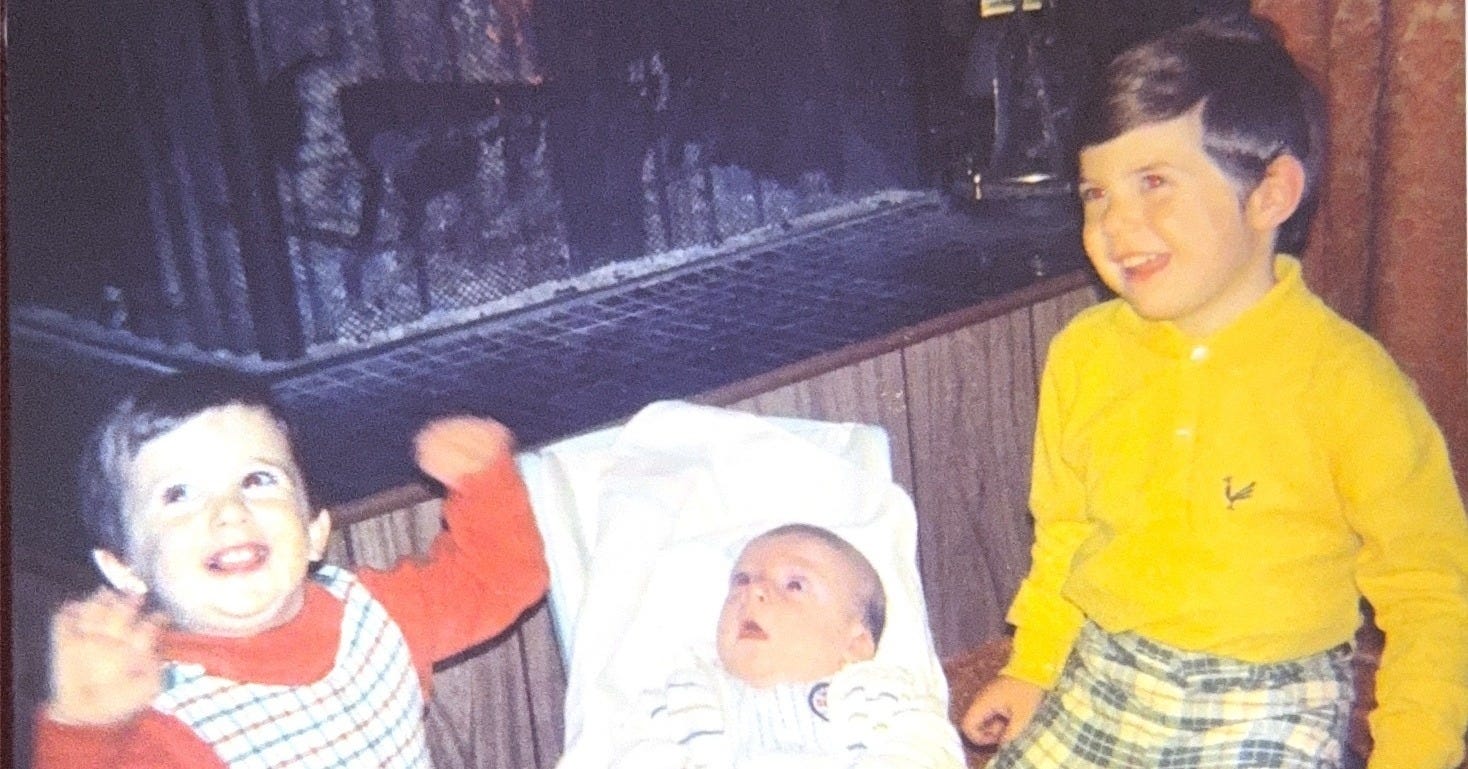
Scott Garson is the author of STORIES OF LIFE AND DEATH, a book that is forthcoming from Cornerstone Press.
Thank you for reading Arnold Garson: Second Thoughts . . .
. . . a part of the Iowa Writers’ Collaborative, which represents more than 60 professional writers with Iowa roots. My goal today was to provide an enjoyable, informative, or worthwhile reading experience – ideally, two or three of these things. Although my subject matter is widely varied in an increasingly specialized Substack world, I hope you may view this diversity as added value that promotes thought. But I digress. This newsletter is free. Which makes me all the more appreciative of those who choose to contribute. I am deeply grateful for such entirely voluntary financial support. In response, I will contribute net proceeds to nonprofit organizations that promote freedom of speech or cover local news in the Midwest. As a paid subscriber, you are thus encouraging me to continue writing so that both of us may effect some overall good for our society. Best wishes and happy reading. You can subscribe or upgrade to paid with the button below.
Comments
Nothing yet. Say the first thing.
Sign in to join the conversation.