
This is an Okoboji story about family, togetherness, and making memories. However, it also is a story about crime and violent death, and how the ugliness of life shaped the wonderful Okoboji summers our family has enjoyed for six generations.
The current generation of young people in our family, now in their teens and early 20s, have spent portions of every summer of their lives at their family cottage at Okoboji. Family members travel from Nebraska, South Dakota, Missouri, and California, as well as Iowa, to experience the joy of togetherness at Okoboji.
Overall, the story spans three centuries, beginning in the late 1800s; we will go back to the beginning shortly.
First, however, comes the introduction of our present summer residence, Clairdell Cottage on West Lake, which has been a fixture in my wife’s immediate family since it was built 95 years ago; more about the name also to come later.
The cottage is situated on Fairoaks Beach, a stretch of land between Pike’s Point State Park on the north and Hayward’s Bay on the south. My wife’s paternal grandparents, from Omaha, hired a contractor from Dunlap, Iowa, to build it. He hauled the construction materials from Dunlap to Okoboji by horse and wagon, a trip that would have taken around five days with the kind of loads being hauled. The cost of construction was $12,000; a tidy sum in the midst of the Depression, but, undoubtedly, the best investment Lynne’s grandparents ever made.
The cottage today is filled with family, lake memories, and memorabilia. It still has many of its original furnishings and its original footprint. The kitchen and bathrooms have been updated and enlarged, screened porches have been enclosed, and air conditioning has been added, but the goal has been to keep as much of the original cottage in place as possible.
Lynne’s great-grandfather, Abraham Daughenbaugh, was the first in her family line to visit Okoboji and to acquire a cottage there.
Abraham was a Gowrie, Iowa, banker, real estate investor, and general store operator, who acquired a farm just north of Spirit Lake, Iowa, in 1899. He purchased the 160-acre property for $1,856, the Spirit Lake Beacon reported. Abraham was known to be a bargain-hunter in his real estate investments, but it is virtually certain that this one turned out to be a bargain that ran well beyond anything he could have expected. The price was $11.60 an acre, the equivalent of $456 an acre in today’s money. Except that farmland has appreciated at a significantly greater level than the cost of living. Dickinson County farmland today sells for as much as $15,000 an acre. Too bad it is no longer in the family.
In any case, Abraham would visit the farm several times each year to keep track of things, and he became familiar with what the lakes area had to offer as a summer resort. He liked what he saw.
At this point in the story, we need to go back a few years earlier and introduce William Gilley, a Carroll, Iowa, farmer, businessman, and civic leader, who began spending summers at Okoboji in the mid-1890s. It was a two-day trip by horse and wagon with a relatively light load – worth the time, he felt, because of West Okoboji’s breezes and location, more than 100 miles north of Carroll. This provided relief from the summer heat at a time before air-conditioning existed; a rule of thumb being that temperatures are about 10 degrees cooler for every 100 miles traveled, south to north.
In 1894, Gilley purchased a stretch of lakeshore property at the south end of West Okoboji, a bit north of the bridge. He laid out the land in residential lots, about 50 feet of lakeshore each, and named the stretch of land for himself; Gilley’s Beach. It was just around the corner from the amusement park and Pillsbury Point. Gilley built a cottage there for his family and then set out to sell the rest of the lots to his friends and business associates in Carroll.
Meanwhile, William L. Culbertson, a Pennsylvania native and Civil War veteran, had come to Carroll County after the war in 1869, at age 25. He farmed for a couple of years and began a career in local politics as county auditor, then county treasurer. He moved to the city of Carroll and married a local girl, Ruth Olivia Johnson. In 1876, he purchased a small bank and was joined in operating it by two other investors. In 1895, the three men purchased the larger First National Bank of Carroll, merged it with their smaller bank, and soon had the largest bank in town. A year later, William Gilley sold lots on his beach on West Lake Okoboji to Culbertson and each of his two partners.
The Culbertson property at Okoboji was toward the north end of Gilley’s Beach, a 50-foot lot, but with 65 feet of lakeshore because the lake cuts a diagonal line across the front of the lot. The Spirit Lake Beacon described the new Culbertson cottage on June 25, 1897, as “a fine cottage at Gilley’s Beach. It is of good size, well planned, and well-constructed.”
Culbertson would continue his career in public service in Carroll, on the County Board of Supervisors, in the State Legislature, on the School Board, and on the City Council for 20 years. He lived in one of the finest homes in town and was regarded as one of the wealthiest men in Carroll. He was active in the Republican Party, and political insiders discussed him as an attractive candidate for governor in 1900, though he did not run.
Then, at 6:40 a.m. on Monday, October 19, 1908, likely following a restless night in bed at his home in Carroll, he told his wife that he was not feeling well, and walked down the second-floor hall to the bathroom. He picked up the pistol he had hidden there the night before. He looked in the mirror and put the barrel to his right temple.
His wife found his body on the floor minutes later. He was 64.
It was a Page 1 story in newspapers across Iowa. The word embezzlement was not used. But phrases like financial worry, land speculation, and using the bank’s funds, left no doubt about what had happened. Bank examiners moved in the same day. They closed the bank, and it never reopened. After a two-year investigation, the bank had paid out 30 cents on the dollar to its depositors — who had trusted the bank with $400,000 of their money, the equivalent of $14.5 million today.
Culbertson’s widow, Ruth, relocated with her unmarried adult daughter, Mary, who had worked at the bank with her father, to a town of 250 people in north central Wyoming. It was, essentially, the middle of nowhere, presumably so they could get away from their familial embarrassment in Carroll. There was not a city of more than about 10,000 population within 400 miles. Conveniently and almost certainly not coincidentally, however, there was a Culbertson family member already residing there.
Abraham Daughenbaugh would have read about all of this in Iowa newspapers. He also would have known Culbertson through banking circles – the banks they each owned were less than 60 miles apart – and the Republican Party, in which they both were active.
Eight months after Culbertson’s suicide, on June 24, 1909, Ruth Culbertson signed over the Okoboji cottage she had inherited from her husband to my wife’s great-grandfather, Abraham Daughenbaugh, who by this time, had taken residency with his family in Des Moines.
The price was $1,600, undeniably a bargain. The purchase included the cottage, which was about 12 years old, its furnishings, one rowboat, an undivided half-interest in a boathouse, and a stable with room for a carriage and two horses. There were similar Okoboji lakeshore cottages offered for sale in The Des Moines Register around this time at prices in the range of $4,000 to $5,000.
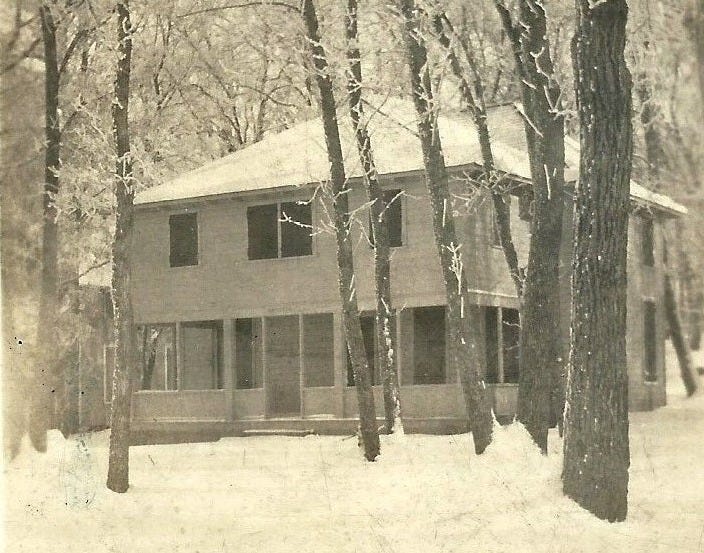
In any event, the Daughenbaugh acquisition of the Culbertson cottage, 117 years ago, marked the beginning of the multi-generational run for our family.
Abraham Daughenbaugh died a year later at age 66. One day before he died, he met with a notary public at his home on Grand Avenue in Des Moines, where Dunn’s Chapel and Iles Funeral Home are located today. He signed papers transferring ownership of the Okoboji cottage to his wife for “$1 and love and affection.” Clearly, he wanted his wife, five children, and three grandchildren – one more would arrive a few years later – to have time to build the memories and create a sense of togetherness that a summer lake cottage can provide.
Over time, the cottage on Gilley’s Beach would be renovated and updated. Abraham’s descendants continued to own it and spend summers there until 2014, when it was sold.
In the summer of 1931, the youngest Daughenbaugh grandchild, Grace Staves, also from Des Moines, was spending the summer at this cottage with her sister and mother. Across the lake and toward the north end, Clair and Adel Baird of Omaha had moved into their new, recently completed summer cottage near the south end of Fairoaks Beach. Their son, William Baird, in college at the time, and his three sisters began spending their summers at the cottage as well.
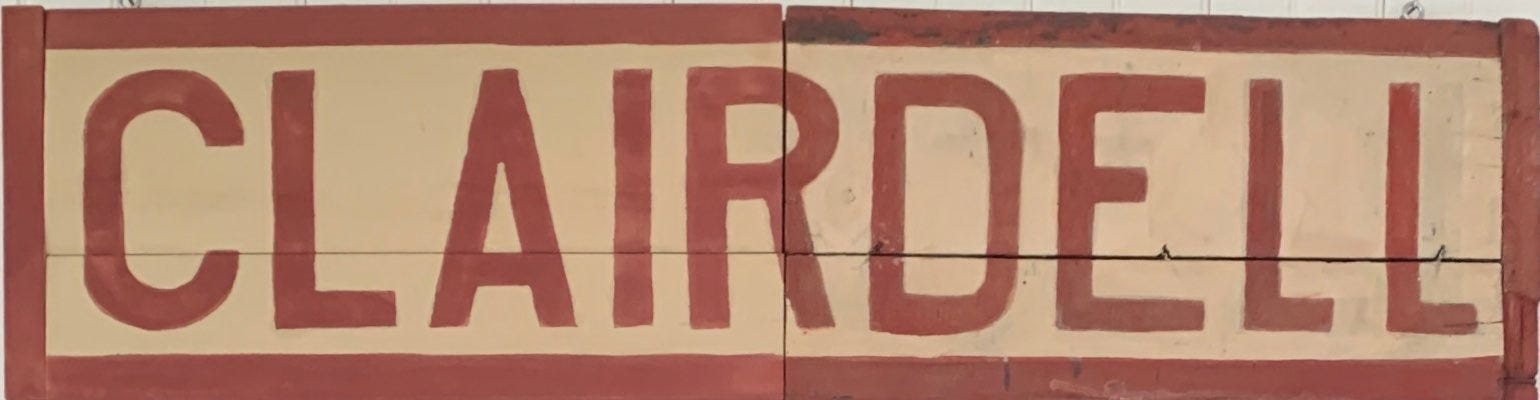
Side story about cottage names: Until sometime after World War II, cottage names were common at Okoboji. The name Clairdell was a conflation of Clair’s and Adele’s given names. Similarly, the Daughenbaugh cottage on Gilley’s Beach eventually was named Graetta, a conflation of the given names of the two daughters — Grace and Henrietta — whose parents were the second-generation owners of the cottage. At Clairdell, the sign that once hung on the front of the cottage was removed and thrown into storage, probably in the 1950s. A half-century later, in the early 2000s, a portion of it was found, rebuilt, and restored. It hangs today in the enclosed porch area of the cottage.
On Saturday nights during the first half of the 20th century, young people of the Lakes area routinely gathered at one of the several Okoboji area dance halls. There were five or six of them, including the Central Pavilion in a building now known as the Central Emporium on West Lake in Arnold’s Park. At one of the Saturday night dances at this location in the summer of 1931, William Baird met Grace Staves. They were attracted to each other immediately and were married in 1935.
Ultimately, the Daughenbaugh cottage on Gilley’s Beach would become the property of Grace’s sister, Jane Staves Clements. The Baird cottage on Fairoaks Beach would become William and Grace Baird’s summer home in 1949. Lynne, her brother, and her sister would move from Gilley’s Beach to Fairoaks Beach with their parents that summer. Lynne is now the senior descendant of Abraham Daughenbaugh in the family line that connects with Clairdell cottage.
I, too, spent time at Okoboji each summer while I was growing up, although the experience was much different from Lynne’s. Our extended family spent two weeks each summer at Gerk’s Resort at the far north end of West Lake. But this story also, oddly, begins with a violent death; story to come.
My father, a widower from the time I was 8 months old, remarried in the summer of 1943, when I was 2. It was a time of war and gasoline shortages. My parents, from Lincoln, needed to find a honeymoon location to which they could travel by bus or train. They never had been to Okoboji, but word-of-mouth made it sound attactive. They stayed at Fillenwarth’s Resort. When the bus dropped them on the roadside at Fillenwarth’s, around midnight, they were met by A. T. Fillenwarth, the owner, in his nightshirt and nightcap.
They had such a good time that they persuaded other family members — my aunts, uncles, and cousins — to join them at Okoboji every year after that. The men of the family all scheduled their two-week summer vacations at the same time each year, and the group continued to grow as marriages and the next generation came along. I was 3 when my parents introduced me to Okoboji in 1944.
From the beginning, however, the family was in search of a lakeshore resort that felt right for them and their needs. They tried three different resorts the first three years. Each of them seemed to have drawbacks. I am told, for example, that one year I had to share my crib with a bucket — to catch the rainwater as it came in through the roof of the small cottage.
Then, in 1946, they discovered Gerk’s Resort at the north end of West Lake, a string of maybe 20 individual lakeshore cottages that constituted a summer vacation resort with amenities ranging from boats and docks to outdoor ping pong and horseback riding. Once a week, Gerk Jansen, the owner, made popcorn and held a big yard party for all the guests. Our extended family loved the location and amenities. There also was an attractive side benefit: They established a close relationship with Gerk, and his wife, Vera, and looked forward to seeing them each summer.
Gerk Jansen had been a barber in Sac City, Iowa, in the mid-1940s, when he heard about an Okoboji lakeshore resort that was for sale at a bargain price. The owners had been Rob Raebel and his wife, Esther, who operated Reabels’ Resort during the summer, but lived there year-round in a house isolated among the vacant rental cottages during the off-season.
On the evening of December 15, 1944, they sat in their home after dinner and signed Christmas cards at the kitchen table. Two men had sneaked onto the property, entered one of the vacant summer cottages, and watched the Raebels through the windows from a short distance. The men, a father and son, were both career criminals. They had worked for the Raebels the previous summer.
Suddenly, they invaded the Raebel home. The son shot Rob Raebel, 63, in the chest; then the father and son took turns clubbing Rob to death. Esther, also 63, was severely beaten — attempted murder would be a more accurate description. The attackers fled in the Raebel’s car, thinking Esther was dead. Their take from the bloody assault was a mere $28, the cash in Esther’s purse.
The case has been eerily compared to the classic nonfiction book In Cold Blood by Truman Capote, the story of two men who invaded the home of the Clutter family in Holcomb, Kansas, in 1959. The men murdered the parents and two teenage children. As in the Raebel case, the perpetrators believed there was a lot of cash in the house, but they found less than $50.
Esther Raebel survived and identified the attackers, who were convicted and hanged simultaneously at the Iowa State Penitentiary in Fort Madison in March 1946 — the only father and son ever to receive capital punishment together in Iowa and possibly in the U.S.
The Raebel property went on the market, but the gruesome history seriously depressed its price. Gerk and Vera decided to become resort operators. They moved into the Raebel residence with their two daughters.
Our family’s first visit to Gerks was four months after the execution of the father and son who murdered Rob Raebel. My last visit to Gerk’s with my parents was in the summer of 1960. The following year, I met Lynne on a blind date at the University of Nebraska in Lincoln. Our first visit together to her family cottage on Fairoaks Beach was in the summer of 1964, shortly before we were married. Two years later, in July 1966, Lynne and I called my parents at Gerk’s to report that they had become grandparents.
Gerk’s, of course, was sold years ago and redeveloped as single-family residences and condos. The elder Jansen daughter, Vergie, operated Vergie’s South Side Resort on the south shore of Spirit Lake in later years.
The condos were among the earliest on West Lake. The craze has grown in recent years and seems as though it may be running out of control today.
Note: This is a revised and expanded version of a story that first appeared on Substack about two years ago. It is the most-read of the 100+ newsletters I have written as a member of the Iowa Writers’ Collaborative.
Thank you for reading Arnold Garson: Second Thoughts . . .
. . . a part of the Iowa Writers’ Collaborative, which represents more than 60 professional writers with Iowa roots. My goal today was to provide an enjoyable, informative, or worthwhile reading experience – ideally, two or three of these things. Although my subject matter is widely varied in an increasingly specialized Substack world, I hope you may view this diversity as added value that promotes thought. But I digress. This newsletter is and will remain free. Which makes me all the more appreciative of those who choose to contribute. I am deeply grateful for such entirely voluntary support. In response, I will give all net proceeds to nonprofit organizations that promote freedom of speech or cover local news in the Midwest. As a paid subscriber, you are thus encouraging me to continue writing so that both of us may effect some overall good for our society. Best wishes and happy reading.
Comments
Nothing yet. Say the first thing.
Sign in to join the conversation.