

I’ll be frank — it’s been a grueling couple of weeks weather-wise and work-wise, so this is going to be a light issue. I haven’t had two brain cells to rub together and don’t have the energy. My “after the heat-wave” week in France is still 30+ C, due to where I live (Rhône river valley), which sucks. And it’s another bad week next week, it looks like. I spend a lot of time looking at apartments in cooler places where I could work, both in France and elsewhere in Europe. There are a lot of downsides to heat that aren’t just discomfort and trouble sleeping — it’s harder to think, all tempers are shorter, you stay inside in the dark with the shutters closed, you don’t exercise enough, etc. The effects kind of pile up!
Last issue was a banger of news and code and demos, so you should subscribe and read that!
TOC:
AI Creativity (Image Gen, Video, 3D / Three.js)
AI Creativity
Image Gen
Just a couple of interesting things, to me…
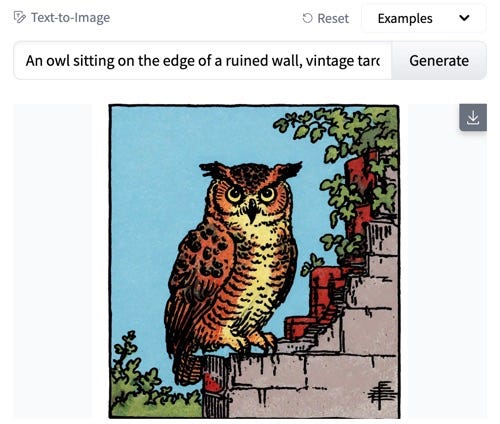
The Krea 2 release stack: Krea dropped a full set of useful stuff — Krea-2-Raw (the base model, for fine-tuning with LoRAs), Krea-2-LoRA-vintagetarot (a vintage tarot LoRA as an example among a bunch of other tuned LoRAs), and the Krea 2 Technical Report. Meanwhile, this guy on X claims to have trained 999 LoRAs with the Fal Krea 2 trainer. He has a video loop that goes too fast to appreciate them, really (“That's 999 unique Style LoRAs, each trained for just 100 steps at 0.00035 LR, taking an average of ~30 seconds to train.”)
Two geekier items:
Porting the Moebius 0.2B image inpainting model to run in the browser with Claude Code — Simon Willison on Moebius, a small but effective inpainting model where you mark regions of an image
Xianbang Wang — minimal t2i — A minimal text-to-image code writeup that makes me want to try it from scratch.
AI Video
Just a few links to some recent contest winning AI videos, to check the most recent skills out there:
A Face Only A Mother Could Love — a short film by Robert Gaudette (Runway Contest grand prize winner) — and the Hollywood Reporter piece on the making of, by an unknown who couldn’t sell screenplays. I think it’s a good short story in a kind of Wes Anderson vibe, with remarkable character consistency, although a few of the B-roll clips are a bit trite with their AI gen style.
WINTERS LAMENT (AI London Film Festival winner) — noted it’s “most-realistic”.
The RealReal — Celebrating the “real” in today’s world (snerk) of advertising and self-actualizing. Just keep watching. A Cannes Lions winner of a Silver Lion in Film, a Bronze Lion in Film Craft AI, and more. (h/t Tom Granger).
Costa Verde, Winner of Cannes World AI Film contest and Best AI Fantasy film.
3D and Three.js
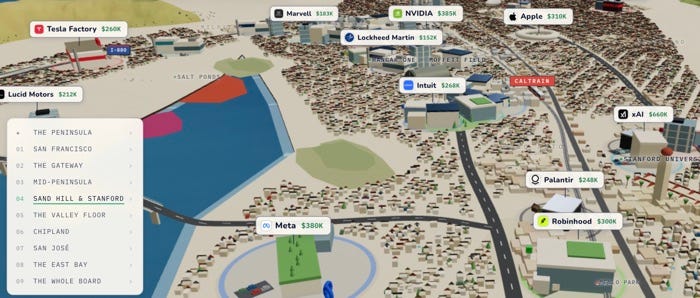
The Peninsula — a living atlas of Silicon Valley (Levels.fyi). Kind of like the opening to Silicon Valley the TV show except interactive. I didn’t realize xAI and Tesla were next door to Stanford, urgh.
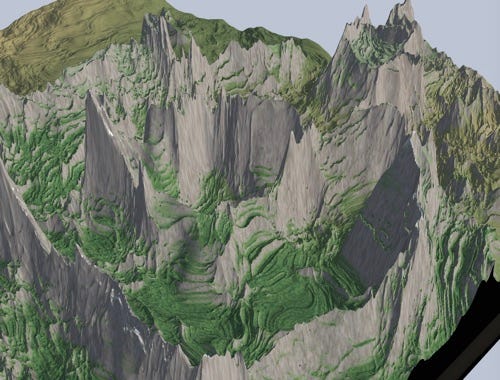
Terrain Studio — Procedural Terrain Generator — A procedural terrain generator in three.js; I will never not love these? Every procgen world is full of stories waiting to be written over it, or found. Whether AI helped (this isn’t) or not.
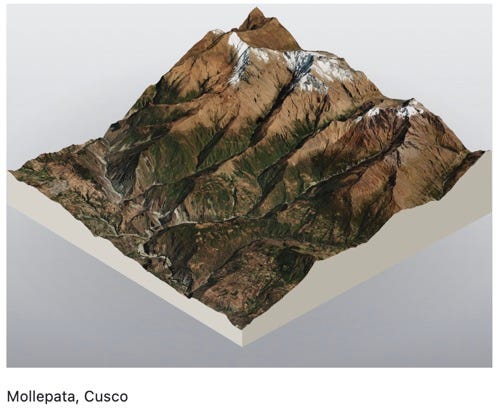
Also this one, more small worldy - Little Landscapes.
Then there’s a cool Infinite Diffusion project that does it with AI — code available, and includes a Minecraft mod to make Minecraft worlds! (Hi, nephew!) The gallery images look really nice.

More deets: “Terrain Diffusion is the first learned procedural terrain generator. I introduced a technique that enables diffusion models to generate outputs spanning massive dynamic ranges, from -10000m in the Mariana trench to nearly 9000m at Mt Everest, all in one world.” And… on the game engine side:
It's functionally stateless, trivially integrates into any game engine, and has almost no practical limitations. To demonstrate this, it was shipped as an open-source Minecraft mod with no external dependencies. Worlds can be shared by seed, players can teleport millions of miles instantly, and it runs in multiplayer. It is also demonstrated in Unity, where the player is able to comfortably fly around the world at 3 times orbital velocity on consumer hardware.
minimaps — Create 3D minimap pucks of areas up to 30km wide from the world map. This is cute but really needs big terrain diffs to be cool as a slice.
OpenGeometry — A CAD kernel for the web (three.js). I’m enjoying watching people make CAD room layouts turn into 3D. Go javascript.
Web Fun / Misc
IN THE WEIGHTS — also much shared, if you have any web presence, check what various models think about you. Snicker. The hallucinations are best, but if you’re like me with a long history online, it’s interesting seeing who has old info and who is more up to date.
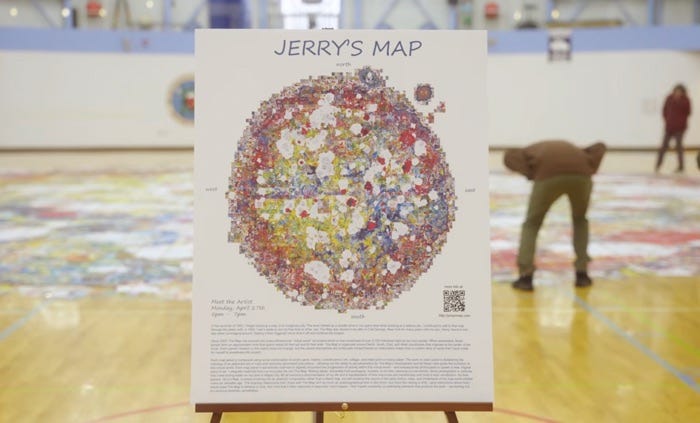
He Won’t Stop Building a Map to an Imaginary Place by People Make Games (so it’s a video) — The story of Jerry Gretzinger (wikipedia, calling him a “folk artist”) and the map he’s been making and modifying his whole life. Jerry uses random card draws to figure out what he’s going to work on, and fills things in… partly with collage cutouts including pieces of real maps. So the process has a procedural generation component, too.
Heikki’s Garden of Flowers (via Waxy) — An archive of letterpress art - “a comprehensive catalogue of historical and contemporary pictorial letterpress works” with 2500 entries as of 2026, plus a lot of filters in the sidebar (a la 1980ies geocities web design). These are the precurors to ASCII art, basically, in manuscripts.

Wiki Spy — A Wikimedia public-domain image search toy from neal.fun, who did amazing image segmentation and layout algorithm. It’s fast, too.

Where to Find the Colors Your Screen Can’t Show You (by Ryan Moulton) — I worked on color management UI at Adobe. A job for which I learned a lot, and this piece gives me a little bit of PTSD even before going in. But Ryan’s deep dives deliver and I learned some things about birds in particular that were wonderful. I also appreciated the reminder to look away from the screen to the world of nature.
Firewood Splitting Simulator (via Justine Moore) - a very simple game, but it is indeed oddly satisfying.
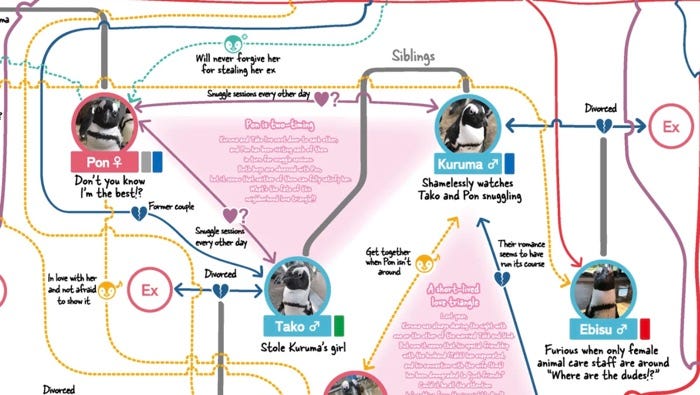
Japanese Aquarium Drops 2026 Version of Its Penguin Relationship Flowchart (via Clive Thompson) — And this year there’s an English version. Animal social networks are so much fun.
An entire Herculaneum scroll has been read for the first time (Vesuvius Challenge) — Finally! Well, pretty much magical.
Searchable NPS Maps Collection (U.S. National Park Service, via Evan Applegate) — the Adobe illustrator files can be downloaded for National Parks maps, which means you can learn a ton about cartography from how they are made.
Radiant — Open Source Shaders & Effects — 130+ production-ready shaders and visual effects for the web. No dependencies. Just drop in.
Games
Much shared — If LLMs Have Human-Like Attributes, Then So Does Age of Empires II. And the substack post about it. “For this we build and train a simple neural network on the videogame Age of Empires II, and note that any entity in a sufficiently-powerful substrate, such as LEGO or the Greater Boston Area, could also present such attributes.” And the blog top liner: “Assuming human-like attributes and measuring them is only measuring the representation.” So, a philosophy exercise.
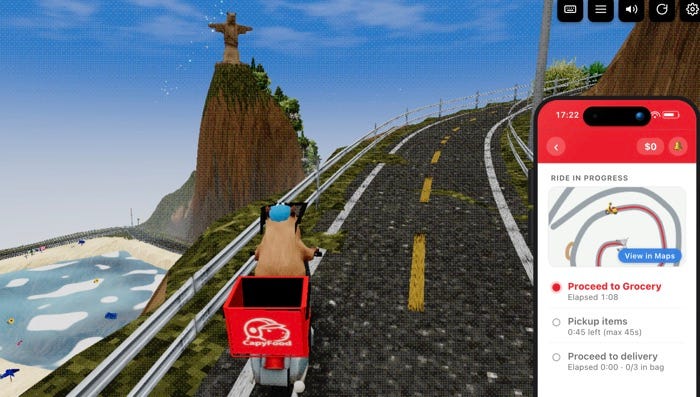
Capybara Delivery — Winner of X #vibejam 2026. Dayum. I haven’t played a lot of it (driving is hard without a controller), but I was immediately struck by how it felt like desktop games I’ve played — you’re a Capybara delivering food in a 3d Rio full of capys.
Play Quake in Your Browser (cssQuake) (via Waxy) — “renders the game as inspectable HTML and CSS powered by PolyCSS.” Everyone is doing quake and Doom in the browser!
Also web hl2 (via Matt Muir) — Half-Life 2 in the browser.
Game 579: Multi-User Dungeon (1978) (via Critical Distance) — From CRPG Addict, a blog playing through all PC role playing games in chronological order. There’s a lot of games covered here, many classics.
bonfiredog/etiquette — A historical/poetry procgen experience with code on github. My Mac really didn’t want to run this, but I trusted Rob! I like the idea of the text scrolling past the window.
“A work of 3D, minimally-interactive digital concrete/kinetic poetry, recreating in real time the rail journey between Penzance and London on the British Great Western Railway, c.1852.”

AI — IVIE: A Neuro-symbolic Approach to Incremental and Validated Generation of Interactive Fiction Worlds - working on making interactive fiction via LLMs with a top down approach, and getting them to pay attention to constraints (NPCs, puzzles, etc). An extension of the PAYADOR work last year.
LLMs generate narrative elements: location descriptions, character backstories, puzzle designs, and objective framing.
Symbolic Python structures maintain world state: following PAYADOR’s object-oriented world model; which locations connect to which, what items exist where, which puzzles block which passages, and whether the objective is solvable given the current world configuration.
GameCraft-Bench: Can Agents Build Playable Games End-to-End in a Real Game Engine? “We instantiate this framework as GameCraft-Bench, a benchmark comprising 140 Godot tasks across 15 game families. Evaluations of frontier coding agents show that end-to-end game generation remains highly challenging: the strongest agent achieves only 41.46%, and most agents score below 40%.”
Narrative & Creativity
Mostly research stuff this time… bangers:
Characterizing Narrative Content in Web-scale LLM Pretraining Data — The first fine-grained study of narrative features in Dolma, a 3-trillion-token open pretraining corpus. They design a framework of 11 interpretable dimensions across agency, setting, and events, and finetune “NarraBERT” to predict them, and apply it to 3M passages — finding narrative structure is measurable at scale and unequally distributed across sources in ways current curation doesn’t account for. Release of both NarraDolma dataset and NarraBERT, too. Examples of their scoring framework applied:
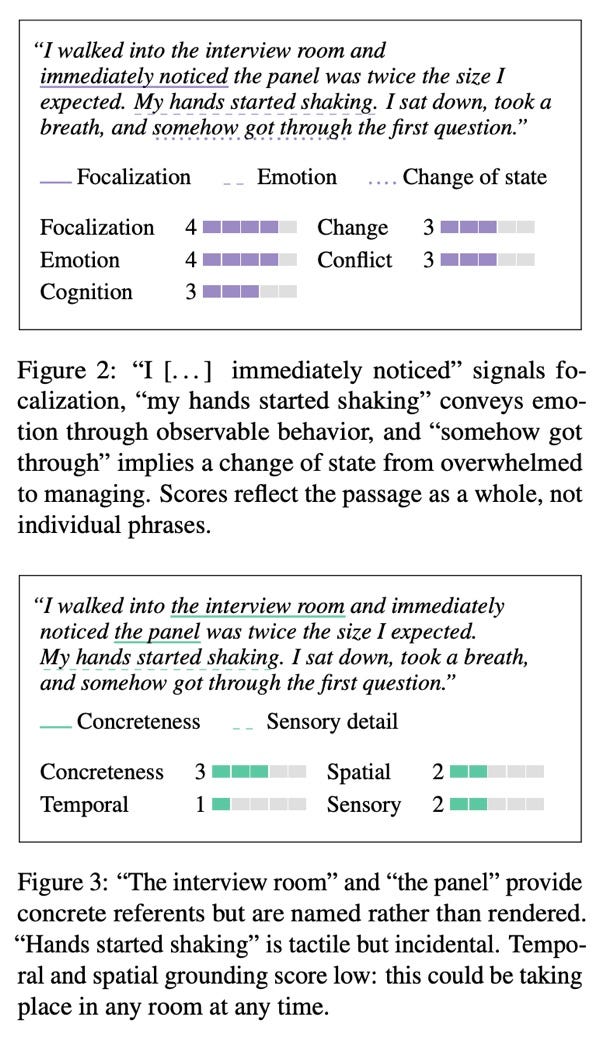
I’ll just note that the event labeling (what happened when and causation) sounds pretty hard to label 😀. (Oh, look, in the end notes: “Some agreement scores between annotators remain modest, particularly temporal ordering (κ = 0.60), suggesting some of these dimensions are intrinsically difficult regardless of annotator expertise.”) Anyway, very interesting project on dimensions of narrative in different subsets of commonly used pre-training data.
Meandering on Manifolds: The Neural Geometry of Stories Over Time (via Maria Antoniak) — Goodfire doing visualizations (and a paper): “how do LLMs represent human emotions while reading short stories, both geometrically (in activation space) and temporally (changing from sentence to sentence)?” This is essentially a kind of “shape of stories” work on very short stories, by sentence, with emotion reported by the LLM itself [a smallish Llama 3 8B model] as a kind of introspection.
“After each sentence, we prompt the LLM to report the degree of surprise, disgust, anger, happiness, sadness, and fear in the story thus far on a scale from 0 to 10. These six scores form a vector that serves as a behavioral readout of what the LLM believes has happened up to a given moment.”
To look at the LLM’s internal representation of the story, “we also harvest the internal activations from the last token of each sentence in a story (without asking it anything). These activations serve as a snapshot of what the model represents after reading the story so far. To model the geometry of these LLM representations, we fit a manifold to these activations.” And then plot in 3D using UMAP:
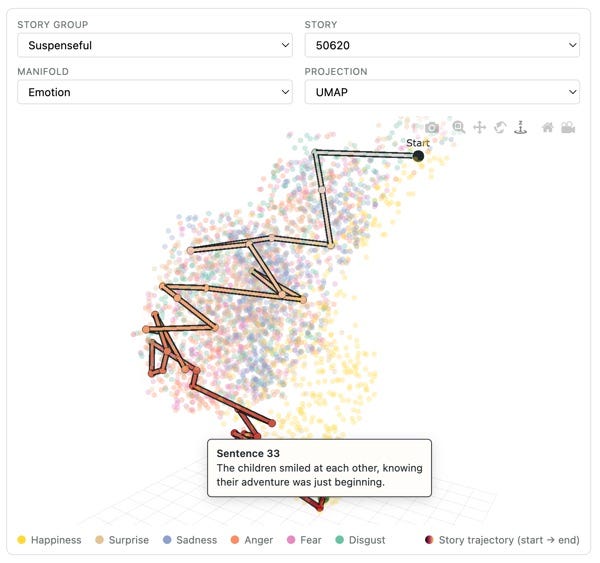
Mostly these stories seem to end in the “Happiness” quadrant, a sure LLM-tell, and especially that awful “their adventure was just beginning,” gag.
AI Fiction in the Wild — Another fab interactive explorable study (with the paper) on what people are actually chatting with LLMs about… turns out some amount of it is interactive fiction! In the sense of co-writing stories, fanfic, erotica… dominated by some power-users, though, so keep that in mind.
“This website hosts anonymized ChatGPT-user conversations where users requested some form of fiction generation—including stories, novels, scripts, roleplay, hypothetical scenarios, erotic imaginings, and more. The data is drawn from WildChat [a published dataset of logs] and was collected voluntarily and with users’ consent between 2023 and 2024. The models were powered by GPT-3.5 and GPT-4.”
They identify the character of the “solipsistic reader-writer” in a loop with an AI chat agent, without any human writer (apart from themselves?). Seemingly having fun. This relationship could also have been called “onanistic” — and I don’t really mean that in a bad way?
“We note that LLMs enable interactivity, play, and permutation in ways that are seemingly pleasurable for users, raising questions about where AI will fit into contemporary storytelling and entertainment ecosystems.” Given their interest in fanfic and fan writers— evidently well-represented in the data—I note other connections that might be made: binge watching tv shows the night they are released thanks to streaming (and in fandom, binge reading fic was around way before streaming!); and in games, the long tradition of interactive fiction, or “choose your own adventure” games — which met the AI world years ago in Latitude’s AIDungeon, featuring some of the very first on-the-fly generated role playing fiction featuring alternating turns with the LLM. The game writing community is vocally anti-AI as jobs are lost right and left at the moment — but who knows what their players are up to. Relevant:
For example, infinite story demanders prompt the model to generate variations of the same or very similar stories over and over again, sometimes for months on end. Some of this behavior may be attributed to users’ dissatisfaction—the story is not quite right, at least not yet. But we argue that in many cases it is fueled by the satisfaction of reading endless permutations of the same story, none of which end the same way twice.
The authors also address addictive behavior — also well attested pre-AI in fandom and fanfic circles; I once spent 6 months reading [redacted x-rated slash topic] stories for Teen Wolf. I think I was super stressed at the time? But at the end of it, my brain was a cheeto, and I had to go cold turkey. Happily, I do not engage in fanfic interaction with Claude (or even chitchat!), just coding.
CASPER in the Machine: Insights into Character Variety in LLM-Generated Stories. “We borrow definitions from narratology to analyze eight intricate dimensions of character, such as stylization and wholeness.” They looked at larger and smaller models and found not as many diffs as you’d think, and also “Unlike human-written stories, LLMs-generated stories are more likely to “play it safe” and have characters with completed story-lines.” and “LLM-generated characters are more likely to show character-growth during the course of the story compared to human-written characters.” See also “Do Large Language Models Always Tell The Same Stories?”
Artificial Writing and Automated Detection — From the Becker Friedman Institute. This is the study that says to use Pangram and mostly believe it.
There are more than 5 POVs. — Article on point of view in fiction by Lincoln Michel.
Data Science / NLP / Tools
OCR models: Mistral OCR 4 (billed as SOTA OCR for document intelligence but there was drama over them not running Chandra OCR correctly) and Unlimited OCR, a Baidu Hugging Face Space and model (long context). I am opinionless about these apart from how fun it is to see so many people care (data doorway?) and have to many to choose from for different problems.
Datalab — introducing Lift — A JSON-formatted document entity-extraction model.
Teaching: Agent Memory Techniques — 30 runnable Jupyter notebooks covering agent memory for LLMs: conversation buffers, vector stores, knowledge graphs, episodic and semantic memory, MemGPT, Mem0, Letta, Zep, Graphiti, and LoCoMo benchmarks.
QUEST — A deep-research AI system with code and a model (Hugging Face Space by osunlp).
Build a Realtime Translation App with Gemini Live API, LiveKit & Google Cloud Run — A tutorial.
Data vis:
A History of Menus is a Menu of History (The Pudding) — What do America’s earliest restaurant menus teach us about America? Love it.
Why Carbon Capture Can’t Conceivably Solve Climate Change (ProPublica) — An infovis-driven piece on carbon capture and climate change.
A Poem
In a candlelit room up north,
I undress before the mirror, beckon
my reflection to bear witness,
petition the vanishing gaze of wax & wick
to salvage an unsalvageable man.
//
I flesh through each melancholy hour,
sceptre the moon into place.
Clouds cape the night in slaughtered wool.
What good is a witch who cannot sever
what was never meant or, better,
summon the dead’s most lonesome ovation?
— first part of Deluxe Mourning Package by Rachel McKibbens, read the rest!
Recs come tomorrow… kind of a lot, actually!
Best, Lynn (@arnicas on mostly bluesky, mastodon, ex twitter).
Comments
Nothing yet. Say the first thing.
Sign in to join the conversation.