

The real issue with the White House post below on X and Instagram is that this investment raises a serious question about whether the very globalist sustainable-finance architecture America should be disentangling itself from is being permitted to embed itself within the rebuilding of our critical infrastructure.
That is precisely what makes this so alarming and precisely why we need to be careful about identifying where the actual danger lies.

L I N K S
https://newsroom.bankofamerica.com/content/newsroom/press-releases/2026/08/bank-of-america-launches--250-billion-critical-infrastructure-fi.html
https://www.reuters.com/legal/transactional/bank-america-launches-250-billion-initiative-us-tech-energy-infrastructure-2026-08-12/
https://www.rockefellerfoundation.org/profiles/karen-fang/
Bank of America has announced a new $250 billion Critical Infrastructure Finance Initiative, designed to mobilize capital for American digital infrastructure, energy and power infrastructure, and core infrastructure through July 4, 2027. The bank specifically identifies data centers, computing hardware, semiconductors, telecommunications, conventional and renewable power, energy storage, transportation, electrical transmission, grid modernization, water systems, critical minerals, and mining among the sectors eligible for financing.
On the surface, much of this sounds remarkably consistent with what the Trump administration has been trying to accomplish.
The Three Pillars of the American System:
Protective Tariffs · Internal Infrastructure · Sovereign Credit (not City of London–style central banking)
And that distinction matters.
Treasury Secretary Scott Bessent has repeatedly emphasized that productive capacity is national power and that American economic policy must reconnect trade, industrial policy, financial power, supply-chain security, and national strategy. He has argued that America can welcome investment while refusing dependency and decline, and that economic statecraft must reward production, investment, innovation, and the rebuilding of domestic productive capacity.
U.S. Trade Representative Jamieson Greer has likewise framed the administration’s trade agenda around reducing import dependence, rebuilding domestic production, strengthening American manufacturing, and constructing new productive capacity inside the United States.
In other words, private American capital financing mines, semiconductors, energy systems, electrical grids, transportation networks, data centers, and domestic manufacturing capacity is not inherently contrary to the Hamiltonian American System.
Properly directed, it could be entirely consistent with it.
That is why the most important question here is not simply:
Who is providing the money?
It is:
That is where Bank of America’s announcement deserves much closer scrutiny.
Karen Fang, Bank of America’s Global Head of Infrastructure & Sustainable Finance, is one of the principal executives overseeing this initiative. Her institutional affiliations are extensive. The Rockefeller Foundation identifies Fang as a leader in global net-zero and sustainable-finance forums and lists her involvement with the B20/G20, the U.N. Global Investors for Sustainable Development Alliance, the G7 Just Energy Transition Partnership, the Sustainable Markets Initiative, the World Economic Forum’s Net Zero Transition Steering Committee, and the Rockefeller Foundation’s Climate Advisory Council. It also notes that she was named a World Economic Forum Young Global Leader.
Those credentials alone should raise legitimate questions about the ideological and institutional framework potentially accompanying this capital.
But there is something even more important in Bank of America’s own announcement.
Bank of America states that progress toward its new $250 billion Critical Infrastructure Finance Initiative will be measured using a methodology consistent with its existing $1.5 trillion sustainable-finance goal.
That should immediately get our attention.
Bank of America has previously explained that its $1.5 trillion sustainable-finance program was designed to mobilize capital toward environmental and social objectives in line with the 17 United Nations Sustainable Development Goals.
And this is where the real contradiction, or potential contradiction, emerges.
The danger is not private capital financing America’s industrial revival.
The danger is allowing the existing global sustainable-finance architecture to determine the terms, standards, priorities, measurements, and conditions under which America’s sovereign industrial revival is financed.
Those are two very different things.
For decades, we have documented what we understand to be the broader globalist institutional architecture surrounding sustainable development, supranational governance, technocracy, degrowth, managed decline, and the transfer of decision-making authority away from sovereign nations. Our concern has consistently been that institutions associated with this system—from international financial and policy networks to organizations such as Chatham House, the Club of Rome, World Economic Forum, Rockefeller networks, and Vatican-aligned global initiatives—have advanced models fundamentally at odds with genuine American constitutional and economic sovereignty.
So we need to ask a much more penetrating question about this announcement:
Is the Trump administration redirecting Wall Street capital into the American System—or is the old sustainable-finance system being allowed to embed itself inside America’s reconstruction?
Those possibilities should not be confused.
If the Trump administration is effectively compelling or incentivizing enormous pools of private American capital to abandon the old globalization model and finance American mines, American manufacturing, American energy, American semiconductors, American infrastructure, and resilient domestic supply chains, that could represent the American System disciplining finance to serve the national interest.
That would be significant.
It could even represent the co-opting of institutions that previously operated within a very different ideological framework.
But if those same financial institutions are permitted to carry their existing SDG-aligned sustainable-finance architecture into the rebuilding process—determining eligibility, standards, measurements, priorities, governance requirements, or ultimately what kinds of American development receive capital, then we have a very different situation.
Then the system America is supposedly escaping may simply be finding another way to embed itself within the reconstruction.
And Bank of America’s explicit connection between this infrastructure initiative and the methodology of its $1.5 trillion sustainable-finance program is precisely why this deserves scrutiny.
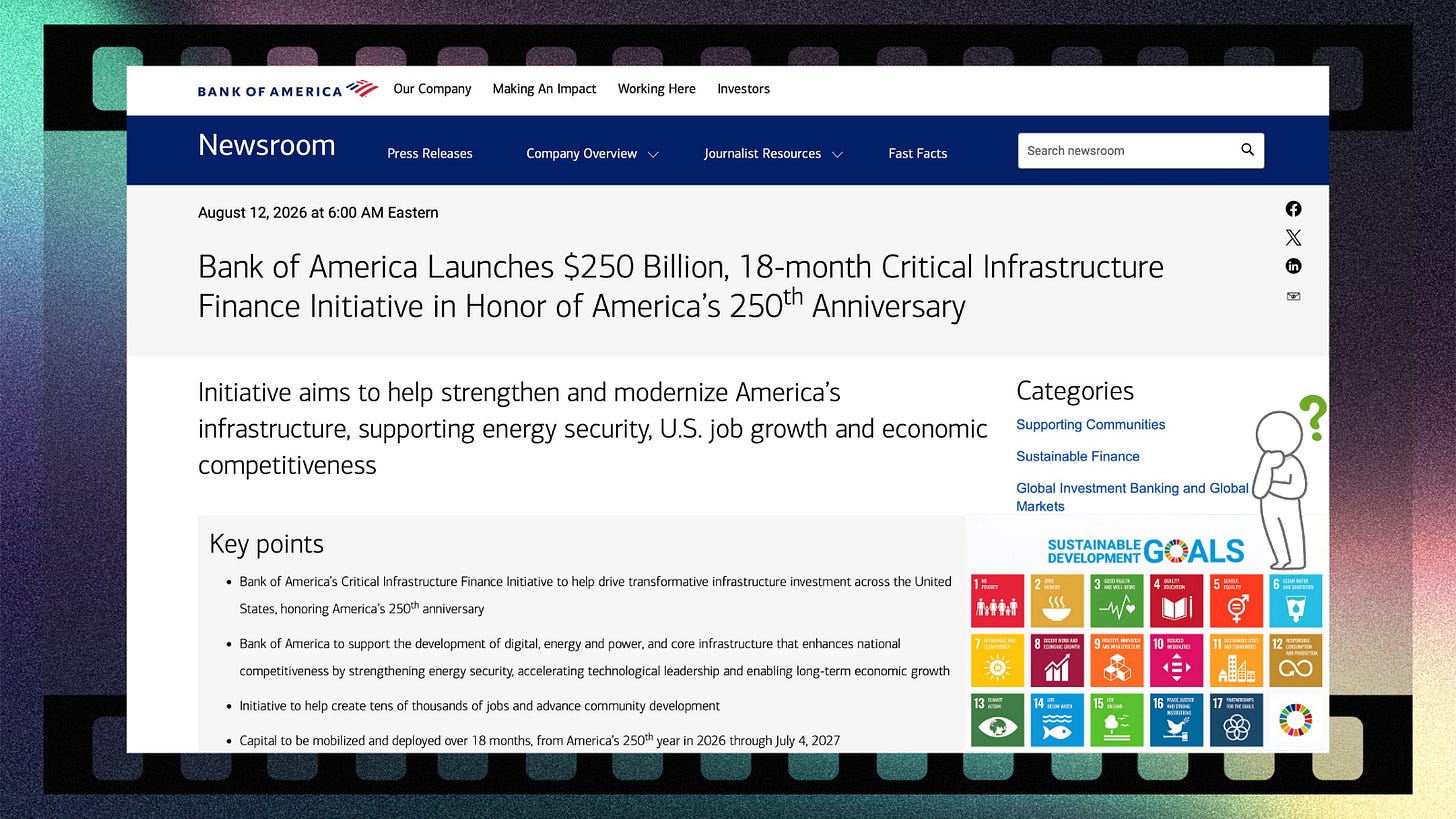
https://newsroom.bankofamerica.com/content/newsroom/press-releases/2026/08/bank-of-america-launches--250-billion-critical-infrastructure-fi.html
At this point, however, the publicly available announcement does not establish that infrastructure recipients will be required to accept U.N. SDG mandates, ESG covenants, foreign governance authority, or political conditions as a prerequisite for receiving financing. What it establishes is that Bank of America intends to measure qualifying financial activity using methodology associated with its broader sustainable-finance program.
That distinction matters if we are going to analyze this accurately.
So the question before us is not whether America needs capital.
Of course it does.
Nor is the question whether major American banks should finance the rebuilding of our industrial base.
They should.
The question is whether American national policy will discipline financial capital to serve sovereign American productive purposes, or whether financial capital will be permitted to discipline American industrial policy according to the standards of the global sustainable-development system.
Who is disciplining whom?
That is the question.
Bessent himself has articulated the principle clearly: America must be able to welcome investment without accepting dependency or decline, and economic policy cannot be allowed to become detached from national strategy.
That principle should be applied here without exception.
America’s larger project must be the restoration of genuine national economic sovereignty: domestic productive capacity, resilient supply chains, energy abundance, strategic industrial independence, manufacturing strength, and an economic system ordered toward the interests of the American people rather than supranational institutions.
That is also inseparable, in our view, from the deeper constitutional inheritance we have spent years documenting: America’s distinctly Protestant tradition of liberty, law, conscience, and self-government grounded in biblical principles rather than an endlessly evolving system of technocratic management.
America should not reconstruct its sovereign productive capacity only to discover that the institutions financing that reconstruction have retained the power to define the rules under which it operates.
So one cannot state the issue simply as:
“You cannot restore the American System while allowing globalist financial institutions to finance American infrastructure.”
That goes too far.
The sharper and more accurate warning is this:
You cannot restore the Hamiltonian American System if the global sustainable-finance architecture is permitted to set the terms under which American sovereignty is rebuilt.
Private capital serving national sovereignty is compatible with the American System.
Private capital governing national sovereignty is not.
And that is exactly what we need to watch.
The success of this infrastructure initiative should therefore not be judged merely by the size of the investment or the number of projects announced. We should be asking:
Who determines which projects qualify?
What standards govern the financing?
What conditions accompany the capital?
Do those conditions strengthen American productive independence, or constrain it?
Are American energy, mining, manufacturing, technological, and infrastructure priorities being determined by elected American leadership and the national interest?
Or are older sustainable-development criteria quietly remaining embedded within the financing machinery?
Those are the questions that will tell us whether this represents the American System capturing Wall Street capital for national reconstruction—or Wall Street’s globalist architecture capturing the American System from within.
And we should be willing to follow the evidence wherever it leads.
What this requires from Christians and citizens is not panic, cynicism, or reactionary fear, but sober discernment. We should be willing to recognize troubling alignments when they appear, ask hard questions, and hold our leaders accountable without surrendering to despair.
Apparent cooperation with institutions we have serious concerns about does not necessarily mean those institutions have won. Neither should political progress cause us to become naive about who is participating in it or what interests they may represent.
Our responsibility is to remain clear-eyed, faithful, and rooted in biblical principles, watching carefully, speaking truthfully, and refusing to confuse political progress with spiritual security.
God is sovereign over nations and rulers alike.
So we stay vigilant without becoming fearful, encouraged without becoming naive, and committed to defending liberty, truth, national sovereignty, and righteous self-government wherever they are threatened.
Watch carefully. Discern rightly. Stand faithfully.
SOLI DEO GLORIA
Summer Black
Armor of Truth
SUMMARY
The White House appears to be looking at this primarily through its broader investment → infrastructure → jobs → American productive capacity framework. Its investment page explicitly celebrates private and foreign capital flowing into U.S. manufacturing, technology, and infrastructure.
Importantly, while the White House has publicly celebrated Bank of America’s $250 billion announcement as “MORE INVESTMENT IN THE U.S.A.,” we have found no substantive White House policy statement explaining the financing architecture behind the initiative and, as of August 12, no public statement from Treasury Secretary Scott Bessent addressing the deal specifically. The White House is emphasizing the amount of investment, infrastructure development, jobs, and economic growth. But that leaves unanswered the question at the center of our concern: who sets the terms under which that $250 billion is deployed?
That distinction is critical. There is an enormous difference between the Trump administration redirecting Wall Street capital toward the Hamiltonian objective of American productive sovereignty and Wall Street being permitted to carry its existing SDG-aligned sustainable-finance architecture into the rebuilding of American productive capacity.
The White House’s celebratory post tells us that it welcomes the investment. It does not yet tell us which of those two dynamics is actually occurring.

American sovereignty · Hamiltonian American System · Bank of America infrastructure initiative · Karen Fang · sustainable finance · globalist capital · critical infrastructure · economic sovereignty · national economic independence · American System of political economy · Alexander Hamilton · Trump administration · White House infrastructure policy · reindustrialization · domestic productive capacity · strategic independence · World Economic Forum · WEF Young Global Leaders · Rockefeller institutions · Sustainable Development Goals · SDGs · technocracy · global governance · City of London · Chatham House · Club of Rome · degrowth · managed decline · Protestant constitutional tradition · biblical principles · Christian discernment · national sovereignty
Comments
Nothing yet. Say the first thing.
Sign in to join the conversation.