
From “Fact Checks” to “AI Detection”
WHAT’S HAPPENING?
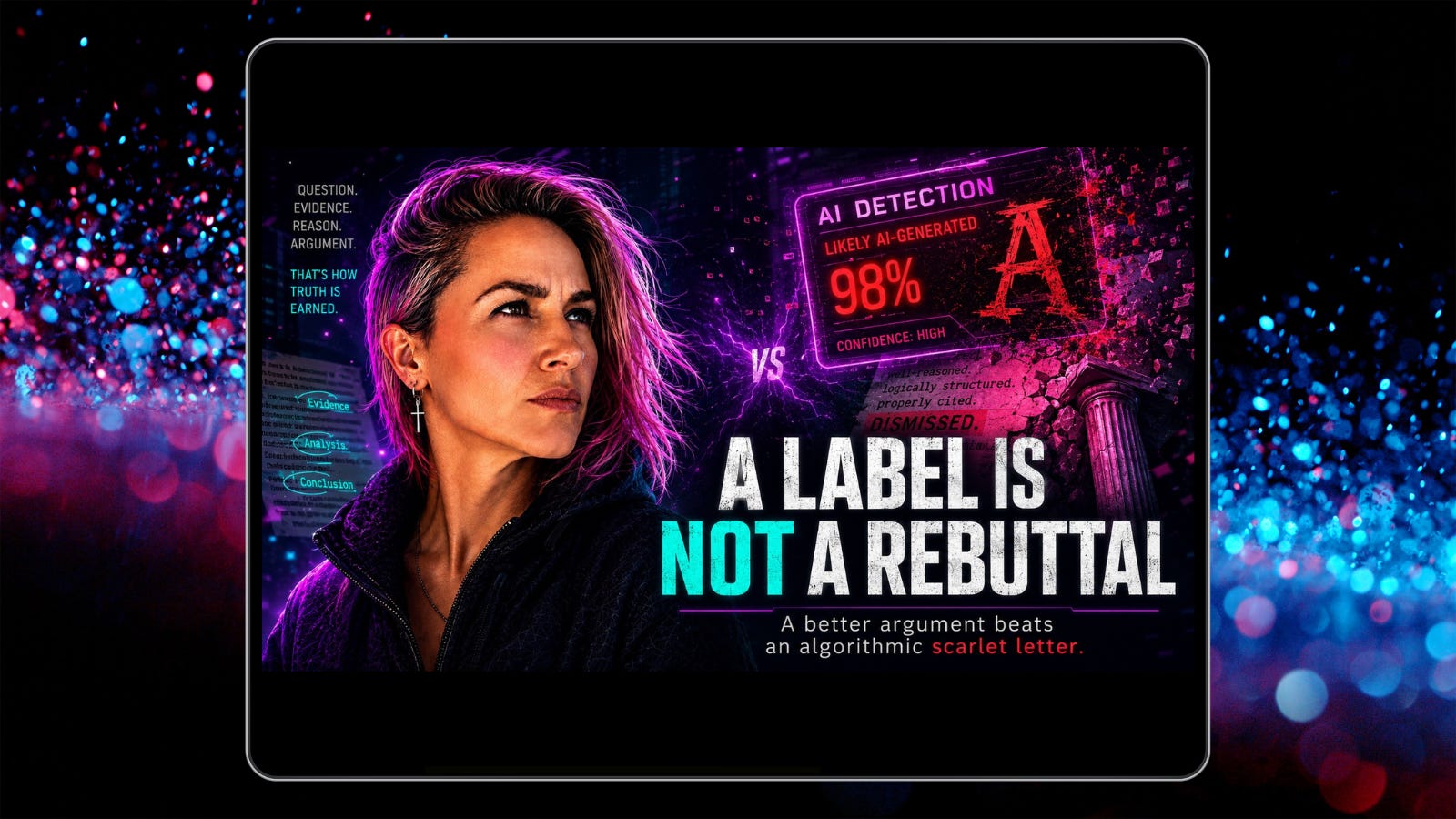
Substack has introduced a new “AI Detection” reputational mechanism that can easily be weaponized against writers. The deeper concern is not simply that some labels may be inaccurate, but that an authoritative-looking score can become a substitute for engaging with the substance of an argument and the quality of its evidence. That creates a troubling new avenue for discrediting authentic, well-researched work without ever having to answer it on the merits.
Regarding Substack’s new “AI Detection” feature, Substack itself expressly acknowledges a critical limitation: Pangram can detect indications of AI use but cannot determine whether substantial human care went into creating the work or whether AI was merely used as a source.
The problem isn’t simply whether the detector is accurate. The problem is what people infer from the detector’s score.
A technically accurate finding that “AI assisted with this text” can very easily mutate socially into:
“The writer didn’t write this.”
“The writer didn’t research this.”
“The ideas aren’t hers.”
“The author is fraudulent.”
“Therefore, we don’t need to engage with the argument.”
But none of those conclusions necessarily follows from the detection of AI-assisted language.
That distinction matters enormously, especially for researchers, investigative writers, and independent journalists who may use AI as an editorial, organizational, or research-assistance tool while remaining fully responsible for the thesis, evidence, analysis, and conclusions of their work.
CASES IN POINT
Here’s what’s already happening on Substack—and it demonstrates how AI-detection tools can create a very real reputational and credibility problem for writers.
Substack’s AI Detector and the Return of the Witch Hunt
Slow AI — Dr. Sam Illingworth

“In Salem, the accusation was the evidence. To be named was to be halfway to guilty…”
And here is why AI-detection scores should not be treated as authoritative judgments of authorship, credibility, or intellectual ownership:
AI Detection Will Always Be Broken
Slow AI — Dr. Sam Illingworth
Even when a detector correctly identifies linguistic characteristics associated with AI, that is fundamentally different from determining intellectual authorship.
A textual classifier cannot, from the finished prose alone, determine:
Who developed the thesis? Who conducted the investigation? Who chose the sources? Who verified the evidence? Who decided what mattered? Who constructed the argument? Who takes responsibility for the conclusions?
Pangram’s system analyzes textual patterns and classifies writing according to patterns associated with human-written and machine-generated text.
But detecting patterns associated with AI is not the same thing as determining intellectual authorship.
In my analysis, AI detection is the new “fact-checker” weapon—not because determining AI involvement is inherently illegitimate, but because an opaque, probabilistic score can be converted into a credibility verdict about the person behind the work.
Once that happens, it becomes remarkably easy to smear or discredit a writer without ever having to refute what the writer actually said.
For investigative writers in particular, that is a much bigger issue than whether someone used ChatGPT to polish a paragraph.
This is ultimately what gets to the heart of the matter: from “Fact Checks” to “AI Detection,” we are watching the emergence of another mechanism that can be used to discredit writers without ever having to refute their ideas.
The danger begins when an authoritative-looking label is treated as sufficient reason to dismiss the writer, bypass the evidence, and avoid engaging with the substance of what has actually been said.
When the label becomes the argument, the evidence no longer matters.
Truth does not become less true because an algorithm assigns it a suspicious label and no label should ever be allowed to substitute for the obligation to answer the evidence.
If an argument is wrong, refute it.
If the evidence is false, expose it.
But a label is not a rebuttal.
The answer to an inconvenient argument is a better argument, not an algorithmic scarlet letter.
As Christians, we should remember that deception is never morally neutral, no matter the medium through which it travels. Scripture repeatedly calls us to reject falsehood, test what is presented to us, speak truthfully, and conduct ourselves in a manner worthy of Christ. (Ephesians 4:25; 1 Thessalonians 5:21; Philippians 1:27)
The digital world may feel like a virtual abyss that’s vast, disembodied, manipulative, and increasingly difficult to discern, but it is also one of the great mission fields of our age. The Great Commission does not stop at the edge of the physical world. Wherever people gather, communicate, search for meaning, and encounter ideas, Christians have an opportunity and a responsibility to bear faithful witness to the truth.
That means our conduct online matters. Our words matter. Our sourcing matters. The way we use technology matters.
We are called to something higher: to speak the truth in love, exercise discernment, refuse dishonest scales, and live above reproach before both God and man. (Ephesians 4:15; Proverbs 11:1; Titus 2:7–8)
In an age increasingly governed by algorithms, artificial intelligence, manufactured narratives, and digital manipulation, Christians should be among the most careful, truthful, transparent, and discerning people in the public square.
As Christians, we believe that the Bible is the Holy Word of God—inerrant and possessing the power to bring life to the spiritually dead. Words matter, and as Christ’s representatives, we are held to a higher standard: to speak the truth faithfully, no matter what deceptions confront us.
We overcome deception by walking in the light of His truth and purposes.
By God’s providence, the virtual frontier is now part of the mission field. Let us enter it faithfully with wisdom, courage, integrity, and the fear of God.
“Whatever you do, do all to the glory of God.” — 1 Corinthians 10:31
Soli Deo Gloria.
Armor of Truth
Comments
Nothing yet. Say the first thing.
Sign in to join the conversation.