
Necessary Historical Background: The conflict of our age is between the Fourth American System—a renewed covenantal republic of sovereign citizens, productive labor, and national independence—and the transnational managerial system that reduces nations and people to economic units governed by financial power.
The American Republic became history’s most successful political expression of covenantal self-government, while the financial architecture centered in the City of London became the most powerful institutional expression of oligarchical management.1
The question now confronting the United States is the same question that confronted medieval Europe and the American colonies:
Will Americans govern themselves as moral agents under God and law, or continue to accept being reduced to economic units administered by concentrated financial power?
If love God and understand Liberty as an inheritance, > THIS < is best suggestion you could receive today.2
Intermediation, Institutional Gradualism, and the Fabian Society
The Roles of British PM Andy Burnham and Canadian PM Mark Carney
Institutional Architecture
The architecture’s3 characteristic method is not usually direct confiscation, military occupation, or the public abolition of markets. It is intermediation: acquiring influence over the indispensable institutions through which political and economic life must pass.
The Fabian Society developed the political-administrative version of this method; the City of London-centered financial system developed its economic counterpart.
Sidney and Beatrice Webb, George Bernard Shaw, and the early Fabians called their method permeation. Rather than risk everything on revolutionary seizure, Fabians would enter political parties, universities, ministries, municipal governments, professional associations, and policy committees, gradually redirecting inherited institutions toward collectivist ends.
The Society still describes its method openly as the use of “gradualist, reformist and democratic means” on a journey toward “radical ends.”
The significance of this method is that institutions do not necessarily have to be abolished or visibly conquered. They can retain their familiar names, structures, and public functions while their priorities, incentives, standards, and governing assumptions gradually change from within.

Prime Minister Andy Burnham: Administrative Intermediation
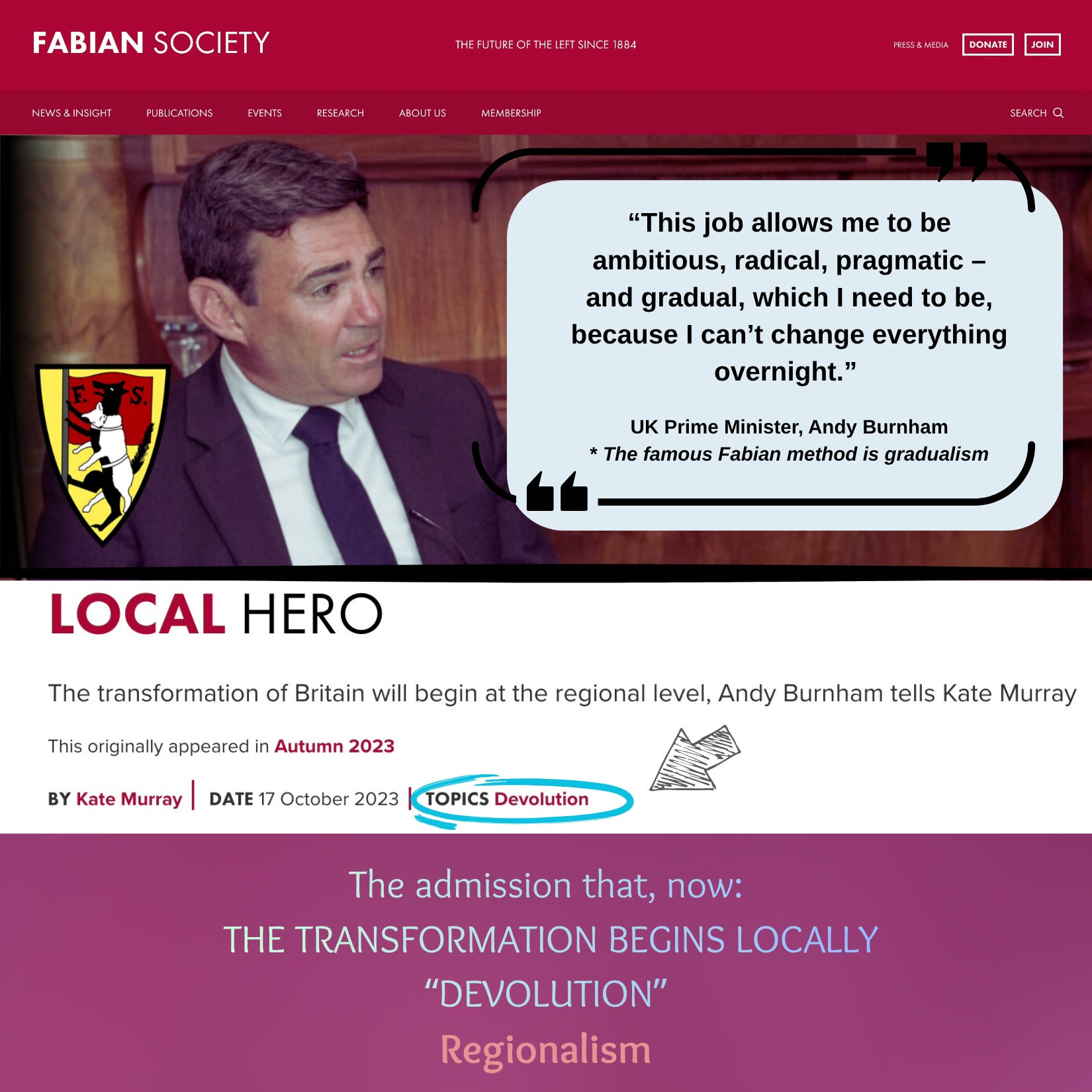
Andy Burnham’s description of himself as “ambitious, radical, pragmatic—and gradual” expresses this method with remarkable precision.
Radical describes the destination: structural changes in ownership, authority, and institutional organization.
Pragmatic describes the means: use whichever existing powers, partnerships, regulations, or inherited institutions can advance the program.
Gradual describes the sequence: implement one politically manageable reform at a time, allow it to become normalized, and then build the next reform upon it.
Burnham’s Greater Manchester program illustrates this form of administrative permeation. Integrated transportation, locally directed energy, public control of services, regional planning, and “whole person care” bring previously distinct functions into increasingly coordinated systems.
Each individual measure can be presented as practical, compassionate, and responsive to a particular social problem. Taken together, however, they expand the administrative field until government and its institutional partners increasingly coordinate the citizen’s health, mobility, housing, energy, environment, employment, and broader social circumstances.
The important mechanism is integration.
Functions once governed separately become connected. Institutions once operating independently become partners within networks. Decisions once made across distinct political, economic, and social spheres increasingly converge within a coordinated regional system.
And because the transformation proceeds incrementally, no single reform necessarily reveals the architecture that emerges when all the pieces are assembled.

Prime Minister Mark Carney
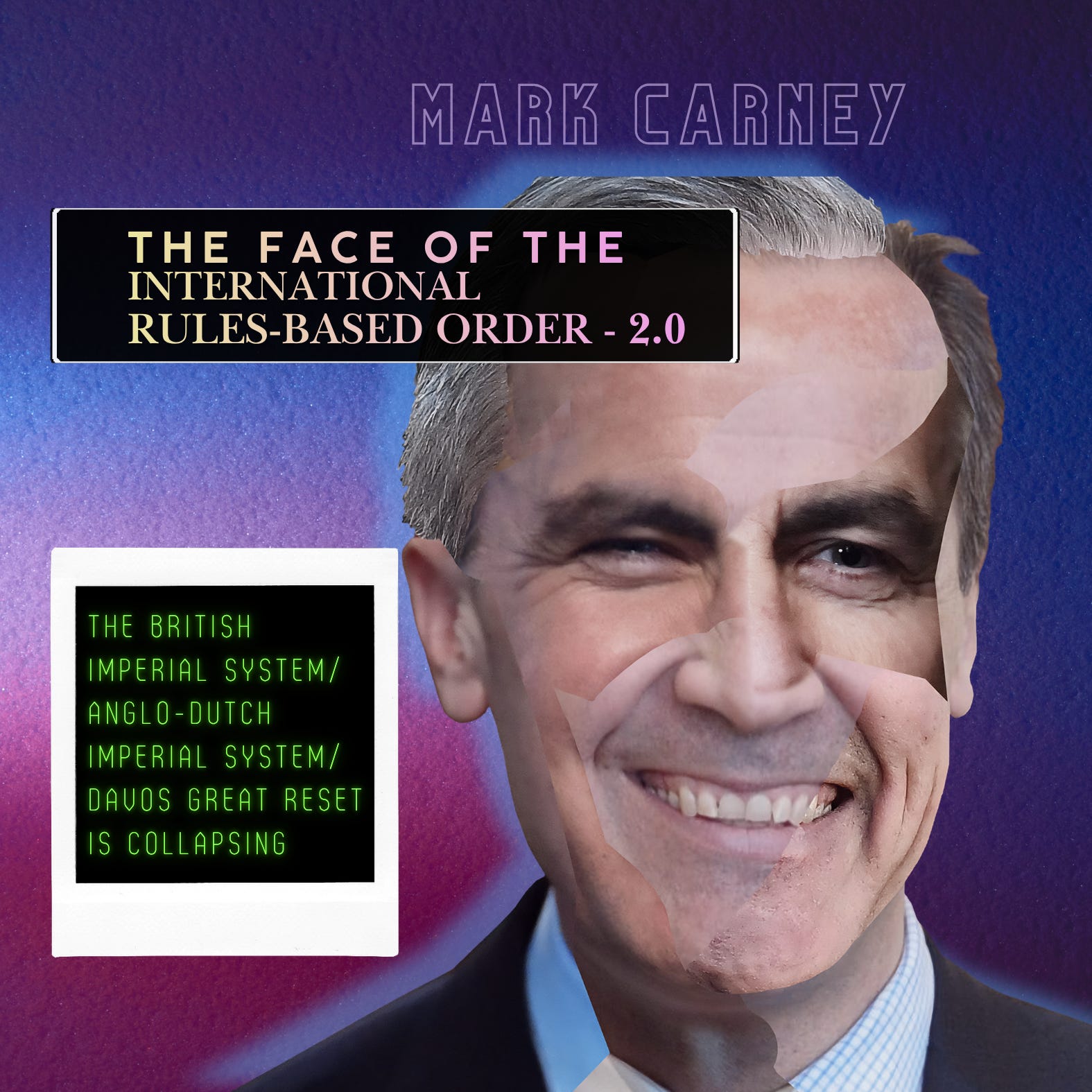
Mark Carney represents the complementary method of financial intermediation.
In his 2015 Lloyd’s of London address, Carney repositioned climate change as a threat to insurance, asset values, and financial stability—not merely as an environmental question.
From there came climate disclosures, supervisory expectations, financial stress tests, investment classifications, and transition plans. By 2019, Carney and allied central bankers were describing Net Zero as requiring a “massive reallocation of capital” and warning that companies failing to adapt could cease to exist.
This reveals the architecture’s economic power.
It need not formally seize the factory.
It can influence whether the factory receives credit, insurance, investment, permits, contracts, or an acceptable risk classification.
The legal title to the property may remain private while increasingly consequential conditions are imposed through the institutions standing between the owner and access to the wider economy.
Michael Bloomberg’s leadership in climate-related financial disclosure initiatives, major asset managers’ adoption of ESG frameworks, and central banks’ incorporation of climate scenarios helped extend variations of this mechanism throughout global capital markets.
Financial power, therefore, need not operate through nationalization. Intermediation itself can become an instrument of governance.

Fabian Gradualism Meets Financial Intermediation
This is where the political and financial architectures become functionally complementary.
The Fabians influence the institutions that define the approved social destination.
Financial intermediaries influence the institutions that control access to the means of reaching it.
Policy establishes targets.
Administrators create measurements, standards, and compliance systems.
Financial institutions translate those standards into costs, incentives, investment decisions, risk classifications, and conditions of market participation.
The result is a system capable of producing substantial structural change without requiring the dramatic abolition of private property, representative government, or markets.
The citizen remains nominally free.
The producer remains nominally private.
The market remains nominally intact.
But the range of economically viable choices can progressively narrow as more transactions pass through institutions operating according to common standards, incentives, and policy objectives.
Not One Command Center, but Compatible Architectures
This distinction is important.
These institutions should not automatically be understood as departments of one centrally commanded conspiracy. They are historically distinct institutions and networks with different origins, constituencies, and interests.
What makes them important is their functional compatibility.
Their shared logic can become one of indirect rule: gain influence over the junctions between citizens and government, producers and credit, commerce and insurance, property and permissible use, education and employment, and communities and the institutions through which resources flow.
Once those intermediary systems become sufficiently important, formal ownership tells only part of the story.
A producer may own his factory but still depend upon financing, insurance, energy, regulatory approval, infrastructure, payment systems, suppliers, and market access.
A citizen may possess formal political rights while increasingly encountering public policy through administrative bodies, public-private partnerships, regional authorities, professional standards, and institutional eligibility requirements.
The crucial question becomes not simply who owns something, but:
Who controls the conditions under which it may operate?
That is the power of intermediation.
And it helps explain how radical transformation can arrive gradually, pragmatically, and almost invisibly—one reasonable reform, one administrative integration, one technical standard, and one transaction condition at a time.
The next question, then, is what happens when this method moves closer to home—when the region itself becomes the organizing unit for transformation.
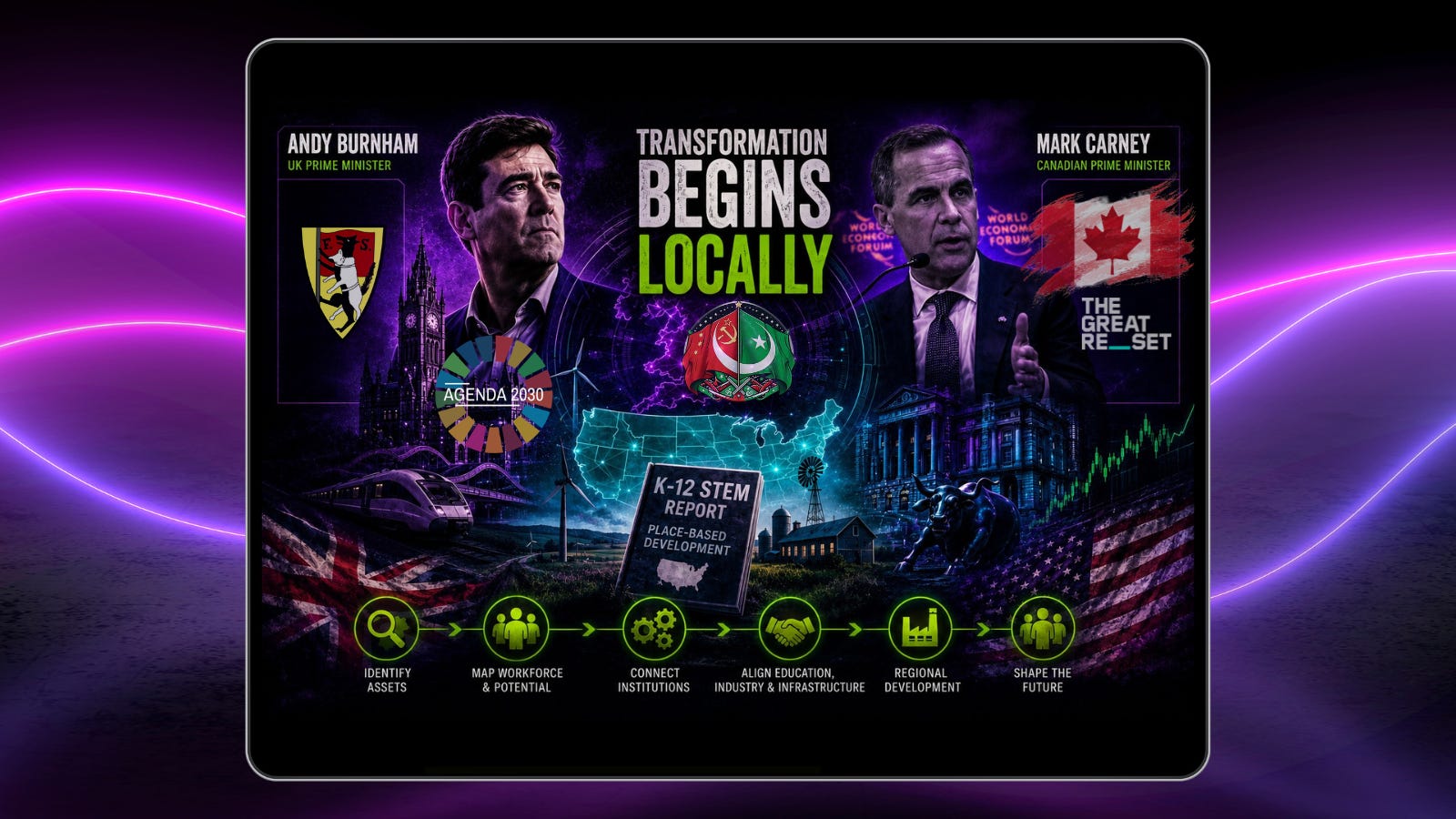
The Transformation Begins Locally
Andy Burnham, Devolution, and the Architecture of Regionalism
Having established the method, Andy Burnham’s emphasis on devolution and regionalism is most telling of true malicious intentions.
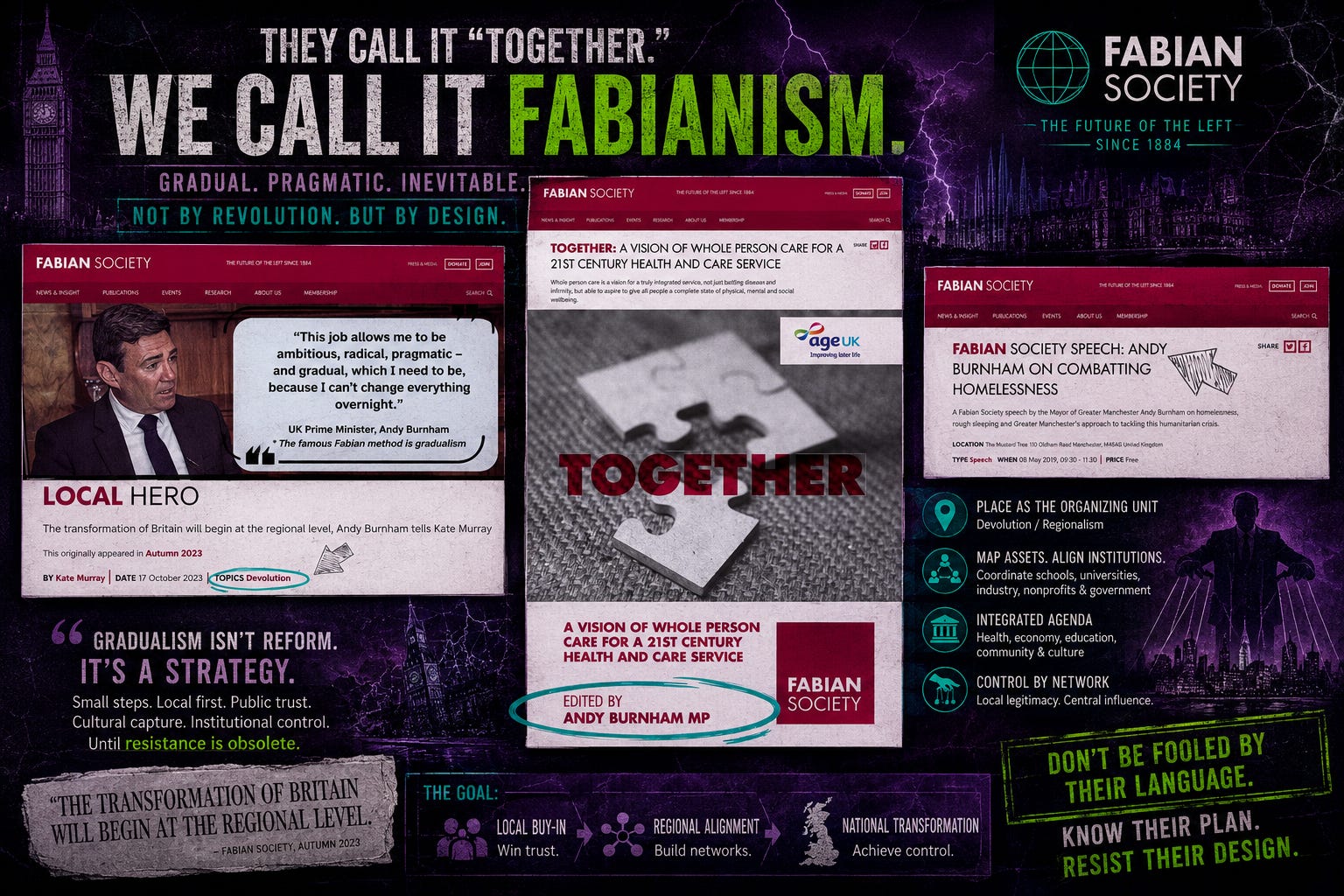
Burnham has a documented history of engagement with the Fabian Society through its publications, speeches, interviews, and events. He edited the Fabian publication Together: A Vision of Whole Person Care for a 21st Century Health and Care Service, addressed the Society on homelessness, and was interviewed extensively about his Greater Manchester model in 2023.
Burnham and the Fabian Society: Primary Sources
These sources are particularly useful because they allow Burnham’s ideas to be examined through his own words and the Fabian Society’s own publications:
Together: A Vision of Whole Person Care for a 21st Century Health and Care Service — Fabian Society publication edited by Andy Burnham.
Together — Full PDF — The complete publication, including Burnham’s introduction and proposals for integrated health and social care.
Andy Burnham on Combatting Homelessness — Fabian Society event featuring Burnham’s Greater Manchester approach to homelessness.
Local Hero: Andy Burnham on Devolution and Regional Transformation — The 2023 interview in which Burnham discusses deeper devolution, city-regions, public services, and gradual change.
The title attached to that final Fabian interview is particularly revealing:
“The transformation of Britain will begin at the regional level.”
Burnham argues that the 21st century will increasingly be shaped by change driven through cities and city-regions, describes Britain as “crying out for deeper devolution,” and speaks of establishing “a new tier of governance for England.”
He also describes his approach as:
“ambitious, radical, pragmatic—and gradual.”
That word—gradual—matters in the Fabian context.
Rather than transformation arriving through one dramatic national act, Burnham describes change proceeding through regional institutions, public ownership, integrated systems, and incremental reforms that can eventually reshape Westminster itself.
From Centralized Technocracy to Regionalized Administration?
Burnham’s opening moves as Prime Minister can, at first glance, look like a repudiation of the Starmer model.
Cancelling Digital ID, cutting energy taxes, emphasizing reindustrialization, promoting vocational trades, reconsidering aspects of North Sea policy, and shifting power away from London can all be interpreted as movement away from the previous governing model.
But those changes exist alongside another set of priorities:
AI-enabled government, the “preventative state,” deeper devolution4, regional governance, industrial planning, public-private partnerships, a revived National Economic Council, stronger social provision, continued Net Zero commitments, closer EU cooperation, and continuity on Ukraine.
The emerging distinction is about how government is organized and administered.
The Starmer model emphasized centralized Whitehall technocracy, Digital ID, Net Zero, and nationally administered systems.
Burnham’s model appears more oriented toward regionalized state capacity, AI, industrial planning, public-private coordination, vocational workforce development, municipal authority, integrated social provision, and economic nationalism layered onto social democracy.
Digital ID being cancelled, therefore, does not mean that the broader administrative architecture is being dismantled.
One mechanism is disappearing while other mechanisms of coordination are strengthened.
And Burnham’s language of a “preventative state” deserves particular attention. The principle is that government should intervene earlier—addressing conditions before they become costly social failures.
The important question is where prevention ends and administrative management of citizens and communities begins. More conditional control metrics.
And This Is Where the Architecture Looked Familiar
While researching Burnham’s regional model, something looked remarkably familiar.
In April 2025, we examined a Biden-era report titled K–12 STEM Education and Workforce Development in Rural Areas. One of the most important concepts we identified was place-based development and community asset identification.
Our original Resource-Mapping and Extraction Operation analysis
The 2024 report called for institutions to identify and leverage community resources, connect programs to local priorities, account for the industries and STEM resources present in different rural areas, and organize regional collaborations among schools, higher education, nonprofits, government, and industry.
The structural mechanism can be summarized simply:
Identify the assets of a place.
Map its workforce and economic potential.
Connect institutions across the region.
Coordinate education, government, infrastructure, and industry around a regional development strategy.
Different countries and political circumstances are involved, and the programs should not be treated as identical.
But the organizing principle is strikingly familiar:
Place becomes the unit through which institutions are coordinated.
That is what makes the comparison with Burnham’s devolution model noteworthy.
The Architecture Remains. The Objective Has Changed.
Something important has changed in America since our original investigation.
The Trump administration has rejected the Biden-era DEI and equity agenda and redirected federal economic and workforce policy toward reindustrialization, energy production, manufacturing, advanced technology, skilled trades, and the restoration of American productive capacity.
That is a significant change in direction.
The underlying architecture of place-based development, regional workforce coordination, education-to-employment pathways, employer partnerships, and institutional integration, however, has not simply disappeared.
The destination has changed substantially.
The machinery remains.
And that distinction matters.
Under the previous administration, we were concerned that this architecture could be used to align rural communities with globalist (Sustainable Development Goals) equity, green-transition, sustainability, and other centrally defined priorities.
Under Trump, similar institutional mechanisms can instead be used to rebuild manufacturing, expand energy production, strengthen skilled trades, develop advanced technology, and restore domestic industrial capacity under America’s historic Hamiltonian American System.
Those are fundamentally different objectives.
But an architecture capable of coordinating education, government, employers, infrastructure, workforce development, and regional economic planning does not acquire its political character from the architecture alone.
It depends upon who controls it and toward what ends.
Does Regionalism Decentralize Power or Its Administration?
That brings us back to Burnham.
Under regionalism: power remains concentrated elsewhere while responsibility for implementing its objectives is distributed through regional institutions.
That distinction is crucial.
There is a profound difference between decentralizing power and decentralizing the administration of power.
A genuinely decentralized system gives communities meaningful authority to choose different priorities, reject policies, govern resources, and pursue independent economic and social arrangements.
A regionalized administrative system may look local while regional authorities remain dependent upon national funding, regulatory standards, institutional partnerships, economic incentives, or broader policy objectives established elsewhere.
In that case, the region becomes not a barrier against centralized power, but an intermediary through which that power operates.
Which brings us to the questions that matter most:
Who controls the architecture?
Who determines its objectives?
Who decides which industries, skills, investments, and economic activities receive institutional support?
Can communities say no?
And ultimately:
Does regionalism return meaningful sovereignty to communities or make centralized objectives easier to administer locally?
That is the distinction worth watching as Burnham begins restructuring Britain around devolution and city-regions, and as America redirects its own place-based workforce and industrial architecture toward reindustrialization under the Founding Fathers’ approved American System, which rejects British free trade and the cult of Davos emanating from the centuries-old City of London/Vatican hub of fading power and control.
The objective can change.
The architecture can remain.
And the ultimate test is whether the people themselves remain sovereign over both.
Read our original STEM, STEAM and STREAM investigation

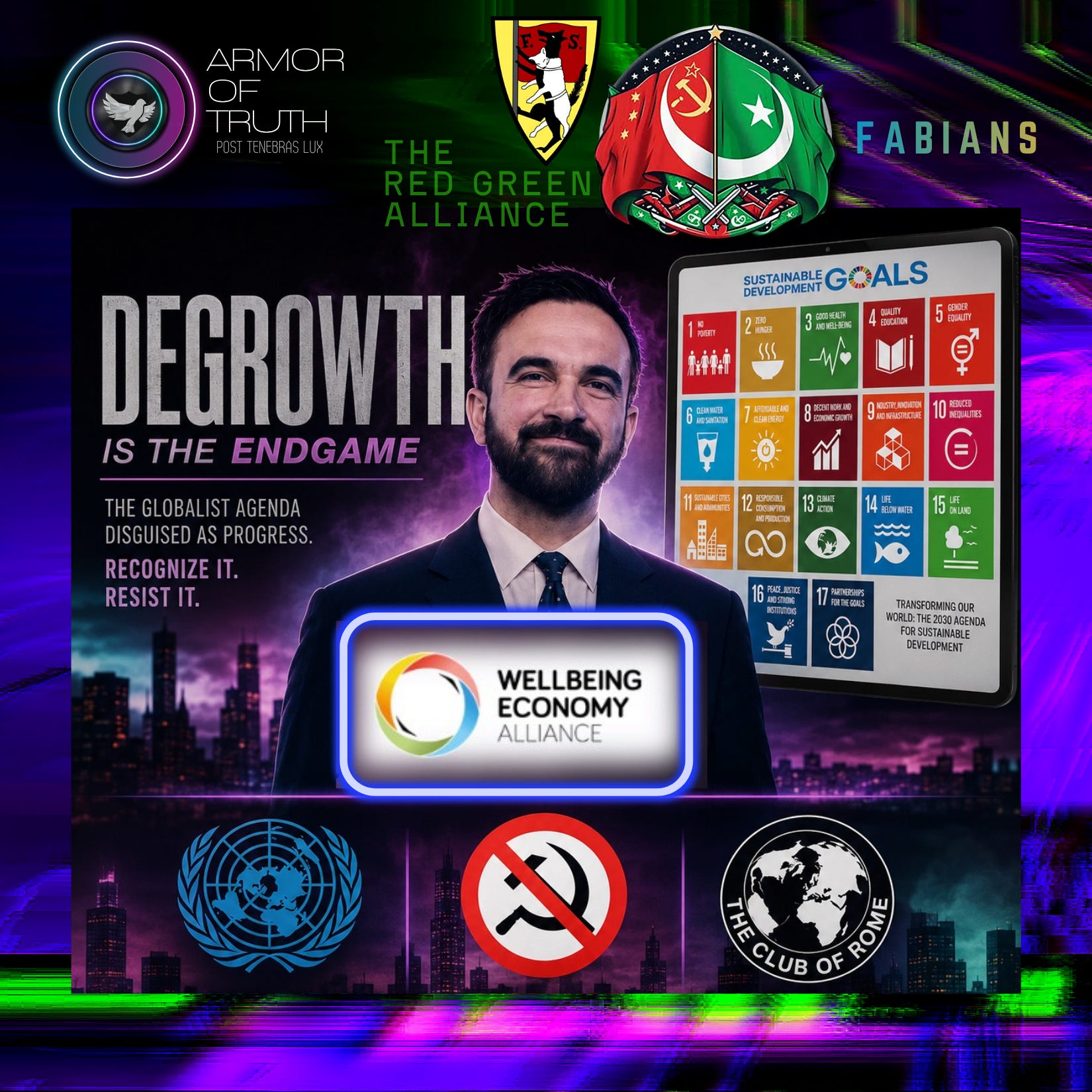
This post is the first in a series that will once and for all show you what you were taught to not see, and explain the system that is not communist or merely capitalist, but covenantal, sovereign, productive, protective, and repeatable anywhere. If you are not familiar with “The American System” of political economy, that was by design. But, you can know, and you can grasp it quickly. To understand the Trump administration’s policies, including Venezuela and Iran, you must know which enemy is being attacked, and it’s not Venezuelans or the Iranian people, it's not even the IRGC (they are merely a proxy of the real enemy). Understanding and recovering this system, the only system that has ever been an effective counter measure against empire and extraction, is necessary. There is a reason so few have heard about it and so many respond with confusion or even anger when you try to tell them that Trump gets it and is doing it. Stay with and read these posts, and watch our upcoming series on our YouTube channel. Once you have the facts, if you want to call us crazy, you are more than welcome to do so. But, you will still stuck in the box they kept you in for fifty years, and you will still be wrong. That’s how confident we are in this message.
If you followed the link, you are more wise than most. Here’s the suggestion:
THREE BOOKS: The American Sovereignty Trilogy by Leonard Meyer
https://lunamesaranch.com/books/
“One argument. Six hundred and fifty years of documented conflict. The American Sovereignty Trilogy traces the oldest war in the Western world — the war between financial empire and productive sovereignty — from its origins in 14th-century Venice to the present moment of American restoration.
Outside the Gates names the adversary: the City of London model of financial extraction, its instruments, its operations, and its six-century campaign against every statesman who tried to build a sovereign alternative. Hamilton. Lincoln. McKinley. Each removed at the moment of maximum threat.
The American System makes the constructive case: the Hamiltonian architecture of national credit, protected industry, and internal development — the system that built the most productive civilization in human history and was systematically dismantled from 1913 forward.
The Donroe Doctrine completes the argument: the Fourth American System as the first serious counter-move since McKinley, the framework of the present restoration, and what sovereign victory looks like in the century ahead.
The trilogy is not commentary on current events. It is the structural map of a conflict that has never stopped — and the documented case that the American people have beaten this architecture before, and can beat it again.
— Leonard Meyer Luna Mesa Ranch Avondale, Colorado
Leonard Meyer is a rancher, historian, and Reformed Christian whose work traces the theological and institutional genealogy of American productive sovereignty across four centuries. Meyer has created a structural map of the conflict between two opposing systems that arose within Western Civilization. The American Sovereignty Trilogy: Outside The Gates: The City of London and the American Republic; The American System: Covenant Economics and the Soul of the American Republic; The Donroe Doctrine: A Corollary To The Monroe Doctrine - Donald Trump’s restoration of the three Hamiltonian pillars is not a policy correction - it is the recovery of a covenant architecture that that runs from Abraham through Hamilton to the present generation, and the heart of the republic will not rest until it rests in the work Providence assigned it.
The Architecture — The conflict at the center of this analysis predates the American founding, the British Empire, and the modern financial system. To understand the present moment, one must begin not in 1776 or 1913 or 2001, but in the Low Countries of northern Europe in the late 14th century, where two irreconcilable visions of the human person emerged within the same civilization. Every institutional structure, financial architecture, political conflict, and civilizational crisis that followed — including the present one — is downstream of that divergence. (Meyer, Outside The Gates)
Burnham’s definition of devolution
Permanently transferring political, fiscal, and administrative powers away from Whitehall (the central UK government) to regional governments, metro mayors, counties, and city-regions.
Comments
Nothing yet. Say the first thing.
Sign in to join the conversation.