
For your TBR:
Elias Canetti’s Crowds and Power , which Susan Sontag called “an immensely interesting, often profound reflection about the nature of society, in particular the nature of violence’ and Iris Murdoch described as “one of our great imaginers and solitary men of genius” is out on the 27th of August.
I cannot wait to get this one!
“So plant your own gardens and decorate your own soul, instead of waiting for someone to bring you flowers.”
~ Jorge Luis Borges
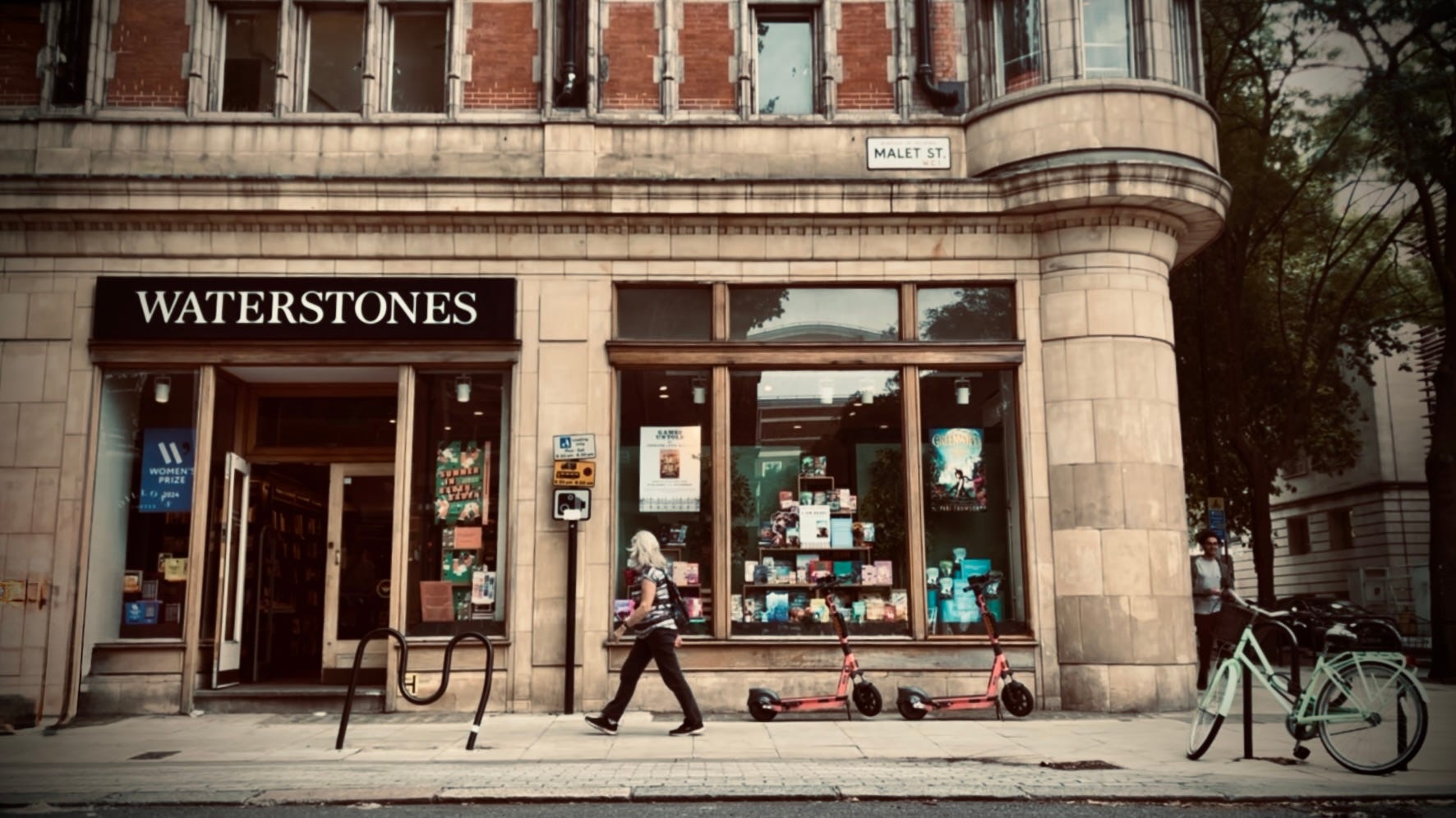
The problem with certain kinds of books is that they rarely fit a particular genre. My bookish friend and I were looking for Borges by Adolfo Bioy Cesares in our favourite bookshop in the world, and that is Waterstones on Gower street.
One falls in love with this shop immediately for it is located inside a Franco-Gothic Masterpiece of architecture. It is the Grade II listed building which was constructed between 1907 and 1908 by architect Charles Fitzroy Doll, who also famously designed London's Hotel Russell.
But the true love begins when you enter the bookshop itself for it’s celebrated as Europe’s largest new and second hand bookshop. Any true bookish Londoner will tell you: ‘They have everything!’
It does not matter how rare, niche or recent the book you’re looking for is. Waterstones on Gower street will have it.
So, when we were looking for that book on Borges, we were surprised that we could not find it anywhere. Yes, we knew that the book defied boundaries of genre, it could be classed as biography, literary criticism, letters, anything, but we looked at the spines of every book in these sections and there was nothing.
It is worth explaining to my reader why we were searching for this book for over 40 minutes. Between 1947 and 1989, Cesares and Borges were having nearly daily conversations about literature. The book logs private, unfiltered, and often controversial opinions of Borges on giants of literature such as Kafka, Shakespeare, Joyce and Goethe.
When Borges’s wife heard of the publication of this book, she claimed it to be a betrayal.
I have to say I haven’t been excited about a book in the same way since the publication of Eckermann’s Conversations with Goethe, which Nietzsche claimed to be the best book in German.
“Let me have a look” said the man behind the till, looking at two of us carrying the invisible white flag that admitted our surrender to find the book.
“I can see that it had to be released already, but we surprisingly have none in stock, which is strange. Give me a moment, I might see if any other shops around have it for you.” Pause. “Hmm, how weird, not a single one of our shops has it in stock.” He went quiet. “ Ah!” I have to say we got excited when we heard his ‘Ah!’ it at first sounded as if he found a copy.
“I am sorry to say but there seems to be a mistake in our system. The book’s release date is mistakenly marked as being released in 2026, but I am sorry to say, it won’t be out for another year. Sorry for the confusion.”
Those of you who grew up in a pre-digital era might remember how much excitement one felt to know that the local music shop had a CD with the album you wanted, or the moment you got a VHS tape or a DVD with the film that you were looking forward to watch. But you will also remember how dispiriting it was when the same shop didn’t have what you wanted. This is how we felt in 2026, realising that we will have to wait for another year for a book we expected way prematurely.
We sat in the bookshop’s café that was full with the University College London’s students who come here to study. Their university is just two or three minutes away from here, so you can see PDFs of medical journals glowing on the screens of their laptops, or the piles of books on law with multi-coloured plastic bookmarks across the pages.
My friend felt particularly down about the wait for the book, so I tried to cheer her up.
“You know there is another book on the subject that you might like. It is less controversial, but brilliant as well. It is Alberto Manguel’s With Borges. I think I have seen the spine of it when we were looking for Bioy Caesar’s book”
I could see a slight interest coming back to her eyes: “When Manguel was 16, Borges used to come to the bookshop he worked, and one day he asked him if he could read aloud to him after work. Manguel agreed and during those read-alongs, that lasted for years, Borges told Manguel everything about his reading journey, his favourite books and writers. It is not as controversial as the one we were looking for, but good enough to satisfy our thirst before we reach the water source.”
I went quiet, picked up my dry chocolate croissant that I bought in the café, dipped it in my coffee, and awaited the reaction.
“We should definitely get that one. I hope they have two copies for each of us! If they don’t I am going to read it first and you next!” she said.
“It is curious how geniuses come in pairs and are rarely isolated as some have tried to portray: Calvino and Pavese, Rilke and Rodin, Nietzsche and Wagner. It feels like greatness attracts greatness. Like with Cesares and Borges. And there is always someone there to record the details , like Manguel records the story of Borges…”
“… and Eckermann who records his conversations with Goethe which then essentially becomes a masterclass in creativity” - I interrupted her.
Neither the croissant nor coffee was good enough in that café and lets be honest we don’t go these cafés for the quality but for the bookish atmosphere. After we finished with our drinks, we went up to the second floor searching for Manguel.
“You know what impressed me the most from some excerpts from Manguel’s book?” - I said as we were climbing to the second floor - “It is that Borges was obsessed with the Encyclopaedia Britannica, he first discovered it as a kid and could get lost inside it for days. I liked the parallel between our life being like an encyclopaedia, we are born into century, language, parents we didn’t choose and yet we have to create meaning out of it.”
There was only one copy of Manguel’s book and it was second-hand. The Waterstones on Gower Street once again proved that it does have everything, unless it hasn't been printed yet.
If you’re curious to know Borges’s language learning technique, and how he taught himself German consider supporting Genius & Ink 🖌 , the full text is below.

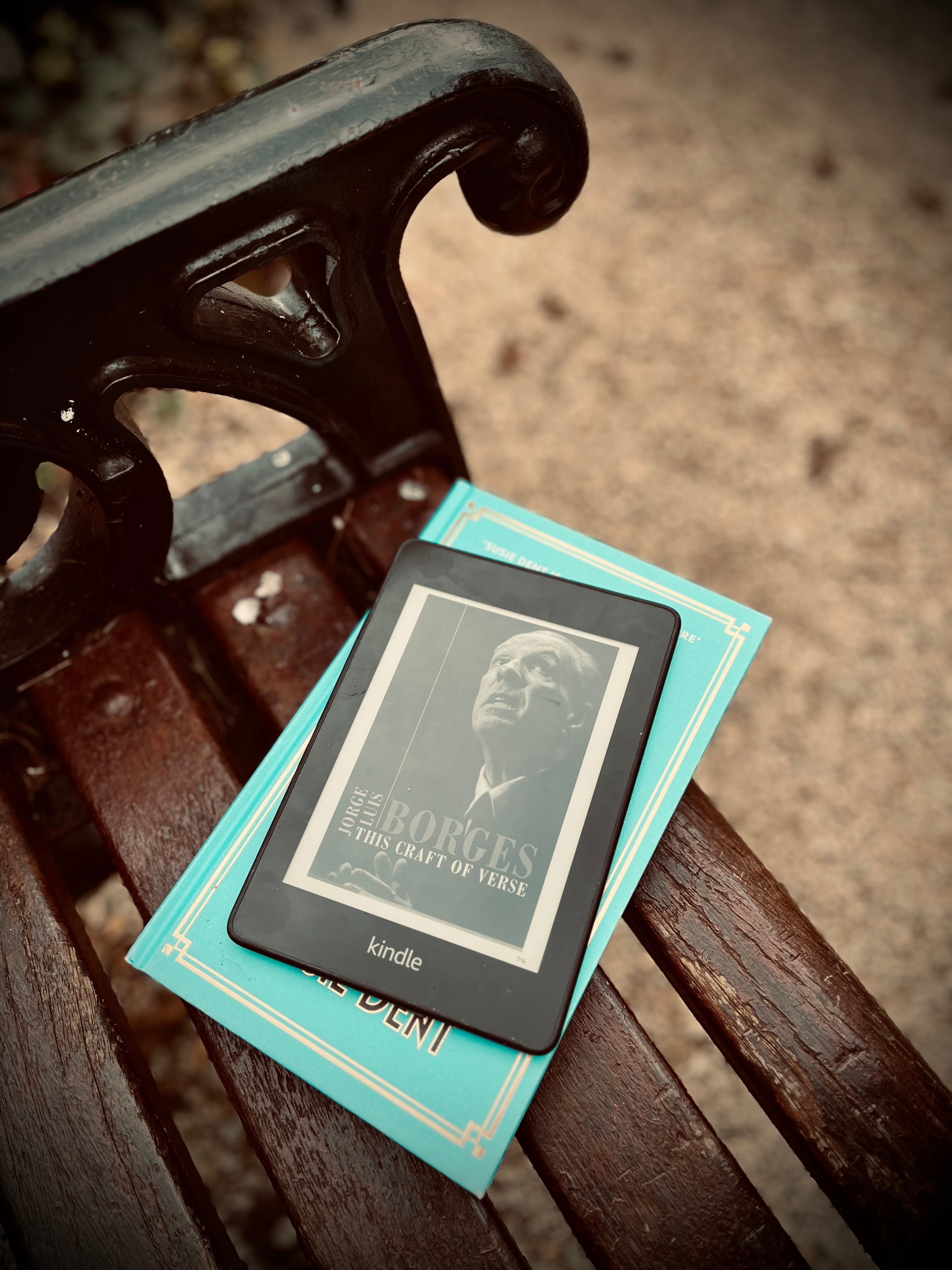
One of the most fascinating stories about Borges is how he learned the German language, a language he came to admire, above all, for its beauty. In 1914, Borges’s family relocated to Geneva during the First World War. He was seventeen. At that time he had two native languages, Spanish and English, and could manage a little French and Latin from school — but no German at all.
Comments
Nothing yet. Say the first thing.
Sign in to join the conversation.