


Hello fellow-traveller,
Welcome to the Odyssey read-along. Here’s the schedule for you to navigate through this story.
This post, and the ones that will follow, are divided into sections so you can easily follow the text and re-read passages. It does not matter what translation you use — the lines should be the same, although translated differently.
This is the ninth post in the series, if you’re curious about what happened before, please feel free to read the previous weeks’ instalments.
In this journey, I am both an Odysseus and a Telemachus. I might get lost and get stuck on Calypso’s island, yet at the same time, like Telemachus, I need to awaken to act. These are the notes of a fellow-reader, not a scholar.
I’ve just released an interview with Emily Katz Anhalt, a Professor of Classics, discussing how we should read The Odyssey. You can listen to it here:
I hope you will enjoy it.
Book 19
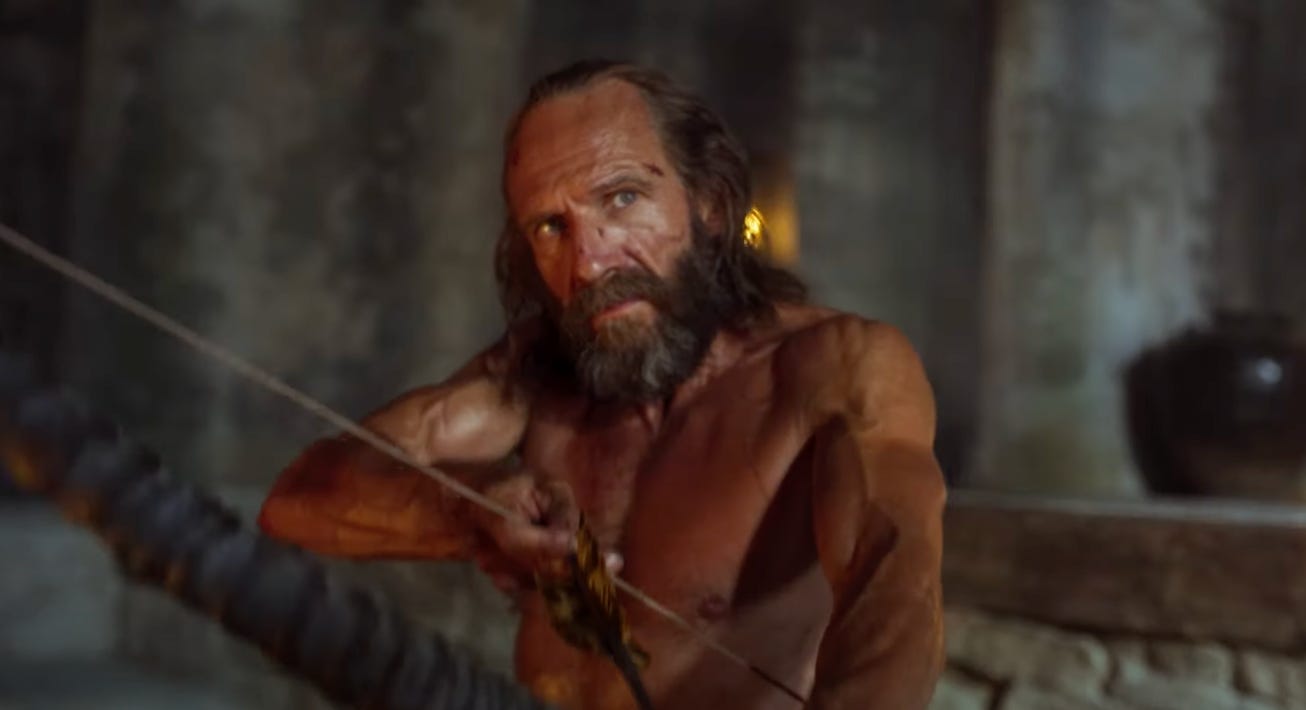
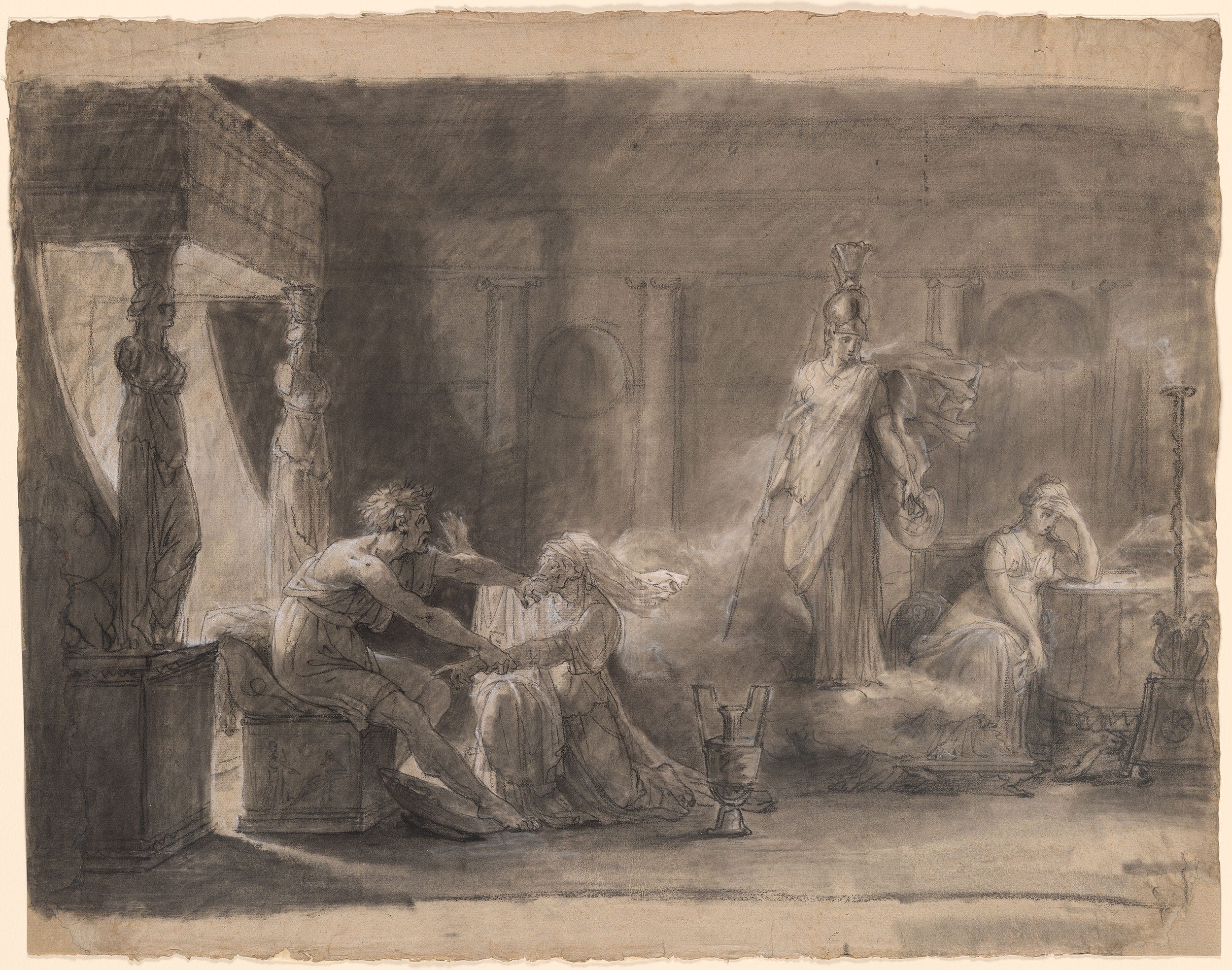
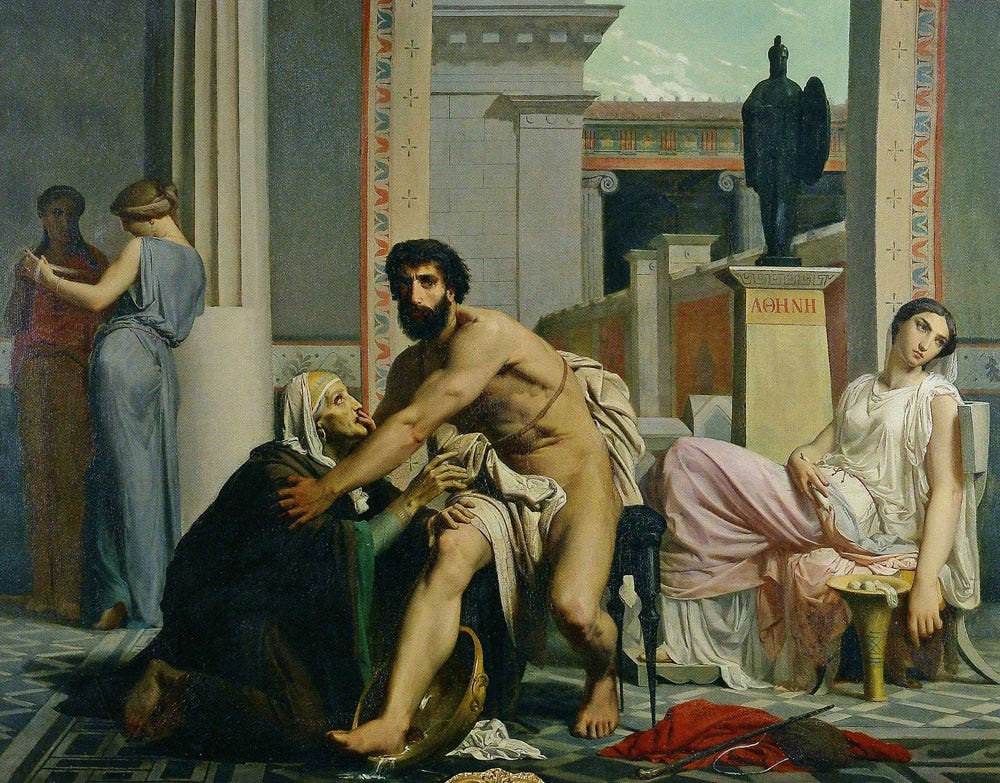
Telemachus and his father secretly remove the weapons from the hall by night — Penelope comes down and speaks at length with the beggar, drawing out his false story of having met Odysseus in Crete — The old nurse Eurycleia, washing his feet, feels the scar from a boar’s tusk on his thigh and recognises him — Odysseus seizes her throat; she keeps silent — Penelope, unknowing, describes her dream: an eagle swooped down and killed her twenty geese — She announces she will set the trial of the bow: she will marry the man who can string it and shoot through twelve axes — Odysseus urges her to hold the contest without delayBook 20
Odysseus lies awake in the hall, forcing down his rage at the disloyal maids — Athena comes to calm him and seal his eyes with sleep — He wakes at dawn and hears Penelope weeping — The suitors gather for what will be their last feast — The prophet Theoclymenus sees a vision of darkness and blood; the suitors laugh at him and he walks out — The hall is loud with feasting; the air is thick with foreboding
Proofread by Lisa Statler

What makes some couples spend decades of their lives together and die (as Armenians say) on the same pillow?
Why do some live happily ever after, while others collapse at the first hurdle?
I believe that the couples who survive are the ones who evolve as they go through life. Every person encounters obstacles, and each obstacle requires shedding one’s previous self: maturing, and becoming a different person than the one who first faced it. The couples who endure across decades face multiple such obstacles, each one demanding that they reconsider who they are. The couples who evolve - survive, while the couples who don’t, break apart.
This is why I find so many modern stories silly: a couple separated for decades finally sees each other, and they run and embrace and continue as if that separation never changed them at all.
This is the profound wisdom of Book Nineteen of the Odyssey: we know that Odysseus has profoundly changed since he left for the walls of Troy. But Penelope, despite remaining in Ithaca, has changed just as profoundly, for she too has faced enormous obstacles, arising from Odysseus’s absence. And so when Odysseus and Penelope finally meet here, Odysseus is a stranger disguised as a beggar, not simply because he is dressed as one, or because he is hiding his identity, but because this strangeness comes from something deeper: he has profoundly changed.
The Greeks had a word for this: when couples evolve together, they called it homophrosyne, or like-mindedness. It is the word we encounter in Book Six of the Odyssey, where Odysseus tells Nausicaa that no gift is greater than a marriage where husband and wife share one mind. Homophrosyne is not agreement. It is not just love, and it is not compromise. It is two minds capable of arriving, independently at the same truth.
And in Book Nineteen, Penelope and Odysseus must come to that same truth together, yet each arriving there independently. Odysseus is unrecognisable to Penelope. But let us not forget, my dear reader: Penelope is equally unrecognisable to him. They are two strangers.
In the sections that follow, I want to show my reader five distinct attempts through which, in this book, Penelope and Odysseus meet one another: the first through a story (mind), the second through the body, the third through a dream, the fourth through a decision, and the fifth through kindness.
We see the first test of homophrosyne, like-mindedness, in action in Book Nineteen, when Penelope demands that the beggar identify himself, then pushes him to prove that he once hosted Odysseus. The demand itself is a test of mind. Penelope doesn’t ask the beggar to comfort her: she asks him to prove who he is and Odysseus, the man of twists and turns, the man who lives by storytelling and cunning, knows that the only way to earn trust is proof over sentiment.
Here too we witness Penelope’s own metis, because she doesn’t ask this beggar what her husband was like, or how he felt. She asks for the things that can be checked: what he wore, not emotions that can be easily faked. This clearly shows that Penelope is as like-minded as her husband. She is a woman of twists and turns.
And when Odysseus, in his disguise as a beggar, answers with total precision, describing the cloak, the brooch, everything, he does exactly what Penelope’s method demands. The Greeks had a name for this register of speech: pseudea etymoisin homoia, “false things similar to true things.”
This is testimony designed to be structurally indistinguishable from fact, and its persuasive power comes entirely from borrowed truth: sense specific, intimate detail that only someone who actually possessed those objects could summon.
There is a detail easy to miss in the middle of this invented story: the beggar mentions Eurybates, the herald Odysseus prized above all his men, because their minds worked as one.
This tells us what Odysseus values most, even in a herald, like-mindedness, not loyalty or service. And that is exactly the bond already passing between him and Penelope tonight, in the very shape of her questions: proof over sentiment, one careful mind testing another. Neither says it aloud, but in praising a stranger's mind, Odysseus has just described, without meaning to, what is already happening between himself and his wife.
Notice, too, what this story does to the teller. Stripped of his own name and his own glory, the beggar spends what little he has left affirming hers, comparing Penelope’s fame to that of a flawless, prosperous king. Kleos flows toward her precisely because he has none left to claim for himself. And notice his eyes which are held steady as horn or iron against his own tears: quietly planting the material of true dreams a hundred and fifty lines before Penelope names the gate of horn herself.
This is dolos, but dolos here is not a departure from heroism. It is continuous with it: cunning speech as the very shape Odysseus’s identity takes when he cannot yet afford a name. She believes the cloth before she can afford to believe the man wearing his absence like a disguise beside her. Perhaps that is the only order in which belief was ever going to be possible.
Comments
Nothing yet. Say the first thing.
Sign in to join the conversation.