

Our read-along has been featured in The Washington Post! You can read it here:
Next Sunday, I am going to publish an epilogue to our read-along, confessing some of the challenges I faced during our journey. Stay tuned!
Needless to say… this is the last post in which we explore the entire book of The Odyssey. I wrote all of this with tears in my eyes…

Hello fellow-traveller,
Welcome to the Odyssey read-along. Here’s the schedule for you to navigate through this story.
This post, and the ones that will follow, are divided into sections so you can easily follow the text and re-read passages. It does not matter what translation you use — the lines should be the same, although translated differently.
This is the eleventh and the final post in the series, if you’re curious about what happened before, please feel free to read the previous weeks’ instalments.
In this journey, I am both an Odysseus and a Telemachus. I might get lost and get stuck on Calypso’s island, yet at the same time, like Telemachus, I need to awaken to act. These are the notes of a fellow-reader, not a scholar.
I’ve just released an interview with Emily Katz Anhalt, a Professor of Classics, discussing how we should read The Odyssey. You can listen to it here:
I hope you will enjoy it.
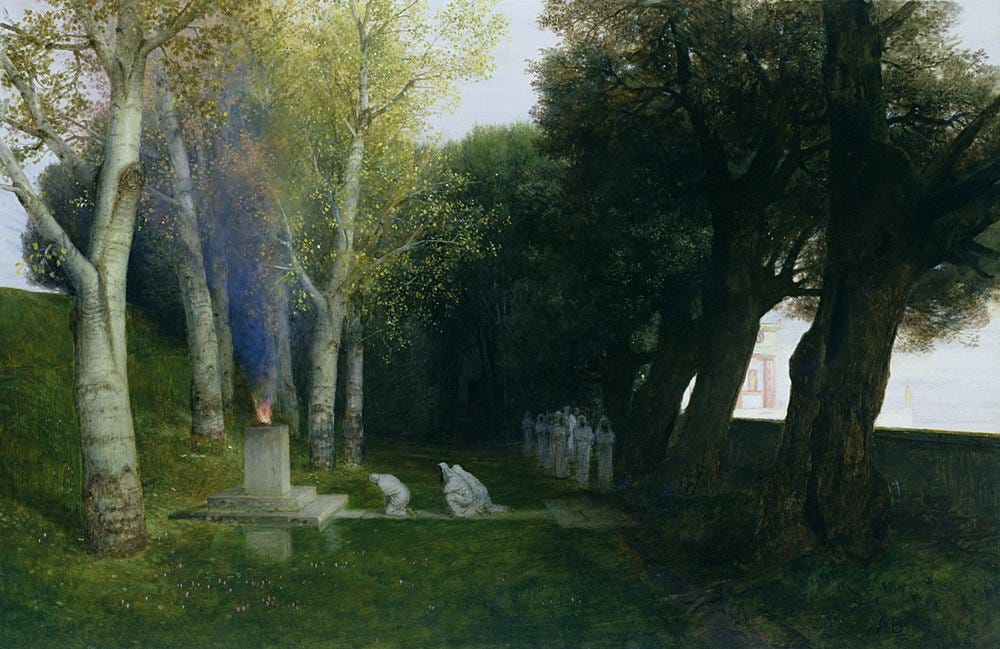
WEEK 11 · Books 23–24 · “Home”
Book 23
Eurycleia runs to wake Penelope and tell her Odysseus has returned — Penelope comes down and sits in silence before the bloodstained man, unable to believe — Telemachus rebukes his mother for her cold heart — Odysseus smiles and waits — Penelope orders Eurycleia to move the bed Odysseus built outside his chamber — Odysseus erupts: the bed cannot be moved, it is rooted in a living olive tree, their secret — Penelope weeps and takes him in her arms at last — They lie awake telling each other everything: twenty years of wandering, twenty years of waitingBook 24
The shades of the suitors descend to the underworld, where Agamemnon envies Odysseus his faithful wife — Odysseus goes to his father Laertes in the orchard and finds him diminished by grief — He tests the old man with a false tale, then reveals himself; Laertes weeps and his strength returns — The families of the dead suitors arm for vengeance — Athena holds the two sides apart and compels a truce — Ithaca is restored to an uneasy peace, and the long journey of Odysseus is at last complete
Proofread by Lisa Statler

The small, almond-sized structure located deep inside your brain that controls your homeostasis (internal balance) is called the hypothalamus. The prefix hypo means “below” or “underneath” in Greek. Thalamus means “inner chamber,” so combined, that small structure within all of our brains is, quite literally, a “lower chamber.”
It is a slightly disconnected, perhaps even too speculative parallel, but Book 23 revolves around the thalamos, which in Ancient Greece meant the inner chamber, the bedroom, the bridal suite at the centre of a house.
The thalamos of Ithaca was built around the olive tree that was already growing in the courtyard. In Greek myth, the olive was central to Athens’s own origin story: in the contest between Athena and Poseidon for patronage of the city, Athena’s gift was the olive tree, and it won her the city’s name and allegiance over Poseidon’s saltwater spring.
It is a symbol of wisdom and peace, and Odysseus has already encountered the olive tree several times before this. On Scheria, washed ashore naked and exhausted, he took shelter under two olive bushes grown from a single root, one wild and one cultivated — barbarism and civilisation, as we explored earlier. He meets the olive tree wherever he needs wisdom, peace, protection, or a sense of the divine.
So the fact that the thalamos of his household — the centre of the house, its inner chamber was built around the olive tree already growing in the courtyard, with the walls raised around the tree rather than the tree fitted to the walls, I find wonderfully beautiful.
And the description of how it was made, in what sequence, is mind-blowing: the leaves cut away like hair falling from a young woman, the smoothing and boring of the trunk reading like the language of marriage itself. Building the chamber is, in some sense, Odysseus building his marriage.
The most beautiful part of the description, to me, is that the living core of that tree is preserved: the bed and the bedchamber function as the household’s navel. The tree was never cut down and turned into mere timber it is still alive and still organic. How beautiful, how wonderful!
This organic nature wasn’t only poetic. The olive was the actual backbone of a Greek household’s wealth and survival rooting a household’s future in something this hard to kill and this slow to grow is itself a claim about what true stability requires.
Comments
Nothing yet. Say the first thing.
Sign in to join the conversation.