
If you suffer from chronic illness or chronic pain, then you know one of the most frustrating and devastating experiences is for someone to gaslight your experience, for them to suggest that it’s not real, or that it’s not as bad as you think, or that it’s all in your head.
But are you also gaslighting yourself?
Do you find yourself thinking you should be better by now? Or that you should be able to do more? Or that you should have mastered pacing at this point and you shouldn’t be over-stressing your body anymore? Or that other people were able to recover faster so you should too? Or that a couple hours of work isn’t that hard, so you should be able to make that happen? Or that a short walk really shouldn’t be so exhausting?
Did you notice the key word in every one of those questions? If you find yourself thinking that you “should” be able to do something, or that you “shouldn’t” be feeling some emotion, or that you “should” have achieved some level of recovery, or any other “should,” then you may be gaslighting yourself.
My experience
I had this realization in my own life a few weeks ago. I learned that a number of my former colleagues were connected—though loosely—to the Jeffery Epstein scandal. In an email regarding a conference with 25 main participants (only two of whom were women), Epstein wrote, “John, the old conferences did not care about diversity. I suggest you not either. The women are all weak, and a distraction sorry.”
During my time at an organization—also the same time that email was written—I was working with or had met a third of the male participants of that conference.
I cannot begin to describe how hard I worked when I was at that organization and how hard I tried to prove myself—and to many of the men associated with that conference, no less. Yet I felt consistently ignored, dismissed and passed over while I was there. It was devastating, and it’s ultimately why I left the organization.
For years after, I wondered what was wrong with me that I couldn’t convince these people that I understood the issues and that I had good ideas. I have since had success with many of my ideas, so I had confirmed the ideas weren’t the problem, but rather, I hadn’t been able to convince them to listen to me. I thought the problem was me.
Then earlier this year, articles like the one linked above started to come out. I learned conclusively that some of the people I worked with were part of a culture that, at best, turned a blind eye when they heard things like, “the women are all weak.” But how many people had I interacted with who actually believed such statements, or worse?
These articles brought up a lot of emotions. Yes, I felt validated. Yes, I felt angry. Yes, I also felt grief because I knew I had spent a decade of my life, including many years after I left, trying to work within that ecosystem.
When those articles started coming out, I practiced what I had learned over the past few years: I felt my emotions, I did JournalSpeak to tap into deeper emotions, and I shared what I was going through with people I trusted. But each time I shared what I was feeling, although the people I shared this with all agreed that this was awful and I was right to be upset, I kept walking away feeling like they were gaslighting me.
My experience felt minimized. No one seemed to understand how upsetting this was, or why it was so painful. People agreed I was right to be angry, but I kept sensing an underlying vibe that I was blowing this out of proportion.
I started to feel alone and abandoned and deeply frustrated. Then I had an ah-ha moment.
During a JournalSpeak session, I suddenly realized that my big problem was not that other people were gaslighting me. The problem was that I was gaslighting myself!
That underlying vibe wasn’t coming from other people: it was coming from me.1
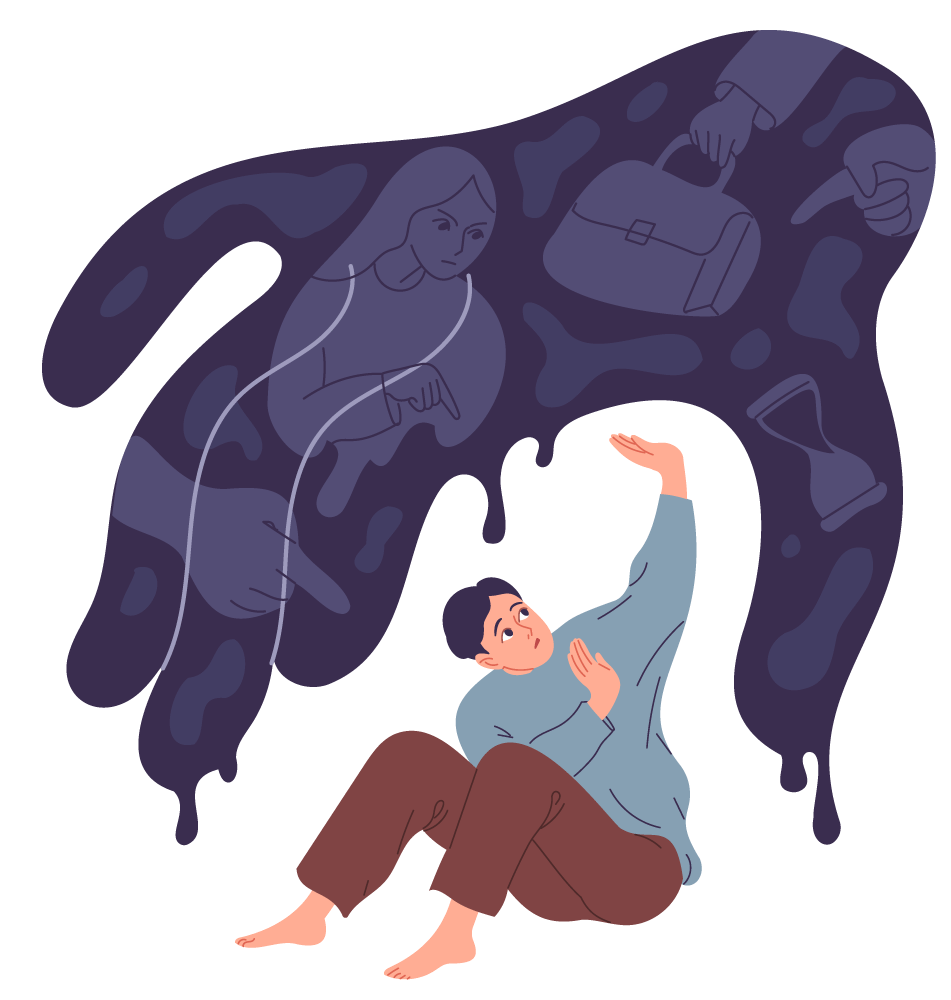
Deep down, hidden in the darkness of my subconscious, was a voice telling me that none of this was a big deal, and I could be wrong anyway. Maybe I had experienced misogynistic colleagues, but maybe not—maybe the problem really had been me the whole time, and I should have worked harder or been smarter. Maybe I really should have been able to do a better job at this organization, and the fact that I couldn’t cut it had nothing to do with other people. If I was a better person, I should have been able to succeed even in a discriminatory setting. Plus, when it comes to Epstein, a lot of women suffered far, far worse than anything I experienced, so I didn’t have the right to be as upset as I was.
The voice was relentless, but it boiled down to three main problems: I should have achieved greater success at that job, regardless of the obstacles in my way; I shouldn’t have been as upset as I was; and, especially since I’m supposed to be so good at processing my emotions at this point, I should have gotten over this and moved on quickly.2

Shoulding on myself
Perhaps you’ve heard the phrase, “stop shoulding on yourself.” At this point, most of us likely know that “should” is a problematic word, and for a couple of years, I’ve tried to shift how I talk to myself. But subconsciously, I was still doing this to myself. When I realized I was “shoulding on myself,” even in a situation where everyone agreed I was justifiably upset, it suddenly clicked how often I had been “shoulding on myself” during my recovery as well.
Even while sick, I should have been able to work from home and take naps and be fine. I should have been able to take my dogs for a short walk. I should have been able to cook easy dinners and put dishes in the dishwasher. The doctors weren’t finding anything wrong with me, so I should have been able to do more than I was doing. Other people got better by doing X, Y, or Z, so I should have gotten better doing those things too. Once I came across these healing techniques, I should have been able to function at a higher level than wherever I was at because I’d already done so much work to heal.
Even today, I often find myself thinking things like: I should be able to stick to a schedule, and I should be able to do a JournalSpeak session and process my emotions on a topic, and be done with it.
The list of “shoulds” was never-ending. Yet every time I told myself that I “should” be able to do something or I “should” be better, I was actually gaslighting myself.
Among other things, I was trivializing my experience, I was questioning myself, and I was denying my real feelings. I was telling myself that my experience wasn’t as bad as it actually was, and something was wrong with me if I couldn’t deal with my situation and function at the same level as other people.
Gaslighting ourselves
Gaslighting is a “form of psychological abuse where a person causes someone to question their sanity, memories, or perception of reality.” I fear many of us do this to ourselves.
If you’re sick, that is your reality. But if you tell yourself that you shouldn’t feel this badly or be so tired, then you may be gaslighting yourself.
Any time you feel resistance to doing something but tell yourself you shouldn’t feel that…
Any time you feel an emotion strongly, but tell yourself that you’re overreacting and it’s not that big of a deal…
Any time that you feel like you should have been able to do more than you were able to do…
Any of those instances, and many other “shoulds,” may be examples of gaslighting yourself.
Often, when we hear a voice inside us say, “I should…” or “it isn’t that big of a deal,” that voice may not be ours, but may instead be critical voices from our childhood that we internalized.
The voice and the words may have originally come from parents or teachers or friends or other influential people in our lives—people who told us that there were certain ways to be, and we weren’t meeting those standards. These people may have been cruel and abusive, or they may have been people who were genuinely trying to help us, but going about it the wrong way. Their words may have been misguided attempts to help us fit in or become responsible adults or even just feel better if we seemed excessively upset about something.
Regardless of the intent though, the outcome was the same: we’re now questioning our experiences and gaslighting ourselves if we don’t feel that we’re measuring up.
If you think you may be gaslighting yourself, I recommend three practices: Parts Work and JournalSpeak so that you can identify the voices that are questioning your experience, and self-compassion, which is the antithesis of shoulding on yourself. (Self-compassion recommendations: My experience with self-compassion, the book on self-compassion, and a short audio course on self-compassion.)
All that said, I’m not convinced that every form of “should” counts as gaslighting. However, I do believe that most, if not all, forms of “should” are harmful. For the next post (hopefully next week), I’m going to dive deeper into issues with the use of “should,” and I’ll offer tips to counter it and be kinder to yourself. Topics will include:
“Should” is the opposite of acceptance, and acceptance is critical to healing.
“Should” is the opposite of self-compassion, and self-compassion is critical to healing.
“Should” triggers feelings of shame, and shame activates your fight/flight/freeze response. In fact, some argue that shame is a freeze response. Every time a part of you says “should,” you may be activating your nervous system and potentially making yourself or your situation worse.
If internal voices are saying “should,” it may be a way for your subconscious to mask repressed things that it wants to keep hidden.
What does “should” feel like in the body?
Tips to deal with all of this.
The Healing Pathways is a reader-supported publication. To receive new posts and support my work, consider becoming a free or paid subscriber.
If you’re feeling gaslit by others, trust that. I’m not suggesting that if you’re feeling like others are gaslighting you, then it might be in your head. How ironic would that be??? Rather, I suspect that, in addition to being gaslit by others, people with chronic conditions may also be gaslighting themselves. I’m sharing my experience here to help you gauge if you think you might be doing this to yourself.
Reminder: Emotional processing takes time, and the amount of time it takes differs depending on the size of the emotional wound. I like to think of it like a physical injury. A paper cut sucks, but heals quickly. A broken leg takes weeks, months or sometimes even years to fully heal. If you break your leg, no one expects it to heal as fast as a paper cut. Yet I often found myself expecting to heal big emotional wounds at the same rate as smaller ones. If you ever find yourself thinking that you “should” be over something already or that you “should” be healed already, it might help to remember that whatever is broken, whether emotional or physical, needs as much time as it takes to heal. Just as two people can cut themselves with the same knife and have two very different sized wounds, two people can also experience similar emotional challenges and require different amounts of time and energy to process. So don’t judge your experience compared to someone else’s. Moreover, with emotional wounds, there may be hidden layers that are festering for a while before you even discover they exist, and you can’t heal a wound if you don’t know it’s there. Give yourself lots of compassion if you feel like you “should” be better but aren’t yet.
Thanks for reading The Healing Pathways! This post is public so feel free to share it.
Comments
Nothing yet. Say the first thing.
Sign in to join the conversation.