
There’s a certain sort of common counterfactual writing that I find myself falling into, sometimes: imagine if the other side did it.
It’s hard not to. We had years of Obama “scandals”. There was the famous contrived panic over him wearing a tan suit.
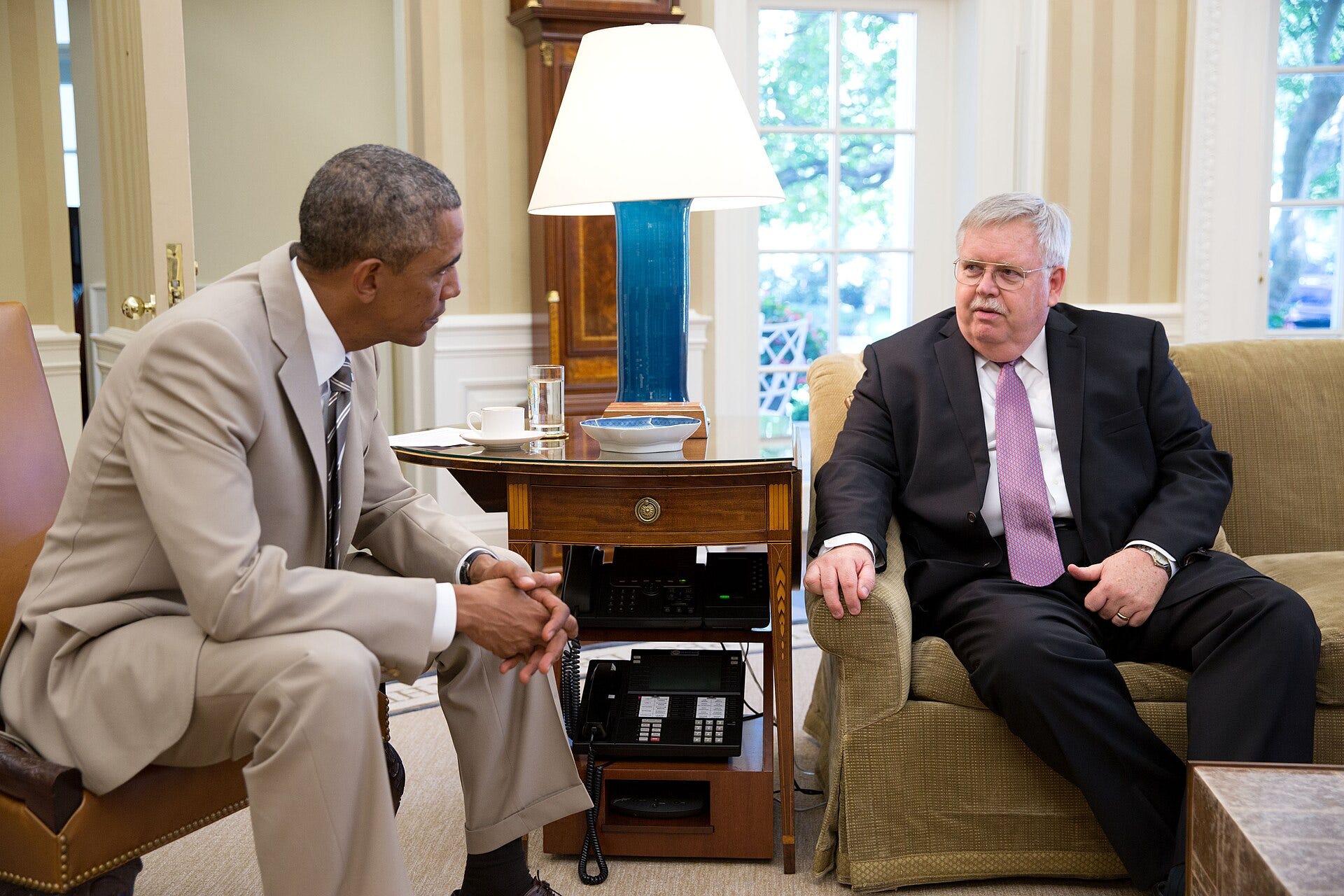
Or remember that slip of the tongue where he started he’d visited 50 states on the campaign but corrected mid-stream to 47, ended up flubbing the line into “57 states”? That was EIGHTEEN YEARS AGO and US conservatives are still talking about it as a sign that Obama was either a moron or a secret Islamic agent.
Meanwhile, when Donald Trump (or a staffer) prematurely posted a tweet about bad press coverage, mistyping “coverage” as the now-infamous “covfefe”, we were treated to endless stories about the real meaning of the mysterious new word.
Or compare the second half of Joe Biden’s presidency. Every slip-up, misspeaking or forgotten name was treated as a major international news story, a sign that Biden was suffering from hidden severe dementia, like when he called Abdel Fattah Al-Sisi the president of Mexico (rather than Egypt).
Trump’s increasing incoherence creates a tension when covering his remarks. His speeches are so long and meandering that they’re rarely broadcast in full. Even when he garbles the soundbites, the media often clears it up in post-production. He shares unhinged rants online, but only on his own Truth Social platform where nobody really sees them (and this is a digression, but it’s wild that the most important US government announcements are made on a social media platform owned by the President and nobody even treats this as a scandal).
But it’s hard to compare like for like. Perhaps Trump’s just lucky, or talented, good at saying dumb things that the media won’t care about, while Biden’s gaffes were more newsworthy. It’s not like they’ve ever made the exact same error, right?
Right?
In July 2024, President Joe Biden hosted in the annual NATO summit in Washington DC. On the final day, July 11, Biden was on stage with Ukrainian president Volodymyr Zelenskyy to announce a defence compact. Introducing Zelenskyy, Biden said:
As I’ve said before, Russia will not prevail in this war. Ukraine will prevail in this war. And we will stand with them every single step of the way. That’s what the compact says loudly and clearly.
And now I want to hand it over to the President of Ukraine, who has as much courage as he has determination. Ladies and gentlemen, President Putin…
Biden immediately noticed his rather awkward error and tried to roll back mid-sentence:
…President Putin—he’s going to beat President Putin—President Zelenskyy. [Laughter]
I’m so focused on beating Putin, we’ve got to worry about it. Anyway, Mr. President.
It was an awkward moment that became a major international story, dominating the day’s coverage of the summit. The BBC’s Chris Mason described the reaction in the room:
There were audible gasps in the press room as the words were uttered. Reporters from all over the world were dumbstruck at what they had just heard.
The Reuters wire service ran the slip as a full story, which guaranteed broad media pickup of the syndicated content. Centre-left publications like the Guardian also felt it was newsworthy as well as, of course, all the US networks.
Other world leaders at the NATO summit were asked about Biden’s fitness after the Putin remark. Zelenskyy was forced to defend Biden. An NBC roundup of the coverage noted:
In Asia, all five major Japanese TV networks reported on Biden’s mistake, as did newspapers in Singapore, South Korea, India, Hong Kong and China.
China’s hawkish Global Times newspaper ran a story headlined: “Biden’s statement of ‘Ukrainian President Putin’ worries foreign media.” It was also a top search topic on China’s X-like social media platform Weibo.
News outlets in Saudi Arabia and Egypt also noted the slipup, and Qatari network Al Jazeera said, “Biden’s gaffes mount and calls for his withdrawal increase.”
Ten days after the incident, Joe Biden withdrew as the Democratic candidate for the 2024 presidential race, citing his age.
Almost exactly two years later — and a few days ago, last Wednesday — President President Donald Trump was in Ankara, Turkey for the annual NATO summit. Sitting on the stage at a joint news conference with Ukrainian president Volodymyr Zelenskyy, Trump gestured towards Zelenskyy and said:
“You have a question for President Putin, please?”
The assembled press chuckled for a few seconds, and Trump, unwilling to admit a mistake, continued
“Do you have a question for President Putin — not Zelenskyy, Putin? What would you like to ask him? Because I’m going to ask him that question.”
Same conference.
Same time of year.
Same Ukrainian president.
Same gaffe, calling him by the name of the same enemy leader.
Same media reaction?
Well…. no.
This time there was no Reuters story. In fact, the Reuters report of the Trump-Zelenskyy meeting doesn’t mention the verbal slip at all. I can’t find any Guardian report either. Ditto CNN, Axios, NBC and most of the other major news outlets that treated Biden’s identical slip a global and potentially presidency-ending story.
A few outlets made Trump’s remarks a story, like Forbes, Newsweek and the Mirror. These pieces also highlighted a few other, erm, odd remarks Trump made at the summit, most notably claiming that the US Navy was attacked by the “Islamic Republic of Japan”. Nobody corrected Trump, and the mistake spawned a bunch of memes and mockery online but also relatively modest traditional media coverage.
Trump also referred to the Obama-era Joint Comprehensive Plan of Action (JCPOA) as the “JCPOC”, though it wasn’t completely clear if that was a mistake or a racist joke.
Oh, and he insisted he was “number one on Tic-Tac”, messing up the name of Tiktok while also lying egregiously about his popularity on the platform.
But even all these together just merited some roundup articles, not the breathless international crisis coverage that Biden’s remarks garnered.
Of course, the two Putin gaffes aren’t really identical. There’s always context; in Biden’s case, the context was the disastrous debate he’d just had with Trump and the pressure on him to drop out of the presidential race as he defended his mental fitness against critics. In that context, every flub was being hyper-scrutinised.
But… well, that’s also kind of true of Trump, who obsessively cites his ‘aced’ cognitive tests to preempt critics that wonder about his age and mental fitness. Trump’s over 80, and his mental and physical health are the subject of intense speculation. OK, he’s not running again, but he’s supposed to be in office for another two and a half years. In some ways, that should be more of a story than Biden, who looked like he was going to lose.
These days, being on the right has become playing politics on easy mode, partly because the right has abandoned almost all moral claims, effectively immunizing themselves against claims of hypocrisy. “We’re supposed to be racists and abusers, so it’s dog-bites man. But those lefties and liberals, they say they’re against that stuff so when they do it, its wrong and it’s newsworthy”.
So having far-right tattoos and past accusations of sexual assault is fine if you’re a Republican. You can be Secretary of Defense.. or War, if you prefer. And that doesn’t mean you can’t attack the Democrats for nominating a man with far-right tattoos and past accusations of sexual assault. Why should it? We’re the baddies, but they’re supposed to be better!
This accounts, I think, for a certain amount of unbalanced media coverage against the left. A generation ago, it was the opposite, when conservative politicians were preaching “family values” but getting caught with their pants down every couple of weeks. But that was then. The 21st century cultural right doesn’t have any such morals to betray.
It’s not hypocrisy, but maybe there’s something similar going on here. Barack Obama and Joe Biden were “supposed to be” normal presidents, respected on the world stage, expected to act with honesty, wisdom and integrity. They’re judged by the rightly high standards of the job.
Donald Trump isn’t. He’s not really expected to be up to the job, so he’s graded on a scale, judged as “clown president” who’s had a good day whenever he hasn’t directly and personally caused a crisis or disaster.

Everything Price Sufferer (but especially eggs)@agraybee
This is what paradoxically makes Trump an impossibly strong candidate, he gets to run as clown president while his opponents are forced to talk about their healthcare policy.
11:45 AM · Dec 1, 2025 · 17.5K Views
16 Replies · 105 Reposts · 1.32K Likes
Trump got Zelenskyy’s name wrong? Well, it’s good he tried! He claimed to be the biggest account on Tiktok? At least this morning he isn’t claiming to have created the tides or building a tower to the moon, right? The reflecting pool is green and now he’s arresting anyone who touched it for sabotage? At least he didn’t demolish the Lincoln Memorial and blame it on Antifa. Yet.
It’s not news that he’s not up to the job because… well, because it’s not actually news that he’s not up to the job!
And that means Trump has had, and still has, a fundamentally positive media environment, even among outlets that openly hate him.
I think this really began in 2015 when Ryan Grim and Danny Shea at the Huffington Post decided that the Trump campaign would be covered in the Entertainment section and not as a political story. They wrote:
“After watching and listening to Donald Trump since he announced his candidacy for president, we have decided we won’t report on Trump’s campaign as part of The Huffington Post’s political coverage. Instead, we will cover his campaign as part of our Entertainment section. Our reason is simple: Trump’s campaign is a sideshow. We won’t take the bait. If you are interested in what The Donald has to say, you’ll find it next to our stories on the Kardashians and The Bachelorette.”
Trump’s been President twice now, and much of the media still follows this policy to some degree, through ICE raids, pandemics and foreign wars. Isn’t it so entertaining? Remember not to take him too seriously, though.
We don’t get to do double-blind controlled political or media experiments. It’s unusual to see the exact same incident under two different presidents and see if our intuitions about coverage are accurate.
This time, we did. Same gaffe, same venue, same context. The only real change was the identity of the president. And that made all the difference.
No posts
Comments
Nothing yet. Say the first thing.
Sign in to join the conversation.