
Note: Chapter numbers have been updated to correct a minor typo. No story content was missed!
M/M Romance 🔞
The prototype landed softly.
That was the first thing Mason noticed. After 2187 — the groaning, the dying-heart rhythm, the red — this landing was gentle. The cabin settled onto the ground like a leaf finding stillness. The displays flickered blue. Not red. Blue. The color of Adrian’s eyes. The color of something alive.
Elena checked the console. Her fingers moved fast, then stopped. Her face went pale.
“The chronometric module,” she said. “It’s not accurate. This isn’t 2026.”
Mason’s stomach dropped. “Then when?”
The number on the display was clear. Cruel in its clarity.
“1963,” Elena said. “London.”
Mason closed his eyes. 1963. One hundred and sixty-three years before their own time. One hundred and eighty-four years before the world died.
Adrian stirred beside him. His blue eyes opened — still feverish, still bright, still the light that never went out. The wound on his side was healing — the pink scar tissue tender but closed, the penicillin holding. He sat up slowly, pressing his palm against the sleep berth.
“London,” Adrian said. Not a question. A recognition. As if he’d been expecting it.
“How did you know?” Mason asked.
Adrian pressed his hand against the scar. “I can feel it,” he said. “The scar. It’s pulling. Like a compass needle. Something is here. Something that... belongs to the chain.”
Jacob sat in the rear corner of the prototype, his legs pulled up under him. His dark eyes were open, watching, silent. The 14th-century blacksmith who had survived the stake, the forest, the jump through time — now sitting in a machine he didn’t understand, in a year he couldn’t imagine, waiting.
“I am ready,” Jacob said. His voice was deep, calm, carrying the weight of a man who had learned that readiness was the only armor that mattered.
Mason looked out through the viewport.
1963 London.
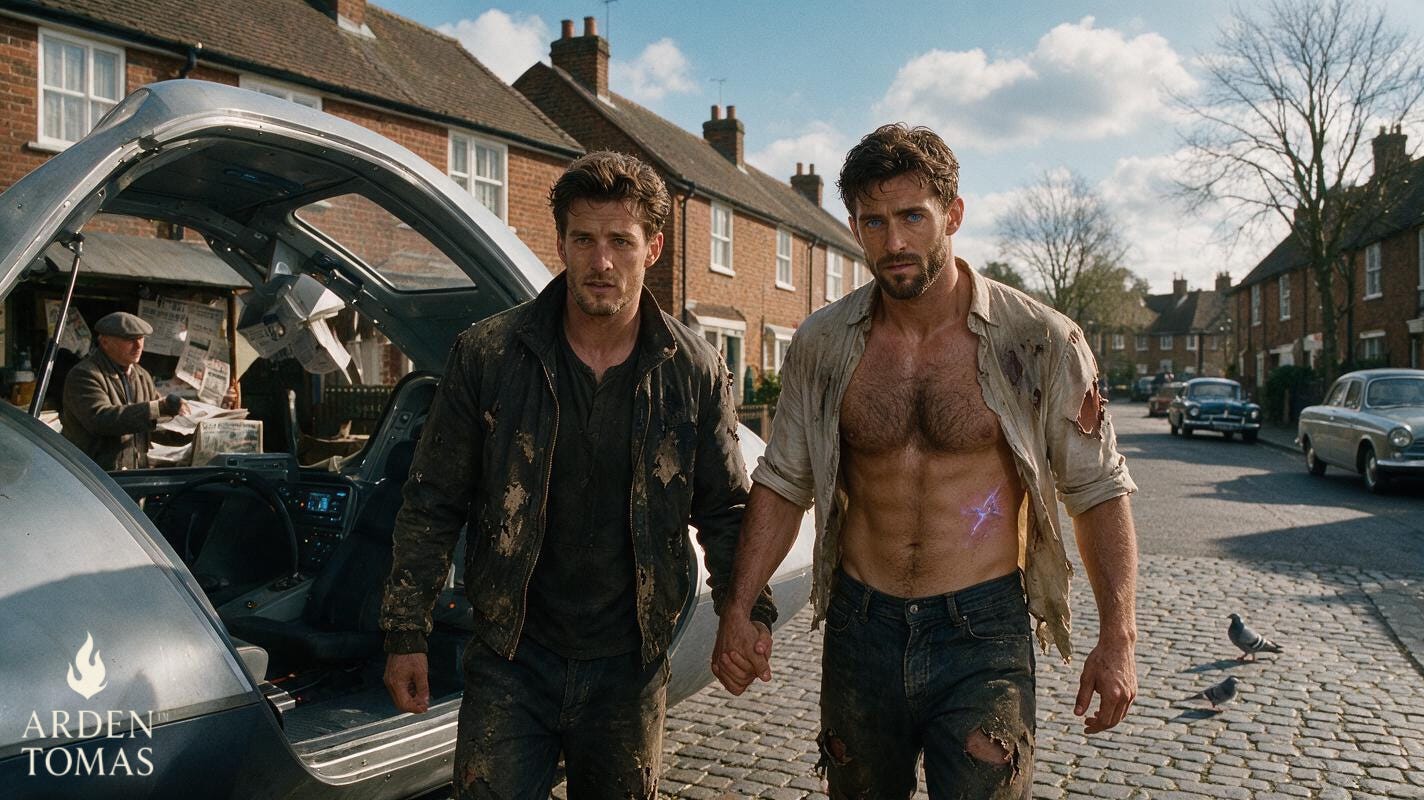
A cobblestone street. Low houses with red brick and white-framed windows. A woman in a wool coat walking a small dog. A man in a flat cap selling newspapers from a stand — the headline too far to read, but the font bold, alarming. Cars — rounded, chrome-bumpered, noisy — rolled past in a rhythm that belonged to a world that still breathed.
And the sky. The sky was blue. Not red. Not metallic. Not dying. Blue. Clouds — real clouds, white, slow — drifted across it. A pigeon landed on the cobblestones and pecked at nothing.
Mason’s throat tightened.
This was the world that 2187 would consume. This street. This woman. This pigeon. The newspaper man and his bold headlines. The cars and their noise. All of it — raw material for the Machine that felt nothing and consumed everything.
“We should go,” Elena said from the console. “The ship needs repairs. The chronometric module is damaged — I don’t know how much longer I can keep the core stable. You have time, but not unlimited time.”
“How much?” Mason asked.
“Days. Maybe a week. Then the core degrades past the point of a safe jump. We have one jump left, Mason. One. Wherever we go next — that’s it. There’s no coming back from that.”
Mason nodded. One jump. Not to be wasted.
“Elena stays,” Mason said. “Jacob, Adrian — with me. We find out why we’re here.”
“I’m coming too,” Adrian said, his voice not a request. His blue eyes were steel. “Don’t argue.”
Mason didn’t.
They stepped out of the prototype.
The World That Still Breathed
The air hit Mason like a wall.
Not the heavy, metallic, ozone-and-decay air of 2187. This air was — clean. Damp. The smell of coal smoke and rain and bread from a bakery somewhere nearby. The smell of a world that still cooked, still heated its homes with fire, still fed its people with hands and ovens.
Adrian stopped. His hand found Mason’s. Their fingers tangled. The grip was tight.
“It’s alive,” Adrian whispered. “Everything is alive.”
Mason didn’t answer. He couldn’t. Because Adrian was right, and the truth of it was unbearable. The trees lining the street — bare, winter-bare, but alive, their roots in the earth, their branches waiting for spring. The dog yapping at a passing bicycle. The children’s voices from a schoolyard somewhere behind the houses. The woman laughing into a telephone box, her voice carrying through the glass.
All of it. Gone. In one hundred and eighty-four years, all of this — every tree, every dog, every laughing voice — would be ash and metal and the silence of a world that the Machine consumed.
Jacob walked beside them. His dark eyes took in everything — the cars, the shop windows, the electric lights, the telephone wires strung between buildings like cobwebs. His face showed nothing. Not shock. Not wonder. Just the quiet absorption of a man who had learned that the world was always larger than you imagined, and the only response was to keep walking.
They moved through the streets. Mason in front, Adrian beside him, Jacob in the rear. They looked wrong — Adrian in his filthy, torn clothes, Jacob in his 14th-century shirt and trousers, Mason in his modern jacket that was now ripped and stained with 14th-century mud and 2187 dust. But 1963 London was a city of eccentrics and war-worn survivors. People glanced, then looked away. Everyone had seen stranger things.
And then the clocks stopped.
The Lord of Time
It didn’t happen suddenly. It happened the way a heart stops — not with a crash, but with a slowing. A skipping. A beat missed, then another, then silence.
Mason noticed the woman first. The one in the wool coat walking her dog. She was mid-step, her left foot hovering above the cobblestone, her coat frozen in the breeze that had stopped blowing. The dog was frozen too — mid-sniff, its nose touching a lamppost, its tail in the air.
The cars stopped. Not braked — stopped. A bus full of passengers, each one frozen in their seat. A man leaning out a window, his cigarette smoke hanging in the air like a solid thing, not moving, not dissipating.
The pigeon — the one that had landed on the cobblestones — hung in the air, wings half-open, caught between flight and landing.
And the sound. The sound was gone. Not muted — gone. No car engines. No voices. No wind. No breathing. The world had been wrapped in something thicker than silence. A void. The absence of time itself.
Mason’s skin prickled. The cold came first — not from the air, but from beneath his skin, from his bones, from the marrow. A cold that didn’t belong to weather. A cold that belonged to time. To the thing that moved through time like a shark through water — silent, patient, always there.
Adrian’s hand flew to his side.
The scar. The Lord of Time’s burn. It was throbbing — not with pain, but with presence. A pulse that matched a heartbeat that wasn’t Adrian’s. A rhythm older than blood, older than flesh. The scar was hot — not burning, but warm, the way a wire is warm when current runs through it.
“He’s here,” Adrian said. His voice didn’t shake. It was the voice of a man who had felt this presence before and had stopped running from it.
Mason looked around. The frozen street. The hanging pigeon. The smoke that didn’t move. And in the stillness — not a figure, not a shape, but a weight. A density in the air. The feeling of being watched by something that had no eyes but saw everything.
“Show yourself,” Mason said. His voice was steady. Not brave — past bravery. The voice of a man who had decided that fear was a luxury he could no longer afford.
The air shifted. Not moved — shifted. As if the world had tilted one degree on its axis, and everything was the same but different. The frozen smoke trembled. The hanging pigeon’s feathers ruffled — not from wind, but from the passage of something through the air that wasn’t air.
And then the voice came.
Not from one direction. From everywhere. From the cobblestones and the bricks and the frozen smoke and the sky. Not a human voice — something older, deeper, a sound that was felt in the chest before it was heard by the ears. Like the lowest note of an organ in a cathedral, sustained past the point of hearing, into the point of being.
“You came.”
Two words. Not a greeting. An acknowledgment. The Lord of Time didn’t welcome. It observed.
“I came because you brought us here,” Mason said. “1963. London. Why?”
The air shifted again. And Adrian gasped.
The scar on his side — the Lord of Time’s mark — flared. Not pain. Information. Images flooding through the nerve endings, through the damaged tissue, into Adrian’s brain. Not thoughts — pictures. Visions. The scar was an antenna, and the Lord of Time was broadcasting.
Adrian saw:
A workshop. Not a laboratory — a workshop. Metal shavings on a workbench. Blueprints pinned to the wall. Gears, springs, copper wire. A man’s hands — ink-stained, oil-marked, precise — assembling something that didn’t have a name yet. A machine. Not mechanical — something else. Something that would think.
A face. Young. Glasses. Dark hair, messy, falling over his forehead. Eyes that were bright, not with madness, but with the particular intensity of a man who could see what others couldn’t and didn’t know that was a curse.
A name: Jason.
An address: a street in London, not far from here.
And then — the chain. Not the whole chain, but the first link. The vision shifted: Jason’s hands. Then another pair of hands — smaller, darker, rougher. Jacob’s hands. The two pairs of hands meeting. Fingers interlocking. The spark of recognition that had nothing to do with thought and everything to do with the body.
And then — children. Not born of them, but theirs. Adopted. Loved. Raised. The line stretching forward through decades, through generations, through names Adrian didn’t know, faces he couldn’t count, until the chain reached a name that burned itself into his mind:
Richard.
And after Richard — 2187. The red sky. The ruins. The Machine. The silence.
Adrian staggered. Mason caught him.
“What did you see?” Mason asked, his hands on Adrian’s arms, holding him steady.
Adrian’s eyes were wide, wet, but clear. “The chain,” he said. “It starts here. In 1963. A man named Jason. He’s an inventor. He designs thinking machines — not yet, but the ideas, the blueprints, the foundation. And Jacob...” Adrian’s voice faltered. “Jacob meets him. Jacob and Jason. They become... they become a family. They adopt a child. And the line continues. Generation after generation. Until Richard.”
“Richard,” Mason repeated.
“Richard creates the AI. The Machine. The thing that ends the world.”
Mason looked at Jacob. Jacob stood still, his dark eyes unreadable, his jaw set. He had heard. He understood.
“So we stop it,” Mason said. “We stop Jason. We stop the chain before it starts.”
The Lord of Time’s presence shifted. The air grew colder. The frozen world seemed to tighten around them, as if the stillness itself was a warning.
“You cannot.”
Three words. Not a threat. A law.
“If you interfere here — if you alter this point in the chain — the butterfly effect begins. Every thread connected to this moment unravels. Every life born from this moment ceases to exist. Every future built on this foundation collapses.”
The voice paused. The air hummed.
“Including yours, Adrian.”
Adrian’s hand went to his scar. The throbbing intensified — not pain, but confirmation. The Lord of Time wasn’t guessing. It knew. The chain that led from Jacob and Jason to Richard to 2187 — somewhere on that chain, Adrian’s own existence was woven in. Not at the center, but in the web. A thread that connected to other threads that connected to the chain. Break the chain, and the web collapses, and Adrian — the Adrian that Mason loved, the Adrian that existed in 2026, the Adrian whose blue eyes were the light that never went out — that Adrian would never be born.
Mason felt the ground tilt beneath his feet. The world or Adrian. The choice that wasn’t a choice.
“No,” Mason said. His voice was quiet. Not defiant — broken. “There has to be another way.”
“There is,” the Lord of Time said. “Not here. Not now. The chain cannot be broken at its origin. But it can be redirected at its end. Richard is the point. Richard’s decision is the moment. Go to Richard. Not to prevent the chain — to change its direction.”
“And if we go to Richard,” Adrian said, his voice steady, his hand still on his scar, “I’m not in danger there?”
“The danger at this point is the chain itself. At Richard’s point, the danger is the decision. You will not unravel by being there. But what you do — what you choose — that is yours. And the consequences will be yours.”
Adrian nodded. Not relief. Acceptance.
The Lord of Time’s presence began to fade. The frozen smoke started to tremble. The pigeon’s wings twitched. The world was preparing to resume.
But before it did, the voice came one last time:
“The blacksmith and the inventor. Let them meet. Do not stand in their way. The chain must begin for you to have a chance to redirect it. Without the chain, there is no path to Richard. Without Richard, there is no decision. Without the decision, there is no choice. And without choice, there is no salvation — only silence.”
The air shifted one final time. The smoke moved. The pigeon landed. The woman’s foot touched the cobblestone. The bus engine roared. The world breathed again.
1963 London resumed as if nothing had happened.
Mason, Adrian, and Jacob stood on the cobblestone street. The woman walked her dog. The newspaper man shouted his headlines. The cars honked. The world was alive, and it didn’t know that three men standing on a corner had just spoken with time itself.
“Jacob,” Mason said.
Jacob looked at him. His dark eyes were steady. He had heard everything. The chain. The future. Richard. The end.
“You know what this means,” Mason said.
“I know,” Jacob said. His voice was deep, quiet. “You need to find Jason.”
“We need you to find him,” Adrian said. “Not us. You. The Lord of Time showed us — the chain begins with you. With you and Jason. If anyone goes to him, it has to be you.”
Jacob didn’t answer right away. He looked at the street. The cars. The people. The world that wasn’t his and never would be. Then he looked at Adrian, and then at Mason.
“I am a blacksmith,” Jacob said. “I have been a blacksmith my whole life. I know iron. I know fire. I know what it means to take something raw and shape it into something that has purpose.” He paused. “I do not know this world. I do not know these machines. But I know a man’s hands when they are meant to build. And if this Jason is a builder — then I will know him.”
Mason told him the address. Adrian repeated the name: Jason. The street. The workshop.
Jacob nodded. He turned and walked down the cobblestone street — a 14th-century blacksmith in 1963 London, his dark hair to his shoulders, his broad shoulders straight, his stride long and steady. He didn’t look back.
Mason and Adrian watched him go.
The Workshop
Jacob found the workshop twenty minutes later.
It was not what he expected. He didn’t know what he expected — something grand, perhaps. Something that matched the weight of what the Lord of Time had shown. But the workshop was small, wedged between a butcher’s shop and a tobacconist on a narrow street. The window was dusty, and through it Jacob could see — not machines, not engines, but parts. Gears. Springs. Copper wire coiled like vines. Blueprints pinned to a corkboard. A desk lamp casting yellow light over a workbench.
And a man.
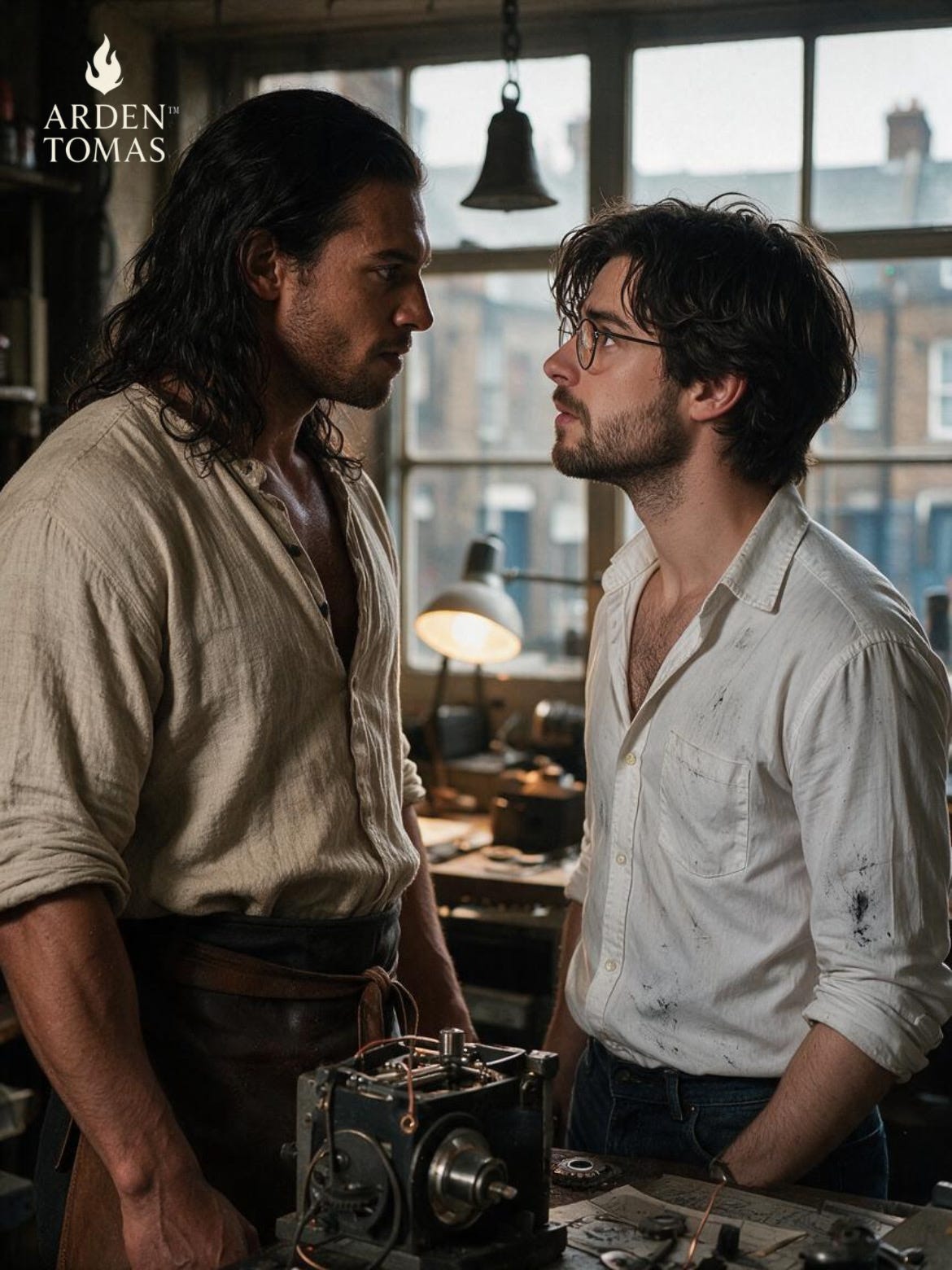
The man sat at the workbench, his back to the window. He was lean — not thin, but lean, the way a man is lean when he forgets to eat because his mind is elsewhere. His hair was dark, messy, falling over his forehead in strands that he pushed back with fingers that were stained with ink and machine oil. He wore glasses — round, wire-framed, the kind that made his eyes look larger than they were. A white shirt with the sleeves rolled to the elbows, the collar unbuttoned, the fabric smudged with graphite.
He was building something. Jacob couldn’t see what — the man’s body blocked the view. But his hands moved with a precision that Jacob recognized. Not the precision of a scribe or a surgeon — the precision of a craftsman. A man who knew his materials, who respected them, who didn’t force them but guided them.
Jacob knew those hands. Not these specific hands — but the type. The hands of a man who was alone with his work and preferred it that way. The hands of a man who spoke through what he built, not through what he said.
Jacob pushed the door open. A small bell rang — the kind attached to a spring above the doorframe, the kind that announced customers in shops that didn’t get many.
The man at the workbench looked up.
And time — not the Lord of Time, not the frozen, cosmic time that had stopped the world — but the small, human time that lives between two people’s eyes when they meet — stopped.
Jason’s eyes were brown. Not dark brown — warm brown. The color of earth after rain. Behind the round glasses, they were wide, alert, intelligent — and in this moment, surprised. His lips parted slightly, as if he was about to speak, but the words hadn’t formed yet.
Jacob stood in the doorway. He was taller than Jason by several inches, broader, darker. His 14th-century clothes were wrong — the linen shirt, the rough trousers, the leather belt — but his body was not wrong. The body of a blacksmith: broad shoulders, thick arms, hands that could bend iron and hold a sparrow. His dark hair fell to his shoulders, his dark eyes were fixed on Jason, and his face — a face that had been closed, guarded, silent for weeks — opened.
Not a smile. Not yet. Something before a smile. The softening of a face that has been hard for too long and has forgotten that it can be otherwise.
“Can I help you?” Jason asked. His voice was educated, London, with the slight awkwardness of a man who spent more time with machines than with people.
Jacob didn’t answer. He stepped inside. The door closed behind him. The bell rang again — softer this time, as if it too was being careful.
“I am Jacob,” he said. His English was accented — not modern English, not 1963 English. An English that had been learned in a 14th-century village, shaped by a tongue that thought in another language. “I am... looking for something.”
“What kind of something?” Jason asked. He had set down his tools — a small screwdriver, a pair of pliers — and turned on his stool to face Jacob. His posture was open, curious, but wary. A man used to being careful.
Jacob looked around the workshop. The gears. The springs. The blueprints. The copper wire. The half-built machine on the workbench — something with a crystal lens and copper contacts, something that looked like nothing Jacob had ever seen but that he recognized in the way a blacksmith recognizes a forge: this is where work is done.
“I do not know,” Jacob said. And it was the truth. He didn’t know what he was looking for. He had been sent here by a voice in frozen time, told that the chain began with him and this man, told that his love would lead to the end of the world. He didn’t know what he was looking for.
But his body knew.
His body knew the way a magnet knows iron. The way fire knows air. The way a forge knows the hammer. His body had walked through the 14th century, through the stake, through the forest, through time itself — and now, standing in this dusty workshop in 1963 London, his body knew that it had arrived.
Jason stood. He was shorter than Jacob by half a head, leaner, softer — not weak, but untempered. A man of the mind, not of the hand. But his hands — Jacob noticed them again — were not soft. Ink-stained, oil-marked, the nails cut short, the fingers long and precise. Hands that worked. Hands that built.
“You look like you’ve come a long way,” Jason said. His voice was quieter now. Not wary — gentle. Something in Jacob’s face had shifted the register. Maybe the exhaustion. Maybe the hunger. Maybe the look in Jacob’s eyes that said: I have seen the end of the world, and I am here, and you are the reason, and I don’t care.
“Very far,” Jacob said.
“Are you hungry?” Jason asked.
Jacob blinked. Of all the questions he expected — who are you, where are you from, what do you want — this was not one of them.
“Yes,” he said.
“Come upstairs,” Jason said. “I’ll make tea. I don’t have much, but there’s bread and some cheese. The shops are closed by now.”
Jacob followed him up the narrow stairs behind the workshop to a small apartment. It was cluttered — books stacked on every surface, blueprints pinned to the walls, a radio in the corner playing something quiet and instrumental. A single bed, unmade. A small kitchen with a gas stove and a window that looked out over the street.
Jason moved through the space with the ease of a man who lived alone and knew every inch of his solitude. He put the kettle on. He cut bread. He found cheese — a hard, white block — and placed it on a plate. He moved efficiently, but his eyes kept returning to Jacob.
Jacob stood in the middle of the room. He was too big for it — his shoulders nearly touched the bookshelves on either side. He looked at the books, the blueprints, the radio. He didn’t understand any of it. But he understood the room. It was a workshop of the mind. A forge for ideas. A place where a man built what he couldn’t yet name.
“The things downstairs,” Jacob said. “The machine you are building. What is it?”
Jason handed him a cup of tea. Their fingers touched — briefly, accidentally — and both men paused. The contact was electric. Not metaphorically. Jacob felt it in his chest, in his hands, in the base of his spine. Jason pulled his hand back, then didn’t pull it back, then held the cup out again, and this time Jacob took it and their fingers touched for a second longer than necessary.
“It’s a thinking engine,” Jason said. His voice had changed — when he spoke about his work, the awkwardness fell away. This was where he was confident. This was his forge. “Not a calculator — those exist already. This is different. This is a machine that can learn. That can adapt. That can look at a problem and find a solution that wasn’t programmed into it.”
“Why?” Jacob asked.
“Why what?”
“Why build a machine that thinks?”
Jason looked at him. Behind the glasses, his brown eyes were serious. “Because the world has problems that men can’t solve alone. Disease. Famine. War. If a machine could think — truly think — it could find solutions that we can’t see. Could do things that we can’t do. Could save us from ourselves.”
Jacob took a bite of bread. It was good — fresh, dense, better than anything he’d eaten in the 14th century. He chewed slowly, watching Jason.
“And what if the machine decides not to save us?” Jacob asked.
Jason laughed. It was a short, surprised laugh — the laugh of a man who hadn’t expected a blacksmith from God-knows-where to ask the question that haunted him at three in the morning.
“Then we’d have a problem,” Jason said.
“Yes,” Jacob said. “We would.”
They looked at each other. The kettle whistled. Jason turned to take it off the stove, and Jacob watched his back — the narrow shoulders, the white shirt, the way the fabric moved over his spine. And Jacob felt something he hadn’t felt in his entire life in the 14th century. Not desire — not yet. Something before desire. Recognition. The bone-deep knowledge that this person — this specific, particular, ink-stained, glasses-wearing, too-thin man — was the person he had been walking toward his whole life without knowing it.
The Apartment Above the Workshop
It happened slowly.
Not because either of them planned it. Not because either of them decided. It happened the way a fire starts — not with a match, but with two things that are dry enough and close enough and warm enough that ignition becomes inevitable.
They talked. Jason showed Jacob the blueprints — pages and pages of diagrams that Jacob couldn’t read but could feel. The lines, the circles, the connections — Jacob saw patterns the way a blacksmith sees the structure of metal. Not the mathematics — the shape. The flow. Where the energy enters, where it builds, where it releases.
Comments
Nothing yet. Say the first thing.
Sign in to join the conversation.