
FIVE PHILHISTORY NUGGETS
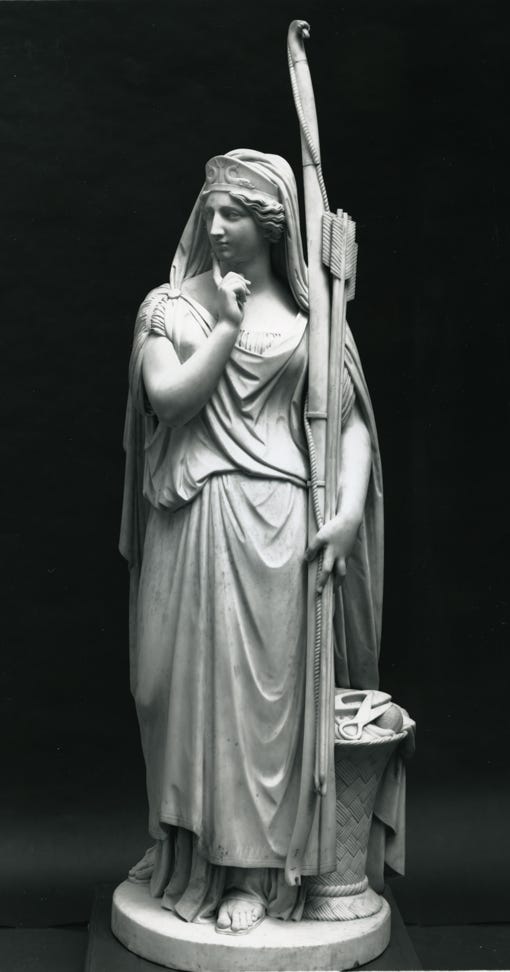
Zara and I recently, along with half of the world, saw Christopher Nolan’s The Odyssey. I know there’s a whole lot of discourse about the film’s quality and authenticity (including a juicy takedown by Odyssey translator and University of Pennsylvania classical studies professor Emily Wilson), but we came out of the Philadelphia Film Society Bourse Theater ($6 Cinemagic Mondays) with springs in our steps. The immortal images of the Homeric source text—Circe and the pigs, Polyphemus the Cyclops, the lotus flowers—have stayed on my mind since, and I decided to see if there were any Philly-bound works of art that explored the Odyssey mythos. Within the Pennsylvania Academy of the Fine Arts collection, I learned, is “Penelope” (1851) a sculpture of the Ithacan queen and Odysseus spouse preparing to (spoiler alert) doom her numerous suitors by challenging them to a feat of bow-centric strength she knew only her recently-returned, in-disguise hubby could pull off. PAFA includes in its online caption a fascinating tidbit about how “Penelope,” by the Roman sculptor Rinaldo Rinaldi, ended up at North Broad Street: Eminent local osteopathic surgeon John Rhea Barton traveled to Rome in 1851 and hand-picked the statue from Rinaldi’s studio. You can even see the work listed in an 1858 PAFA exhibit guide! I would love to see a cinematic rendering of Barton’s interaction with Rinaldi and presentation of the beautiful work to the PAFA folks:
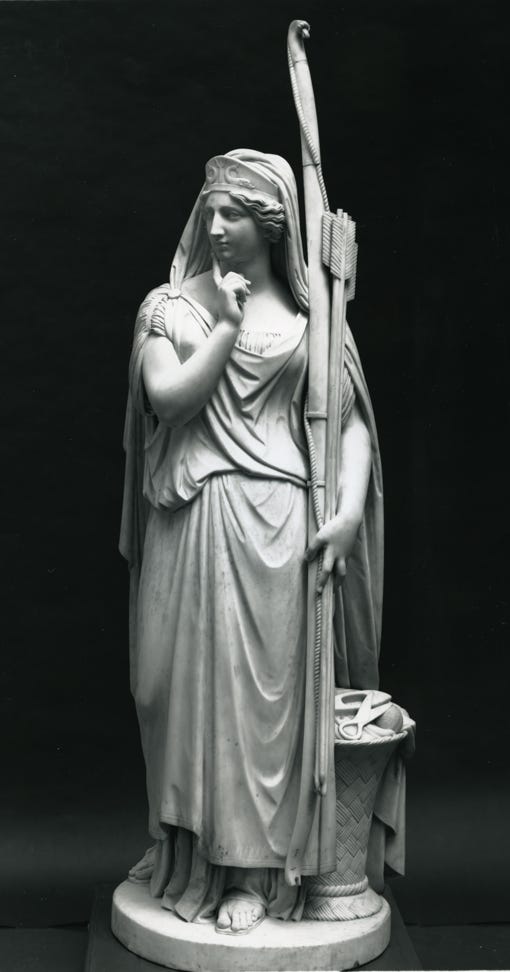
Rinaldo Rinaldi’s “Penelope” (Courtesy of the Pennsylvania Academy of the Fine Arts, 1851).
Last week, Pennsylvania Governor Josh Shapiro appeared in the music video for Philly rapper Meek Mill’s “Dreams to Nightmares,” a reworking of Meek’s iconic 2015 anthem “Nightmares to Dreams.” The Governor’s appearance made me ponder the history of musical Pennsylvania chief executives. I recalled that 1970s Governor Milton J. Shapp was an accomplished violinist, but I was shocked to find that in early 1974 he also wrote and produced—while in office, mind you—a Watergate parody song, even attending the recording session at Philly’s famed Sigma Sound Studios. The track, “The Ballad of Rose Mary,” addressed President Nixon’s personal secretary Rose Mary Woods, who was then under fire for her potentially deliberate erasure of 18 ½ minutes of missing Oval Office tape that many believed contained the “smoking gun” evidence that Nixon was in on the break-in (we still don’t know what was on that tape!). The singer of Shapp’s ditty, a Germantown High School Spanish teacher named Sue Levenson, pleads, “Rose Mary, oh Rose Mary / Please relate to our Head of State / He must make things perfectly clear, yes my dear / He must tell what the bleep went on at Watergate.” The “bleep” is Gov. Shapp’s authorial self-censorship, not mine! Shapp and Levenson’s folksy anthem thankfully survives on the Post-War American Political Songs YouTube channel, although I can’t track down the other Shapp track recorded during the same session, a commentary on the energy crisis called “No Shortage of Love.”
Since early March, Uber Eats and vehicular automation company Avride have been sending little food delivery robots around the city. Holding at constant the obviously dystopian elements of this whole development, these lil’ guys are sort of cute—they chug along with vaguely anthropomorphized faces, navigating curbs and occasionally clumsily bumping into people. I find myself wanting to speak to them. I looked into past moments of Philadelphian robot invasions and discovered that automated traffic signals—the whole green, yellow, red thing—were once conceptualized as forms of robots! A photograph from Temple’s Evening Bulletin archive shows an early trial light sometime during the 1920s at 35th and Powelton in West Philadelphia. The caption describes an “electric traffic cop,” also referring to the then-bewildering contraption as a “robot device.” I had never considered traffic lights to be robots, but I guess that’s how technological ubiquity operates—the novel becomes commonplace quite quickly. I’m sure I’ll stop even noticing my new Uberian friends in due course…
The city feels a little emptier these last couple of weeks, and I’ve slowly gleaned that many Philadelphians are “down the shore” in New Jersey. I am ashamed to admit that I have only been to the shore once—we spent a very cold February weekend in Atlantic City with our wonderful friends Ben and Sarah two and a half years ago, and did a very long and frigid walk down the boardwalk to Ventnor and Margate—we did see Lucy the Elephant, the zoomorphic seaside building designed in 1882 by Philadelphia inventor J.V. Lafferty. Beyond that, however, I really don’t know anything about the Shore. So I tracked down Rowan University social studies professor Harold F. Wilson’s magisterial, three-volume 1953 work The Jersey Shore: A Social and Economic History of the Counties of Atlantic, Cape May, Monmouth, and Ocean. You can read Wilson’s megillah on good old Archive.org—Vol. 1, Vol. 2, and Vol. 3. I’ve only just dived into this proverbial Atlantic Ocean of Jersey Shore information, but Philly is everywhere—in the real estate, in the architecture, and in the copious personal biographies of notable Jersey Shore residents that make up Vol. 3…I can’t believe Professor Fisher wrote all this…
I was yearning for a good Philadelphia summer poem this week—some moving language to help deal with the dog day heat and the loose ends that always begin to get tangled at the end of this warm season. I found Heather McHugh’s beautiful “Language Lesson 1976.” I’m not sure if this was written in 1976 or not, but McHugh’s winding declaration of love captures the sticky 200th birthday party in all of its glory and all of its odd and sometimes-alienating consumerism—a dichotomy I’ve been considering a lot lately! I can’t capture the line breaks effectively, but I loved the language of this little bit, even though it works even better in the context of the whole poem: “In Philadelphia today I saw a kid on a leash look mom-ward and announce his fondest wish: one bicentennial burger, hold the relish.” I can relate, kid, I can relate…
Thanks for reading Archiveadelphia! Subscribe for free to receive new posts and support my work.
PHUILDING OF THE WEEK: THE IVB BUILDING, PART II
When last week’s Archiveadelphia concluded, I was walking back to the Bellevue to give my afternoon history tour, thoughts of the IVB Building and its role in pushing Philadelphia’s late 1960s ambition swirling through my head. Philly-born architect Richard Saul Wurman, who had designed IVB’s distinctive lobby bank, had just called me, and we had scheduled a time to Zoom the next day.
A very brief refresher on the context of this lobby bank, for those who missed Part I: The IVB Building, at 1700 Market, was the tallest building constructed in Philly during the 1960s, a reinforced concrete skyscraper whose reputation has been decidedly mixed in the decades since.
IVB opened in early 1969, occupying a very central site in the city’s growing office district west of City Hall. The anchor tenant was Industrial Valley Bank, an upstart regional financial institution that had gained something of a swinging reputation during the long-haired, turbulent, assassinations-and-drugs-and-Vietnam latter portion of the decade.
IVB brought on Wurman, then a young and outspoken architect and planner with the small firm Murphy, Levy, and Wurman, to design a statement lobby bank in its new colossus. I studied up on Wurman’s early career before our Zoom. His biography—even up until 1969—does not fit within a single Archiveadelphia, but I shall try:
He was born in North Philadelphia in 1935 and raised in suburban Melrose Park. He studied architecture at the University of Pennsylvania and graduated first in his class, somehow finding time for a six-month traveling fellowship to map the remote Mayan city of Tikal in the Guatemalan rainforest. Upon his return, he worked for two years for his former teacher Louis Kahn, who dispatched him to London to construct the first of two Kahnian floating musical barges, the Point Counterpoint I.
Wurman wrote the first book on Kahn, Notebooks and Drawings of Louis I. Kahn (1963), taught widely, wrote another book Urban Atlas (1966) that offered statistical comparisons and detailed maps of twenty American cities, started Murphy, Levy, and Wurman with two Penn classmates, did the SEPTA (Philadelphia’s transit agency, for those not in the know) master plan, joined an influential Bicentennial planning group of young professionals, creating much of the initial visual scheme for the 1976 fete in the process. Tying together many of Wurman’s early projects, as I see them, is a sense of the importance of public space, modern, eye-catching graphics, and a healthy distrust for authority and convention.
I’ve left a lot out, but that gets us to early 1969. Now: I purposefully left the description of the lobby bank out of my piece last week—I wanted to hear from Wurman about the design details before I dove too deeply into defining this singular ground-level attraction.
As I booted up my computer for the Wurman Zoom, I pulled up my PDF of the August 1969 Progressive Architecture, which featured a substantial article on the lobby bank by architectural critic C. Ray Smith, complete with beautiful photographs by John Naar. I’d love to showcase these vivid Naar shots, but I must be steadfast in my desire to honor copyright! But if you’d like to follow along with a visual accompaniment, open this issue PDF to pages 90-97.
Note that you can catch a glimpse of the lobby bank design in the credit sequence of Bob Rafelson’s 1972 film The King of Marvin Gardens, as protagonist Jack Nicholson trudges across the frame:
Progressive Architecture in place, I clicked open the Zoom. Wurman appeared, full of vim and vigor at 91 years old, beaming in from Florida onto my computer screen. We first talked in more detail about the genesis of the IVB bank lobby commission. Wurman was brought about by John C.T. Alexander, an IVB Vice President who, at only 34, had a greater understanding of contemporary aesthetic sensibilities than some of his older compatriots—in addition to being a hard-driving man of finance. “You wouldn’t want to fight in front of him in a war, because he was that ambitious about what he did,” Wurman recalls. “And he locked onto me, and I was the same way.’”
“So he and I became friendly,” Wurman continues, “And he said, ‘We’re gonna do a bank. Why don’t you do it?”
Wurman was interested. “He sold them on me,” Wurman recalls of Alexander’s advocacy to his less groovy colleagues. This was a significant opportunity for Wurman’s fledgling firm. “I was a fair-haired boy…I mean, my object at one point in my life was to become a well-known, or well-done, or well-cooked architect.” So Wurman set to work on the 10,300-square-foot bank floor.
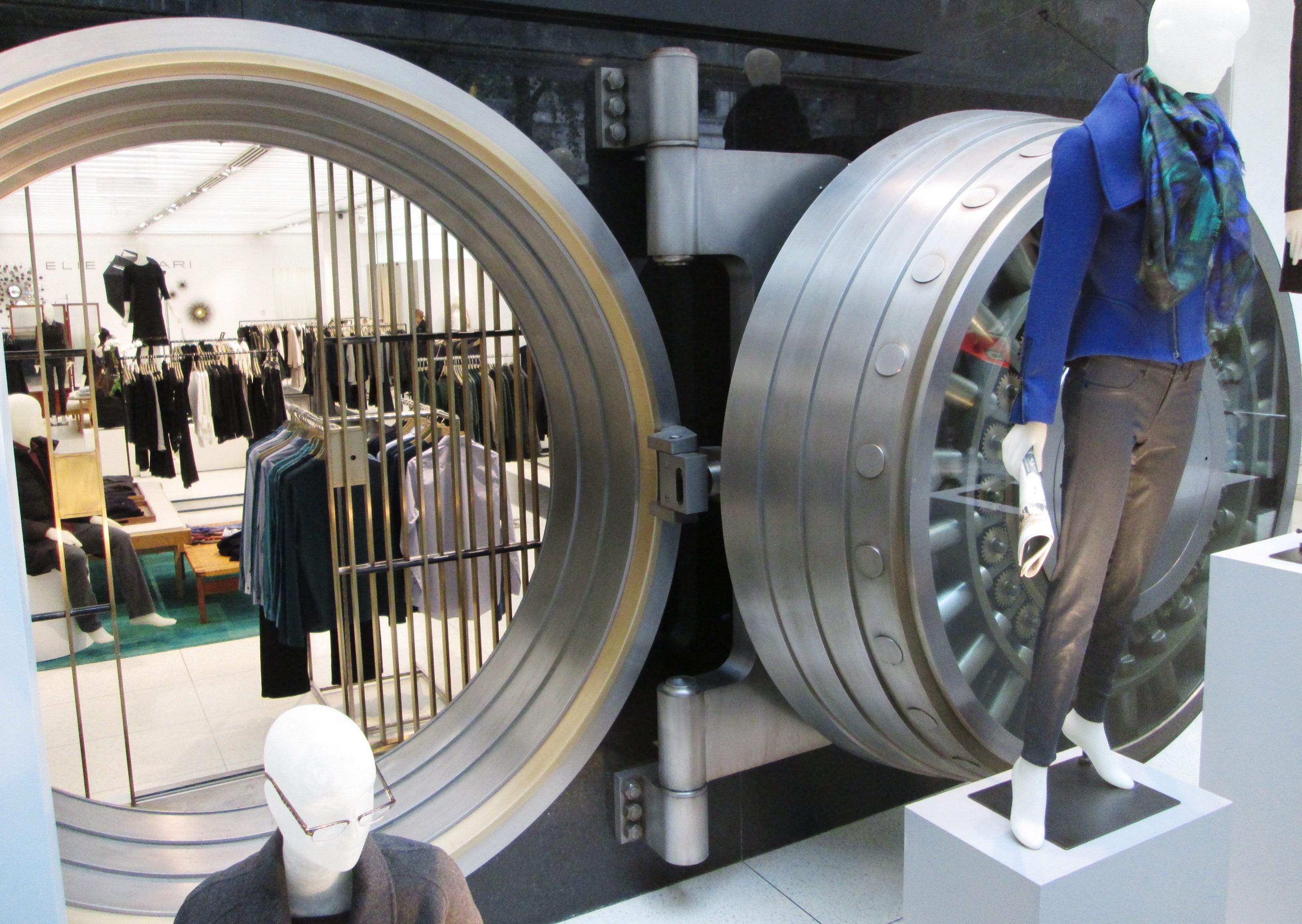
Wurman thought about this “new, young bank” and considered the recent history of forward-thinking buildings for financial institutions. He flashed on the work by Skidmore Owings & Merrill architects Gordon Bunshaft and Charles Evans Hughes III (grandson of the eminent Supreme Court Justice), who in 1954 had amazed the architectural world when they departed from the oft-columned, usually fortress-like bank designs in their scheme for the Manufacturers Hanover Trust Company Building at East 43rd and 5th Avenue in Midtown Manhattan. Bunshaft and Hughes III went full International Style, with transparent glass allowing pedestrians to look straight into the bank. They even showcased the sacrosanct vault, which they presented at a 90-degree off-set toward the street.
“You could see this beautiful round [vault door], the way that you’d see one in a movie, right?” Wurman said. “And that was radical…’We’re in the money business. This is our sign. That’s where the money is. Follow the money.’”
The only public domain photograph I can find of the Manufacturers Hanover Trust Company vault is from 2013, when the space was a showroom for designer Elie Tahari—the current incarnation is a UNIQLO flagship—the vault is still vaulting, though:
Wurman took the Manufacturers Trust ethos into his thinking about IVB: “This bank should be inviting. You should not think you’re getting frisked going in the door. You should be invited in.”
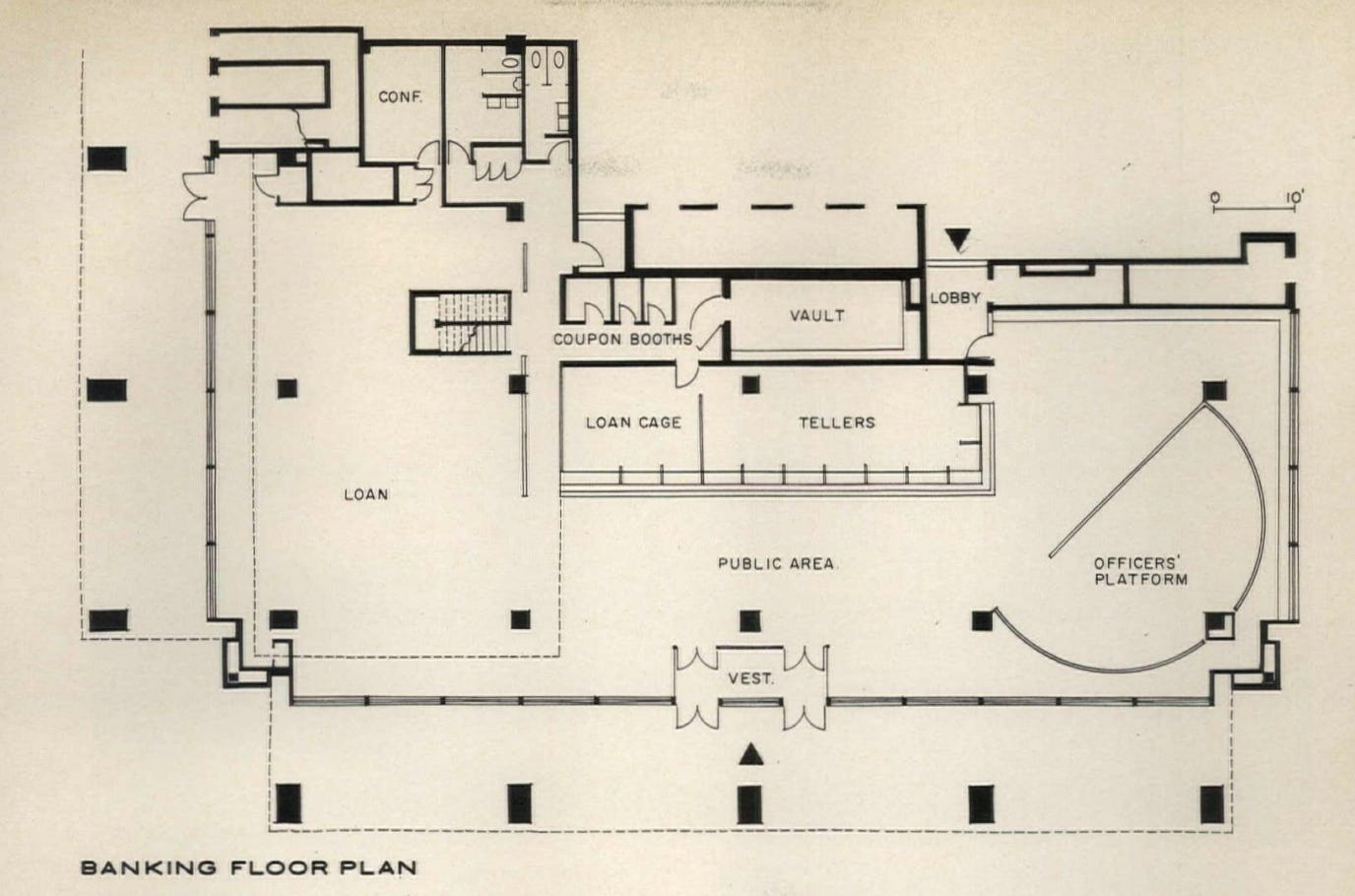
Wurman’s design began to take shape. He opted to put columns bedecked with fluorescent neon lights over each teller desk—totally visible from the street. “The lights over where you come and put your money….that’s a sign,” he says. “You don’t have to look where somebody’s behind [the desk]. You know just where to go when you walk in the door 50 feet away.”
Other unusual components:
A coin-like silver vinyl back wall.
A purple, circular plexiglass balustrade in which officer desks were housed.
A floor of dark blue, polished neoprene.
A self-referentially traditional teller desk, covered in the white marble with which depositors would have been familiar…gotta know the dough is secure!
Here’s the floor plan for Wurman’s bank—look how it flows!
The pieces of Wurman’s unconventional design that perhaps got the most attention, however, were the 30-by-18 foot rotating murals placed in back of the officer’s balustraded area: “I had a friend who painted billboards, you know, off the highway,” Wurman says. “So I thought, ‘Well, let’s do these billboards. I’ll get my friend to paint them.”
Wurman turned to the logos and visual signifiers of IVB’s biggest corporate depositors for inspiration: “I got their biggest clients, and I art directed what image I wanted…I designed them, because I did a lot of graphic design. That was fun.” The mural-billboards switched out every six weeks.
Wurman and his billboard-painting friend’s first design was inspired by IVB client and Pottstown, PA-based frozen foods giant Mrs. Smith’s Pies. The result was a Warhol-esque, giant piece of cherry pie, with the Mrs. Smith’s logo replacing one of the cherries. Another mural advertised the IVB-sponsored Philadelphia Golf Classic, with a zoomed-in look at an orange club face about to strike a golf ball with “IVB” emblazoned in big black lettering. A third showed a golden version of the Allentown-based Mack Truck metallic bulldog mascot that still graces the hood of every Mack.
Brief aside: Zara and I visited the Mack Truck Museum at the old Allentown HQ in 2023…the bulldogs abounded; highly recommend. And Wurman was definitely onto something—I now have a strange, unshakeable affinity for the bulldog and would be thrilled to chill with a super-sized, painterly version of the canine while I dropped off some checks:
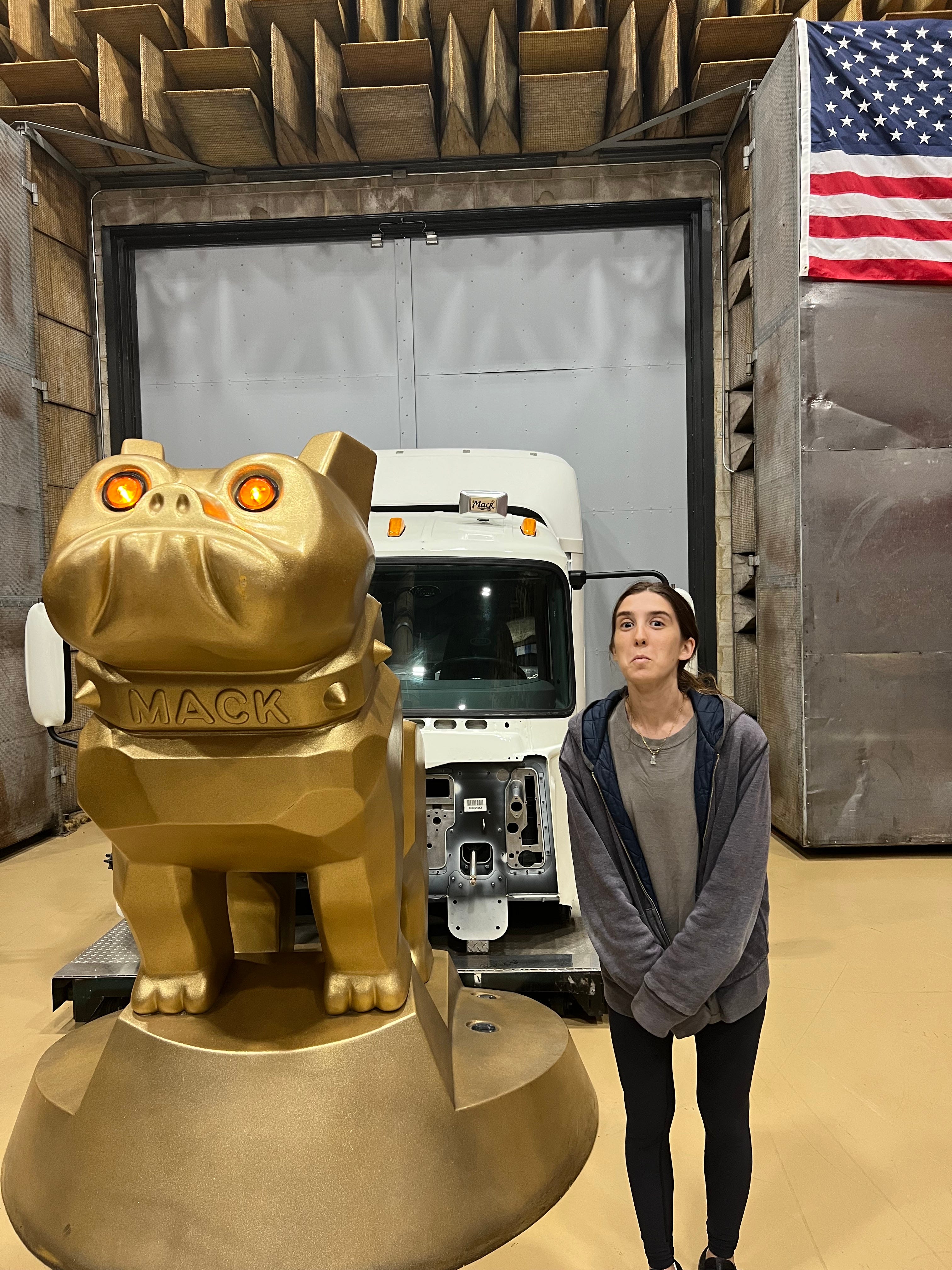
“It was a place where you could sit around talk, and there was a great, changing painting,” Wurman recalls. “You’re going to be close to a billboard, which everybody wants. It’s an interesting experience in scale.”
Wurmans’ archivist, an expert in information architecture named Dan Klyn, shared these shots of Wurman framed by the pie and presenting his scheme to John C.T. Alexander:
Wurman places the murals within a larger Philly trend. He notes that the turn of the 1970s was a massive moment for Philly billboards, including a particularly memorable, yellow-text-on-blue-background highway sign crafted by “ad biggie” (Wurman’s words) Elliott Curson for the civic boosters Action Philadelphia. The sign, positioned near Conshohocken on the traffic-heavy Schuylkill Expressway, read, “Philadelphia Isn’t as Bad as Philadelphians Say It Is.” Wurman also suggests that he may have been the source of the quote…
Elliott—if you’re reading this, please chime in! Another aside: Curson is still a fixture in Philadelphia and is a true living legend who has told me the best stories about 1960s/1970s Philly…
Wurman calls the murals “super-graphics,” a term for big, painted, often multi-planar imagery put directly onto buildings. The movement was popularized by Northern California’s utopian Sea Ranch community in the mid-1960s, wherein graphic artist Barbara Stauffacher Solomon put interpretations of her far-out, double-spiraled logo inside, outside, and around the project’s wooden, seaside homes.
As it turns out, the critic who coined the term “super-graphics,” and dubbed the architects who employed them—Wurman included—as “Supermannerists” was none other than C. Ray Smith, the writer of the Progressive Architecture piece on Wurman’s lobby bank! Smith even included an edited version of the IVB write-up in his 1977 collection Supermannerism: New Attitudes in Post-Modern Architecture. The whole book, available to borrow virtually here, is fantastic…
Given Smith’s predilections for Supermannerism, it is not surprising that he thought the IVB lobby bank would signal a crucial shift in how financial institutions engaged with the public. And he even referred to the Bunshaft and Hughes III project:
Not since 1954, when Gordon Bunshaft took the Manufacturers Hanover Trust out of its stone fortress tradition and put it into a “defenseless” glass box, has anything major happened to the image of banks. Now Murphy Levy Wurman may produce for IVB in the 70’s what S.O.M. [Skidmore Owings & Merrill] did for banking in the 60’s.
If Smith saw Wurman’s design as the start of a grand movement, Wurman views the project as more didactic, emerging naturally from his own aesthetic sensibilities. “That banking building couldn’t come out of a program that the [IVB] Bank Board of Directors would write, or even the CEO, or even John C.T. Alexander giving me permission,” he says.
And while Wurman does credit the billboard and supergraphics boom, he also suggests that his mentor Louis Kahn gave him the tools to conceptualize the bank design: “[The lobby] follows Lou saying, ‘What does a building want to be? What does a brick want to be? It follows the existence will of something. And in that sense, it was different than saying it’s terrific architecture. I don’t think it’s great architecture, but it was an interesting floor plan and the circulation was proper. It related to the street. It related to the bank being its own billboard—not the billboard on the wall, but that whole space is a billboard.”
Wurman also admits that he didn’t even consider that IVB might not vibe with his bank concept: “It never occurred to me that it would bomb. And it could have! I mean, it really could have been a real loser. The Board of Directors could have come and said, ‘We don’t want this. This doesn’t look like we’re a grown-up company where your money is safe with us,” or any of the things that banks usually did. You wanted a few thick walls, small openings. You’re safe when you come in. There’s a guard at the door. And I never thought that I wasn’t doing that. I don’t do things for a negative reason. I just thought what it wanted to be was what I did.”
Philadelphians, meanwhile, may have been a bit overwhelmed by the newness of the IVB lobby, but generally embraced the uniqueness of the branch. The Inquirer’s Beth Gillin captured the reactions in a feature entitled “Depositors Dazzled by Pie in the Sky.” One businessman, staring at the Mrs. Smith cherry pie mural, muttered, “It looks like something you’d see at the Automat.” The Automat, of course, was the chain of waiterless, coin-operated cafeterias that had reached their peak decades earlier but were still sprinkled through the Philly landscape. 1
Some made the inevitable Warhol comparisons, to which IVB’s John C.T. Alexander, the forward-thinking executive who brought Wurman aboard, responded somewhat tartly, “We don’t like to think of this as op art or pop art—that’s kind of gone by the board. I mean, they were popular years ago.”
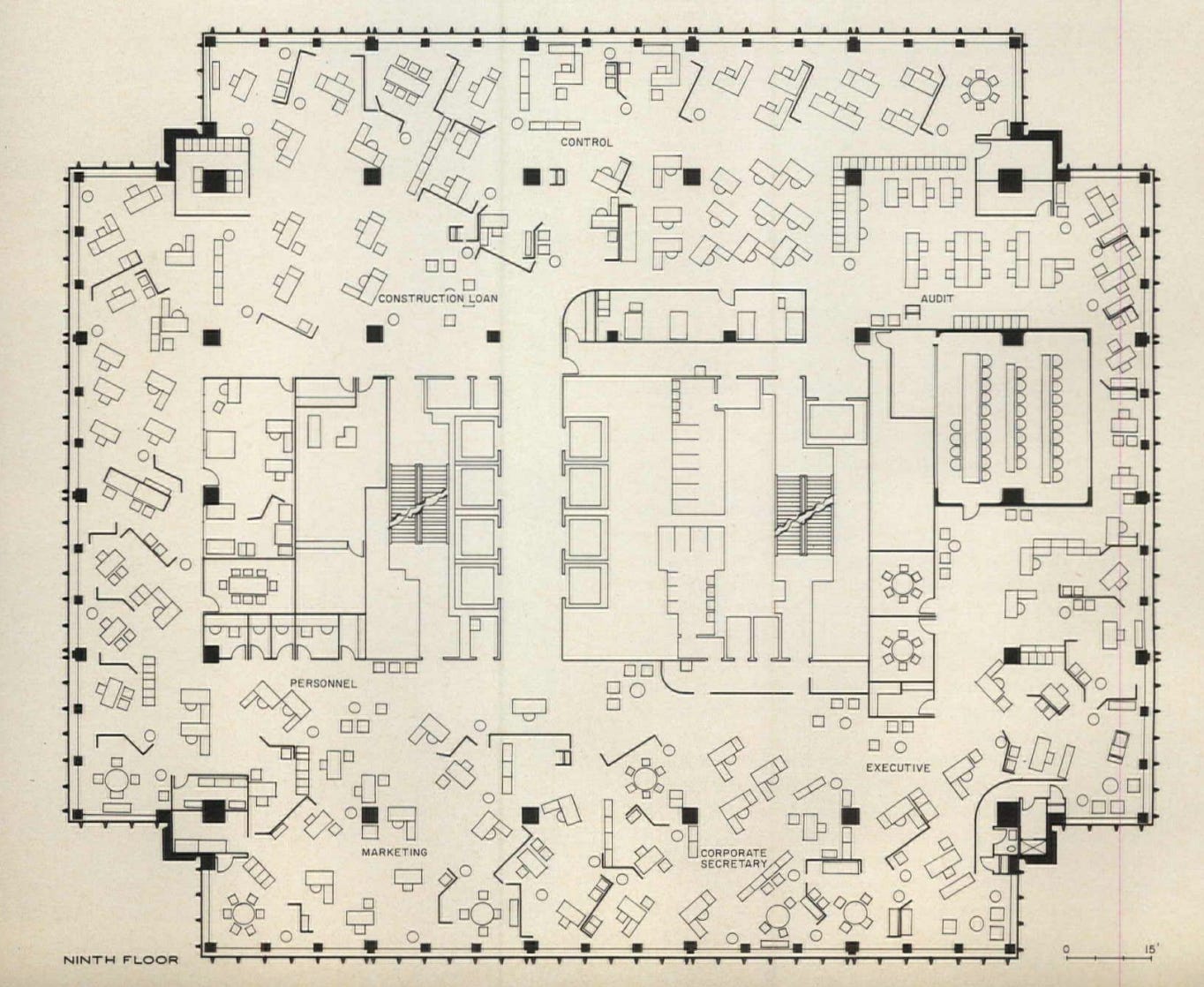
Wurman didn’t just do the bank. He also designed IVB’s corporate offices on the building’s 9th floor, one of the first open floor plans in the United States. He got the idea from Germany, where a management consultancy called Quickborner devised the concept of an airy, divisionless work schema dubbed Bürolandschaft, or “office landscape,” in the late 1950s. “That was the most up-to-date thing, and I wanted to be a couple of steps ahead,” Wurman recalls. Here’s the forward-thinking office design plan, with each department clustered in a circular pattern, complete with supergraphics delineating their respective areas:
As those who read my first installment will know, many today consider the IVB Building to be a tired and largely inaccessible reminder of the failures of late-1960s corporate design. I still like the building, but I do grasp the arguments of the detractors; there isn’t a lot that’s public-facing about the building today. To get a sense of the excitement that Wurman’s design engendered—and the energy and idealism that he brought to the project—is thus an exhilarating reframing of what the IVB Building meant to Philly in those early years.
Wurman spent much of the rest of the early 1970s fighting for a Philadelphian architecture and built environment that engaged playfully and effectively with the public. He influenced and supported the Parkway Program, a cutting-edge “school without walls” that met in civic locations across the city and embraced hands-on learning. An Inquirer magazine piece from 1971 details Wurman’s tour of Parkway high schoolers through the built environment, where he critiqued curbs as impractical, railings as inaccessible, and the city’s Trailways bus terminal at 13th and Arch for not having a clock! He had some especially choice words for Penn Center, the much-maligned blocky modernist business hub that has often been denigrated and defended in Archiveadelphia’s pages. “This space belongs to us and it should DO something,” Wurman told the Parkway students. 2
He helped to create a 1971 exhibit at the Philadelphia Museum of Art called City/2, in which he explored how the publicly-owned half of the city could engage more thoughtfully with the citizenry.
He co-authored, with the brilliant architect and preservationist John Andrew Gallery, the 1972 Man-Made Philadelphia: A Guide to its Physical and Cultural Environment. The book incorporated a series of hyper-detailed, drawn maps of Market Street East, Market Street West, Broad Street South, Broad Street North, and so on, highlighting notable buildings, streets, transit routes, parks, and thoroughfares. The book also included different Center City plans, including Kahn’s ink-drawn, impressionistic plans, which—per Wurman and Gallery—included “a hierarchical pattern of street movements, coupled with a system of parking garages (harbors).”
“This book is a key to Philadelphia which unlocks the city to understanding and discovery—allowing us to see the things we always see but never see,” Wurman and Gallery stated.
Yet Philadelphia was still struggling to find its architectural and civic enthusiasm. Despite architectural critic Smith’s predictions that the IVB bank lobby would transform the architectural firmament, I’ve been hard-pressed to find too many other Philly adopters of this type of space during the rest of the 1970s. If you do have similar examples, please send them my way!
“It was okay,” Wurman says of 1970s Philly. “It was kind of getting okay, trying to…It was a little engine that could.” Wurman believes today that bureaucracy and an entrenched elite stopped the city from embracing more public-facing projects: “It’s all about people, you know? And it’s always a very few people. I mean, you can hate that because it’s so elitist, but in the end there’s a few people who make decisions and a few people who stop things. And that people that stopped things I don’t like, so this is a very warped—this is an opinion opinion.”
The People Who Stopped Things (PEWST, I coin, acronymically) in Wurman’s eyes, were led by Ed Bacon, the executive director of the Philadelphia City Planning Commission. “He was trying to be [Robert] Moses from New York,” Wurman says. “Bacon wanted to be known as—and he did became known as—the city planner. He wanted to be Pope Sixtus IV…he wanted to be Haussman. He wanted a name like that in the history books. And he wrote the book [The Design of Cities], promoted it, pushed it, and sold it.”
Wurman gave me a lot of grist for my own critical mill. I honestly feel humbled by how little I know about who to blame for the Philly Phrustrations of the 1970s and beyond…but I do know that the IVB lobby bank seemed incredibly cool.
Wurman and I talked about a lot of other things, too—his remarkable ACCESS/Guide series of guidebooks, his founding of the TED (Technology, Entertainment, Design) conference, his thoughts on Artificial Intelligence, and his in-progress 100th book, a two-volume, 1,500-page roman à clef called 5.
I can’t really do the book’s concept justice, but: The Wurman-esque protagonist is named the Commissioner of Curiosity and Imagination. His archivist Dan Klyn is presented as a pretzel vendor. Ed Bacon and the other Philadelphians who stopped things (PEWSTs) are combined into a character named the Despicable Doctor Indelible. At the book’s start, the Commissioner of Curiosity and Imagination (Wurman) is dropped by parachute onto the Micronesian atoll of Kapingamarangi. Octopi play a large role, as do various conceptions of threes and fives. I can’t wait to read this book!
We ended our conversation with a return to the long-gone IVB bank lobby, dismantled sometime in the 1980s as the building changed hands and the bank merged with Fidelity. Wurman reminds me that I shouldn’t get too hung up on the flash and coolness of the Supermannerist design. “I didn’t mention that it looked nice, or the aesthetics, or the color of the materials,” Wurman says. “Everything I talked about was the performance, the pedestrian, the image of the bank, what it’s like to go into a bank…And then if you solve the performance thoughtfully—it’s the thoughtful making of place in space, not prettiness—it becomes a handsome thing. It works okay…It might not be great or memorable, it’s not going to be the Pantheon. But it was okay.”
I, for one, think that the lobby was pretty great and memorable, and I didn’t even get to see it in the flesh! “Nothing like that lasts anymore,” Wurman acknowledges. “We’re not in a maintenance society. Nothing is built for long, and never has been. And it has to be much more anonymous to last.”
Ashes to ashes, I guess—but it’s awfully fun to look back and marvel.
Beth Gillin, “Depositors Dazzled By Pie in the Sky” Philadelphia Inquirer (PI), 2/4/1969.
Beth Gillin, “A Critics Tour of the Public Environment,” PI, 6/13/1971.
Comments
Nothing yet. Say the first thing.
Sign in to join the conversation.