
FIVE PHILHISTORY NUGGETS
Last Wednesday, Zara and I got to see and hear the world premiere of Gregory Spears’s new opera, Sleepers Awake, at the Academy of Music. The Opera Philadelphia production, conceived with director and “event architect” Jenny Koons, was gorgeous and understated, full of lanterns, shadows, and echoes. Spears’s meditative interpretation of the fairytale was also moving—a gentle and poignant interpretation of the Swiss modernist Robert Walser’s 1913 take on the fable. After the show, I looked for other musical versions of Sleeping Beauty (I do love “Once Upon a Dream” from the 1959 Disney animated film), and came across a 1961 Columbia Masterworks recording of conductor Eugene Ormandy and the Philadelphia Orchestra absolutely soaring on Tchaikovsky’s 1889 Sleeping Beauty ballet suite. I listened on repeat as I wrote this Archiveadelphia, and you can, too, here on YouTube.
On Friday, we attended the weekly party at the Philadelphia Museum of Art to see the PMA-bound half of “A Nation of Artists,” a special Semiquincentennial retrospective whose other portion is on view at the recently-reopened PAFA Historic Landmark Building (I’ve still never been inside this Frank Furness-architected jewel and cannot wait to visit). We loved the exhibit, and I was particularly taken with Philly-born painter William Glackens’s “Bal Martinique,” a dance scene at an imagined, racially integrated Parisian nightclub. The painting pulses with life and idealism, and inspired me to take out William Glackens and the Eight: The Artists who Freed American Art, a 1957 book by Glackens’s son Ira exploring the cultural impact of Glackens and a group of close painterly compatriots, including my personal favorites Maurice Prendergast and Robert Henri. It’s a fun and very personal read, and prominently features Philadelphia collector Albert Barnes, a major backer of the group. You can read the tome on Archive.org!
I was sad to see the news last week that Philadelphia musician and DJ Gregg Foreman had passed away at only 53 years old. Here’s his Inquirer obituary. Foreman was a true music scholar, crafting genre-bending, R&B-meets-funk-meets-blues-meets-emo tracks with the 1990s band Delta 72 and serving as the great 2000s indie star Cat Power’s music director. He also looked awesome, calling his distinctive fashion “Moth,” a mix of mod and goth. I listened to some of Foreman’s earliest efforts on his longtime bandmate and friend Ben Azzara’s website—the two started the band Junction before moving on to Delta 72. Foreman shows his prodigious dexterity and creativity on a 1989 EP release, from when he was just 16 or 17. I particularly love his guitar work on “Saturation,” which you can hear here.
Last week was also marked by another sad musical passing—the death of San Francisco Symphony conductor Michael Tilson Thomas. Growing up in SF, especially as the son of an opera singer, MTT (as everyone called him) was something of a musical God, a generous, accessible, and profoundly brilliant conductor and musical ambassador who brought pride to the city with his widespread touring, his guest conducting, and his leadership of the New World Symphony, an acclaimed youth conservatory in Miami. MTT conducted and played piano in Philadelphia many times, and had a particularly close tie to the outdoor Mann Center in Fairmont Park. The Mann posted a very sweet photographic tribute to the maestro on their social channels. I’ve been in search of a recording of a 1972 Mann performance in which a very young Tilson Thomas conducted the Philadelphia Orchestra and the legendary soprano Beverly Sills. Does anyone have a bootleg?
I’ve continued to watch Philadelphia movies when I’m on the elliptical. This week, I checked out The Soldier (1982, directed by James Glickenhaus). Only the opening scene actually takes place in Philadelphia, but provides some prime views of the Parkway. The movie begins with a bloody shootout between a deep-cover CIA-within-the-CIA group led by the titular, otherwise nameless Soldier (played by the stone-faced Ken Wahl) and a Soviet agent disguised as an old woman pushing a baby carriage. The Soldier & Co. then copter out of Philly (great departing shot of the black helicopter framed by the Philadelphia Museum of Art), before the action pivots to Washington, Austria, and the oil fields of Saudi Arabia, where the Soviets have threatened to blow up a plutonium bomb and cause a society-ending oil shock if Israel does not vacate the West Bank. There’s a lot going on, but I kind of dug the weird tonal shifts, and there’s a to-die-for soundtrack by synthesizer gods Tangerine Dream (other great soundtracks by them: Thief, Risky Business, Miracle Mile). The movie is available for free on Tubi!
PHUILDING OF THE WEEK: THE IBM BUILDING
Last Monday, I shared some Bellevue history with IBM employees meeting for a conference at the hotel. I was excited to get to talk with the IBMers, as the pioneering technology company had several cameos at the Bellevue during the early days of the computer revolution.
In the 1950s, the Bellevue twice hosted the Eastern Joint Computer Conference, a popular meeting of industry leaders and academics. The theme for the December 1954 meeting, attended by 1,700, was “The Design and Application of Small Digital Computers.” I guess there was already a pretty clear sense of where things were headed 72 years ago…
This conference came at the dawn of the transistor revolution. The little electrical switches were beginning to replace cathode ray tubes, the awkward, very large semiconductors that had previously dominated the electronics industry. New, much smaller and faster devices were thus beginning to proliferate all over the market. The first transistor-exclusive computer, the TRADIC from Bell Labs, emerged in January 1954. The first transistor radio (the product that effectively ushered in portable audio) came on the market just a month before the computer experts met at the Bellevue.
And at the conference, IBM showcased a new contribution to the transistor-world, a 2,220-transistor computer that—while still the size of a small refrigerator—was far more compact than its comparable cathode ray equivalents. “Tubeless ‘Brain Robot’ to Dazzle Computers,” the Inquirer breathlessly exclaimed in its headline announcing the demonstration. 1
Regrettably, I really know next to nothing about coding or computer hardware. I’m embarrassed to admit that I actually spent an hour last night asking ChatGPT to explain the actual functioning of transistors to me, a mostly futile and bizarrely self-reflexive undertaking...asking a computer how a computer works. My line is always open if someone wants to endeavor to give me a rundown here.
Even so, I’ve always been fascinated by how people thought about and engaged with computers in the early days. One of my favorite college courses was a class I took called The History of Big Data, taught by the brilliant History of Science Professor Rebecca Lemov. I wrote my research paper for the class on “World3,” a full-earth MIT computer simulation sponsored by the Club of Rome, the somewhat shadowy international 1970s think tank concerned about population growth. The paper explored how attempts to technologically predict the future of growth created a broader cultural reckoning with race, class, and how to approach an expanding world…
This interest in how computing advancements in the mid-20th century shifted the American mind followed me beyond the course, and I picked up some IBM-specific tomes that got to the broader cultural ramifications of their corporate arc—longtime IBM leader and son-of-founder Thomas Watson Jr.’s 1990 memoir Father, Son & Co.: My Life at IBM and Beyond (some super Freudian dynamics at play) and Paul Carroll’s critical 1993 study Big Blues: The Unmaking of IBM.
So as I began considering a Phuilding for this week, I pondered IBM’s footprint in Philadelphia—and what the company’s presence in Center City might say about the city’s broader perspective on high technology and computers.
I shared some of these ideas with David Seltzer, my neighbor/friend and the public financier and brilliant history writer who also suggested that I include Mike Douglas’s disco groove “Philadelphia” in last week’s Philhistory Nuggets. Seltzer remembered that IBM had been the anchor tenant and original namesake of 7 Penn Center, the 21-story glass-and-concrete tower at the Northeast corner of 17th and Market Streets.
A bit of research on the erstwhile IBM Building’s background revealed that an Archiveadelphian convergence was occurring. Regular readers know that there’s been an ongoing discourse in these pages about architect Vincent Kling’s design complicity (or lack thereof) in the slab-centric architecture of much of Penn Center, the ambitious downtown redevelopment program that replaced the Pennsylvania Railroad train viaduct that had once cleaved Center City in half. Here’s how this piece of Market Street looked in 1953, just before the viaduct, popularly dubbed the “Chinese Wall,” came down:
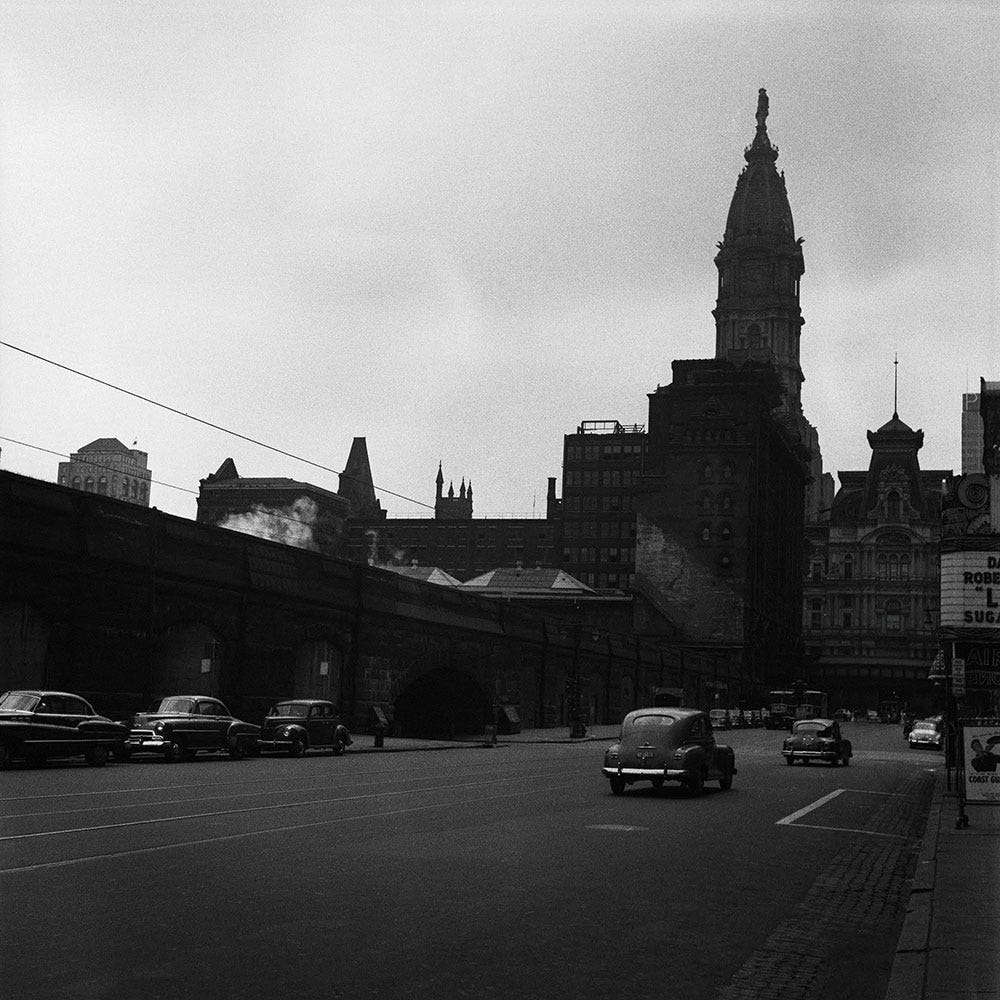
I had initially pegged the ugliness of the whole project on Kling, before former Inquirer architecture critic Thomas Hine alerted me that the New York firm of Emery Roth & Sons was in fact responsible for the most boring of Penn Center’s structures.
The IBM Building, announced in 1960, came after the arguable prime Emery Roth offenders, Penn Centers 2 and 3—two virtually, straightforward identical rectangular blocks offset and in parallel just West of City Hall.
The various blocks of Penn Center were sold off piecemeal by Pennsylvania Railroad and thus are an out-of-order, multi-decade collection of towers. IBM head Thomas J. Watson Jr. snatched up the site, which the Railroad had been using as a parking lot, for $1.6 million, with plans to use the new skyscraper as a regional marketing hub.
In 1960, Penn Center also included some towers that were more interesting than 2 and 3. There was the slightly handsomer 1957 Sheraton Hotel designed by Boston’s Robert Dean, and the somewhat alluring, also 1957-dated Transportation Building (6 Penn Center), a bona fide, sort of cool Kling design that combined a sprawling, slightly-below-grade Greyhound Terminal with a concrete office tower on latticed white stilts. The Transportation Building, right across 17th Street from the IBM Building, converted to luxury rental apartments last year (a special shoutout to the super cool Eileen Tognini, whose design firm worked on the conversion and who attended my Bellevue tour last Thursday—sign up for the tour here).
The IBM Building was another actual Kling, and thus offers an opportunity to study not only IBM’s corporate aesthetics and impact on Philly, but also to delineate Kling’s design approach to corporate modernism.
From the outset, Kling suggested that he would take a more creative approach to the IBM Building—even throwing some subtle shade at Emery Roth. “It will be in keeping with the dignified air of the Center, but will be more exciting and bolder in design than present buildings,” he told the press in November 1960. 2
Temple’s Evening Bulletin archives has a very funny personality picture of Kling at the building’s announcement. I’m going to link rather than embed for copyright purposes, but please click here to see the shot. The famously dapper architect stands in a pinstripe suit, pipe in hand, mugging right into the camera while Philadelphia Mayor Richardson Dilworth, Pennsylvania Railroad boss James Symes, and IBM Data Processing Division head Gilbert Jones stare with far less panache down at a scale model of Penn Center, with Jones gesturing, ruler in hand, to the IBM site. Kling appears above the fray, an intellectual city-molder and man of drama in the company of bureaucrats. This may be extrapolating a lot of non-existent vibes from a photograph, but it’s nonetheless quite the image…
Seen from Market Street, the IBM Building, which began going up in 1963, was almost entirely a concrete wall, with one strip of vertical windows ascending up the center of the building. On its sides, however, the building jutted out into offset curtain walls of glass. The structure almost looked like a computer, with the glass a glistening screen and the concrete the electronic mind of the machine. Here’s a mid-construction shot from Temple, showing the scaffolding on Market Street and the Transportation Building across the street. And I also got some shots of the building last week:
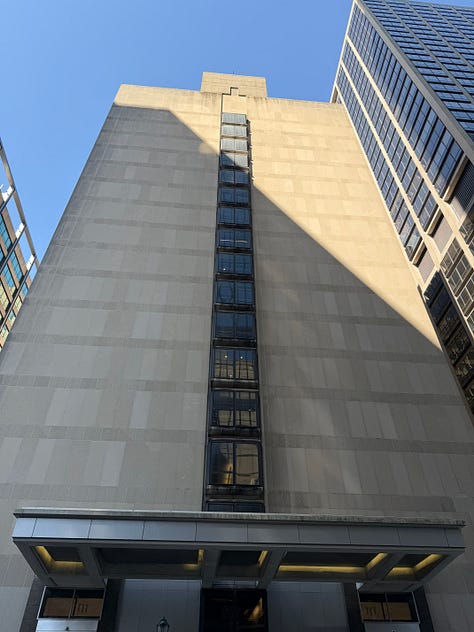
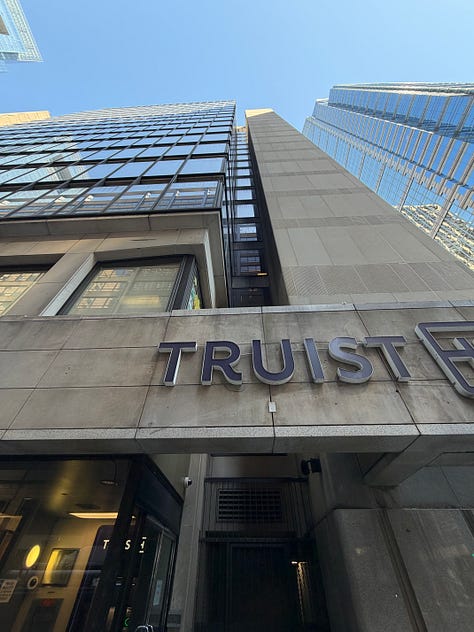
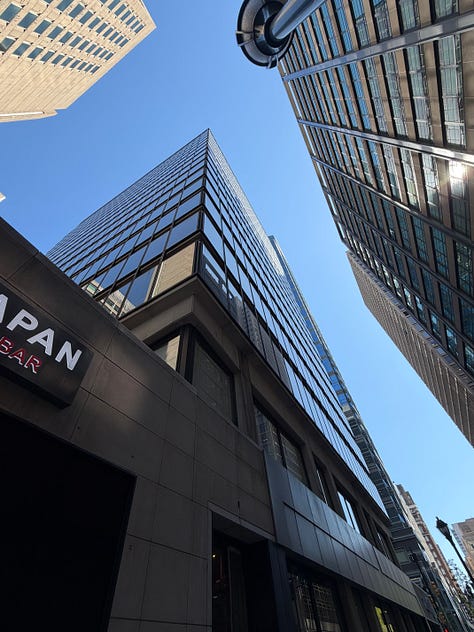
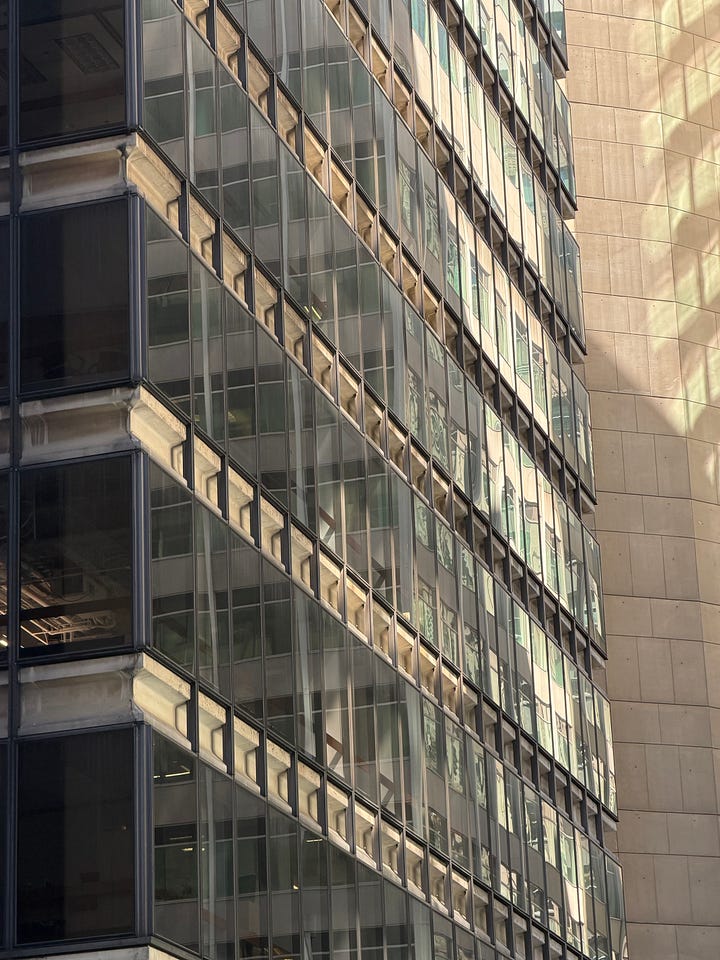
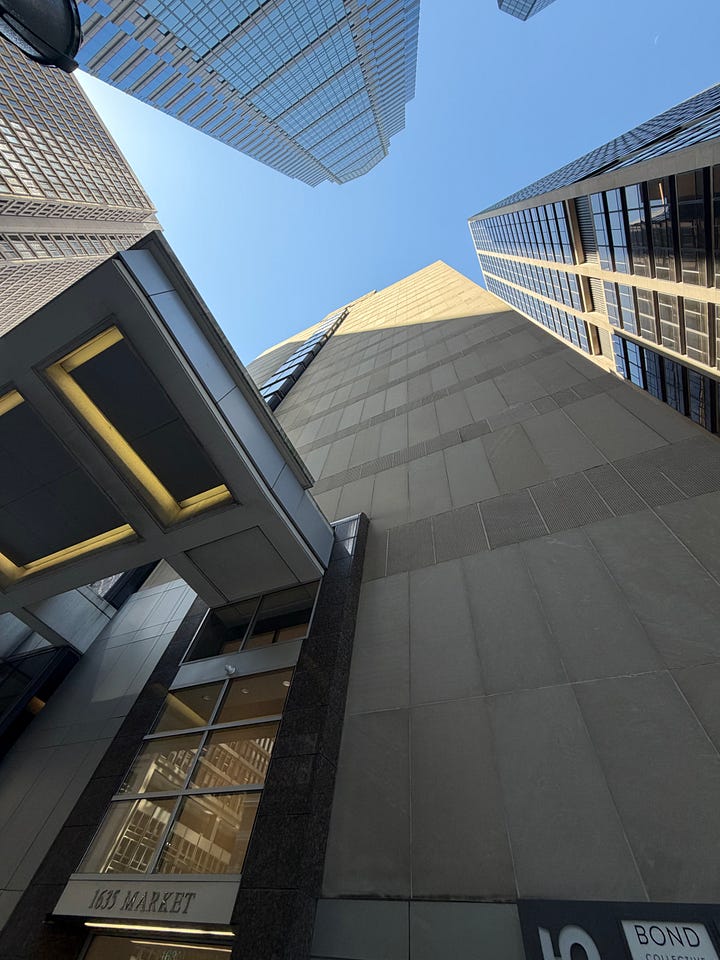
Kling included a connection to Suburban station and the broader underground transportation concourse, and the siting also benefited from its proximity to a sunken, Rockefeller Center-style skating rink directly to its North—this was more Penn Center land, which would eventually house the Kohn Pederson Fox-designed 8 Penn Center (1982).
The sleek modernity of the IBM project took a hit in December 1963, when propane tanks at the top of the building’s shell lit wooden scaffolding on fire and started a big fire in frigid pre-dawn temperatures. The tanks were fueling heathers to dry the building’s concrete, a novel method for speeding up construction that had never before been attempted in Philly.
Some 400 early-rising, bundled Philadelphians gawked at the eruption, which, per the delightfully Hemingwayian prose of Daily News columnist Tom Fox, “sent tongues of blue flame into the sky.” The damaged tanks rained down on Market Street and exploded in the roadway—a chunk of one made it all the way across the street and smashed the glass of Dewey’s Restaurant, a popular 24-hour chain diner that would be the site of a famed LGBTQ+ sit-in two years later. Dewey’s manager, Sam Esposito, suffered cuts on his legs from the tank’s unwelcome entry. Firemen spraying hoses from atop the Transportation Building managed to eventually put out the blaze.
Another dramatic Temple-Bulletin photo shows workers on a crane inspecting the charred concrete pillars of the building after the explosion. No matter how computerized society was becoming, the elements could still occasionally announce their supremacy.
Construction continued mostly unabated. In June 1964, IBM executives, joined by Philadelphia’s new Mayor, James Tate, raised a “data capsule” into the building’s skeleton using a pulley system to mark the building’s “topping out.” Queue yet another link to a vivid Temple-Bulletin shot of the ceremony. The Space Age time capsule contained a reel of magnetic computer tape containing a history of Philadelphia, some background on Penn Center, and the names of those who constructed the building.
The Inquirer’s real estate editor, Oscar B. Teller, had some fun imagining a latter-day reader in search of the “data capsule”: “Memo to a historian reading the microfilm edition of the Inquirer a century from now: If you’re looking for the cornerstone of the IBM Building—or Seven Penn Center Plaza—you’ll find it welded to a beam just under the roof.” 3
Oh, Oscar—it’s only been 64 years, and I imagine you would be pretty gobsmacked by the glowing, aluminum laptop on which I am perusing fully text-searchable PDFs of your eminent newspaper! I wonder if anyone has retrieved this Data Capsule, though…I’m sensing a National Treasure-esque heist in the making (I’m only joshing, particularly if InterVest Capital Properties, the current owners of the building, happen to be reading!).
Another kerfuffle late in the construction game continued to highlight the unpredictability of cutting-edge technologies. In January 1965, an electric-powered scaffold broke down with three workmen aboard eight stories up on the almost-complete IBM Building. The workmen yelled in frigid weather for almost an hour before the fire department was dispatched to retrieve them. Unable to reach the men with ladders, the firefighters ultimately used the low-tech “Halligan’s tool,” a sharp crowbar, to knock out a window from inside the building to fetch the stranded.
After all the data capsules, propane explosions, and jammed scaffolds, the gleaming IBM Building finally opened. Over the next two decades, Kling’s computer-esque building provided a home for the tech giant. And given the whole propane thing—plus the general forward-thinking nature of IBM—it’s fitting that the building, in May 1967, became the first ever Center City office building to have a fire drill. Temple-Bulletin also has this immortalized, with bemused, suited IBMers chuckling as police officers guide them out of the structure.
In the mid-1980s, with architectural trends pushing toward the postmodern and Kling’s highrise beginning to look a little dated, local developers, from Bellevue owner Ron Rubin to Liberty Place visionary Willard Rouse, began coaxing IBM to move into one of their new skyscrapers. The Los Angeles development firm of Maguire/Thomas Partners swooped in, however, and convinced IBM to become the lead tenants for One Commerce Square, the first in a pair of 41-story granite towers with cascading setbacks and big stone diamonds at their tops.
The architect was I.M. Pei & Partners, the same iconic firm behind Society Hill Towers, another grouping of epoch-defining Philly skyscrapers over on the Delaware. The news conference announcing the IBM exodus from Penn Center to Commerce Square, a few blocks West on Market Street, was held at the Bellevue, of all places!
Kling’s new had thus become old—the transistors transisted, the hard drives whirred, and the Pride of Penn Center became obsolete. Thankfully, however, Morris Katzen, a local developer specializing in renovations, bought the building from IBM in 1987 and poured $60 million into a redo of virtually the entire interior. Initially, Katzen, a co-founder of the influential adaptive reuse firm Historic Landmarks for Living, abandoned a scheme to demolish the building altogether. “I wasn’t that crazy,” Katzen told the Inquirer. Plus, he liked the architecture, calling the IBM Building “the most interesting of the Penn Center buildings.” 4
Beyond his interior renovation, Katzen formally renamed the building “7 Penn Center,” getting rid of the IBM logo etched into the concrete facade on Market Street and replacing it with a big “7.” He undertook some serious asbestos remediation. And he installed a retail arcade on the backside of the building, in the remaining sliver of space between “7 Penn Center” and 8 Penn Center, the former site of the skating rink.
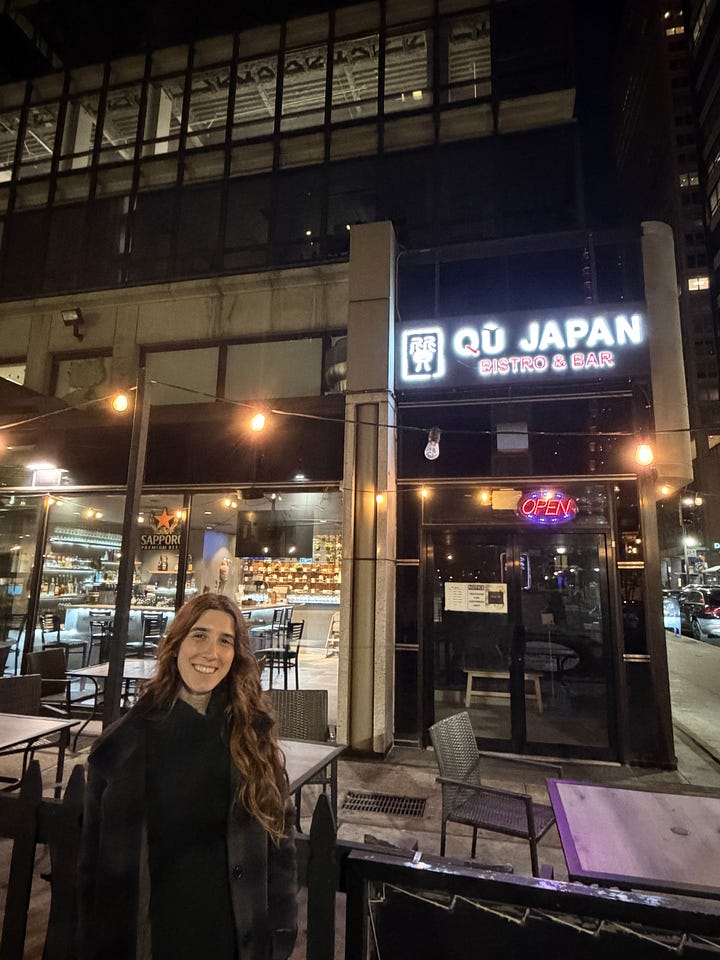
And it was to this retail arcade that Zara and I, after seeing “Sleepers Awake” at Opera Philadelphia last Wednesday, got dinner at Qu Japan Bistro & Bar. We even thought about visiting Concourse Dance Bar, a subterranean club now operating beneath the tower, but our clubbing days are mostly behind us (I do hear that there is a ball pit, similar to Chuck E. Cheese).
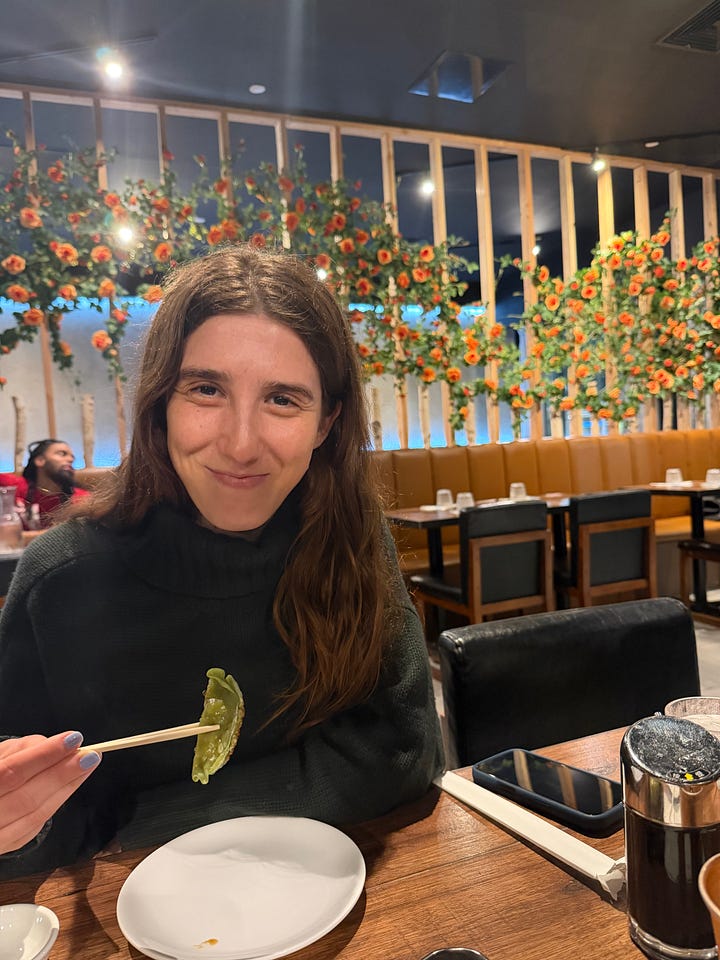
So, instead, we ate flavorful veggie gyoza and salmon rolls (go to Qu!) and paid homage to Kling’s computerized gift to Philadelphia, smartphones abuzz in our pockets, reflecting on the giddy, distant days of early computers that helped to shape the skyline:
Tubeless ‘Brain Robot’ to Dazzle Computers,” Philadelphia Inquirer (PI), 12/7/1954.
“IBM Plans $10 Million Building at Penn Center,” Philadelphia Daily News, 11/23/1960
Oscar B. Teller, “Time Capsule Placed Atop IBM Building,” PI, 6/24/1964
Susan Warner, “Up to the Task,” PI, 7/9/1989
No posts
Comments
Nothing yet. Say the first thing.
Sign in to join the conversation.