
Before I begin the themed nuggets, I wanted to give a shoutout to a very special exhibit at the Library Company of Philadelphia. The show, “Philadelphia’s Radical Revolution: From the Stamp Act to the Federal Convention,” is on view until October 9th, free to visit and open Monday-Friday, 9AM-4:45PM. I was lucky enough to get a tour by curator and Library Company librarian emeritus/legend Jim Green, who showed me Benjamin Franklin’s annotated draft of the shockingly legislature-empowering 1776 Pennsylvania State Constitution and ephemera from the 1778 Meschianza, a blowout British occupation ball planned by British spy/rock star/Benedict Arnold co-conspirator John André. The exhibit is sourced entirely from an archive collected by Swiss immigrant artist and archivist Pierre Eugene du Simitiere (1737-1784), who provided his own captions for many of the objects. I’ve seldom felt more compelled by colonial Philadelphia than while hearing Jim describe these treasures, and I believe this is an indispensable visit for any Philadelphian’s 250th slate!
FIVE DOYLESDELPHIA NUGGETS
Last weekend, Zara and I were in Doylestown, a lovely borough about 30 miles north of Philadelphia, for the wedding of our wonderful friends Nanci and Spencer. As with York and Harrisburg, we found Philly lore around every corner…
Zara and I had visited Doylestown once before—a captivating, all-too-brief visit punctuated by the revelation, during a visit to the National Shrine of Our Lady of Czestochowa, a Polish church just outside of town, that the actual mummified heart of famed Post-WWI Polish Prime Minister and classical pianist Jan Paderewski was housed within a bronze replica of his bust inside the sanctuary…a lot to process. In any case, we also visited during this initial sojourn the Mercer Museum, an impressive collection of pre-industrial tools assembled by Doylestown icon Henry Chapman Mercer (1856-1930). Today, Mercer is best remembered for his nearby Moravian Pottery and Tile Works, a California Mission-style factory that still produces Mercer’s distinctive tiles today. We got to see some demonstrations of how clay sourced from nearby Lake Towhee becomes tile. A grainy but informative film that we viewed at the start of the visit revealed that Mercer had also served as the Curator of American and Prehistoric Archaeology at Philly’s University of Pennsylvania Museum in the 1890s. In that capacity, he explored the Yucatan in search of “evidence of man’s antiquity.” Mercer’s resultant book, The Hill Caves of Yucatan (1895) is available at Archive.org.
While strolling on picturesque Court Street up toward the Tile Works, we spied a Pennsylvania Historical and Museum Commission (PHMC) plaque in front of the one-time home of Casimir Sienkiwiciz. The text explained that Sienkiwiciz (1890-1974) was a Polish-born (a large population of Polish emigres in Doylestown) economic advisor to governments, an accomplished impressionist painter, and the first chairman of the Southeastern Pennsylvania Transportation Authority (SEPTA), the consolidated public transit organization that emerged in 1965. The historical record is surprisingly somewhat sparse on this Renaissance Man whose transit-quest transformed the Philly region (we took SEPTA out to Doylestown!). I did find, however, an expanded biography in MarkerQuest, a blog run by Lehigh Valley historian Laura Klotz, who has endeavored to photograph and research all of the PHMC markers. A quest after my own heart, and a very cool dive into Sienkiwiciz’s fascinating life…
We also visited Doylestown’s Michener Art Museum, named after its principal fundraiser and native son, the prolific South Pacific author and civil rights activist James A. Michener. The Museum houses a gorgeous collection of Pennsylvania Impressionism. Zara and I were particularly taken with “Jersey Village,” a snowy Delaware River scene. The wall text revealed that the painter, Fern Coppedge, won a Gold Medal in 1932 for the painting from Gimbels Department Store, the Philadelphia institution that threw a Women’s Achievement Competition for its 90th Anniversary. The contest supposedly also featured “quilt-making, cake-baking, candy-making, and lampshade-decoration.” Fascinated both by the gendered nature of the Gimbels to-do and Coppedge’s larger story, we tracked down the catalog from a 1990 Coppedge exhibition at Michener, available here from where else but Archive.org. The catalog includes a fascinating biographical essay about Coppedge by art historian Michele Pavone Stricker, who explores how Coppedge’s education in Philadelphia influenced her meld of impressionistic and classical painterly tendencies!
We also took a hike out to Delaware Valley University (DVU), just south of town. We had a meditative mid-afternoon moment at the pastoral campus’s Lake Archer and wondered how this oasis-school had come to be. The answer blew my mind: In 1894, Philadelphia reform rabbi Joseph Krauskopf, who led the pioneering Keneseth Israel congregation (then on Broad Street, now in Elkins Park) traveled to Russia to investigate the treatment of persecuted Jews in the Pale of Settlement and to help plan for agricultural resettlement of Russian Jews. He met with aging War and Peace novelist Leo Tolstoy, who suggested that Krauskopf instead start a Jewish agricultural school in the United States as a bulwark against American antisemitism. “I gave Tolstoy the solemn promise that upon my return home the earliest task I would enter upon would be the establishment of an agricultural school for Jewish lads, and other lads,” Krauskopf wrote in his 1911 My Visit to Tolstoy, available via Project Gutenberg here. Two years after his trip, Krauskopf started the National Farm School, today’s DVU!
Regular readers will recall a Philhistory Nugget last month, in the 2601 Parkway Archiveadelphia, about the short-lived Philly psychedelic rock band The American Dream, whose Byrds-like jams provided my rainy-early-May soundtrack. I was excited to find that the group was the headliner at a Woodstock-style music festival held in Doylestown in 1970. The show was organized by a 23-year-old native, Scott Tutt, who went on to produce early tracks by the Southern rock band Alabama. The Festival took place at a nursery outside of town owned by landscape architect Charles Royer—buttoned-up town officials turned down several more central sites. I can’t find any audio of the American Dream set, but I did track down this awesome soundless footage shot by James Clinton Curran, who was kind enough to put up the time capsule on YouTube.
DOYUILDING OF THE WEEK: THE BUCKS COUNTY COURTHOUSE
An admission: Picking a Phuilding—or in this case a Doyuilding—can be a stressful process. I’ve tried to ease the potential for indecision and second-guessing by going from lived experience. Which buildings did I behold for the first time in the previous week? Which ones took my breath away? Befuddled me with their aesthetic or spatial choices? Seemed connected to some intriguing political or real estate scandal? And when I’m traveling, I tend to use the interwebs to see if any Philadelphia architects helped to construct the built environment of wherever I’m exploring…
So, in advance of our arrival to Doylestown, I consulted the Society of Architctural Historians’ online Archipedia, which offers run-downs of notable structures complete with delightfully voicey accompanying explanatory essays.
I knew, from our one previous adventure to Doylestown, that the borough was blessed with a preponderance of 19th century gems—whole streets of Second Empire houses with covered porches and mansard roofs and a compact, often fanciful Victorian retail and restaurant core.
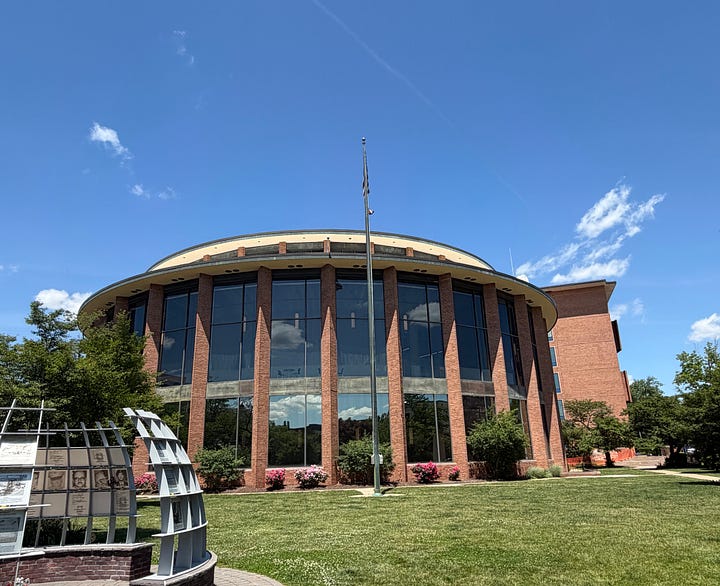
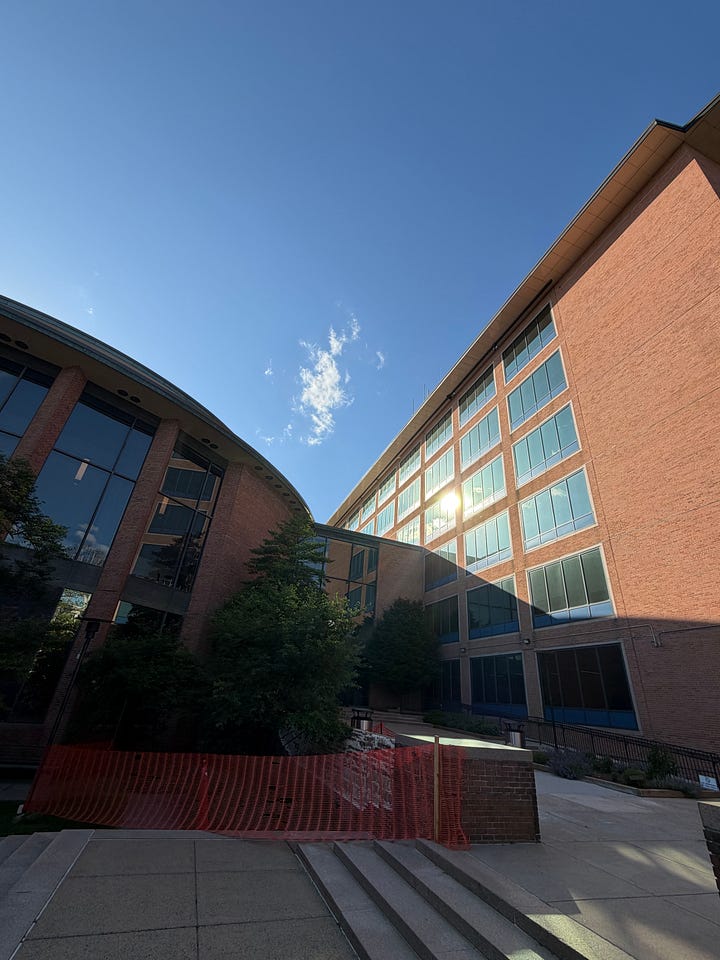
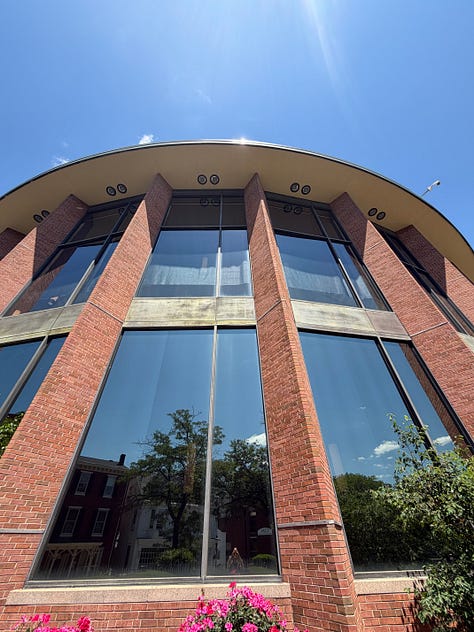
I thus searched Archipedia for something both Philly-architected and decidedly 20th century. I was curious how new structures had emerged around this frozen-in-time architectural menagerie. I found my Doyuilding in the Bucks County Courthouse, a brick and precast concrete donut built in 1962 and designed by the Philly firm of Carroll, Grisdale, & Van Alen. Now, I say donut, but architectural historian George E. Thomas, in his Courthouse blurb, revealed that pilots flying over Doylestown have dubbed the circular blobule “the toilet.” Nice!
Zara and I walked the grounds of the Courthouse and definitely saw both donut and toilet in the five-story circle—things became particularly lavatory-esque when the Courthouse was put in conversation with the interconnected Bucks County Administration Building, a less eye-catching, slightly taller rectangular annex that does look suspiciously like the back of a toilet:
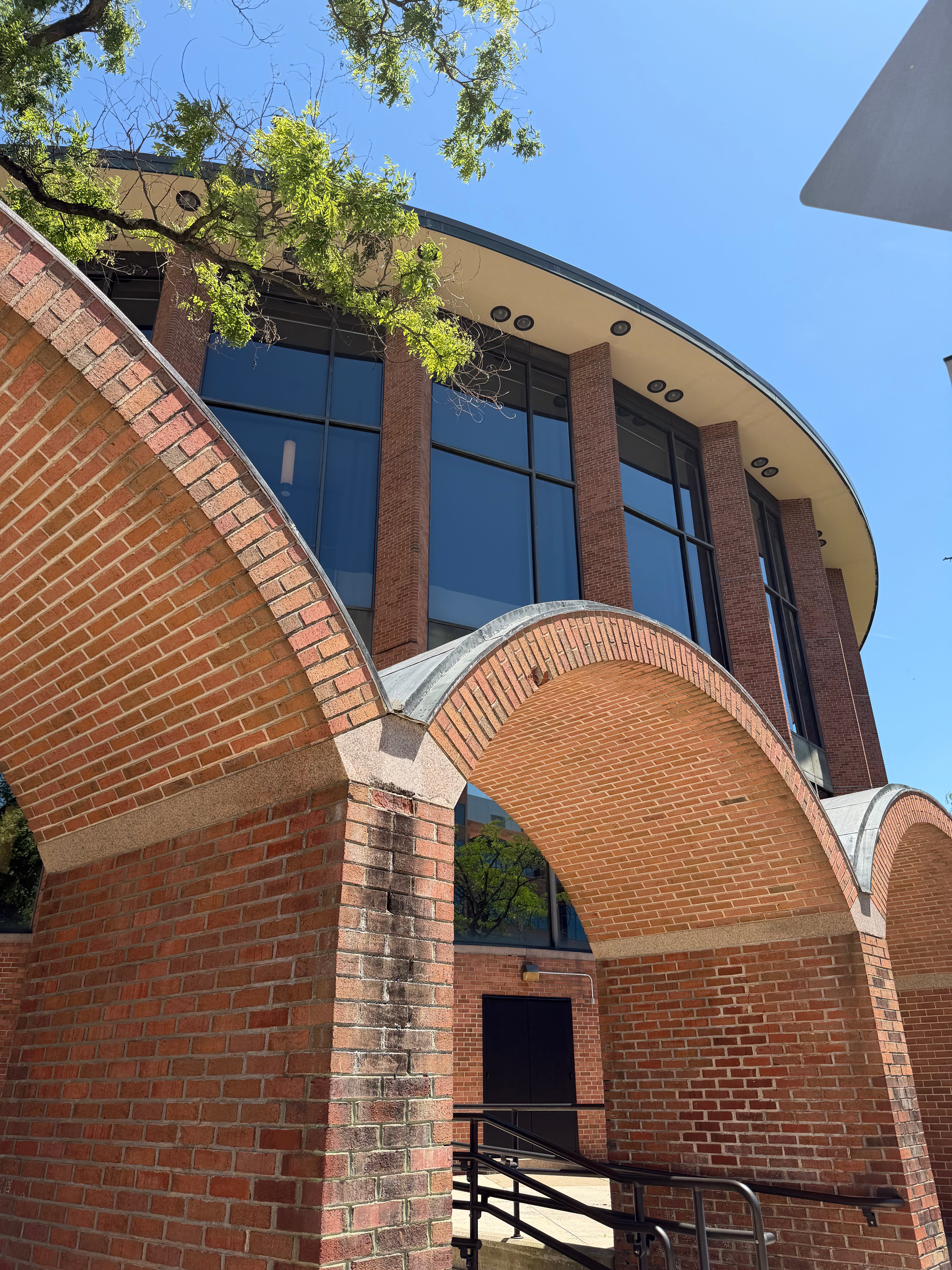
I much liked the cylinder, and was a particular fan of the cool brick archways that lined the triangular plaza:
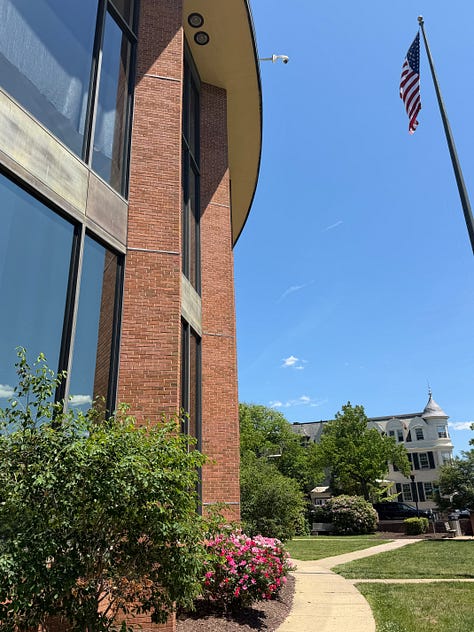
I did detect, however, the disconnect between the modernism of the Courthouse and the beribboned homes that lined the rest of Court Street. Thomas alluded in his blurb to this seeming mismatch, but he offered a more positive critical interpretation: “It is easy to forget in how many ways modern design reflected the independent design traits of strong Victorian buildings that we now find interesting.” I dig the idea that Victorian design was just as shocking as Modernism in its day, and I mulled this as I searched for good sight-lines to capture the two disparate architectural modes:
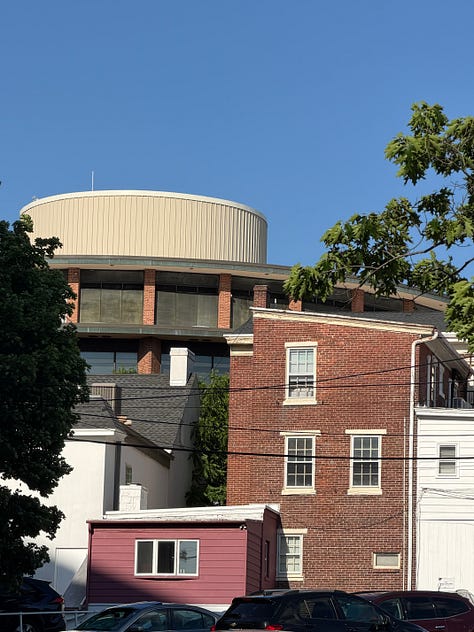
We soon returned to our lodging from our Courthouse surveying. We were staying in what our AirBnB host, Jean Rollo, called her FROG (Finished Room Over Garage), an impossibly cozy and calming studio looking out over Jean’s verdant garden. I had noticed that Jean’s AirBnB bio said, “Ask me about local history.” As it turns out, Jean writes a column, “History Lives,” that utilizes her historical findings at the Doylestown Historical Society and appears in the Bucks County Herald. Kismet, truly…
I ventured a query about the Courthouse. Shortly thereafter, Jean printed out an article she had written about the angst the Doylestown community felt when local leaders demolished the 1877 predecessor Courthouse to make way for what I am choosing, for the often elusive goal of avoiding more scatological imagery, to call The Donut.
Jean quoted from a January 1954 edition of the Bucks County Traveler explaining the unrest of the citizenry:
There probably has not been such a wailing and gnashing of teeth in central Bucks since the terrible day in 1876 when the powers-that-be decided to tear down the old 1812 courthouse and replace it with the hulking stone fortress that now serves as our seat of justice. Today’s protests range from claims that there is beauty in the old building (which is more like a castle on the Rhine than an American courthouse) to more justifiable pleas that a large, new building…would concentrate parking in an already congested area.
So the Doylestownians of 1954 already recognized the ferris wheel (or rotating Donut) of taste and nostalgia that always accompanied new architectural modes!
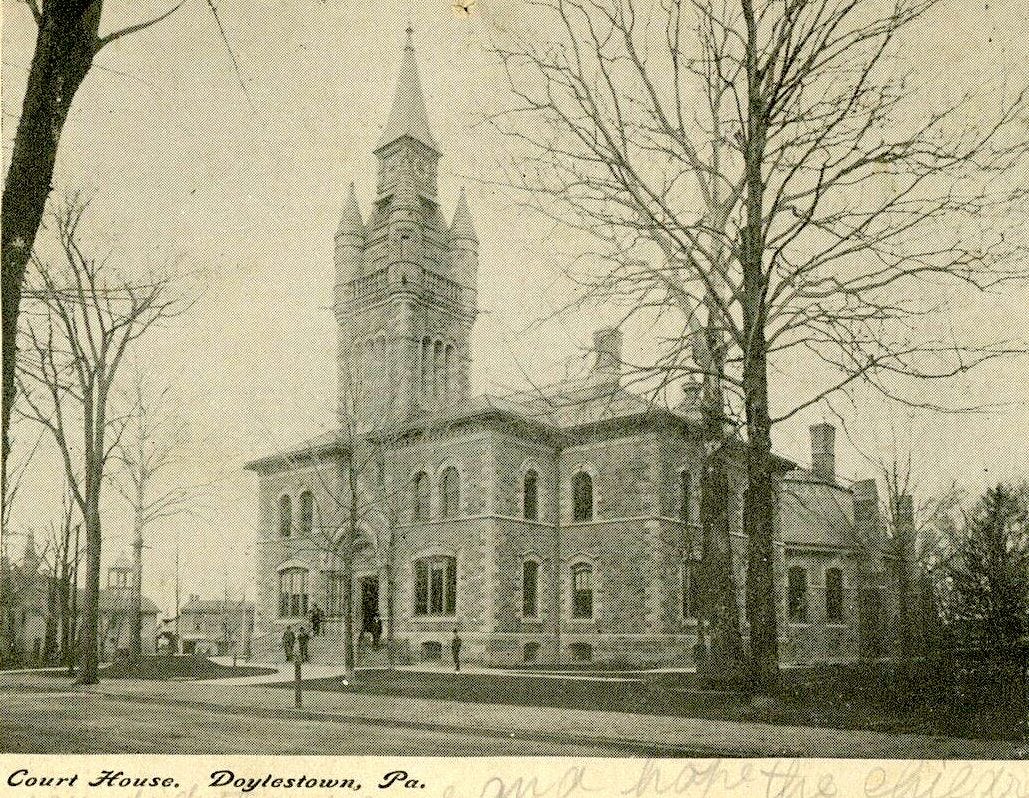
The County Traveler included a photograph of the 1878 Courthouse, which was indeed a Rhineland castle of epic proportions—and a major aesthetic change from the humble 1812 original.
I was excited to learn that Philly architect Addison Hutton was behind the 1878 iteration—so Philadelphians had rocked the boat in both episodes of teeth-gnashing!
I’m far from a Hutton completist, but the Courthouse is by far the most elaborate of his buildings I’ve yet seen—the tower, with its four pointy finials, is Victorian pomp at its flashiest:
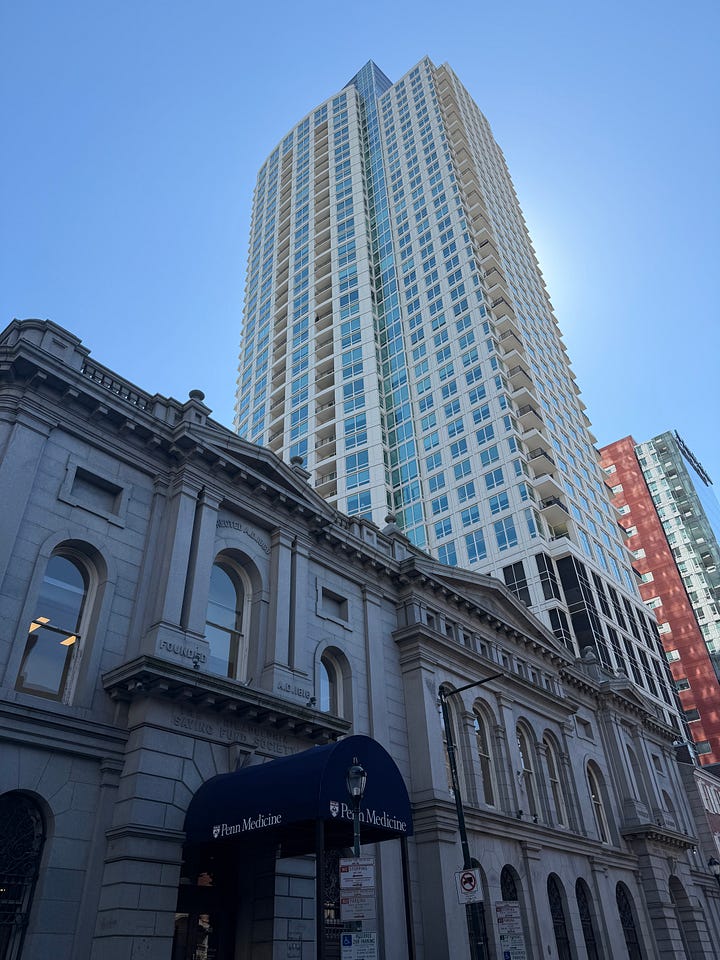
Hutton has made cameos in several other Archiveadelphias. He designed the original Packard Building, the YMCA HQ that I covered in my piece on its Deco successor (famed for its Samuel Yellin-wrought iron gates). He was also the architect for the handsome edifice of the Pennsylvania Historical Society. And, just a couple of blocks from my apartment, he crafted the home of the Pennsylvania Savings Fund Society at 700 Walnut, now part of the gleaming St. James luxury apartment high-rise.
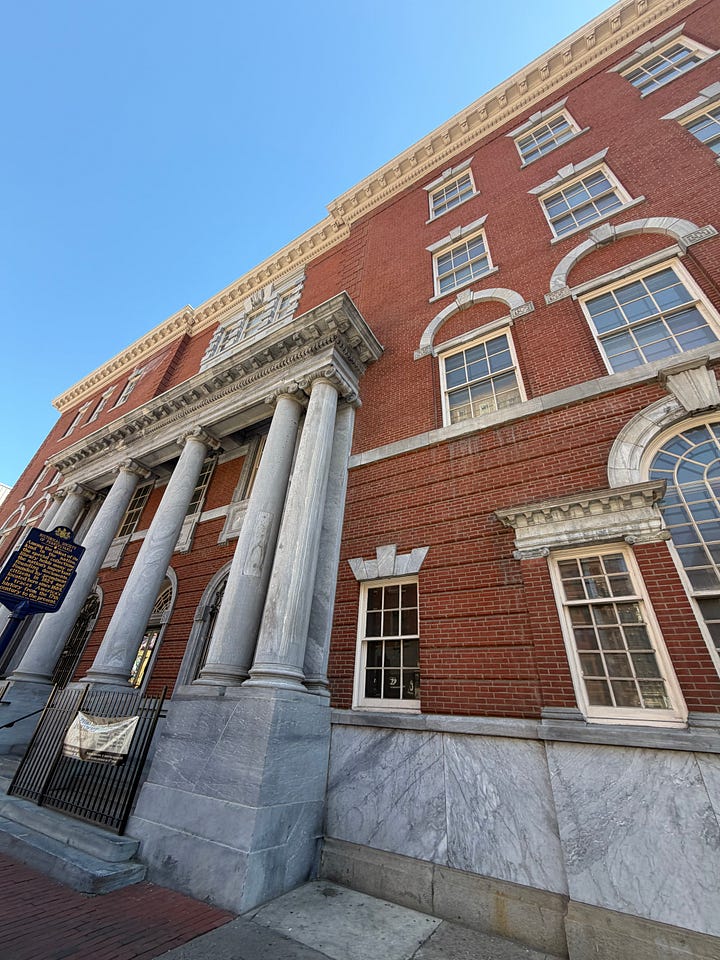
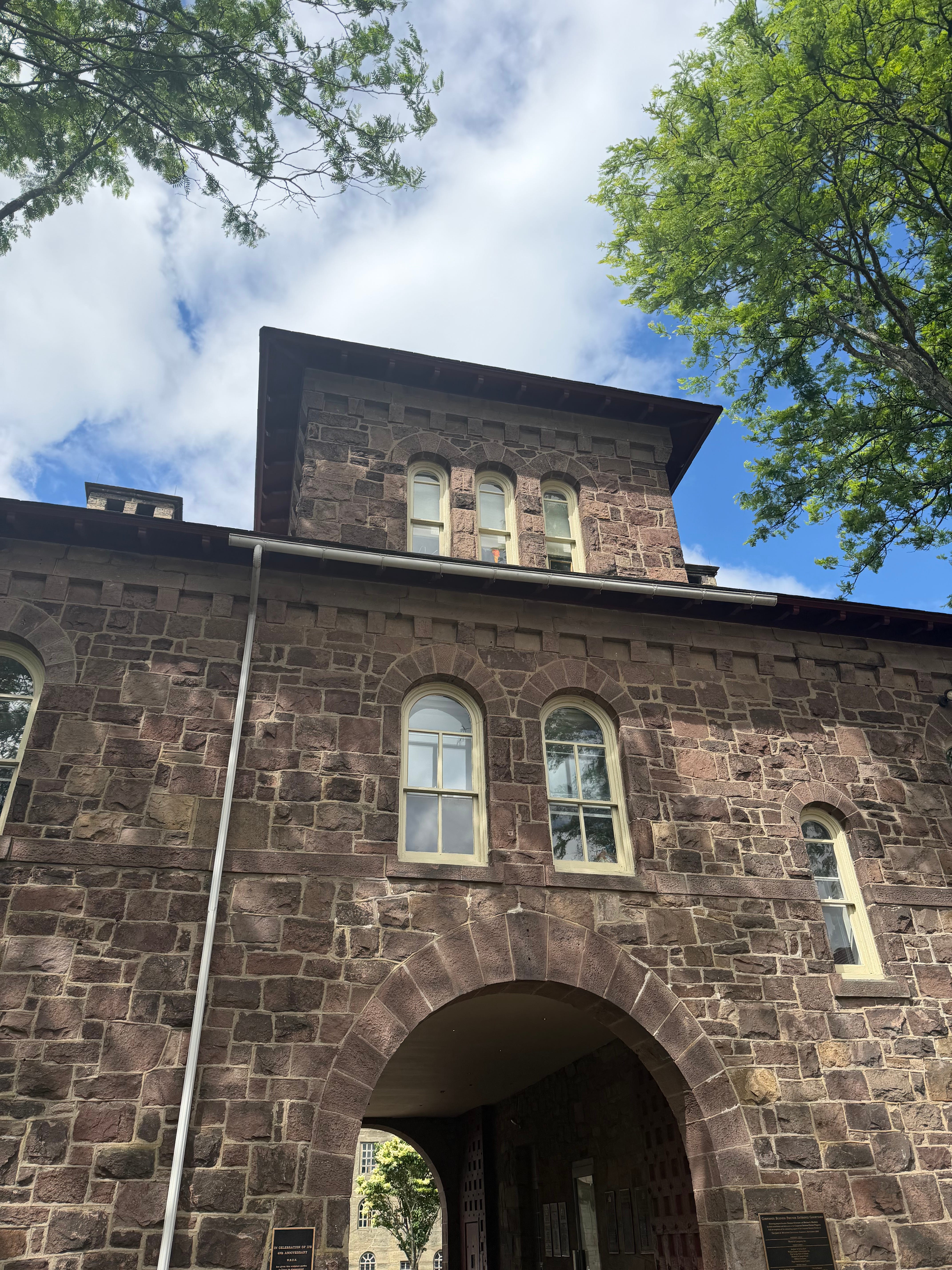
Hutton left quite his mark on Doylestown, designing several other iconic local buildings, including the high-spired Doylestown Presbyterian Church and the Bucks County Prison. The Prison, now incorporated into the Michener Art Museum, was modeled after John Haviland’s Eastern State Penitentiary and is a beautiful, if not somewhat foreboding, piece of work:
Another Doylestown historian, Doreen Stratton, wrote about Hutton’s Courthouse design in a post on her blog, Bucks Underground Railroad, which also houses Stratton’s deep scholarship on abolitionists and freedom fighters in the area. Stratton directed me to William Watts Hart Davis’s 1904 History of Doylestown: Old and New, which contains a detailed account of the Courthouse’s 1878 arrival.
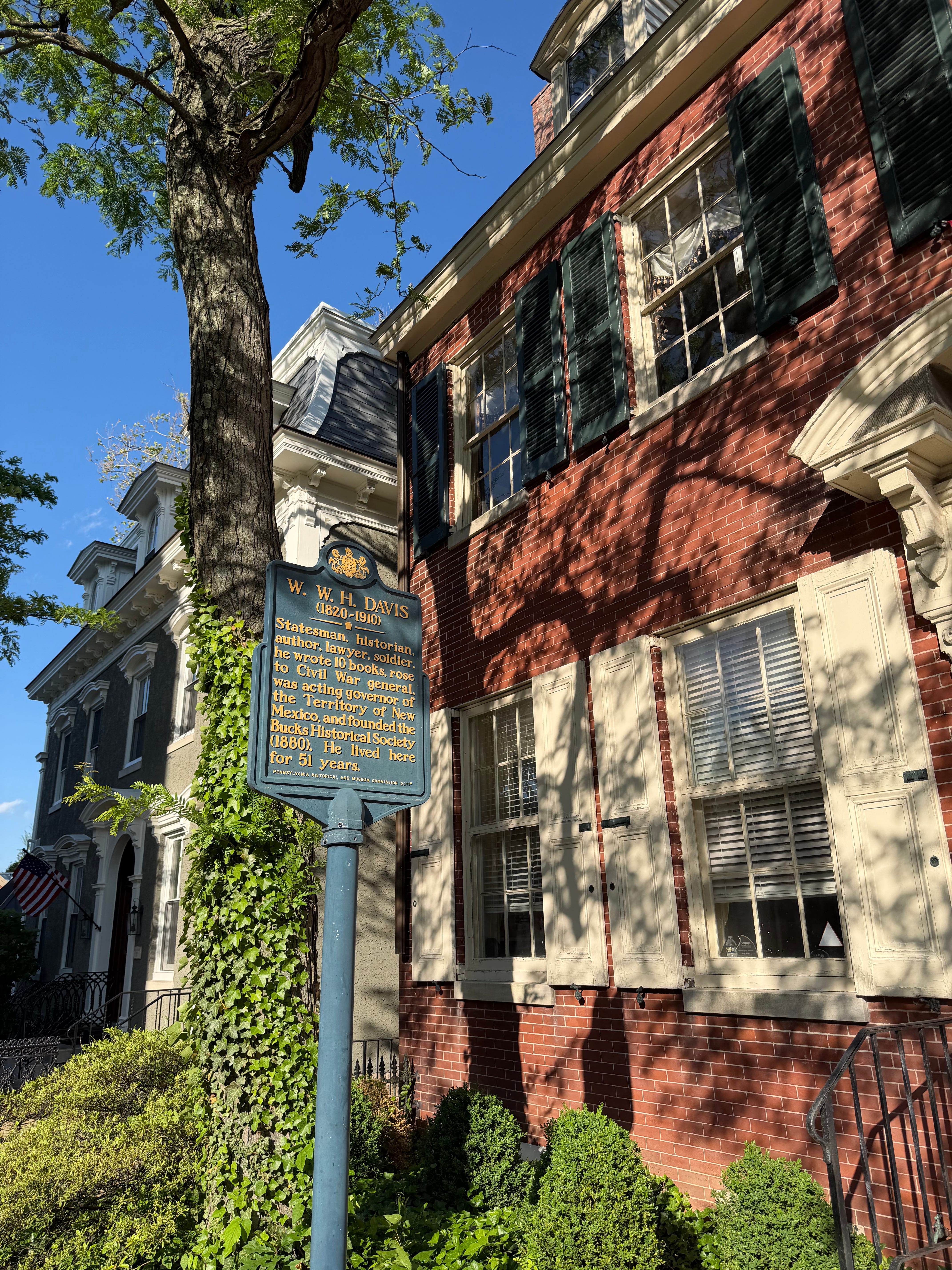
Davis, born in nearby Davisville in 1820, was a highly decorated Civil War Brigadier General who at one point served as acting governor of New Mexico Territory. He founded the Bucks County Historical Society in 1880 and wrote prolifically on both the Southwest and his home county. He was an active participant in Hutton’s courthouse. For one thing, he lived right across the street, in a pretty, shutter-heavy brick house:
Davis offered this excited bit on the construction in the Fall of 1877:
The premises were alive with laborers, masons, bricklayers, carpenters, et al; the hum of industry greeted one’s ear on every side, and the work was pushed with vigor in order to get the building under cover before winter set in.
Davis also gave the keynote address at the laying of the Courthouse’s cornerstone, an address he reprinted in part in his history. Davis went heavy on the drama in his remarks:
“While all ages have lavished wealth in the erection of beautiful temples for the worship of God, is it not meet and proper that we honor the temple of Justice, a co-laborer with the church? This edifice, then, whose corner stone we this day lay, and which is rapidly rising from its foundations to completion, under the hands of skilled mechanism, is a fitting tribute to the sacred profession of the law. When finished, the blind goddess, with poised scales, will open wide her portals, and summon her worshippers to consecrate this new temple to the cause of Justice, Mercy and Truth.”
Color me inspired! That was Hutton, Davis, the dawn of the Gilded Age—a collective effort to catapult Doylestown out of the farmy doldrums of the 19th century and into the ranks of a grand continental tradition.
The Hutton Courthouse gained literary immortality in realist novelist (and nearby Lambertville, NJ resident) James Gould Cozzen’s 1942 The Just and the Unjust, a sprawling depiction of a murder trial set in a fictionalized Doylestown called Childerstown. I admit I did not read the 447-page book (though its now on the list), but I did isolate some Courthouse descriptions (walking advertisement for Archive.org over here). I particularly liked this straight-forward but evocative one:
Inside this curious edifice with its pinnacled buttresses, vast hip roof, and stilted, ecclesiastical high windows, the shape of the courtroom was a semicircle. Nine concentric tiers of oak seats looked over the railed enclosure of the bar to the great bench, a massive and solid black-walnut pile.
By the 1950s, the Hutton Courthouse had grown frayed. Doylestown’s leaders gazed back toward Philadelphia and found another architectural firm with cachet: Carroll, Grisdale, & Van Alen. The three principals, J. Roy Carroll, John Grisdale, and William L. Van Allen, were masters of the sleek and the sharp who had all studied under Paul Cret at the University of Pennsylvania. They had made a splash in the early 1950s with their design of the Philadelphia Airport’s International Terminal—a streamlined and futuristic paean to the emergent Jet Age. The Free Library of Philadelphia houses photos of the firm’s overall plan and shots of the arched internal waiting area and drop-off, which have their own Donutty quality.
The fact that The Donut got built at all in the sedate borough is surprising. Former Penn political science professor Oliver P. Williams (and talented, late-life throw rug maker!), in his magisterial 2001 County Courthouses of Pennsylvania: A Guide, suggested that the very comfort of the area allowed for the risk: “Only a self-confident middle-class suburban and exurban county with a cultural tradition like Bucks would have the public moxy to build such a departure from one of the politically correct styles.”
But skeptics still abounded. When J. Roy Carroll Jr. headed to Doylestown in early 1955 to unveil the plans to the city leaders, he was met with a certain bemusement. Bucks County Judge Edward G. Biester, upon seeing Carroll’s circular vision, said the building looked like “something from the World Fair.” Temple’s online Evening Bulletin archive has some of the original drawings to which Biester reacted—they are worth a gander.
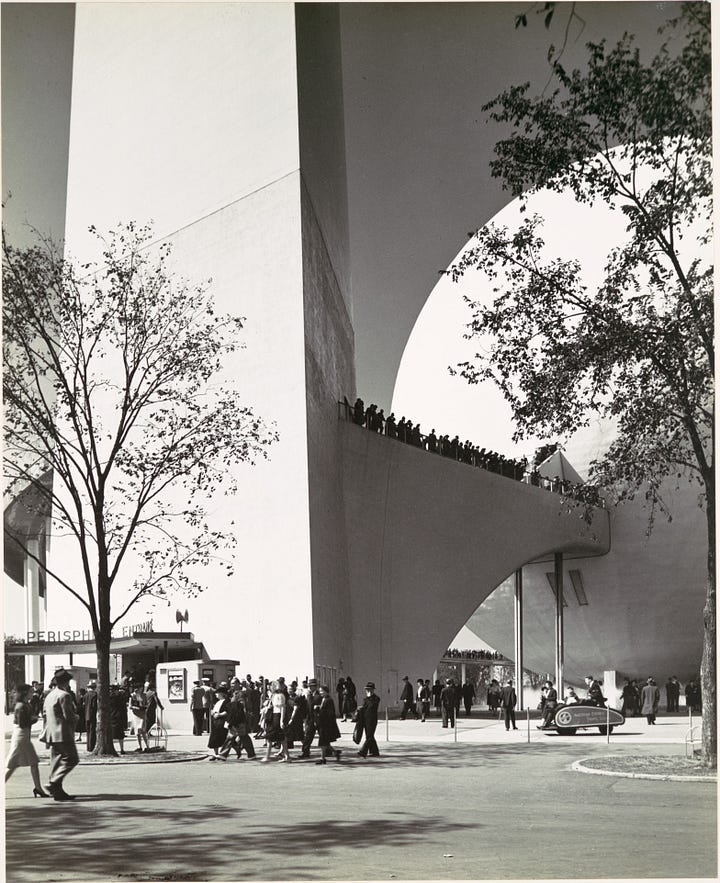
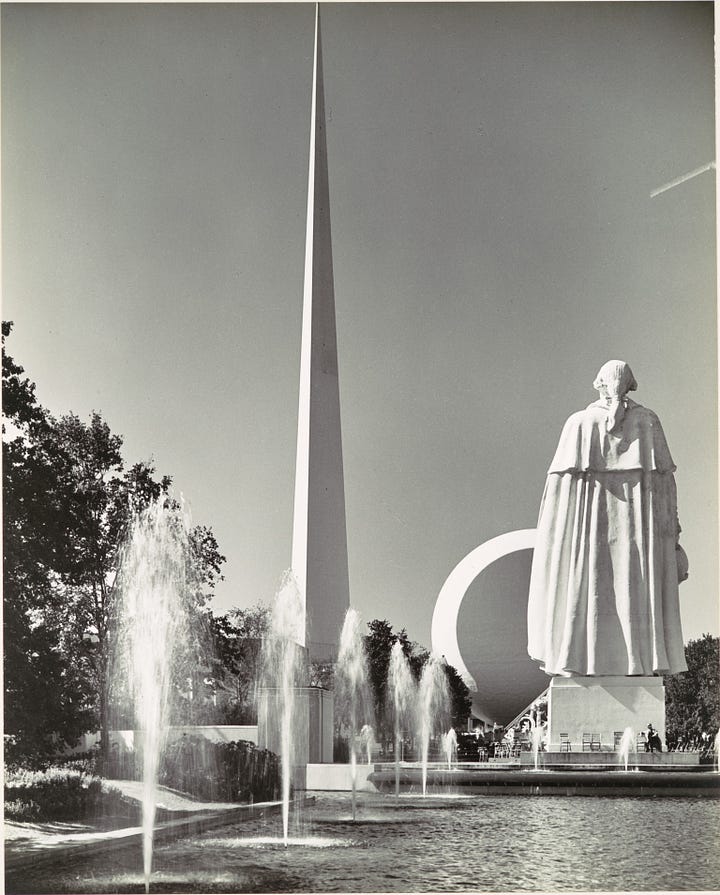
I don’t know exactly which World(‘s) Fair Biester was invoking here, but my guess is the 1939 New York World’s Fair, the apotheosis of American technocratic imagining. That Fair incorporated several circular buildings, including the famed Perisphere, a white orb encircled by an elevated walkway. And the rectangular annex toilet-back looked a bit like the Trylon, the big, spiky escalator next to the Peripshere:
In terms of The Donut: The rectangular administration building came first, with construction completed in 1960, while the Hutton Courthouse still stood, increasingly isolated. Carroll, Grisdale, & Van Alen made some nods to the texture of the neighborhood. “The red, Colonial exterior brick we believed to be a natural and logical choice for historic Doylestown, with its rich Colonial tradition,” Elisha Stafford, an associate with the Carroll firm, explained.
Another controversy concerned the fate of the Courthouse Plaza-bound 1830s Ross Law Office Building, Doylestown’s oldest brick building, which Carroll & Co. wanted to demolish and many Dolyestownians were desperate to save. “Leaving the Ross House is perfectly possible, technically, but artistically impossible,” Carroll architect John Grisdale told the Bristol Daily Courier. Ultimately, the Ross House was uprooted and moved a few blocks away.
A bit of a cold, progress-driven vibe from Grisdale, though! And a perspective that was pilloried, per another post on Stratton’s Bucks Underground Railroad blog, by three local teenagers who opposed the destruction of Hutton’s Courthouse and the general acquiescence to modernity. “THE SINS COMMITTED IN THE NAME OF PROGRESS,” the youths wrote on a fence across the street from the site. Stratton argued that Hutton, a “nonconforming quaker,” would have dug the act of civil disobedience.
Despite the graffiti, the Ross House dust-up, and even a series of unsuccessful lawsuits aimed at stopping The Donut from cooking, the Hutton Courthouse met the bulldozers and cranes in October 1960, and The Donut soon went up, opening in 1962 to much continued local dissension.
Pundits were particularly preoccupied by the interior. There were carpets hand-made in Puerto Rico, ebony woodwork, and expensive wallpaper—all contributing to the steep $8 million price tag.
I spent some time in the archives of the Bucks County Panorama, a local magazine that covered The Donut’s arrival. The October 1962 issue (thank you for the one trizzilionth time, Archive.org!) includes a breathtaking photo tour and lots of positive spin.
In a January 1962 Panorama column, however, local radio host Bob Brugger absolutely eviscerated the new Courthouse, complete with lots of emphatic bolding. He called The Donut the “Conrad Hilton of fall-out shelters” and “Frank Lloyd Wrong for downtown Doylestown.”
Disclaimer—I swear I found the Brugger article after I made the 1939 World’s Fair connections, but Brugger makes the same leap! He argued for selling The Donut, and said he had a “jim-dandy prospect”: “Robert Moses, president of the new New York’s World Fair. Talk about a ready-built trylon and perisphere.” Great minds, great minds…
Brugger offered a final warning:
“Doylestown, if it continues to conspire in this conformity to modern mediocrity, could very well become just another Drive-In on the treeless desert of discount marts. (If this is progress, Brother, we might as well let Howard Johnson start bidding on the Mercer Museum right now!)”
In an ironic coda, given all of the Doylestownian angst about The Donut’s appearance, J. Roy Carroll assumed the presidency of the American Institute of Architects in 1963 and promptly went on a crusade against what he perceived as the unattractiveness of American cities, traveling the nation to preach for prettier cities at various industry conventions.
Carroll delivered a particularly spicy denunciation of architectural ickiness at a convention of the Pre-Stressed Concrete Institute at San Francisco’s ornate Palace Hotel (please get me a Delorean to time travel there right now):
We cannot continue to build a handful of beautiful buildings and other structures in a sea of ugliness….We are getting the reputation of being the ugliest country in the Western world and, unfortunately, we deserve it.”
With Carroll’s scolding still smarting in my ears, I took a walk around Philly yesterday to consider if and how Carroll’s own works fought against ugliness. I came away uncertain.
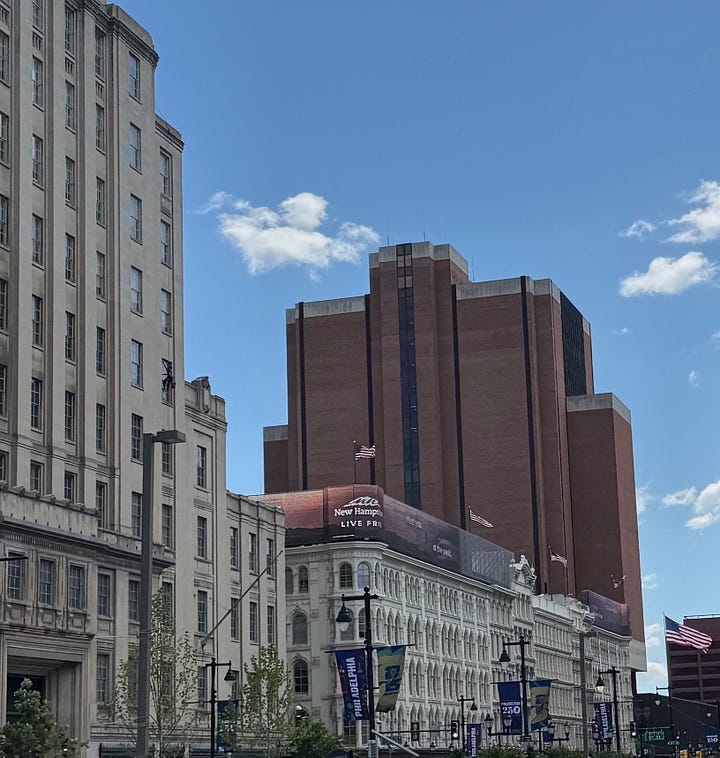
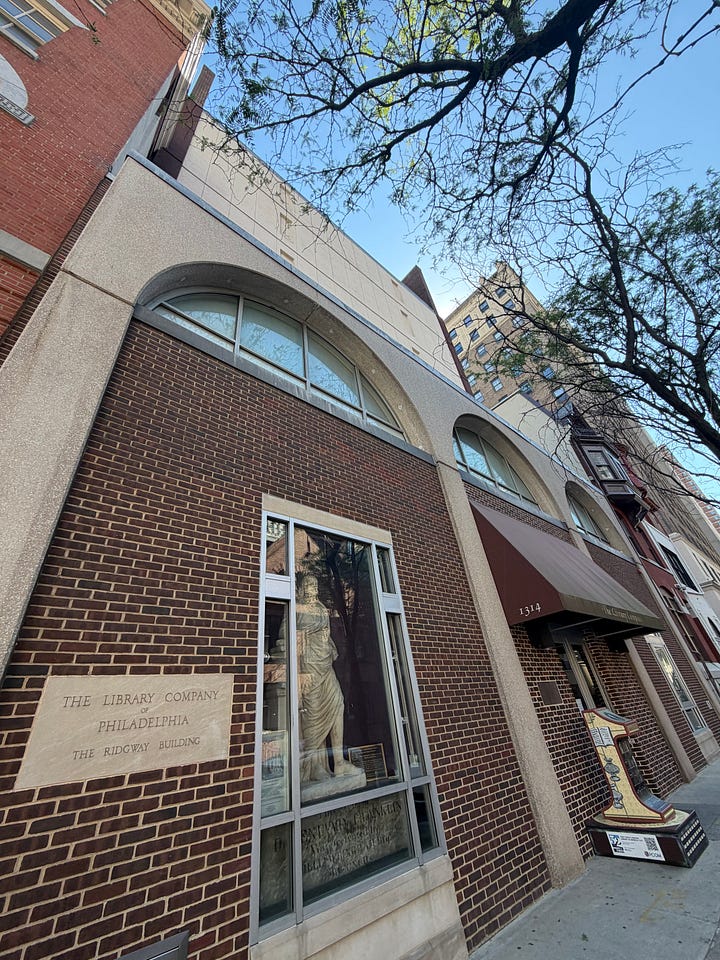
Yes, the Airport Terminal and The Donut have a certain attractive curvature and economy of space, but I found a lot of their Phuildings harder to love. The James A. Byrne United States Courthouse is too much like a vertical cardboard box. The adjacent William J. Green Federal Building looks like the cardboard box has been turned on its side. The Library Company of Philadelphia, notwithstanding the incredible scholarship that goes on within, is a bit suspect:
I also found a surprising dearth of critical analysis on the firm and its broader place within the Philly architectural scene. Thankfully, Inga Saffron, the genius architecture critic at the Inquirer, has expended some ink about Carroll & Co.’s impact.
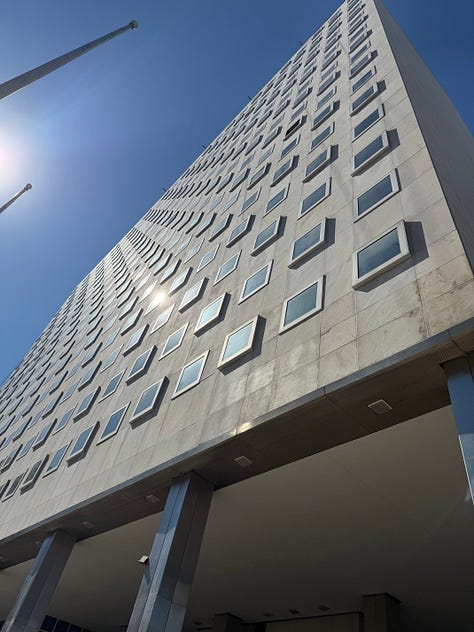
In a 2007 post on her erstwhile blog Skyline Online, Saffron explored the firm’s legacy through the lens of their Pennsylvania State Office Building at Broad and Spring Garden Streets. I was thankfully en route yesterday to the Preservation Achievement Awards at nearby Vie, so I stopped by and took some shots.
Saffron liked the “alternating windows,” which she said “gave the otherwise, by-the-book International Style high-rise a serious sense of rhythm.” I’m inclined to agree—they are fabulous windows indeed:
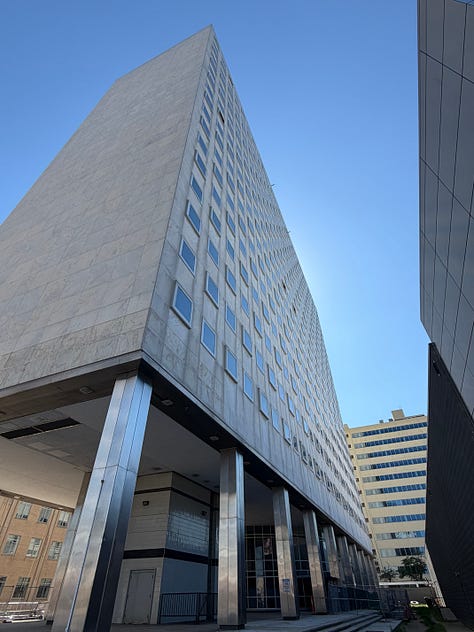
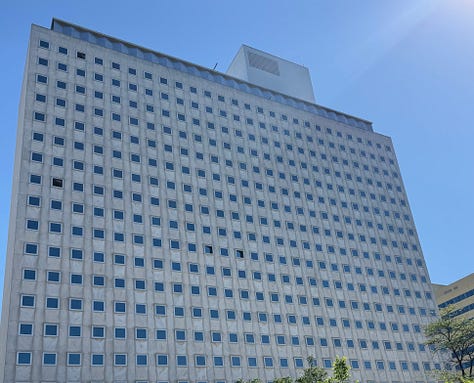
Saffron also weighed in on the “fascinating curiosity” that is the The Donut, arguing that the Doyuilding was “bold in its form” but “utterly blinkered to the lovely town at its feet.”
And she argued that the firm had an overriding deficiency: “Their designs are nearly always socially maladroit on the ground floor.” So The Donut’s lack of engagement with its surroundings was thus replicated in Philly…
Yet Saffron ends on a positive appraisal, and one that I share about this under-discussed firm:
“It’s evident that this was a creative bunch bursting with ideas, even as they stayed loyal to Modernism’s rules about geometry and regularity. They didn’t repeat the same forms over and over. Each project seems to be an attempt to create something fresh and original. And that’s still worth admiring today.”
I like this optimistic vision of Carroll & Co.’s striving for the unique! Leave it to the cute and old-school Doylestown to make me consider cylindrical Donuts, architectural cycles, and the elimination of architectural ugliness, successful or not…
No posts
Comments
Nothing yet. Say the first thing.
Sign in to join the conversation.