
FIVE PHILHARRISBURG NUGGETS
Last weekend, Zara and I took the Amtrak to Harrisburg, our often-underappreciated state capital, for our third anniversary trip. We had a blast, and—as with Zara’s birthday trip to York—found that Philadelphian reminders were around every corner:
We were thrilled by the Susquehanna Art Museum, located in a beautifully restored 1916 bank building in the city’s very hip Midtown. The temporary, Semiquicentennial-inflected exhibit was “American Identity: Restoring the Susquehanna River’s Artistic Legacy.” We took in painterly renderings of the winding river—a principal feature of Harrisburg— dating back to John Smith’s 1610 expedition. We were particularly entranced by a vivid 1830s portrait, “River Landscape, the Hunt,” complete with dogs swimming after a submerged stag, antlers stretching up from the water, while hunters watched from a nearby canoe. The painting was attributed to Thomas Doughty (1793-1856), a lifelong Philadelphian who a nearby piece of wall text told us was long-associated with the Pennsylvania Academy of Fine Arts, making an initial splash in 1824 by exhibiting his illustrations of frontier-focused author James Fenimore Cooper’s The Pioneers, or Sources of the Susquehanna. The Internet Archive has the catalogue from a 1973 Doughty retrospective at PAFA—a wonderful overview of this pioneering landscape master.
Yearning for more artifactual explorations, we headed to the State Museum of Pennsylvania on Saturday afternoon. I was bowled over (no pun intended) by the circular, Madison Square Garden-esque architecture, thought up by the local Lawrie & Green firm in 1964. The stunning Memorial Hall is a multi-floor deal with an 18-foot bronze statue of Billy Penn and a sprawling curved mural by Lawrence Marigliotti showcasing the development of the state. The Hall feels unchanged from the 1960s and would be a great place to film a period Irishman-influenced Harrisburg crime drama, with a tense meeting between a local bookie and an undercover Fed taking place in front of the bronze Penn. We enjoyed another Semiquinny exhibit, “Revolutionary Things,” which showcases endless ephemera from the Centennial and Bicentennial (1926 Sesqui oddly absent). A special highlight was seeing one of the five actual wagons from the Bicentennial Wagon Train Pilgrimage, a state-funded, cross-country extravaganza in which the 1800s-replica trains converged on Valley Forge for the big anniversary. Penn State even made a very entertaining documentary about the initiative, “Eastward, Ho!”—available here on YouTube.
Walking back from dinner on Friday night, we saw a statue in the darkness of the Capitol complex. Upon closer inspection, we learned that this was a bronze figure of Boies Penrose, the notoriously corrupt U.S. Senator and GOP Philoperative. I first encountered Senator Penrose when researching my forthcoming Bellevue book. A regular at the hotel, waiters in his later days, per a highly entertaining 1978 American Heritage piece by iconoclastic Philly historian John Lukacs, put a screen around his table to conceal some of his more extreme consumption habits (he once, according to a congressman friend, ate 26 reed birds and drank nine cocktails and five highballs during one dinner). Further digging revealed that the sculptor of the Penrose statue was another Philadelphian, Samuel Murray, who also crafted the dramatic likeness of Commodore John Barry, the early American Navy leader, behind Independence Hall.
Strolling about East Harrisburg on a very hot Sunday, we passed Lincoln Cemetery, a final resting place for many notable 19th-century Black Harrisburgers who played fundamental roles in the fight against enslavement and racial inequality. One of these inspiring people was Thomas Morris Chester (1834-1892). Born in Harrisburg, Chester traveled to Liberia for high school and to teach. Upon returning to the United States at the start of the Civil War, Chester settled in Philadelphia. In 1862, he gave a rousing speech, “Negro Self-Respect and the Pride of Race,” at an anniversary celebration for the Library Company of Philadelphia. The full speech is available here, via Cornell’s digital collections. Near the end of the War, Chester became one of the only Black journalists to report from the front for a major daily, the Philadelphia Press. You can learn much more about his fascinating life from this 2015 New York Times profile,
I opted to watch, upon returning home, the 2000 dark comedy Lucky Numbers, starring John Travolta as a down-on-his-luck Harrisburg weatherman and Lisa Kudrow as his sometimes-girlfriend and the “lottery girl” who presents the winning numbers on Travolta’s same station. The duo hatch a scheme to rig the lottery and collect the winnings, leading to violent hijinks involving Michael Moore (in a startlingly funny role as Kudrow’s creepy cousin/collaborator), Tim Roth (an inexplicably British strip club owner), and Bill Pullman (a bumbling policeman). The film, written by Harrisburg comedy writer Adam Resnick and directed by When Harry Met Sally genius Nora Ephron, was inspired by an actual 1980 scandal, the “Triple Six Fix,” wherein Pittsburgh TV lottery personality Nick Perry weighed down the 4s and 6s in his drawing and had two associates in the vending machine trade buy a lot of 4 and 6-heavy tickets (the winning number, devilishly, was 666). The scheme was uncovered and jail time ensued, in part due to the vending brothers buying up a lot of their tickets in the Philly area! The film, still nominally a period piece but intriguingly moved to 1988 Harrisburg, is a bit all over the place, but there was something undeniable about Travolta (whose recent Cannes berets have been inspiring me deeply) and Kudrow’s energy. Here’s the YouTube Movies link if you’re feeling patient/adventurous…
HARRIPHUILDING OF THE NEXT TWO WEEKS: STRAWBERRY SQUARE
Zara and I stayed at an AirBnB on Walnut Street, across from the State Capitol complex. Staring out the window of our little second-floor apartment, we saw the hilly grass lawn, with winding staircases ascending to the seat of government, its glittering green dome shining in the sun.
A few storefronts from our AirBnb, at the corner of South 4th and Walnut, was Denim Coffee, one of a small Central Pennsylvanian chain that pours some very generous double Americanos. I had reached a euphoric level of caffeination, midway through one of these elixirs on the first day of our trip, when I gazed from Denim’s window across South 4th and beheld Strawberry Square.
Strawberry, as I shall call the Harriphuilding, stuck out from the mostly-brick, late-19th-century structures that lined our portion of Walnut. This was a 12-story, block-long behemoth, with silver stone cladding, an arch-heavy entrance arcade, a walkway from the second floor leading over to the Capitol green.
Wandering inside, I learned that Strawberry was not only large, but profoundly intricate. The interior (complete with another Denim Coffee kiosk) was a three-story triangular atrium formed by three separate corridors stretching across the large volume. A second-story food court had a jagged triangular balcony edge decorated in neon. Two towers, one nine stories tall, the other twelve stories, rose around the atrium, united externally by a metallic grid dropping down between them—a fetching curtain wall facing the Capitol. And walking the ground floor corridor toward the backside and the central business district beyond, I was enraptured by the incorporation of 1800s facades and brick styles into the Strawberry architectural scheme.
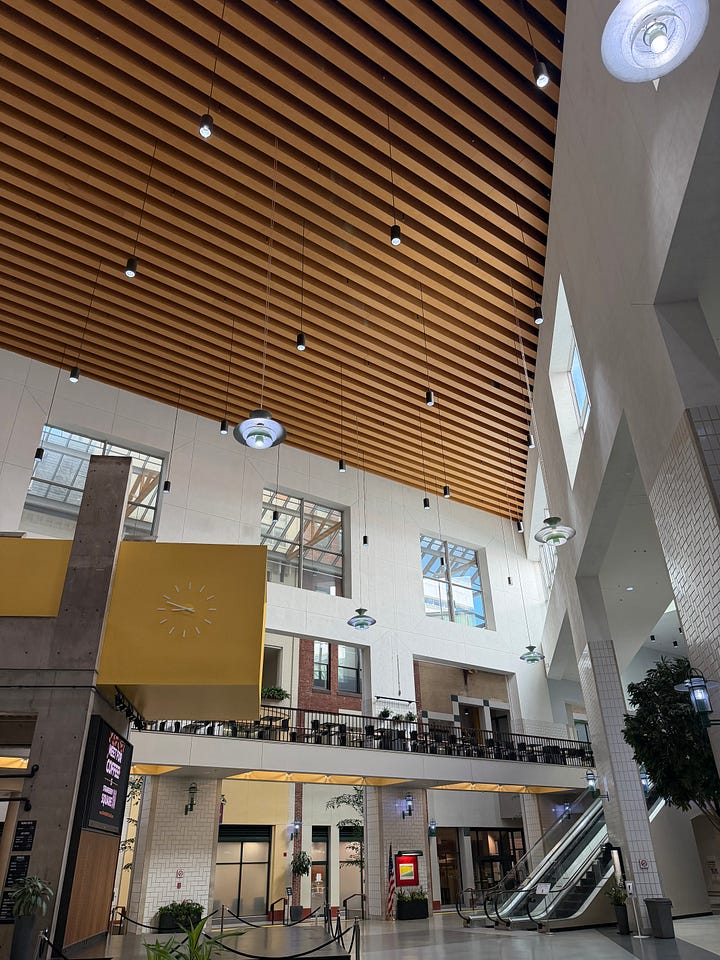
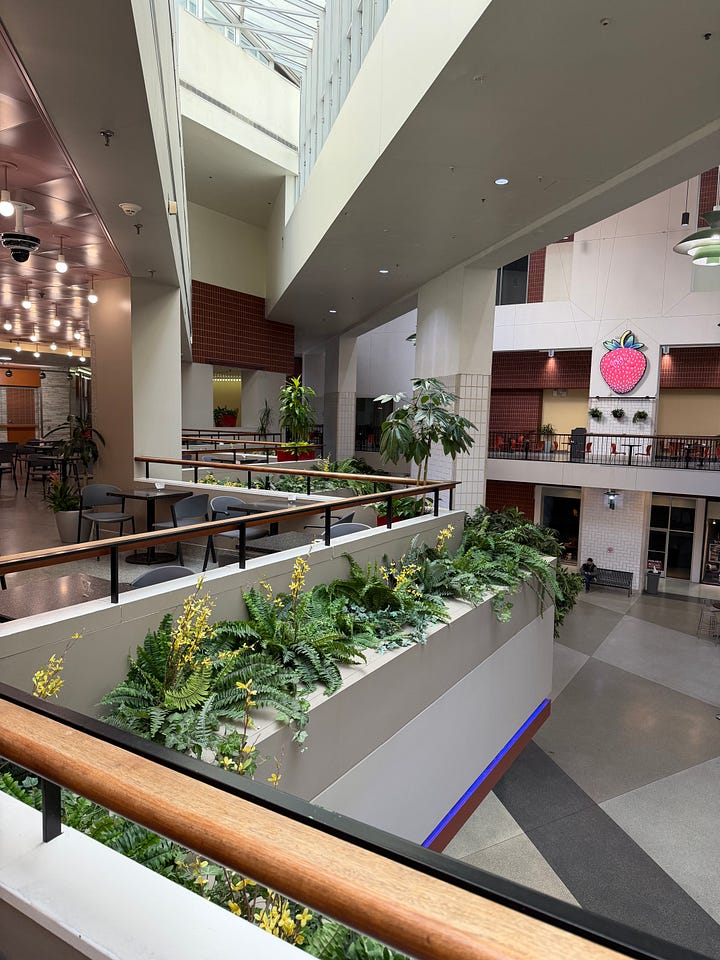
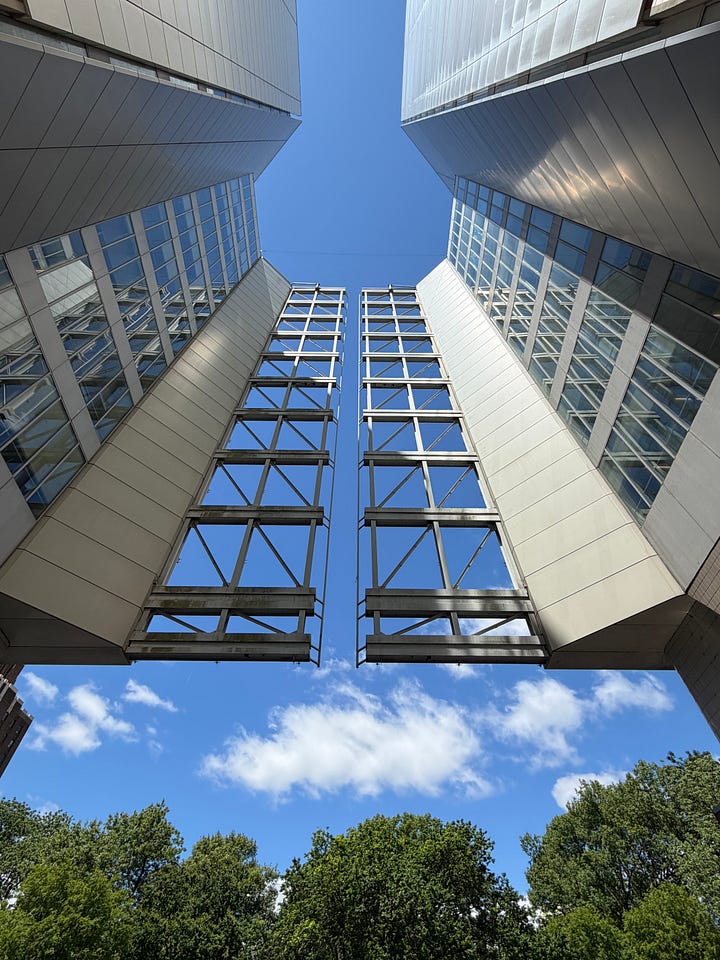
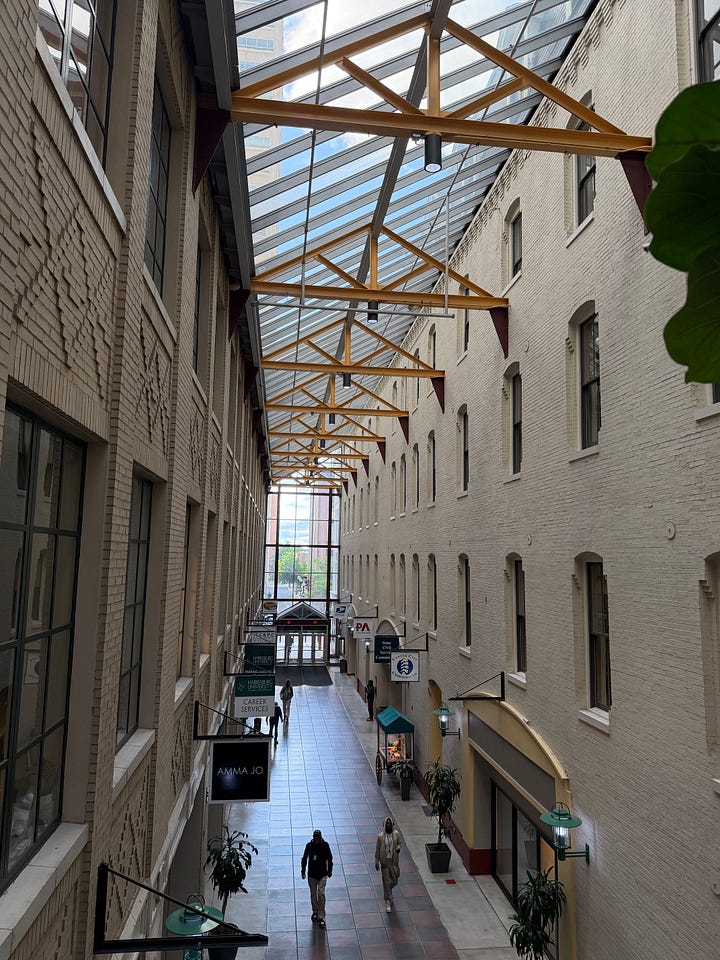
This was a project into which my archival teeth deserved to bite, particularly when Googling revealed that iconic Philadelphia firm Mitchell/Giurgola—behind such city-defining projects as the Liberty Bell Pavilion and the Penn Mutual Building—were behind Strawberry, and that the Mitchell in Mitchell/Giurgola, Ehrman Mitchell Jr., was from a very colorful Harrisburg family. The Philadelphia-Harrisburg architectural axis was established right here in this gargantuan, mixed-use, 1978 grand projet.
I started reaching out to surviving Mitchell/Giurgolians who were working at the firm when they were Strawberrying in the late 1970s, and I also found some fun Harrisburgers who had major dish on the heady early days of the complex. By day’s end, I recognized I had a two-parter on my hand.
So—as is my want with Archiveadelphia—I decided to focus this week’s installment on the earlier history of the Strawberry site and to continue putting together interviews and intel on the actual construction for next week.
For this week, then, my questions were: Had the site of Strawberry Square always been an important block for the city, particularly given its linkage location between the Central Business District (CBD) and the Capitol? And were there Philadelphian connections at play earlier in the site’s saga?
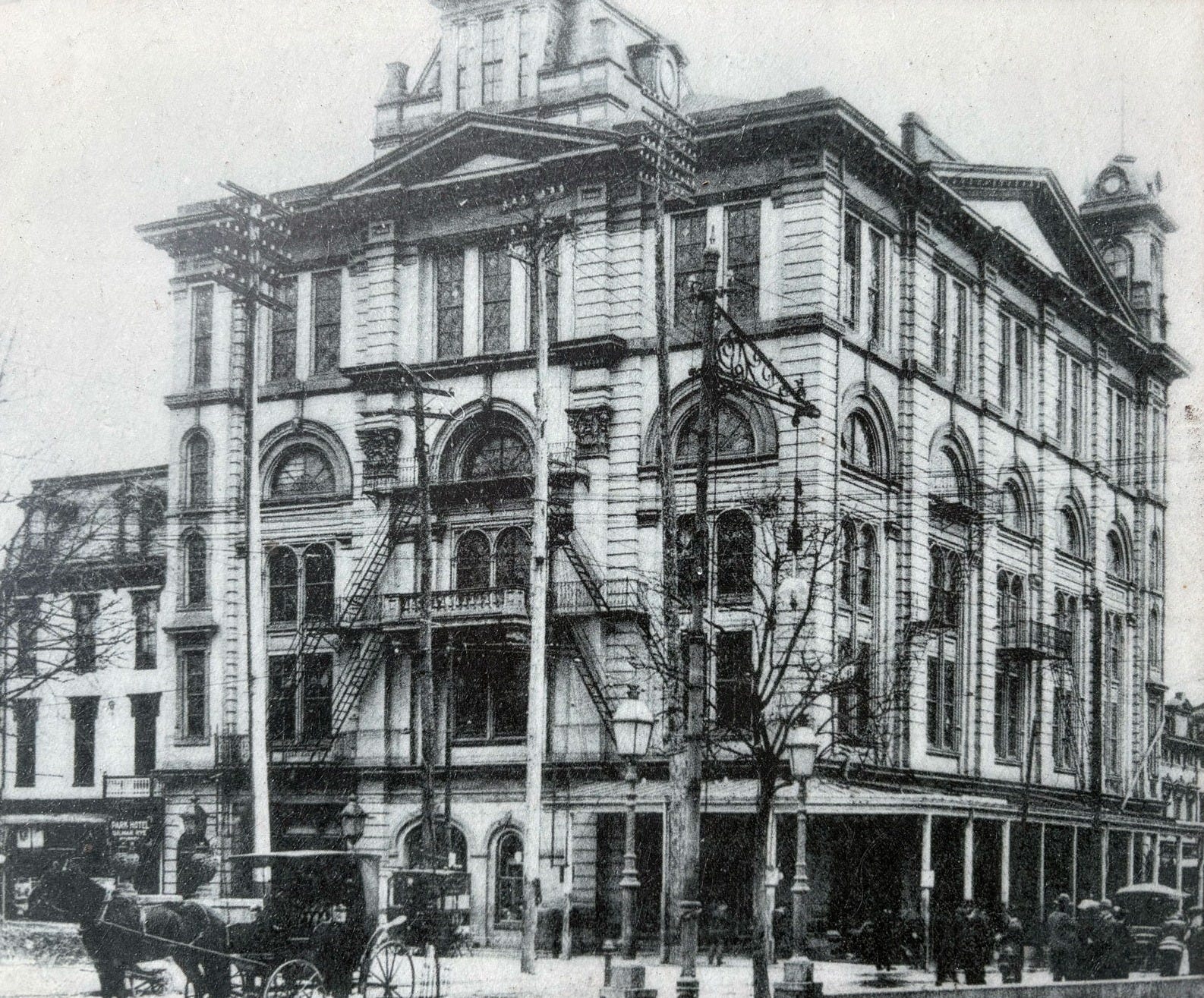
As expected, this prominent square had long been central to Harrisburg’s self-conception. In 1872, the city raised its Grand Opera House on what became Strawberry. The Opera House real estate was cobbled together from smaller hotels, offices, and residences, assembled in part by the largesse of the local Masonic order, who liaised the emerging Opera House as their clubhouse when outside performances were not afoot.
The Opera House-slash-Masonic-Temple architect was Frank E. Davis, a prolific Baltimorean. His elegant design housed a 1,500-seat theater and ground-level retail—early mixed use in action! The white-trimmed, arch-heavy stone building was a real French Second Empire gem:
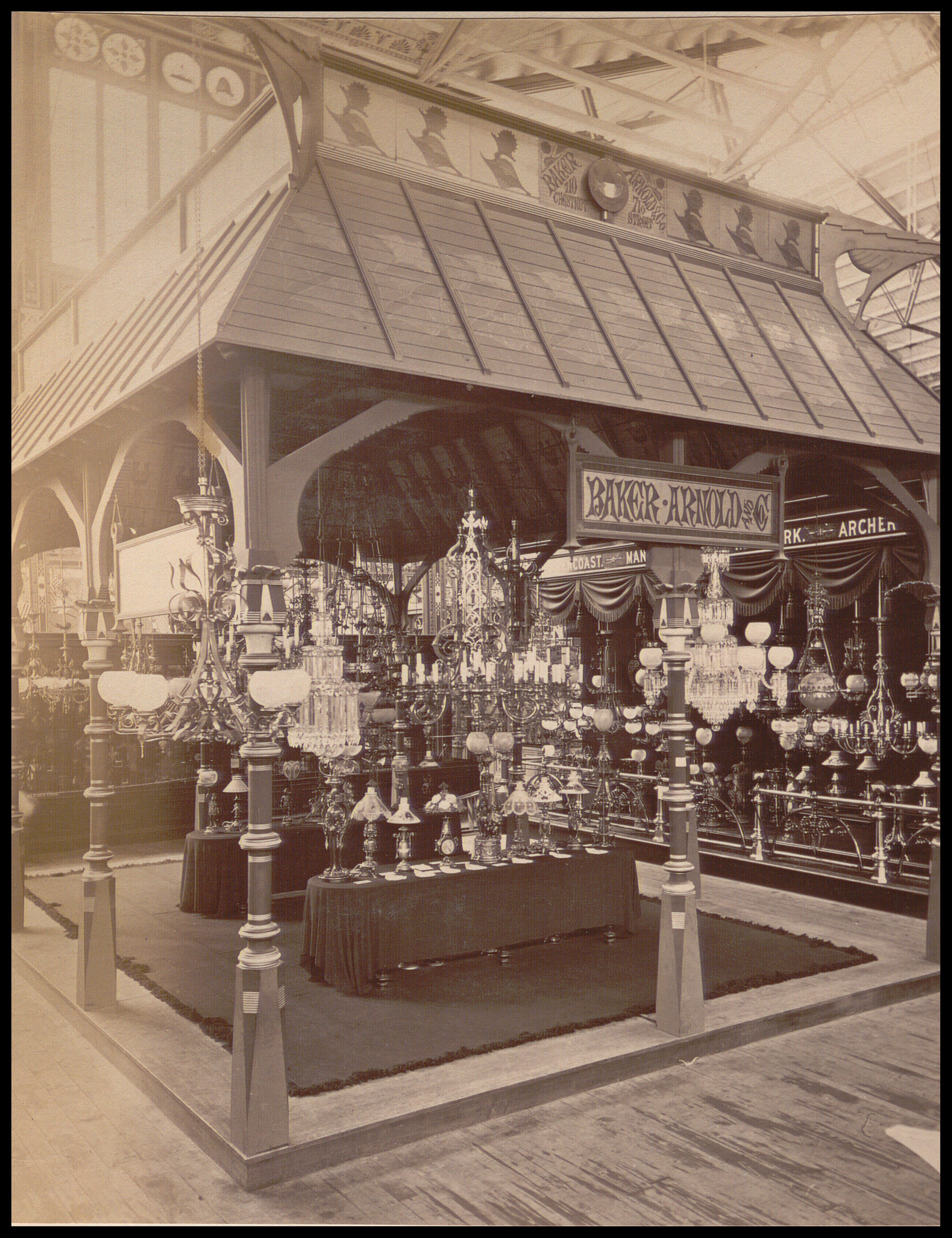
Many of the interior furnishings came straight from Philadelphia, which was already laying an early claim to its moniker as “The Workshop of the World.” Baker, Arnold & Co., the famed Philly gas fixture kings, provided chandeliers. I dug up a Semiquincentennial-resonant photo of their booth at the 1876 Centennial Exposition in Fairmont Park, just a few years after their Opera House work:
And William Gibson, the so-called “Father of Stained Glass” and another Philadelphia resident, offered the glasswork for the building.
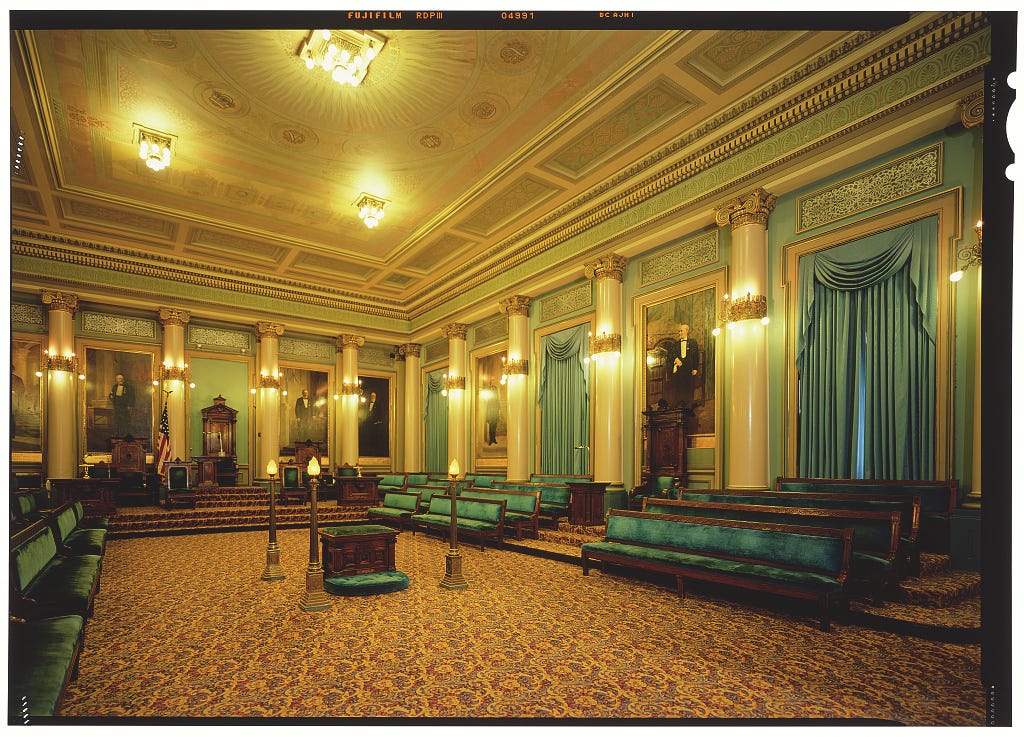
I cannot for the life of me find an interior shot of the Opera House, but I imagine that the vibe was somewhat like the interior of Philadelphia’s Masonic Temple, the fantastical James H. Windrim-architected castley thing on North Broad. The Philly Masonic Temple opened the very same year as the Harrisburg equivalent, was also right across from the seat of government (City Hall, which was in its infant stages of construction at the opening) and also featured both Baker, Arnold & Co. and Gibson goods. Here’s a shot of the Ionic Hall, which I’m choosing to imagine had a similar vibe, spatial differences notwithstanding, from the Opera House auditorium:
So—Philly provided a lot of the craftsmanship for this pre-Strawberry delight. And, God Knows, the Quaker City also provided much of the drama that invaded the space. Often a site of partisan political meetings that might be too freaky for the Capitol across the street, the Opera House hosted, in 1895, a particularly contentious state Republican Party convention. The drama, briefly, concerned a battle between the machine politician, close Penrose ally/mentor, and U.S. Senator Matthew Quay, and the reformer Governor Daniel Hastings. Quay was not a Philadelphian (he was from Beaver, in Western PA), but he had solidified his power by dominating Philly’s patronage system as the County Recorder at the turn of the 1880s. He even resided during that formative period in a large house just a couple blocks from my apartment, at 11th and Spruce.
The national press flocked to Harrisburg for the Quay-Hastings showdown, with rumors that Quay might bring some rough dudes out from Philadelphia to physically intimidate his rivals. But Quay, known for his wily ways, managed to retain his power sans thugs, promising to reform the GOP’s out-of-control patronage system. And he—the Opera House being quite hot in the August sun—even used a decorated fan produced by the Inquirer (a very supportive machine paper), which read “Vote for Quay.” The Opera House showing was so expert that Quay ran for president the next year, though William McKinley bested him at the Convention.
Beyond politrix, the Opera House hosted many Philly artistic troupes. In 1887, for example, came the McCaull Opera Comique Company, to perform the new Gilbert & Sullivan operetta Ruddigore. John McCaull, the company’s Scottish-born leader and a former Confederate soldier dubbed “Colonel McCaull,” had recently taken over a theater across from the Academy of Music at Broad and Locust, where he often offered regional debuts of British G&S joints. And he took the whole Philly production on the road to Harrisburg!
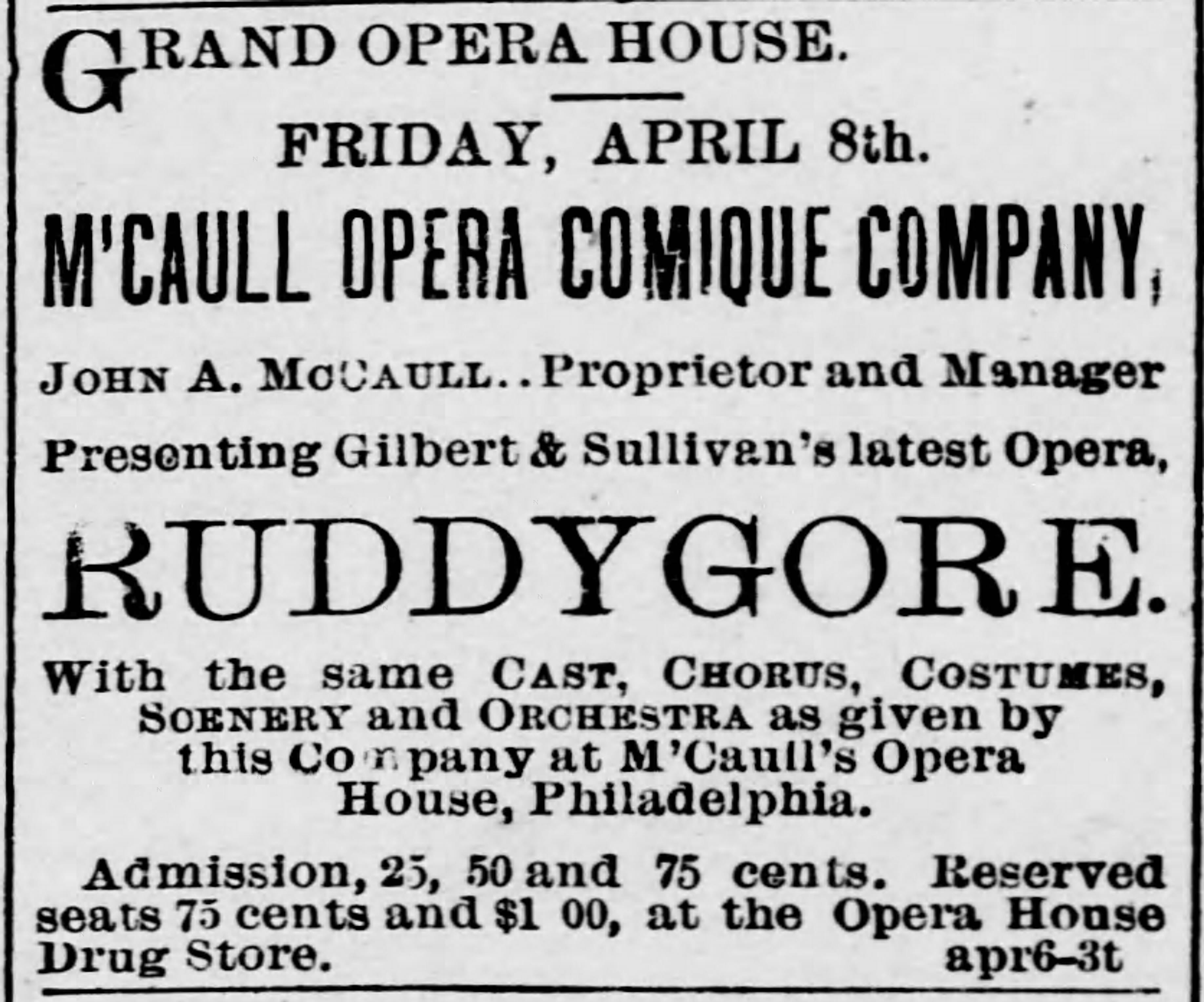
As a proud Gilbert & Sullivan Scenes Camp alumnus, I’m somewhat thrilled by the idea of Harrisburgers hearing the iconic patter song “When My Eyes Are Fully Open” and absorbing the gothic curses of Ruthven and Despard Murgatroyd for the first time. I apologize if you, reader, are totally unfamiliar with light opera, are unsettled by the vision of 15-year-old David singing these fast-paced ditties in full late Victorian costume, and are losing patience with this line of research…
But alas, yet another fire. As regular Archiveadelphia readers are probably deducing, so many of the site histories of the buildings here chronicled include at least several totally transformative and tragic blazes. Now, I know that building fires are still a huge issue (see: Notre Dame, or this week’s conflagration at one of Philadelphia’s proverbial Notre Dames, the Black Sheep Pub & Restaurant), but the sheer relentlessness of incendiary incidents in earlier eras makes me grateful for the present.
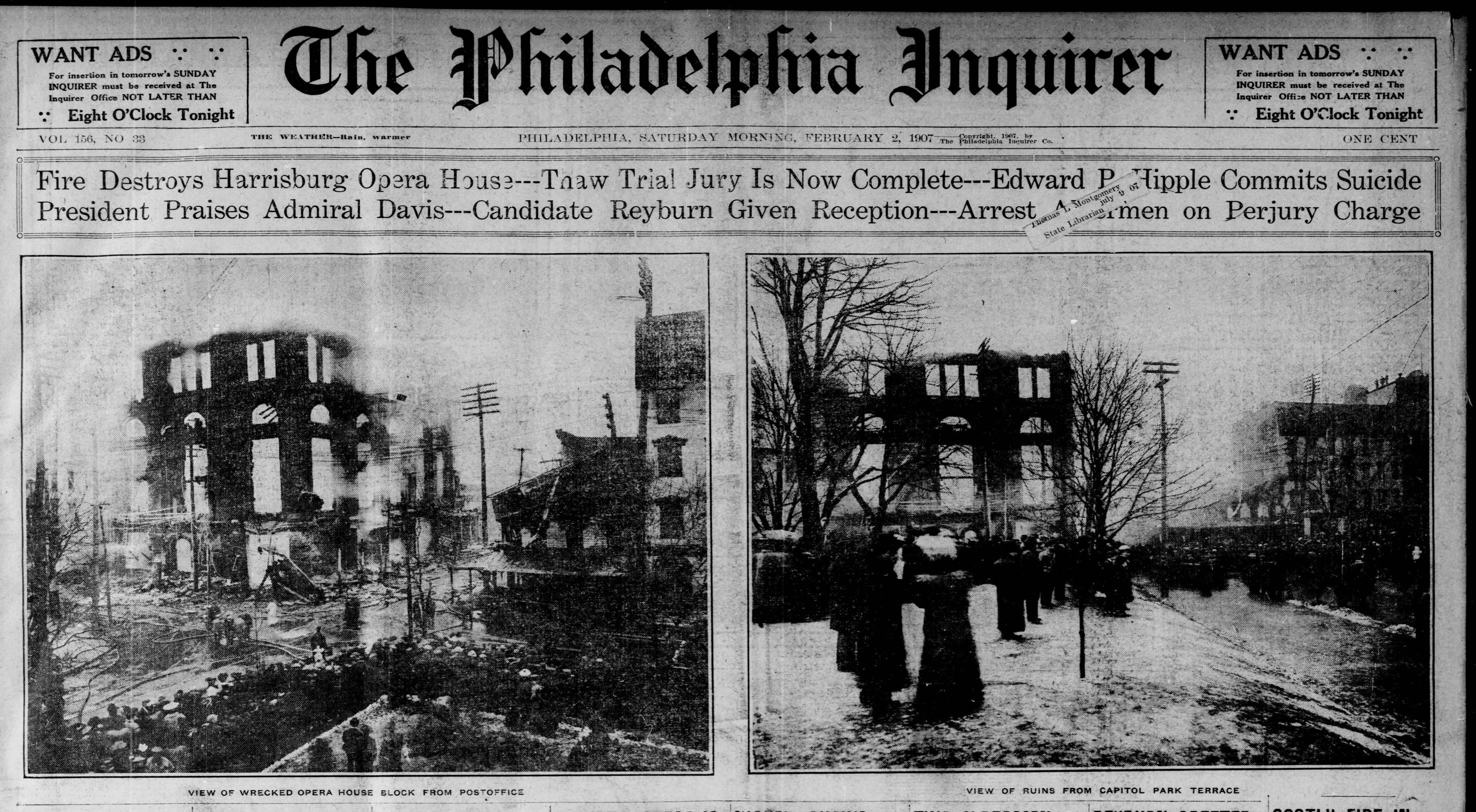
In any case: In January 1907, almost ten years to the day after a fire consumed the State Capitol across the street, the Opera House went up in flames. The fire started in the early morning in John Pyne’s hat store, one of the ground-level retail establishments. At first, some thought the cause might have been an exploding fort set piece from the previous night’s production of the remarkably-offensive-sounding “His Pale Faced [Derogatory Name for a Female Indigenous American]” up in the auditorium, but these hypotheses were ultimately dismissed. I briefly and unsuccessfully searched for a copy of this play just to set the scene for the fire, but I can’t find one and honestly don’t think I even want to know…
Whatever the trigger, the fire spread rapidly, with the city narrowly avoiding the burning of the whole CBD due to heroic firefighting and substantial snow cover. But even if the city survived, the Opera House, the Pride of Harrisburg, was no more. The Inquirer ran pictures of the devastation above the fold on Page 1:
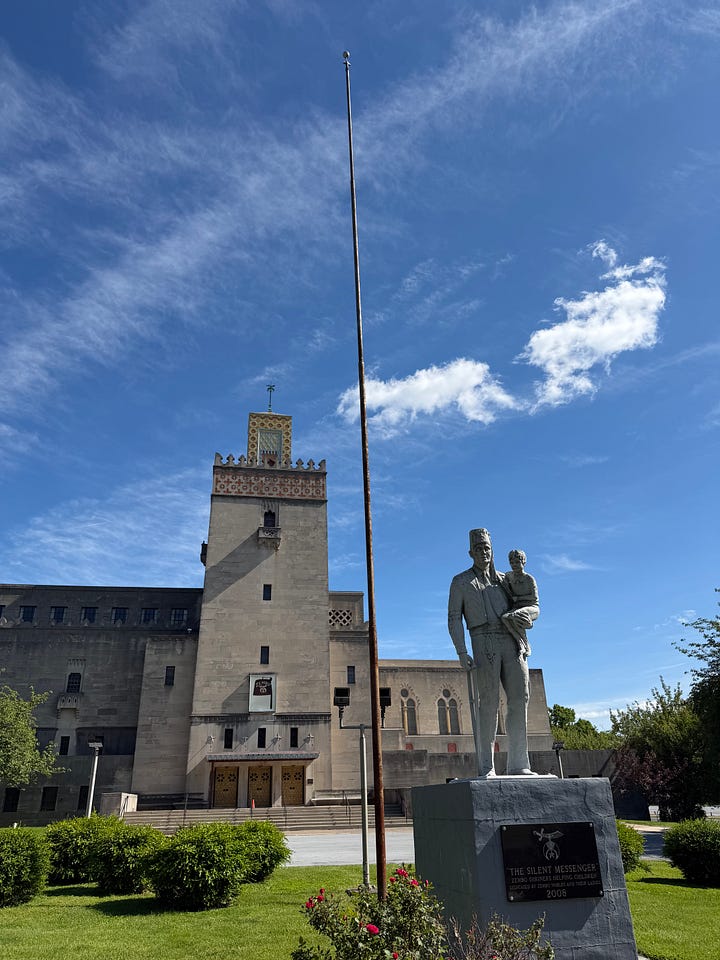
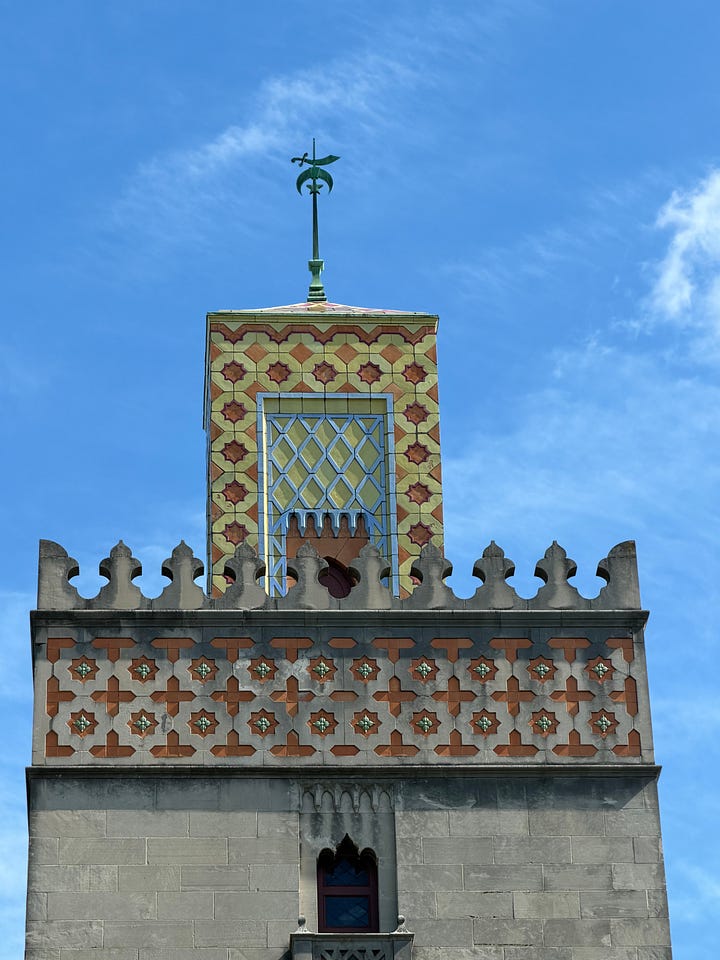
The Masons, for their part, headed a couple of miles north to Uptown Harrisburg and eventually built something even wilder—a place called the Zembo Shrine Auditorium. This building, finished in 1929 and designed by influential and local City Beautiful architect Charles Howard Lloyd, really has little to do with this broader inquiry despite also being a Masonic thing, but I just have to include some pictures of this Moorish Revival structure. I’ve never really seen anything like it:
Now forget about Zembo and return to 1907. After the fire, the empty, central, increasingly depressing Opera House block stayed vacant for almost a dozen years. At one point, supposedly, a man even raised chickens on the site, the elaborate Capitol dome creating quite the juxtaposition.
Then, a group of city fathers led by E.Z. Wallower, a man with an all-time name and a whole lot of connections from his leadership role in the city’s (and to some degree, the nation’s) electric, mining, newspaper, street railway, and steel interests, decided the city needed a grand hotel.
“The old Opera House corner was a gaping wound in our body politic,” Wallower told the Harrisburg Telegraph. 1
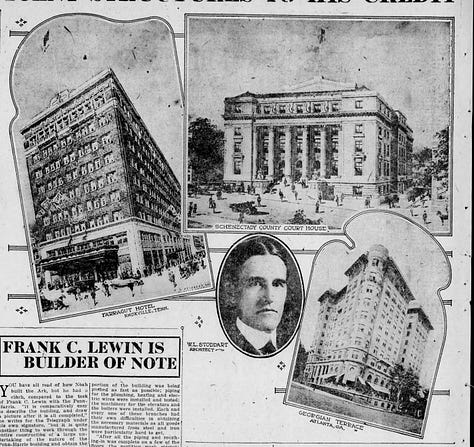
Wallower and Co. brought on William Lee Stoddart, a hotel architect who was making waves for his handsome and efficient Southern hostelries. Stoddart was responsible for two particularly iconic Atlanta hotels—the 1910 Georgian Terrace Hotel, a French Renaissance jewel that is still going strong today, and the 1913 Winecoff Hotel, which had a terrible fire in 1946 that killed 119 people, but is, improbably, also still operating as a luxury boutique jam called the Ellis.
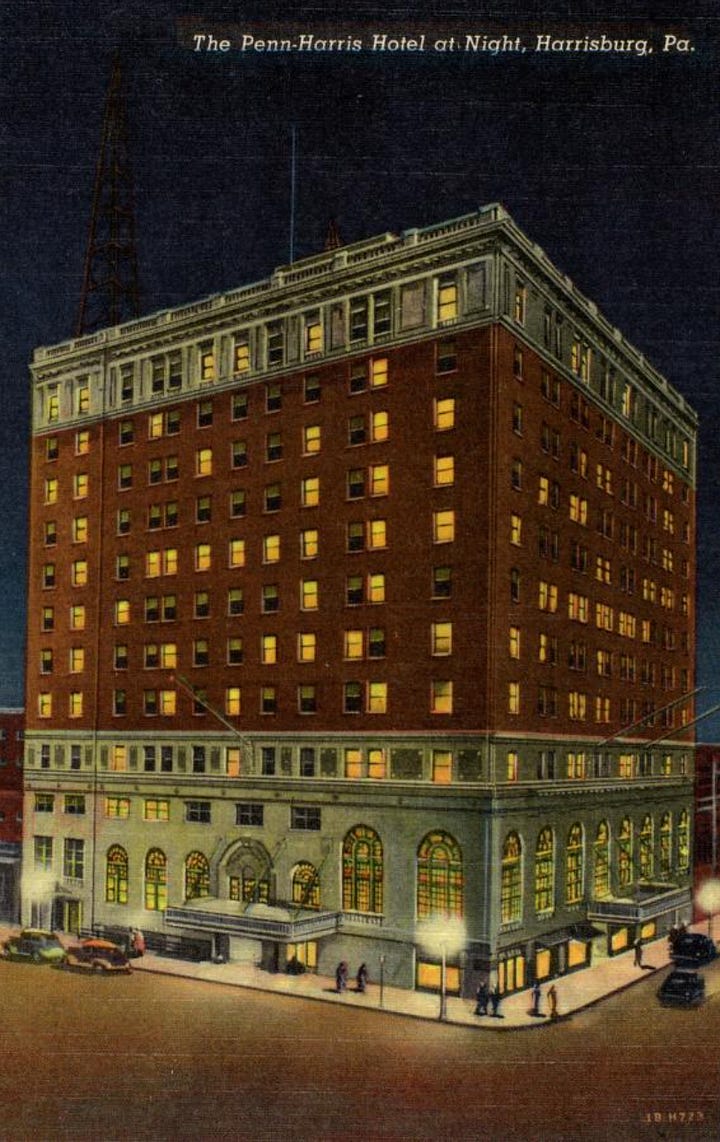
Stoddart, backed by a very eager Harrisburg that had long wanted both a replacement for the Opera House and a first-class hotel, delivered a simple but attractive design: A brick, 12-story, 250 room tower with arched three-story windows at its limestone base, a big ballroom, and lounges decked out in French carpeting. Stoddart would, in 1925, go on to design the similar-looking Yorktowne Hotel in York, a building that we admired during the famed Zara Birthday Trip of March 2026.
The hotel, dubbed the Penn-Harris, a portmanteau of Billy Penn and Harrisburg founder John Harris, opened just in time for a New Year’s Eve blowout on December 31st, 1918.
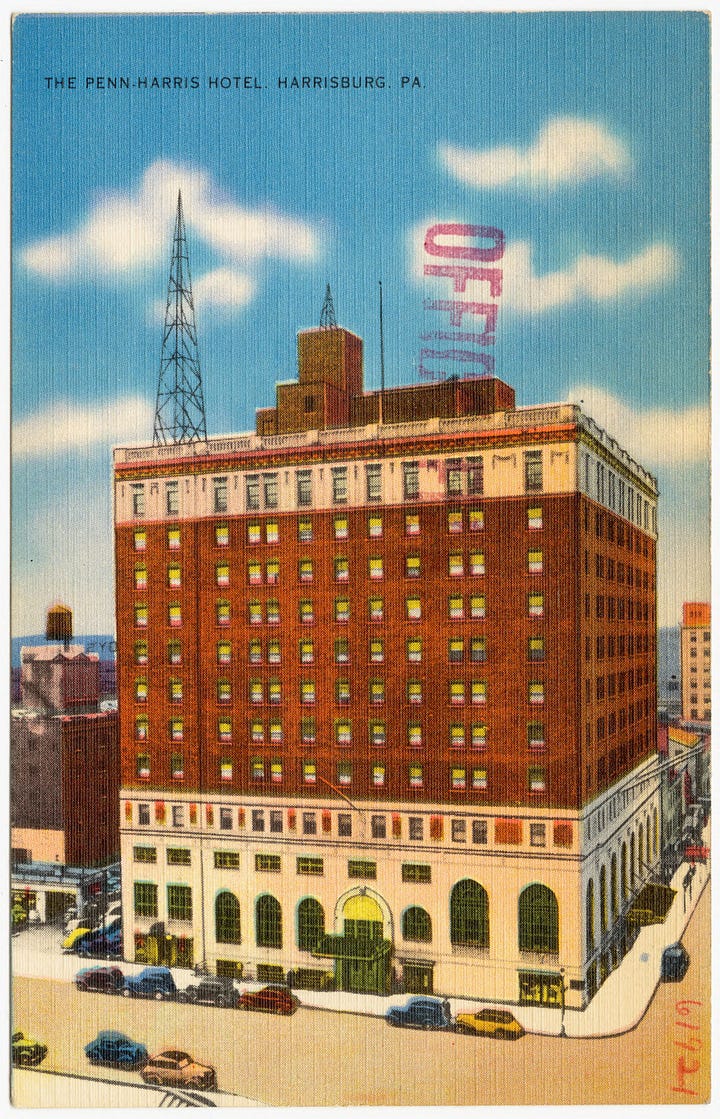
For someone who has been spending the last two years writing a book about the Bellevue (formerly the Bellevue-Stratford) Hotel here in Philly, the parallels were almost immediately apparent. For one thing, there was the hyphenated name. For another, there was the over-the-top French Renaissance furnishings. For a third, there were the widespread declarations that the hotel signaled a sort of political and cultural metropolitan arrival of a previously unseen magnitude.
I kept an eye out for mentions in the euphoric Harrisburg newspaper copy about the Bellevue-Stratford and its creator, George C. Boldt, who was also responsible for the Waldorf-Astoria in Manhattan.
Sure enough, in the Telegraph: “No matter how big the city, a beautiful and substantial hotel does more to put it and keep it on the map than any other one activity. Witness the Waldorf-Astoria, which, under the capable management of a Boldt, is now as well-known as Gotham itself. In similar manner the Bellevue-Stratford has helped to make Philadelphia.” Boom goes the Boldtamite! 2
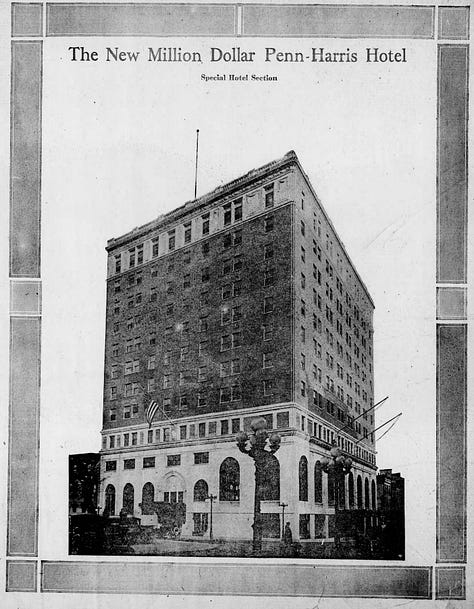
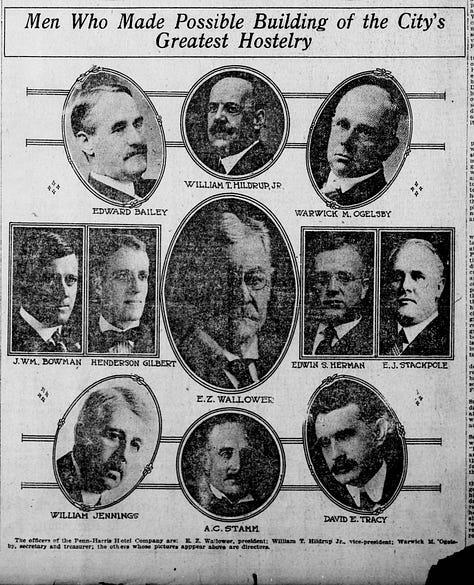
Philadelphia papers, meanwhile, covered the Harrisburgers’ exuberance with the condescending eye-roll of an older sibling. “One hotel more or less in Philadelphia would be a trifle. Here it is the talk of the town, for Harrisburg never had a modern hostelry…Nothing ever caused so much curiosity as the building of this edifice. The Tower of Babel was [as] uninteresting as a cat and seven kittens under the kitchen stove compared to this.” Okay, point taken, Inquirer, but I kind of feel like it would be super interesting to observe a whole litter of baby kittens in such a cute domestic setting…3
For the next 54 years, until 1973, the Penn-Harris was cooking with gas—and the Bellevue parallels kept coming. The hotel, like the Bellevue, housed a staggering number of politicians—some 200 state Senators and representatives when the General Assembly was in session across the street.
The Bellevue, beginning in the late 1930s, had the Hunt Room, a wood-heavy, male-dominated tavern where the aforementioned politicians got very drunk. The Penn-Harris had the Harris’ Ferry Tavern…same deal.
The Bellevue housed every President, Teddy Roosevelt onwards. The Penn-Harris got a lot of them, too. Then-candidate John F. Kennedy, during the Nixon race in September 1960, stayed at the Penn-Harris and offered a televised stump speech at the…Zembo Shrine Auditorium! I’m glad to see that building return, albeit again circuitously, to this narrative.
And as with the Bellevue Center City Philly, the 1960s were rough for the Penn-Harris and Harrisburg’s CBD—white flight, a resultant population plummet of epic proportions, manufacturing dry-up, the rise of suburban motels, and the cultural turn away from French Renaissance carpeting all stung hard.
The Penn-Harris, unlike the Bellevue, opted to throw in the towel. The demolition in 1973, which followed the departure of many other smaller hotels from downtown Harrisburg and the massive regional destruction of Hurricane Agnes, meant that there were not any hotels adjoining the Capitol complex. Columnists heralded the end of an era. The Inquirer’s stodgy Harold J. Wiegand, in a broader eulogy for old-school politicking hotels, wrote, “If the trend continues, we may find the political fate of our country determined, some time, in the sterile atmosphere of motel coffee-shops.” 4
A botched demolition that unintentionally brought down four adjacent historic buildings was a sadly perfect additional blow for a demoralized city. Something new had to happen. The editorial board of the Harrisburg Patriot-News released “Dark Corner,” a pressing statement shortly before the destruction, pleading with city and state leaders to avoid another decade-long, post-Opera House era of inaction: “This area would be best served if we knew within this very month the future of Third and Walnut, the crossroads of our community.” 5
Harrisburg, in crisis, would once again look both inwards and toward Philadelphia for inspiration—and they would find Mitchell/Giurgola and Strawberry Square…
“President Wallower in Historical Mood,” Harrisburg Telegraph, 12/31/1918.
“Penn-Harris, on Opening, Meets with Approval of Entire City,” Harrisburg Telegraph, 12/31/1918.
“Harrisburg Routs its Bond Slackers,” Philadelphia Inquirer (PI), 4/29/1918.
Harold J. Wiegand, “Old Politics Thrived in Old Hotels,” PI, 11/28/1973.
“Dark Corner,” Harrisburg Patriot-News, 1/3/1973.
No posts
Comments
Nothing yet. Say the first thing.
Sign in to join the conversation.