
FIVE PHILPHOURTHIAN NUGGETS
The Semiquincentennial, the 250th birthday of the Declaration of Independence, is upon us! Philadelphia, already hosting FIFA, now gears up for tomorrow’s parade and Saturday’s Wawa-sponsored Welcome America’s “One Philly: Unity Concert for America.” From an historical vantage, the 1876 Centennial, the 1926 Sesquicentennial, and the 1976 Bicentennial tend, understandably, to get a lot of play (I will be Bicentennialing dramatically in mere moments once we get to the Phuilding of the Week), so I thought I’d zero in on a few lesser-known July 4th celebrations for this week’s Nuggets:
I’ve become obsessed with the Grand Federal Procession, a 5,000-participant, 17,000-observer parade through Philadelphia (in a city of 40,000) on July 4th 1788 that celebrated the ratification of the U.S. Constitution. Francis Hopkinson, the Declaration signer and composer who is the namesake of Hopkinson House, the 1960s apartment house that was Archiveadelphia’s Phirst Phuilding, wrote the primary account of the day, printed by famed Philadelphia publisher Mathew Carey and available in full here from Lehigh University. Pioneering doctor and fellow Declaration signer Benjamin Rush added some further words to the pamphlet, arguing that the placidity of the affair was due to the fact that attendees only drank “beer and cyder,” rather than “anti-federalist” hard liquor. American Studies professor Laura Rigal wrote a very fun account of the Procession for Rutgers’ Encyclopedia of Greater Philadelphia, revealing that actor and circus performer John Durang dressed up as the god Mercury and threw copies of a Hopkinson-penned ode to the adoring crowds. A choice excerpt: “On Alleghany’s tow’ring head / Echo shall stand—the tidings spread / And o’er the lakes, and misty floods around / An Æra new resound.”
I’ve long been aware that the first American balloon flight took off from the Walnut Street Prison work yard near Washington Square in 1793. I did not know, however, that 100 years later, on July 4th, 1893, Philly photographer William Nicholson Jennings took off in front of Memorial Hall in Fairmount Park, before some 20,000 spectators, to snap Philadelphia’s first aerial photograph. Here’s the shot from the Free Library of Philadelphia’s online collections—check out the unfinished City Hall in the distance. Temple History Professor Emeritus Ken Finkel wrote about Jennings’ flight on PhillyHistory Blog, where I learned that Jennings and Co. ascended to “the Municipal Band playing ‘My Sweetheart’s the Man in the Moon,’” a then-recent popular song by vaudeville composer James Thornton. I tracked down a clip of Jane Russell singing the ditty in the 1952 film Montana Belle…a very relevant soundtrack for the sky-blazing trip.
On July 4th, 1962, President Kennedy gave a barnburner of a foreign policy speech in front of Independence Hall, sounding a call for a “Declaration of Interdependence” between the United States and Europe. The skeptic in me knows this was all afoot amid the worsening situation in Vietnam, the bellicosity of the Cold War, and the myriad other Jenga blocks of idealism that would come crashing down after JFK’s assassination and the other collective existential traumas of the latter 1960s. But damn, if Kennedy could not spin a rousing vision of a calm diplomacy that could “achieve a world of law and free choice, banishing the world of war and coercion.” You can watch the full remarks at the JFK Library online portal here, and you can learn more about Kennedy’s visit (and see some remarkable vivid photographs of the happening) in this JFK Library blog post by Audiovisual Reference Archivist Maryrose Lane Grossman.
On July 4th from 1965 to 1969, Philadelphia was home to the Annual Reminders, some of the earliest large-scale LGBTQ+ demonstrations in the nation. The Reminders were pickets of Independence Hall, orchestrated by a coalition of activists including local legends Barbara Gittings and her partner Kay Tobin. OutHistory crafted a fantastic online exhibit about the Reminders for the 50th anniversary of the first protest—scroll through participant interviews, primary source documents, and a secondary source bibliography. The Library of Congress also uploaded this short documentary, “The Second Largest Minority,” shot by activist Lilli Vincenz at the fourth Reminder in 1968!
Since Mayor Ed Rendell inaugurated the “Welcome America” festival in 1993, the climactic Fourth of July concert has brought iconic acts to the stage on the Benjamin Franklin Parkway. After involved YouTube searching, I found two earlier shows: The Pointer Sister’s appearance during the 1993 inaugural fest (apologies for the grainy VHS tape) and Patti LaBelle’s 1996 show. These shows, sponsored at this juncture by the oil company Sunoco, strike veritable Independence Day gold. The LaBelle appearance in particular, perhaps due to her hometown hero status, absolutely pulsates—the vocal runs, the (sometimes sultry) crowd interactions, LaBelle’s donning of a sequined American flag baseball cap, the closing, soaring “Over the Rainbow.” I ended my video watch with a level of admiration for LaBelle’s voice, penchant for drama and delightful camp, and passionate Philly spirit that put me in an incredible mood…I am going to make screening this footage a July 4th tradition, and I suggest that you do, too!
Thanks for reading Archiveadelphia! Subscribe for free to receive new posts and support my work.
PHUILDING OF THE WEEK: THE FEDERAL RESERVE BANK OF PHILADELPHIA
Given the Semiquincentennial, I knew I wanted to look back 50 years and cover a Bicentennial Phuilding this week—meaning a structure completed in 1976 and connected to the broader birthday pageantry.
There are some wonderful choices, all of which I anticipate will be Phuture Phuildings:
The African American Museum at 7th and Arch, elegantly designed on a tight schedule and a tight budget by the underappreciated architect Theodore Victor Cam.
The Mummers Museum in South Philly, wackily designed by the Ueland & Junker firm.
And the WHYY headquarters on Independence Mall, which is a dramatic reworking of the endlessly fascinating, short-lived Living History Museum, a screen-heavy, futuristic paean to the American story in a building designed by Archiveadelphia favorites Mitchell/Giurgola.
I ultimately decided, however, to pick the Phuilding next door to WHYY on the Mall: The Federal Reserve Bank of Philadelphia.
Who isn’t entranced by the Federal Reserve? From the dramatic 1910 formation by the nation’s banking elite on Georgia’s secluded and vibe-heavy Jekyll Island, to the Fed’s often-rancorous dance between the business community, the President, and the general American public over interest rates and inflation…not that any of these tensions exist in the placid economic and political landscape of 2026!
Beyond the Fed Phascination, this selection sprouted from the fact that I had never really noticed the Fedifice. In fact, when I tracked down the Fed as a 1976 building while perusing lists on the Athenaeum’s Philadelphia Architects and Buildings portal, I couldn’t even conjure in my mind’s eye how the Fed looked. I have a soft spot for these less Phlamboyant Phuildings and in unearthing the roles that they played in shaping the architectural and cultural direction of the city, even if I’m often a little chagrined when I have missed formidable and central institutional spaces…
And this oversight also begs a further question—Was my oversight due to the Fed being bad architecture?
When I strolled over to the outside of the Fed, I found an 8-story, boxy beast clad in reflective pink granite and stretching across a whole city block. I didn’t think the Phuilding was bad architecture; to the contrary, I thought the Fed had aged impressively, looking almost postmodern/Venturi & Scott Brown-y with its central vertical stripe-glass and its upper-floor cut-outs—not to mention an attractive and massive internal atrium that I could just barely make out through the heavy security at the entrance:
I badly wanted to go inside, but I had missed my only way in (short of visiting a tenant), the recently-reopened, Fed-sponsored “Money in Motion” exhibit. Much more on my eventual visit to the interior of the Fed later on…
For the moment, though, I decided to go back to the archives and try to explain how the Fed building came to be and where it fits within its surroundings.
I have long been entranced by Independence Mall’s cassoulet of clashing architectural modes—colonial brick, Beaux-Arts ornament, and sleek corporate modernism stand side-by-side, anchored by the central rectangular green of the Mall and all framed at the southern end by Independence Hall, where all of this American self-definitional magic happened…
How did this cassoulet get cooked? And which ingredient was the Fed (the duck fat, methinks)?
Normally, this would be the point in the Archiveadelphia when I would take you through the site history, spinning yarns of early 19th century surreality and the long march toward the modern. In this case, however, the area on which the Fed stands was so vast and so systematically destroyed that I can only capture wisps of what came before.
The Fed stands on the north side of the 600-700 block of Arch Street, stretching halfway up to Race Street. That whole swath was demolished in the massive urban renewal clearance project to open up space for Independence Mall—a process started in 1948 by the U.S. Congress, designed to spruce up the whole area in advance of the Bicentennial a quarter century later.
The destruction of the block that would become the Fed, part of “Independence Mall Urban Renewal Area—Unit 3,” came near the tail end of the clearance, in the late 1960s. Destroyed stores included plastics emporiums, bookbinders, standard stock gear warehouses—in other words, the types of stores that were increasingly obsolete in the ready-made 1960s world of mass production in far-removed factories.
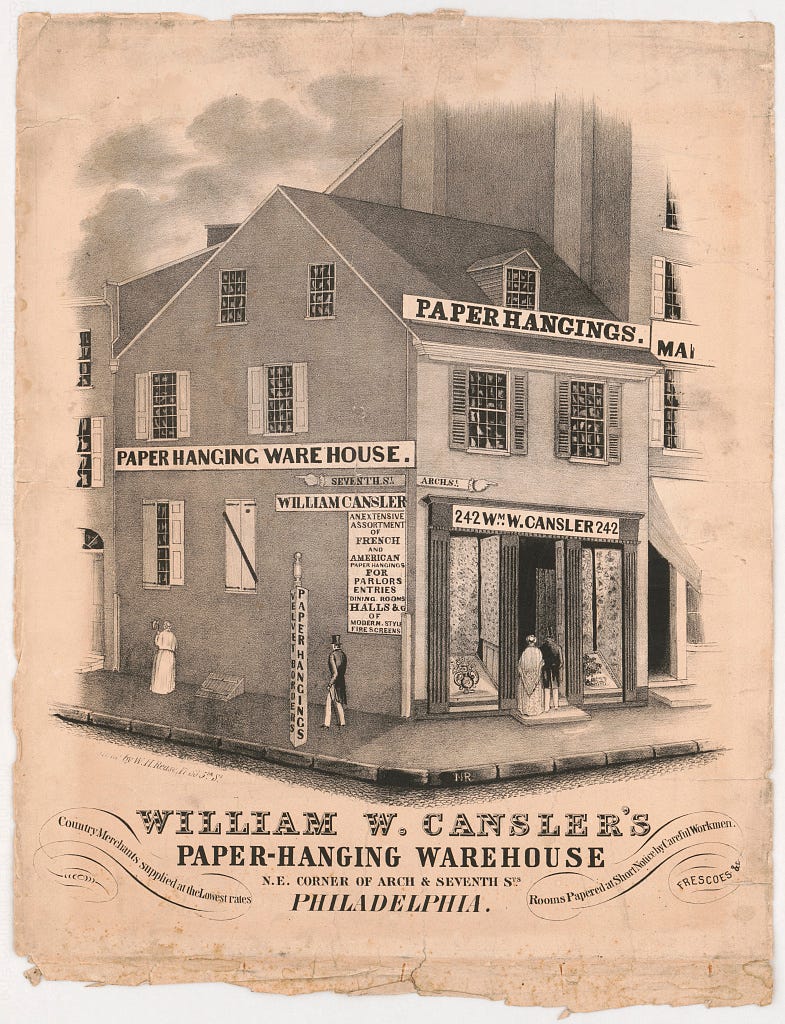
These dinosaur stores had replaced other once-important addresses. In the 1840s, William W. Cansler’s “paper-hanging warehouse” had offered Philadelphians a pretty store to grab the latest chic wallpaper:
In the middle of the block, from 1828 to 1936, stood the Arch Street Theatre, seemingly designed by the eminent John Haviland, the architect also responsible for the nearby, still-shining Walnut Street Theatre (though others have attributed both theaters to Philadelphia’s other most famous architect of the age, William Strickland). In the latter image, you can also make out a hotel called the Metropolitan and two carriage shops…a true field of rabbit holes:
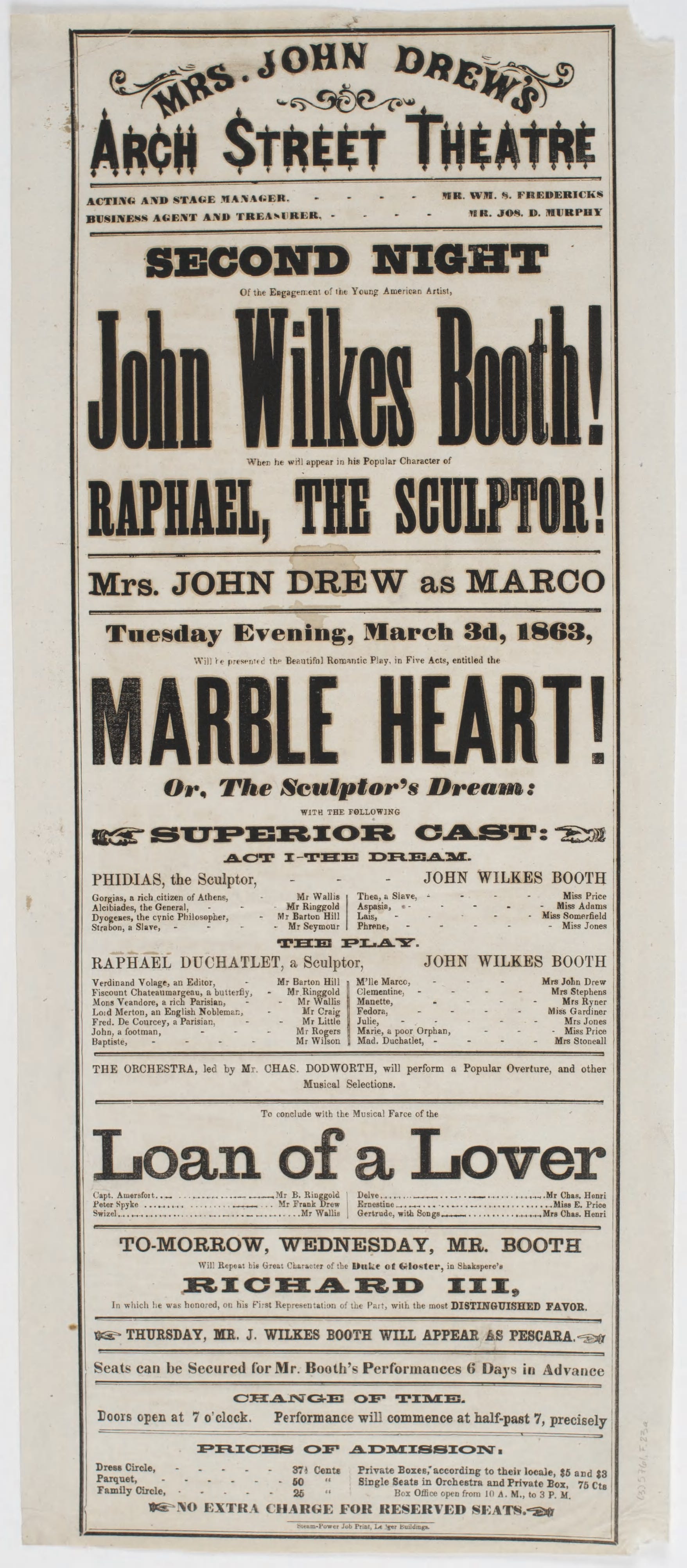
The Arch, in its columned beauty, played host to many leading actors of the age, including one who turned out to be not-so-great—John Wilkes Booth. The Library Company houses many of the notices of Booth’s many appearances at The Arch, including his March 1863 turn as a villainous sculptor in The Marble Heart, a play that President Lincoln would see, at Ford’s Theater with Booth in the role, several months later when the play headed to D.C. (I think I knew about this little pre-assassination run-in from my 8th grade class trip to Ford’s, but I’ve become overwhelmed all over again upon re-learning today):
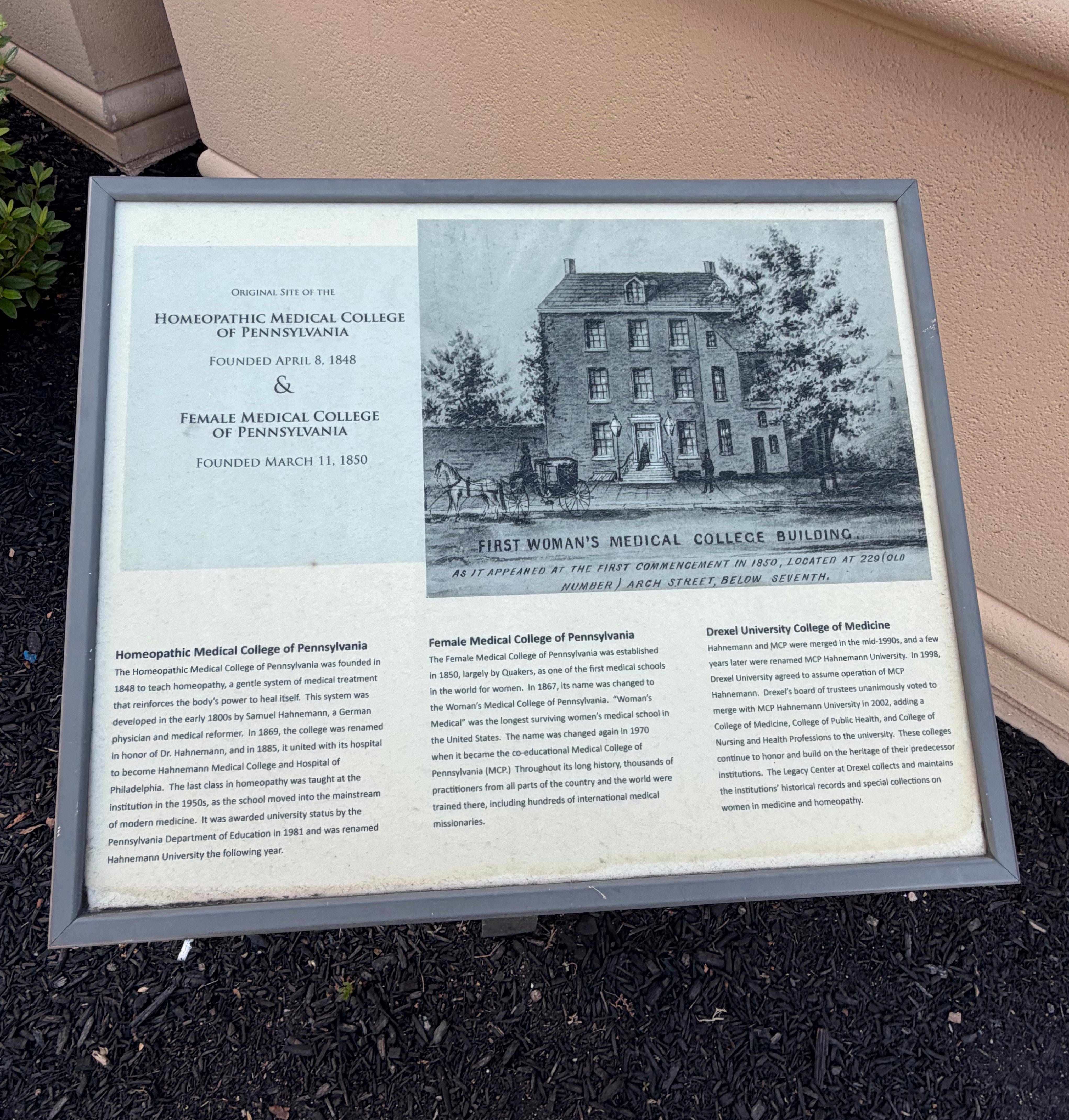
And on the 6th Street corner of the Fed is a plaque that pays homage to two influential medical institutions who called the site home beginning in the mid-1800s—German immigrant Samuel Hahnemann’s Homeopathic Medical College, which later became the famed Hahnemann University Hotel (tragically closed in 2019), and the Quaker-led Female Medical College, which, per the plaque, was “one of the first medical schools in the world for women”:
Okay, so I guess I still did the surreal 19th century site history schtick, even if I barely scratched the surface of this ever-changing block. In any case, the painted ponies went up and down, the 1960s wrecking ball came, and the cleared blocks to the west of the burgeoning Independence Mall stood ripe for redevelopment.
Enter architects Alec Ewing and Stan Cole. Per a 2014 Hidden City article by the brilliant local historian Bradley Maule, Ewing, a youngish architect who had come up in his father’s firm, got a star commission by Plexiglas makers and chemical masterminds Rohm & Haas to construct the first privately-owned Phuilding on the cleared Independence Mall land.
Ewing teamed up with Cole, the in-house Rohm & Haas architect, to work on a sleek new HQ for the company. After some bad reviews from the city powers-that-be on their initial design, the duo got some serious assistance from Pietro Belluschi, the eminent head of the MIT School of Architecture and Planning.
Belluschi is close to my heart, both for his work on my hometown of San Francisco’s Bank of America skyscraper and St. Mary’s Cathedral and for his design of Adath Israel in Merion, the jewel of Main Line mid-century synagogues:
The trio had a real winner with the Rohm & Haas Corporate Headquarters (1964), glistening in the Plexiglas made by its sponsor and supported by some of the coolest flared concrete columns I’ve ever seen:
Given their success with Rohm & Haas (thank you, Pietro!), Ewing and Cole decided to team up, building what would eventually become a still-thriving design and engineering firm with over 400 employees spread across the nation.
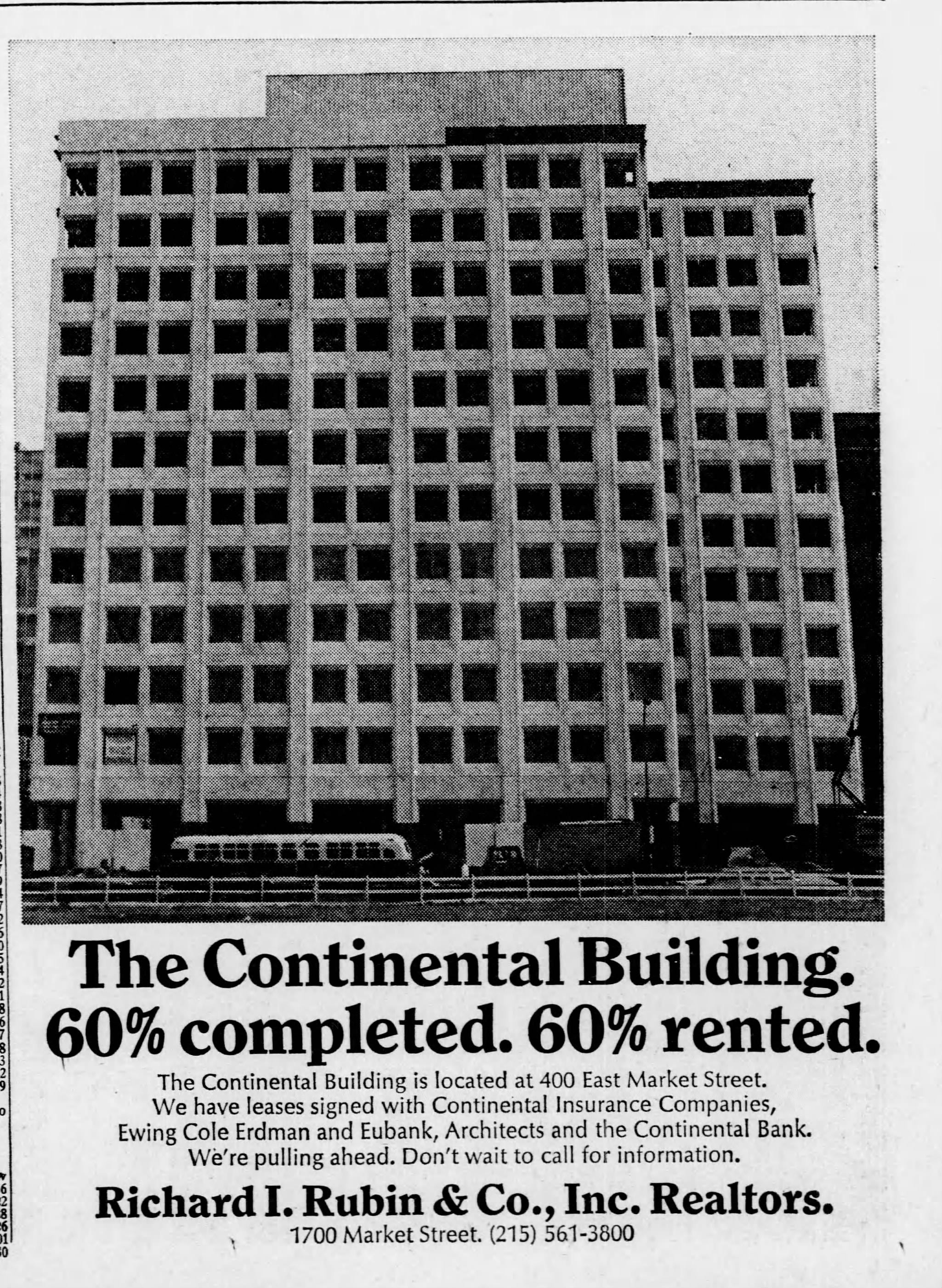
In 1970, the growing firm moved into the Continental Building at 400 Market, a Brutalist building just off the Mall leased by local legend Richard I. Rubin and his sons Ron and George. The Rubins, of course, would go on to purchase and save my favorite Phuilding, the Bellevue Hotel. The Rubins even advertised Ewing and Cole’s arrival:
From this appropriately space-age new perch, Ewing and Cole designed another Phuturistic Mall-side structure across the street, the 11-story Philadelphia National Bank Building (1972), which stretched from 4th to 5th Streets on Market:
And Ewing and Cole began to look West toward Philly’s growing Center City core, where they built two early 1970s high rise highlights: The 40-story, reinforced concrete 1818 Market and the 29-story, bronze glass and aluminum 2000 Market, both of which came dangerously close to the top of Billy Penn’s hat atop City Hall. These office buildings have aged imperfectly, but they demonstrated that Ewing and Cole could build block-defining structures of both the horizontal and vertical varieties:
As Ewing, Cole, and their ever-growing team were hard at work, the employees of the Federal Reserve Bank of Philadelphia were feeling severely cramped. The Bank, long headquartered at a Paul Cret-designed 1934 Deco gem at 925 Chestnut Street, had grown from 800 employees in the mid-1960s to 1,300 in the mid-1970s—this was the decade of stagflation, mind you, and the Fed had much work to do:
On the recommendation of none other than Pietro Belluschi (thank you again, Pietro!), the Fed brought on Ewing and Cole to design their new home on the expanse of Arch Street land still lying vacant from the work of “Independence Mall Urban Renewal Area—Unit 3.” Pietro also helped with the design again…that guy is the greatest!
Ewing and Cole, armed with $50 million and 800,000 square feet, thus crafted their atriumed, glass-beribboned, pink-granited new home for monetary policy. Temple’s Evening Bulletin archives shows construction in the pit by August 1973—a comfortable timeline for the new Fed to be ready for the Bicentennial.
As the Fed neared completion, Philadelphians reacted with some degree of disorientation. “Many people think the new Federal Reserve Bank looks weird, wrong, or even incompetent,” Inquirer architecture critic and Friend of Archiveadelphia Thomas Hine reported. Hine, however, shared my fondness for the window bands and the granite. He argued that Ewing and Cole used the granite more as a “graphic device” than a structural material—a call-back to earlier stone banks, but a sly acknowledgement of the fact that stone was no longer necessary to make formidable structures stand up. “The result is not something that is instantly ingratiating,” Hine admitted, “but it is scarcely routine. One must always be grateful for a building that is interesting to look at, and this one is.”
Beyond looking interesting, the Fed was clearly doing interesting and very impactful things. Arthur Burns, the pipe-toting, much-embattled Fed Chairman who had spent much of his tenure wrestling with President Nixon over interest rates (Nixon wanted them low!), spoke at the opening of the Phuilding in September 1976. Burns used his address to reassert the need for Fed independence in the aftermath of the Nixon tug-of-war, in a speech that again has zero relevance to the current state of play:
“I doubt that the American people would want to see the power to create money lodged in the presidency—which may mean that it would in fact be exercised by sundry political functionaries in the White House. Such a step would create a potential for political abuse on a larger scale than we have yet seen.”
Damn, Chairman Burns!
So that’s the Fed. I’d seen the Phuilding, I’d researched Arch Street, I’d gained a new appreciation for Ewing and Cole (now technically EwingCole), I’d vibed out with Arthur Burns.
But I hadn’t yet gotten inside the Fed—and I had a really good reason for wanting to do so: The atrium of the Fed houses the largest mobile in the world, a 100-foot tall, 60-foot wide, 14-disked, ceiling-dangling work of art that slowly rotates clockwise. And the mobile, White Cascade, was the work of the Great One, Alexander “Sandy” Calder.
This city’s love for the Calder family knows no bounds. Many proud Philadelphians, shortly after our move last year, recited the three-generation legacy of public sculpture that the Calder boyz left behind—Alexander Milne Calder’s statue of Billy Penn atop City Hall, his son Alexander Stirling Calder’s Swann Memorial Fountain in Logan Circle, and his son Sandy’s Calder’s haunting “Ghost” mobile (1964) in the Philadelphia Museum of Art, and on and on…
This Calderlove reached a fever pitch last year with the opening of the Calder Gardens on the Benjamin Franklin Parkway—a contemplative space designed exquisitely by museum experts Herzog & de Meuron. I took a couple of shots from my visit with my mom and her partner Rob last November that show the interplay of light and form in this Temple of Sandy:
So obviously I had to see White Cascade. And thankfully, after a prolonged closure, the “Money in Motion” exhibit reopened on June 4th. And double thankfully, Zara and I had a little window during the workday during a late lunch on Tuesday to make our way over…
After going through some heavy security and ostensibly heading into the exhibit, we turned around and looked up. Awe abounded! White Cascade is impossibly large and staggeringly cool. Bathed in light in the airy atrium, the aluminum disks on the slowly circling mobile look like swirling coins in the miasma of capital accumulation. We’re all just grabbing for them, I guess…
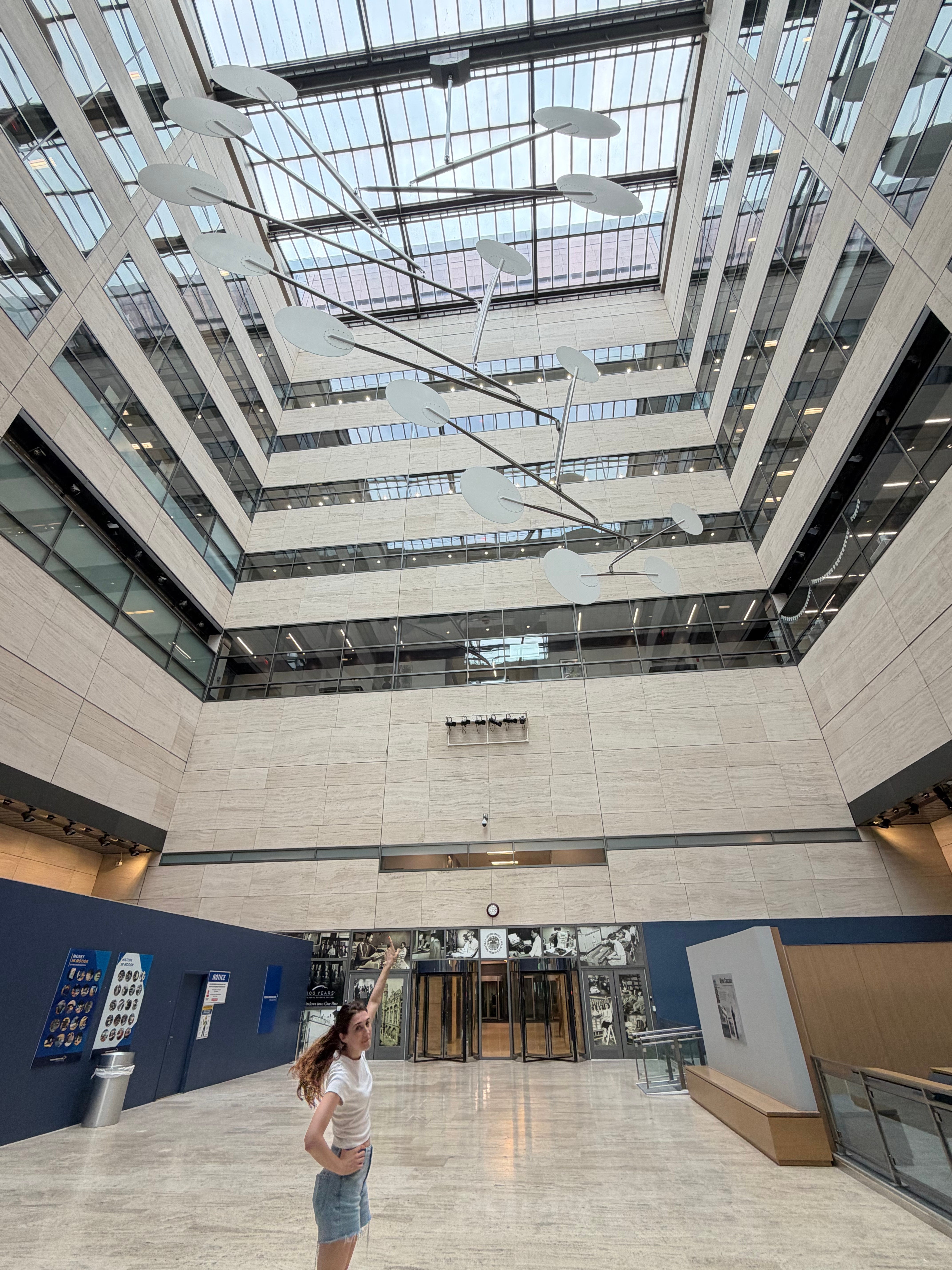
Granted, the revamped exhibit is very cool, too—you get little bags of shredded money (“Fed Shreds”) and go through all these high-tech modules where you decide how to handle various economic crises:
I kept finding myself distracted by White Cascade, though, even as I listened to very entertaining cartoon versions of Alexander Hamilton and Woodrow Wilson explaining the importance of federal monetary intervention. Calder’s pull was simply too strong:
I am sorry, President Wilson, for losing focus during your delightful Fed exegesis and giving into the siren’s song of White Cascade…
Some post-facto digging also revealed the drama of Calder’s whole universe in 1976. First things first, he straight up died of a heart attack in November 1976, just after dedicating White Cascade. Second things second, he was experiencing an incredible zenith of rockstar-status popularity in the months leading to his demise.
In Calder: The Conquest of Space: The Later Years: 1940-1976, the latter half of his endlessly interesting two-part Calder biography, art critic Jed Perl illuminates the whirlwind of Calder’s final year, the Bicentennial:
In February 1976, Calder, mostly living on the Indre River in Touraine, France, was hospitalized in White Plains, New York, with prostate trouble.
In June, Calder was in Barcelona for the opening of his old friend Joan Miró’s artistic foundation, an exhilarating space designed by Josep Lluís Sert for which Calder had donated his 1937 Mercury Fountain, which spouted the toxic elemental liquid.
Back in France, Calder was managing the completion of a slew of monumental projects, including his 38-foot-tall Jerusalem Stabile and his also-mammoth (though not White Cascade mammoth) mobile/stabile mix called Mountains and Clouds for the Hart Senate Office Building in Washington D.C.
Calder arrived in New York in early autumn to prepare for a retrospective at the Whitney (“Calder’s Universe”) and a show at the gallery of his longtime dealer Klaus Perls.
A New Yorker “Talk of the Town” piece by the inimitable Geoffrey Hellman captured the frantic undertones of Calder’s final year. Hellman, at Perls’s HQ, quoted Perls bragging endlessly about all of the installations, tributes, and exhibitions, all while Calder sipped on a Campari and soda.
Midway through his litany, Perls finally pivoted to Philadelphia, where he revealed he would be accompanying the artist in a Braniff jet decked out in a Calder design—the Flying Colors of the United States, one of several such plane designs, bedecking planes usually used for flying public routes, that Calder crafted for the airline in the lead-up to the Bicentennial:
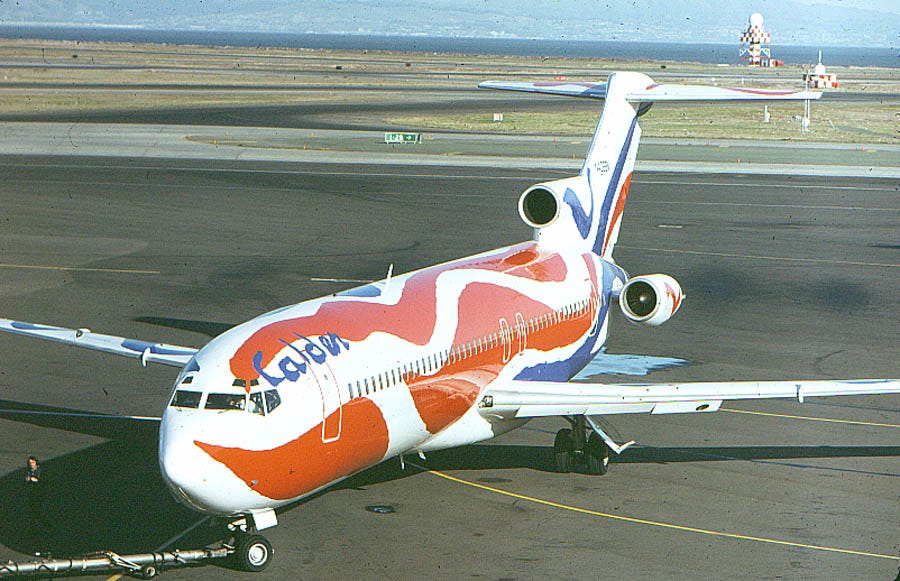
“Calder looked alarmed,” the New Yorker piece detailed at the invocation of the Philly visit.
Perl, too, acknowledges that Calder had a complicated relationship with his hometown:
He had always felt at best lukewarm about the city he had left forever when he was still a little boy. Such feelings were for private consumption; in the margin of William Rogers’s biographical manuscript he had scrawled, “I don’t like Phila.”
Despite his private misgivings, Calder still touched down in Philly on October 5th, 1976 in his undulatingly-painted plane, to attend part of a week-long, blowout “Calder Festival,” coordinated by the Philadelphia College of Art.
Upon arrival, Calder quickly headed to the Fed to do some final work on White Cascade. Two days later, he would be on hand for the formal dedication of his stunning work.
The rest of his Philly itinerary is just as overwhelming to confront as his broader 1976 tour:
A dinner at the Atlantic Richfield (ARCO) oil company offices on the top floor of Center Square, where he was a co-honoree alongside Herbert Bayer, the Austrian painter who designed the company’s logo. Calder, looking disgruntled, posed with Mayor Frank Rizzo.
A ballet premiere of “Under the Sun,” a Calder-inspired work choreographed by the vaunted Margo Sappington and performed by the Pennsylvania Ballet Company at the Shubert Theater.
An afterparty ballet fundraiser, “Mobilia,” at Memorial Hall in Fairmount Park.
A visit to Palumbo’s with Philadelphia College of Art head Tom Schutte, where Calder made a satirical sketch of a police officer who had asked for his autograph en route.
A dinner party thrown by gallerists Hope and Paul Makler, to which Calder brought ten uninvited guests.
A helicopter tour to view his family’s artistic contributions to Philadelphia from the air.
A month later, still in New York after the much-praised Whitney show opened, Calder suffered a fatal, early-morning heart attack.
White Cascade, then, stands as a send-off to Calder and as a reminder of the sheer star power he wielded in his final months. I also marveled at the very concept that an institution as buttoned-up as the Fed would embrace public art so wholeheartedly. Part of this was likely, once again, the result of Belluschi’s influence…he loved Calder!
I also tracked down that the VP of the Philly Fed—and the man in charge of the construction efforts—was a decided arts and culture lover. He was Russ Connor, a former jazz drummer who had developed an intellectual fascination with big band leader and clarinetist Benny Goodman before pivoting to the world of banking. Connor would ultimately write four books about Benny and spend much of his free time cataloguing every recording that the jazzman ever cut.
After Calder’s demise, Connor and his Fed compatriots kept up the usually-staid institution’s link to public art. In 1978, Connor oversaw the installation of sculptor Beverly Pepper’s Phaedrus outside of the Fed—a 19-foot-tall, dramatically cantilevered triangle of interlocking steel plates. I saw Phaedrus as some sort of metaphor for the emotional precariousness of America’s relationship to money—a sharp, jutting, ambition:
Like Calder, Pepper had a totally singular life. She worked primarily from Italy from the 1950s on, developing new technological strategies for fusing various metals, often donning a helmet and picking up a torch. She was married to Newsweek’s Mediterranean bureau chief and was friends with Gore Vidal and Federico Fellini. She worked until her death at 97 in 2020, and had an equally talented offspring; her daughter, Jorie Graham, is one of my favorite poets. Leave it to the Federal Reserve of Philadelphia to give me some of the coolest artistic biographical explorations I’ve gotten to undertake in years…
Post-Phaedrus, the Fed continued to value art. Temple’s digital archives led me to two later sculptural works displayed in the atrium in 1988, seemingly sponsored by the university’s Tyler School of Art:
Curtis Caswell’s “Wheel of Fortune,” a lifesize rendering of a bowtied businessman pointing at his wheel of a head, each sliver containing some intriguing but seemingly incoherent financial equation.
Linda Ruffman’s “Dummy,” showcasing a two-headed man with big, gnashing teeth protruding from his rotund torso. Perchance a commentary on the duality and risk of public-private partnerships in long-term economic planning? In the Temple shot, a Fed employee has removed her glasses to quizzically examine the work.
As Zara and I left the Fed to gear up for a week of commemorations, extreme heat, a lot of writing, and just as much Philly wandering, I felt a sense of gratitude for Ewing and Cole, Belluschi, Calder, and Pepper. And I also gave thanks to the Phuildings—even those that I initially miss—that help to explain the artful, monied, and morally-complex roads to Philadelphia’s dramatic anniversaries.
Comments
Nothing yet. Say the first thing.
Sign in to join the conversation.