
FIVE PHILHISTORY NUGGETS
The FIFA World Cup is in full force in Philadelphia, with Brazil and Haiti facing off tomorrow night at Lincoln Financial Field. The hubbub inspired me to look into the more obscure corners of local soccer history and led me to the Philadelphia Fury, a member of the North American Soccer League (1968-1984; a Major League Soccer precursor) that played here from 1978 to 1980. In 2016, prolific soccer researcher Stephen Holroyd offered a three-part history of the Fury for the Society for American Soccer History’s website—here’s Part I, II, and III. Holyroyd reveals fascinating details about the Fury’s conception—their literal rockstar investor group included Paul Simon (!), progressive rock keyboard legend Rick Wakeman (of Yes fame), and then-heartthrob and guitar god Peter Frampton (fresh off of his record-setting Frampton Comes Alive album). You can see Wakeman rocking a Fury jersey (designed by famed menswear fashioner Sal Cesarini) in this clip from Wakeman’s short-lived 1983 variety show GasTank, backing Donovan on an almost New Wave-y rendition of Mellow Yellow.
Last Sunday marked the 51st ODUNDE festival, a celebration of African American music, folk arts and crafts, fashion, and activism (ODUNDE roughly translates to “Happy New Year” in the West African Yoruba language). The festival began in 1975 and was the brainchild of Lois Fernandez and Ruth Arthur, who together ran an African boutique called the Hut at 500 South 23rd Street. I initially struck out in my search for footage of ODUNDE’s early years, but eventually found several amazing archival pieces in the Arthur Hall Collection, a Temple University-hosted collection chronicling the works of Hall, an influential Black Philadelphian dancer and community organizer. Hall’s African dance ensemble was involved with ODUNDE from the beginning—here’s video of his 1980 ODUNDE offering to the Yoruba god Oshun and general coverage of the 1995 festival. This Spring 1996 issue of Pennsylvania Folk Life magazine contains a more extensive history of the festival, including much more on Fernandez and Arthur’s hopes of uniting the community through their efforts.
Two Sundays back was the Philadelphia Pride March and Festival. On YouTube, I found a 90-minute video of the 1989 Pride Parade shot by Patrick Nelson, a San Francisco-based painter and Philly native. The ‘89 parade, which marked the 20th anniversary of the Stonewall uprising, was the first supported by the city after a long hiatus, and the speeches, poems, and songs reflect the deep pain and anger that the community was feeling during this brutal moment in the AIDS epidemic—a potent reminder of the resilience of the LGBTQ+ movement. I was particularly moved by the poetry recited by Black Vietnam veteran and prolific publisher/artist Lamont Steptoe, who offered gorgeous tributes to the writer James Baldwin and to Joseph Beam, the pioneering activist who had died of AIDS the previous year.
The Athenaeum of Philadelphia recently opened a wonderful new exhibit, “Discourse & Discovery: Places of Gathering in Philadelphia.” I was particularly moved by drawings done by Philadelphia architect Paul Cret for the Ellen Philips Samuel Memorial, the terraced sculpture garden on the banks of the Schuylkill honoring the art patroness, who left much of her estate to the Fairmount Park Association (now the Association for Public Art). The drawings show the vivid originality of Cret’s hand, and are joined in the exhibit by eye-popping renderings of the Philadelphia Zoo, the original booth plan for Reading Terminal Market, and gorgeous photographs and paintings of Washington Square back when trolleys curled around the Square and made their way down 7th Street. The exhibit is open until October…do not miss it!
Two Saturdays ago, I attended a walking tour of Queen Village organized by David S. Traub, the architect and preservationist responsible for the organization Save Our Sites. The tour was a fascinating look at several neighborhood landmarks, including St. Philip Neri Church and the Neziner Synagogue building. I also was lucky to meet several Phascinating Philadelphians on the tour, including Susan Babbitt, a brilliant local historian responsible for the blog Philadelphia As Advertised. The blog, found here, is a magisterial journey through advertisements found in Philadelphia newspapers and magazines. My favorite section is “Odd Electricities,” which contains turn-of-1900s notices for “Dobbins’ Electric Soap” (sounds safe!), “Electric Oil” remedies, and “Electric Baths,” proto-tanning beds with 40 internal electric lamps.
PHUILDING OF THE NEXT TWO WEEKS: THE BLACK SHEEP
While writing in these pages about the 1907 Harrisburg Opera House fire a few weeks ago, I briefly referenced the two recent, unfortunate conflagrations that have temporarily closed the Black Sheep Pub & Restaurant, here in Philadelphia at South 17th and Latimer Streets.
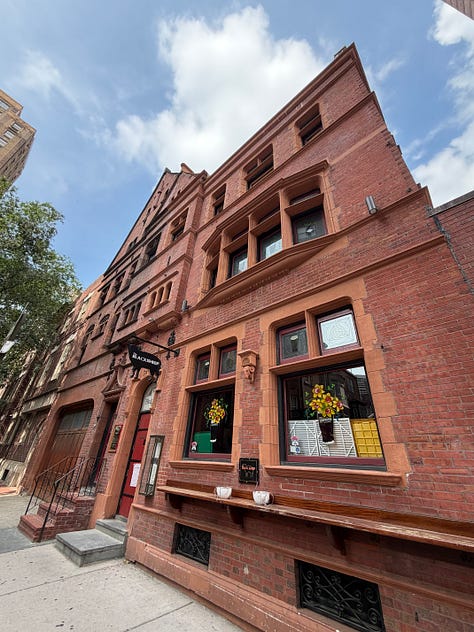
The Black Sheep is a great bar—boisterous on the weekends, with a reasonably-priced, expansive craft beer list and fun Quizzo. The building, too, is fascinating, half of a massive double house dating from around 1890 that swallows up much of the mini-block of 17th Street between Sansom and Latimer. I’m hoping that the Black Sheep, which has operated since 1999, reopens its doors very soon!
Despite my fondness for the bar, I hadn’t thought of making the Black Sheep a Phuilding until:
(1) Former architecture critic for the Philadelphia Inquirer and Friend of Archiveadelphia (FoA) Thomas Hine alerted me that the Black Sheep’s building was designed by the endlessly intriguing Gilded Age Philadelphia architect Frank Miles Day.
(2) I discovered that the Black Sheep space had gone from a home, to a speakeasy, to a Frank Sinatra-themed shrine, to a pioneering gay bar, to—finally, in 1999—a pub.
I realized that the Black Sheep’s story—the influential architecture, the impossibly colorful occupants, the dramatic disasters and twists of fate—not only deserved a treatment, but demanded a two-parter.
This week will explore Day’s design legacy and the often-tragic tales of two mustachioed magnates who called the Black Sheep building home—hyper-successful dudes who, in Icarussian fashion, became Black Sheeps themselves, due primarily to their shockingly quixotic political aspirations.
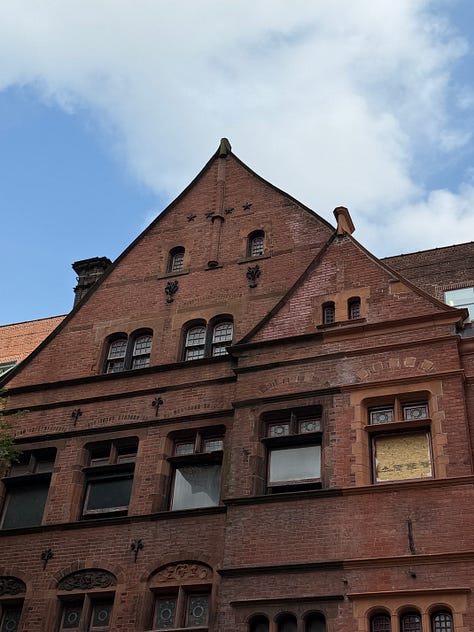
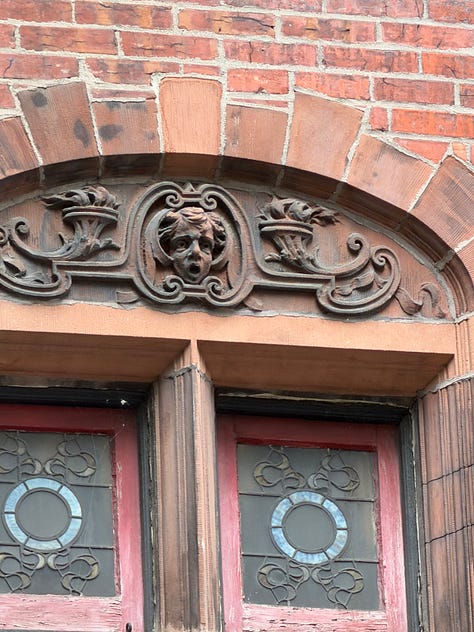
First, the architecture: When Tom Hine alerted me that the Black Sheep building, 245-247 South 17th Street, was the work of Frank Miles Day, I walked over to the double house and took in the partially-boarded-up brick behemoth, with its overlapping pitched roof elements, its elaborate window scheme, and its cool little sculptural elements, including a very surprised-looking cherubic figure:
My mind’s eye immediately flashed to the Art Club of Philadelphia building, a Day-designed, ravishing Italianate structure that stood from 1890 until 1976, next door to the Bellevue Hotel at 220 South Broad Street.
The Art Club and the Bellevue were often star-crossed. In 1902, as laborers dug out the foundations for the Bellevue in preparation for its vertiginous ascent, a cave-in on the Walnut Street side of the pit sent shockwaves across the site and put the Club, where prominent Philadelphian-members orchestrated painting exhibitions, in peril. Panicked, ultimately overstated reports of cracks in the Art Club’s walls and an impending collapse led many members to stay away until the Bellevue’s steel lattice was in place.
The momentary panic soon subsided, but the Bellevue, in its grandeur, scandal, and centrality to the cultural life of Philadelphia, soon overshadowed the goings-ons at the Art Club. By the 1940s, the Club had gone largely dormant, and Day’s building housed the Keystone Automobile Club (a AAA affiliate that helped with roadside assistance). In 1952, a 14-foot, 150-pound steel girder on the Bellevue’s roof, present for an elevator renovation project, fell off the hotel and into the Art Club, instantly killing an office worker in full view of his traumatized colleagues.
After Keystone (understandably) moved out, Bankers Securities, the Bellevue owners and real estate empire founded by Archiveadelphia regular Albert M. Greenfield, scooped up the space and oversaw a revolving door of tenants, including the very-short-lived Philadelphia Bell football team and a long list of political campaigns.
As Center City struggled in the 1970s, the federally-funded Historic American Buildings Survey, perhaps sensing a possible demolition, got some shots of the Club. The May 1972 photographs capture the building’s shattered windows, still adorned with decals for Maine Senator Edmund Muskie’s 1972 presidential run, whose Philly HQ that Club had housed and which had ended a month earlier after Nixonian dirty tricks famously reduced the earnest Muskie to tears (or snowflakes) during a tense press conference…the deterioration of the Art Club and Muskie’s psyche were entwined tragedies of 1970s dysfunktion:
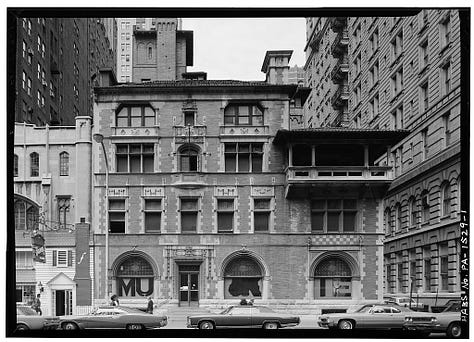
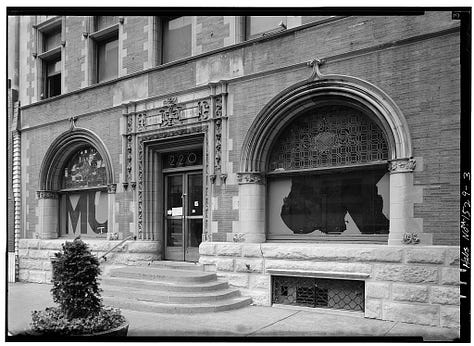
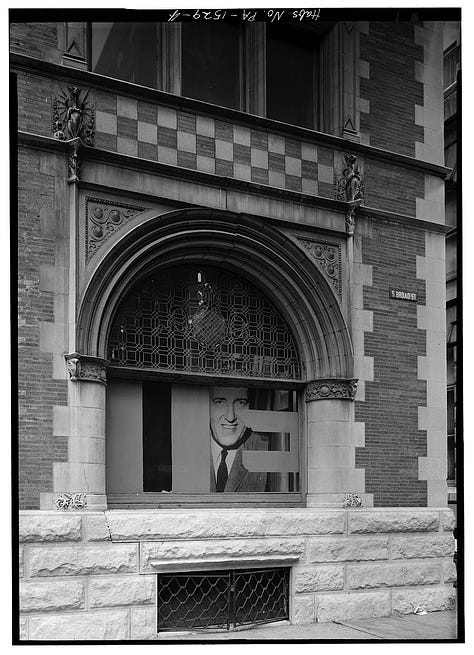
The HABS folks had their fingers on the pulse. In 1975, Bankers Securities indeed destroyed the building for a surface parking lot. Hine, who wrote several columns on the demolition, decried the loss of Day’s palazzo, quoting famed church architect Ralph Adams Cram, who called the Club, shortly after its completion, “a manifestation of delicacy and sweetness, of fine instincts and subtle sympathies.” Hine also noted that Day had produced a structure that “departed from contemporary work in its use of ornament to help define the mass of the building rather than simply for its own sake.” 1
So I knew Frank Miles Day primarily through this sweet, tragic, architecturally revolutionary paean to practical ornament, even if the Club was knocked down 18 years before I entered the earthly fray. And I felt similarly fond of Day’s work on the Black Sheep.
I was curious where the Black Sheep fit within Day’s journey, and what other resonances the buildings might have…
In search of Day material, I headed to the Athenaeum of Philadelphia on Tuesday to peruse the two most notable scholarly Day monographs: A 1980 University of Delaware Art History dissertation by Patricia Keebler entitled The Life and Work of Frank Miles Day and a 2025 book by local historian Julia Steinberg Agnew called Frank Miles Day: The Life, Work, and Legacy of a Philadelphia Architect, available for purchase here!
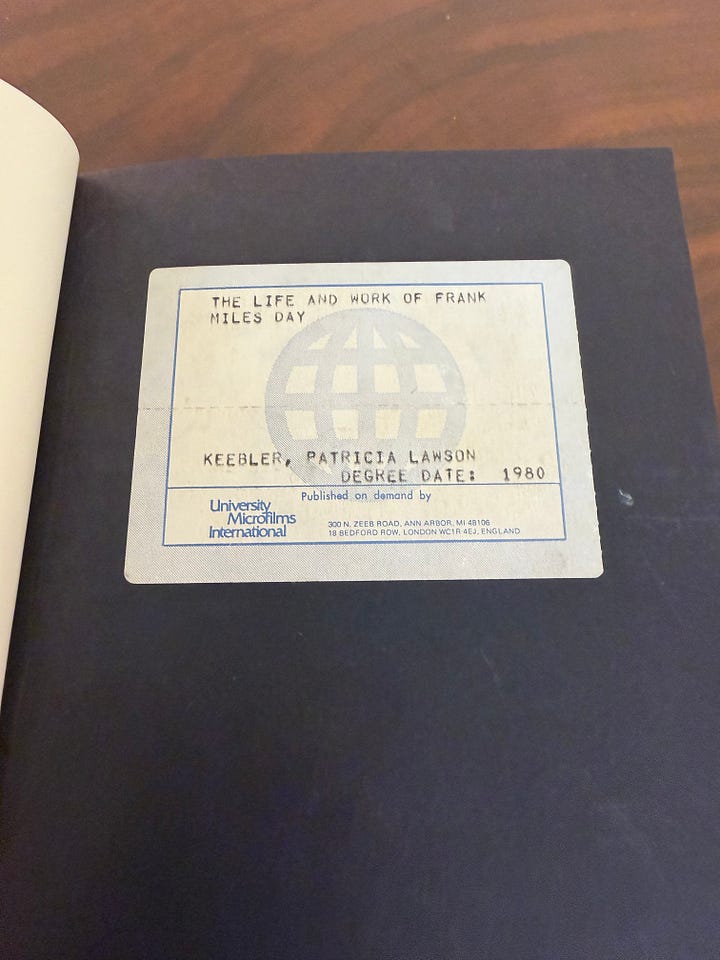
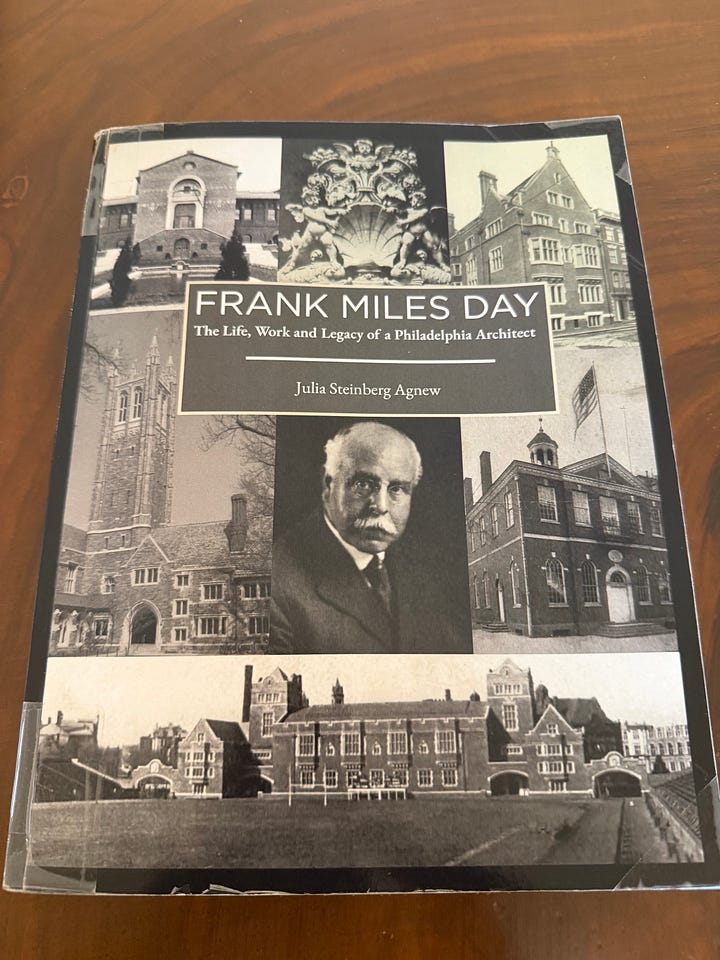
Both works were fantastic—I felt a feeling of gratitude for scholarship and architectural communion across time and space! I learned that Day was a Philly native, born in 1861 to Charles Day, an immigrant tailor from Kent, England, and Anna Rebecca Miles, the daughter of a local boot maker. After studying architecture at the University of Pennsylvania, Day headed to Europe for two years of intensive study that, per Agnew, “would directly influence his architectural designs for Philadelphia.”
Day sketched constantly—the Gothic palaces of Siena, the dormer windows of Nuremberg, the hotels of the Loire Valley. His style, later dubbed “Creative Eclecticism,” was taking shape.
Upon returning to Philadelphia, Day trained with Addison Hutton, who recently turned up in Archiveadelphia for his design of the also-demolished Doylestown Court House. Day started his own firm in 1887, at just 26, and two years later won his Arts Club commission—his first major building and a real coup…
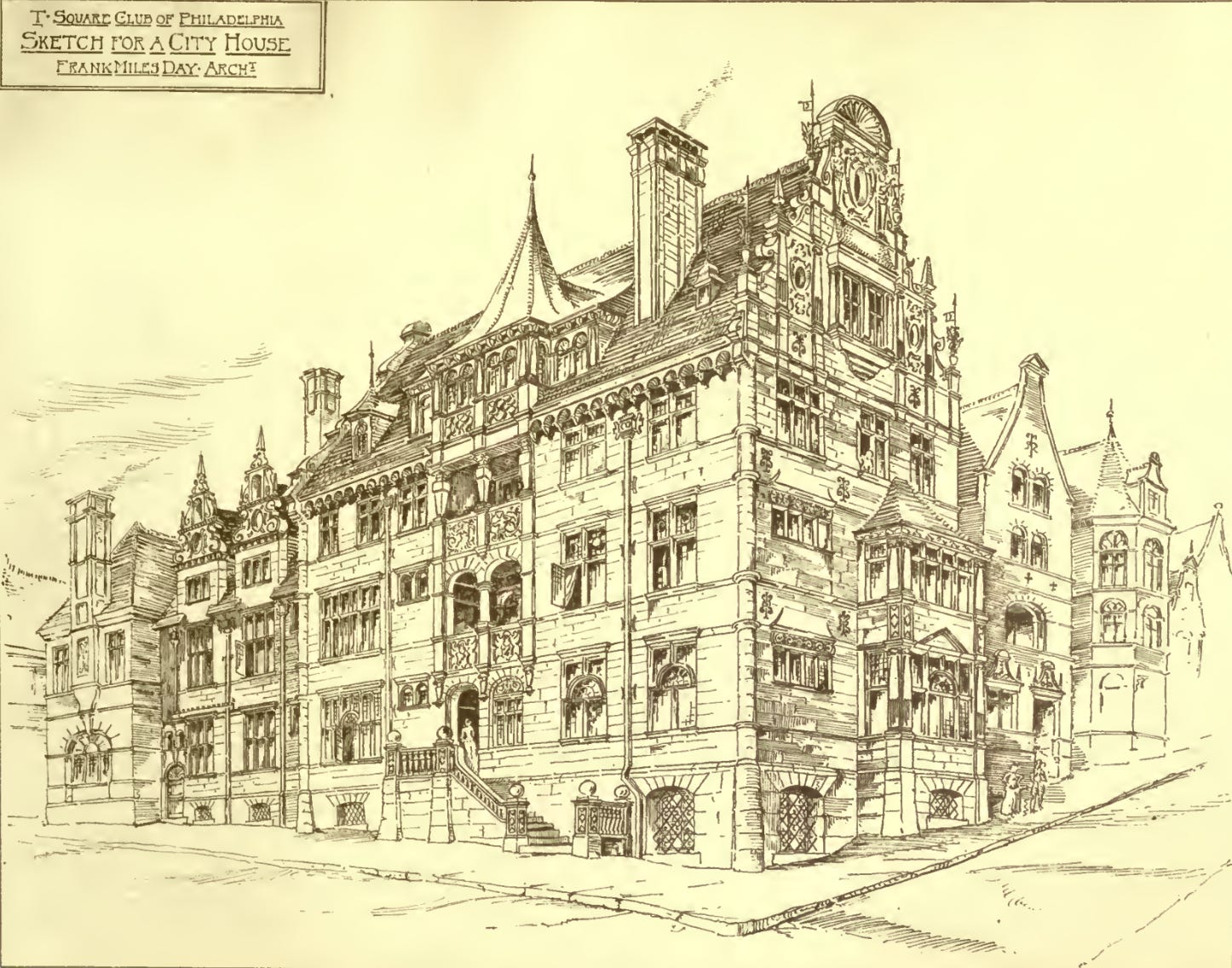
Beyond clubhouses, Day started flirting with private residences. His first published design was a “Sketch for a City House,” published in the December 1st, 1888 issue of the American Architect and Building News. There’s a lot of the Black Sheep here, though the sketch is even more dramatic. Agnew writes that the maximalist, sculptured gables and dormers “recall his sketches of the houses of Nuremberg and Regensburg”...a proper Germanic Phuilding:
Only months after the sketch hit the architectural press—and just after Day had secured the Art Club commission—he got the Black Sheep job…what a year for a young upstart!
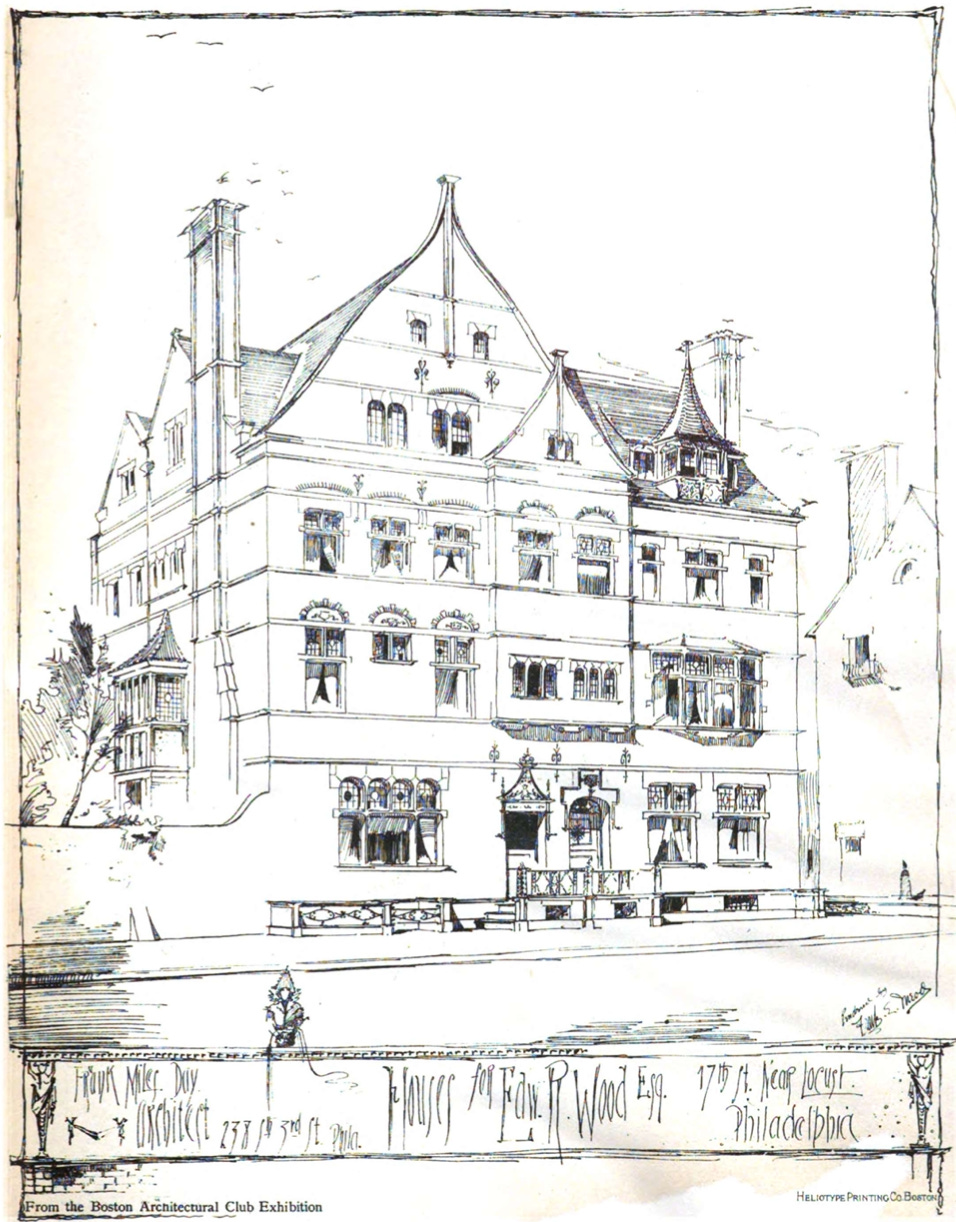
In her Day dissertation, Keebler suggests that the architect was quickly progressing. The “Sketch for a City House,” she argues, was “clearly the work of a beginner, still overwhelmed by memories, assembling undigested motifs into an interesting but hardly integrated design.” The Black Sheep plan, in contrast, was “an original composition based on, but not copied from, the European precedents recorded in Day’s notebooks.”
And I do think that’s what I so enjoy about Day’s buildings—they don’t really look like any other structures in the city. You can see some tones of the three other local architects most closely associated with “Creative Eclecticism”—the shingle-master Wilson Eyre and the firm of Collegiate Gothic experts John Stewardson and Thomas Cope (Day, Eyre, Stewardson, and Cope would all work on the University Museum at Penn). You can even see a little bit of the eccentric Willis Hale. But there’s something in Day’s particular brand of European soufflé that is all his own.
Just check out the chimneys, the curves, and the procession of windows in this drawing for the Black Sheep printed in the American Architect in 1889 (though actually drawn, complete with a flock of birds and strange little mermaid Gods around the nameplate, by Day’s even younger associate Frank Mead):
After my time reading Keebler and Agnew at the Athenaeum, I ventured out to go meet Zara at Iffy Books, a Rittenhouse-area store devoted to computer hacking culture that offers a fantastic free Tuesday evening writing circle. En route, I stopped at several other Day houses to see how they measured up to the Black Sheep.
I saw Day’s handsome loggia for 1116 Walnut, now Moriarty’s (another favorite bar). I saw another double house he constructed at 1213-15 Locust and marveled at its flat, overhanging roof, not unlike the Art Club. I saw the intricate brick work of 1219 Spruce and the fanciful pointy roof at 1922 Spruce. And I saw a whole row of delightful Days from 1920-1930 Pine a block away—all of this while going only a couple blocks out of my way on my Iffy Books trajectory.
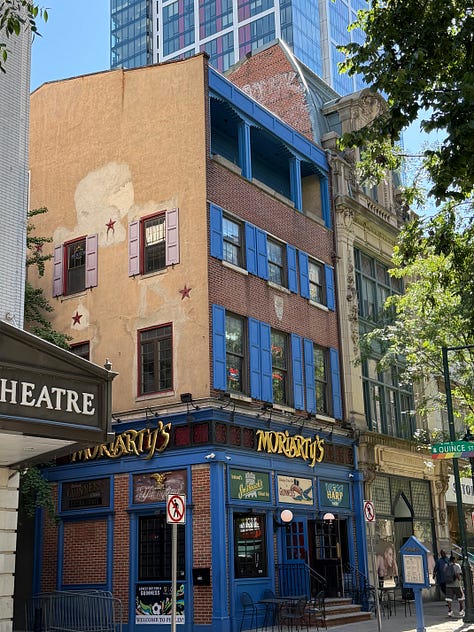
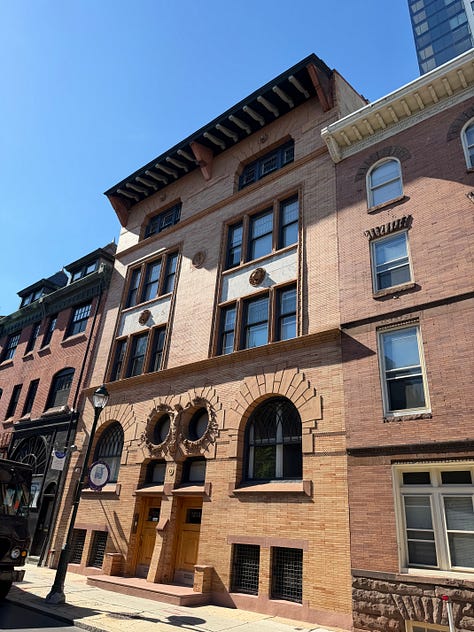
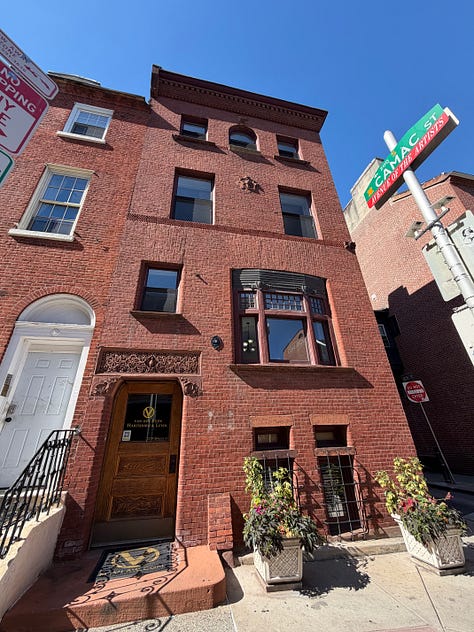
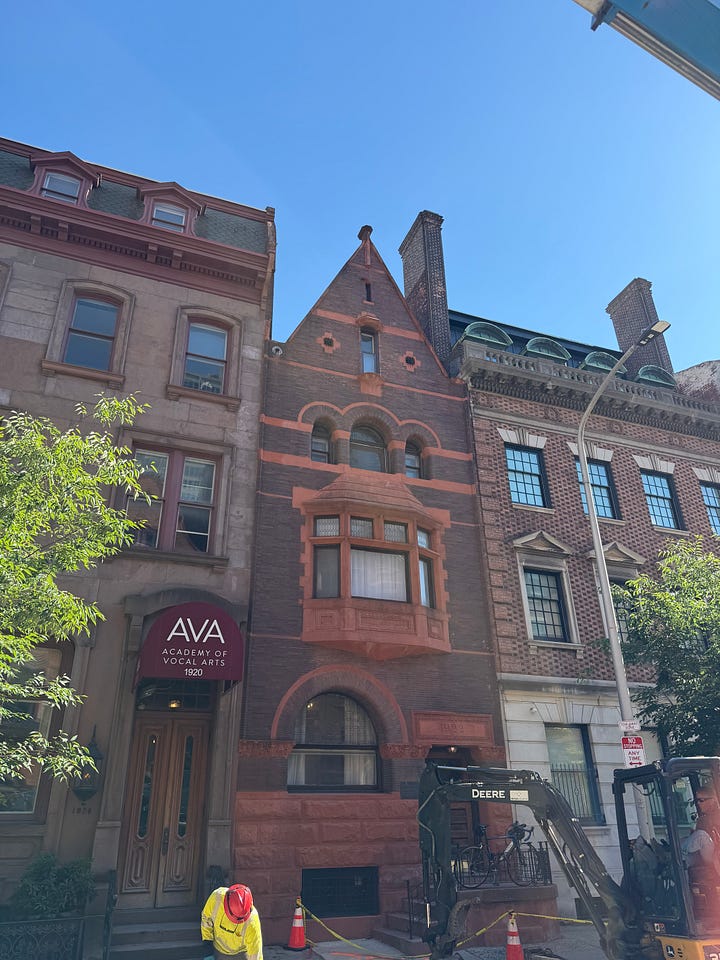
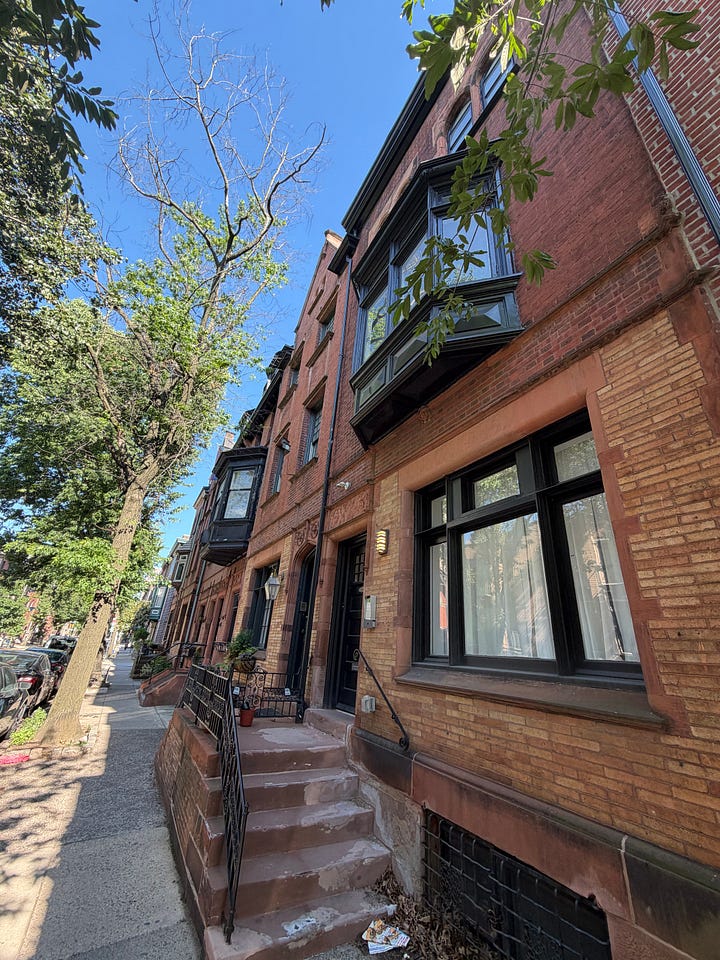
I am now a bona fide residential Day fan. And the admiration runs deeper when Day’s output is put in conversation with his very cool life, which included a friendship with the brilliant muralist Violet Oakley, his passion for gardening (he was a founding editor of House & Garden), and his close partnership with his wife Anna, a brilliant political reformer, opponent of child labor, and suffragist whose life Agnew covers deeply in her Day tome.
Now, I know I’ve been referring to the double house that has started this Day preoccupation as the Black Sheep. This is not wholly accurate on two fronts. Firstly, the Black Sheep is the southerly half of the double house, 247 South 17th Street. The other half, 245 South 17th Street, is still a private home today. Secondly, the proper name in Day’s age was the Edward Randolph Wood House, after the powerful man who paid for its construction.
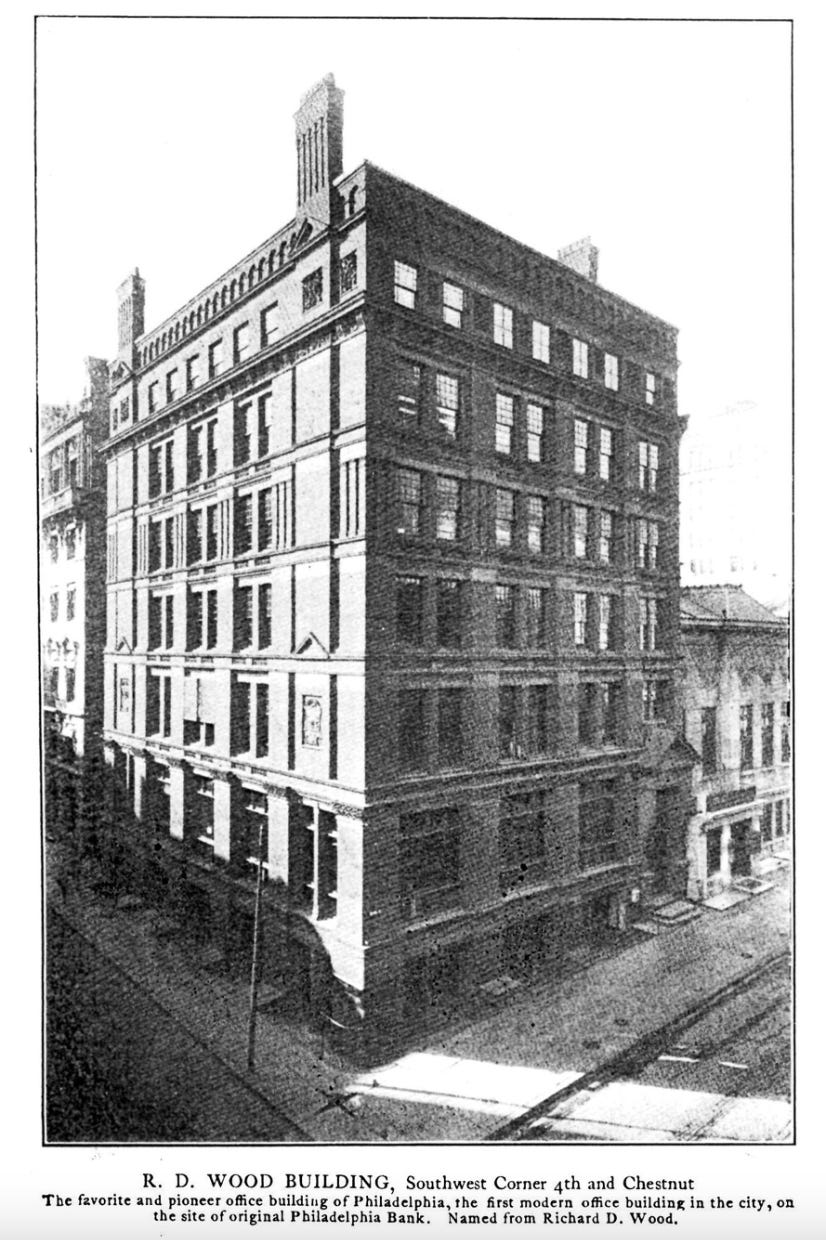
Wood was from a well-known old Quaker Philly family that had gone industrial—his dad created a prosperous iron business. He became a lawyer and helped expand his family’s various factories, manufacturing glass and bricks in New Jersey and working out of the long-gone, imposing Wood Building at 400 Chestnut Street:
Wood, per Agnew, envisioned the double house as a residence for his sons. He held onto the home as he aged, hosting dances, weddings, funerals, and teas with his expansive family in the northerly (245) portion. Nothing too lascivious, as far as I can tell!
The same relative placidity was not found in the southerly (247) section, the part of the structure that would become Black Sheep. Wood sold 247 very shortly after construction to J. Edward Addicks, a man whose penchant for drama has sent me down several rabbit holes, each of which I am struggling to exit.
Born in Philadelphia in 1841, Addicks worked as a flour speculator before entering into the lucrative and burgeoning gas trade in the 1880s. He ruthlessly cornered the market in Boston and Brooklyn, making tens of millions and gaining the nickname “Gas” Addicks. Often accused of corrupt self-dealing, he somehow managed to avoid prison.
In 1886, Addicks’s friend Joseph Bernard Wilson, a Delaware railroad man and secretary of Philadelphia’s vaunted Union League club, died of stomach cancer at 43. Addicks and his wife Rosalie financially supported Wilson’s widow, Ida Carr Wilson, with whom they were very close—the Wilsons had even named their daughter Rosalie.
Addicks seemingly purchased 247 from Wood to house the grieving Ida and was often in residence at the Wilson country manor in Claymont, Delaware—a rambling house called Miraflores.
With Ida’s housing and budget settled, Addicks turned to another quest: Securing a position as a U.S. Senator from Delaware. Despite only intermittently residing in the state, Addicks became truly Addick-ted to jockeying for the post, trying desperately from the late 1880s to the early 1900s to get a seat. Delaware historian Michael Morgan chronicled in a 2023 Salisbury Daily Times article how Addicks used much of his gas fortune to manipulate the idiosyncratic state political system, paying the onerous poll tax for impoverished Delaware residents in exchange for support. The effort completely fouled up the state’s democratic institutions, creating pro-and-anti Addicks factions in the GOP so polarized that the state legislature left the Senate seats altogether vacant for two years, from 1901 to 1903.
Amid Addicks’s ferocious Senatorial quest in 1894, an affair came to light that deeply damaged his prospects. Addicks’ wife Rosalie sued him for divorce, accusing him not simply of supporting Ida Carr Wilson—mind you, his close friend’s widow—but of carrying on a years-long affair with her, both at Miraflores and at 247 South 17th Street. The national press went wild, and Addicks emphatically denied that he had engaged in “adulterous intercourse” with Mrs. Wilson in the 247 house or anywhere else. He promised to “fight this case to the death” and assured the public that the charges would not affect his political aspirations. 2
Addicks failed, however, in his continued quests for the Senate. The unfortunate truth, however, was that Addicks and Mrs. Wilson were Addick-ted to love. After expensively settling with Rosalie, Addicks and the now-former Mrs. Wilson married at Miraflores in 1898, in an extravagant ceremony catered by none other than Bellevue Hotel founder George C. Boldt!
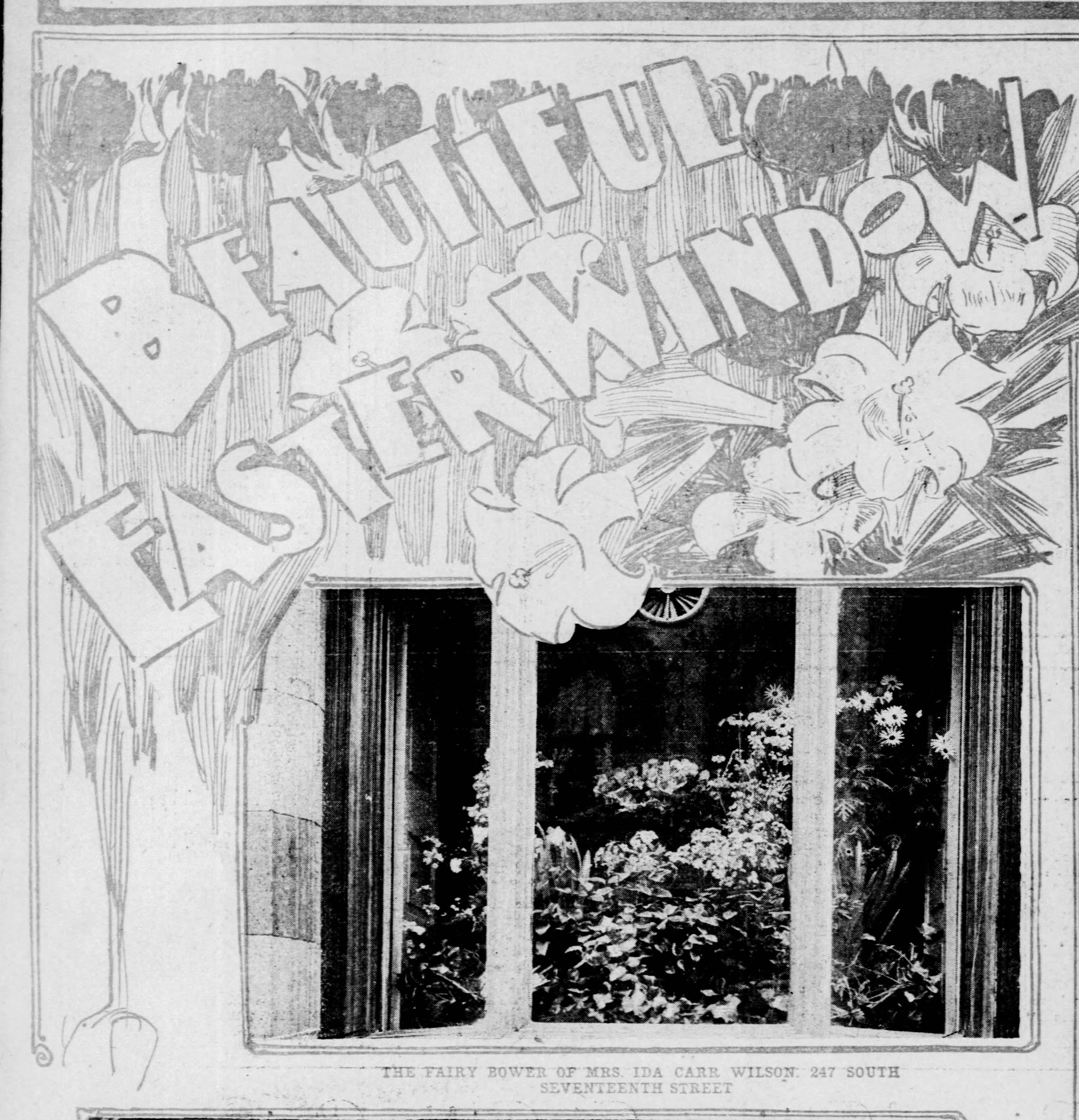
As Addicks tried to regain political control of Delaware, the newly official couple strived for some sense of normalcy at 247. A 1900 Inquirer graphic shows Ida’s Easter “fairy bower” in the house’s window:
The scandalous roots of the relationship, however, continued to dog Addicks, with his political enemies claiming that Ida, from her 247 perch, was influencing Addicks’ various connivances in the state. The controversy reached a fever pitch after Addicks’, citing Ida’s preference, supported the lieutenant of his biggest political adversary. “Thus is Delaware riven by the fancy of a woman,” the Philadelphia Times declared. “Old politicians shake their heads and wonder.”
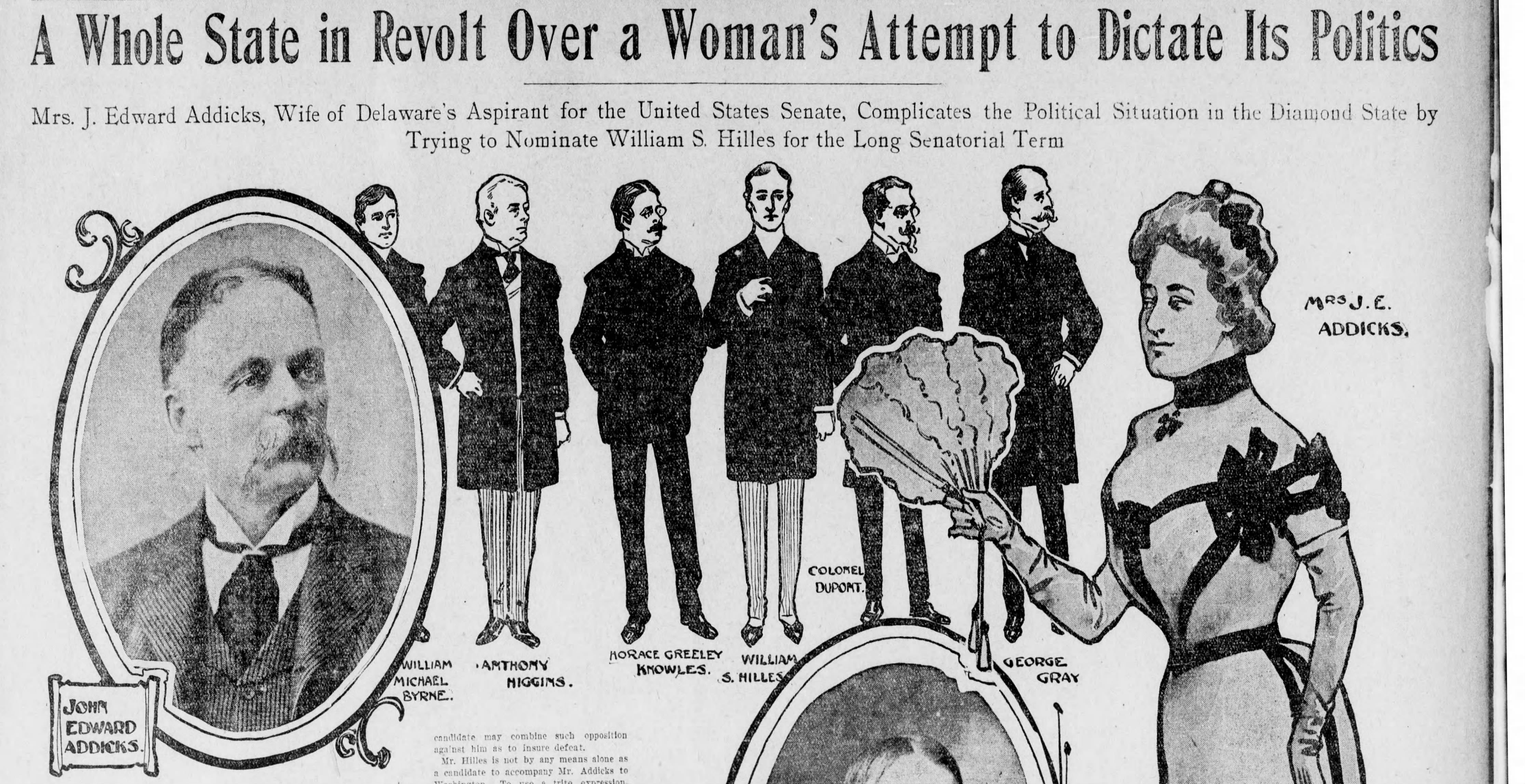
Unsurprisingly, the Addicks story ended tragically. Unable to achieve his Senate-dream, Addicks, besieged by creditors, tried desperately to hold onto 247, but the house went into foreclosure in 1907.
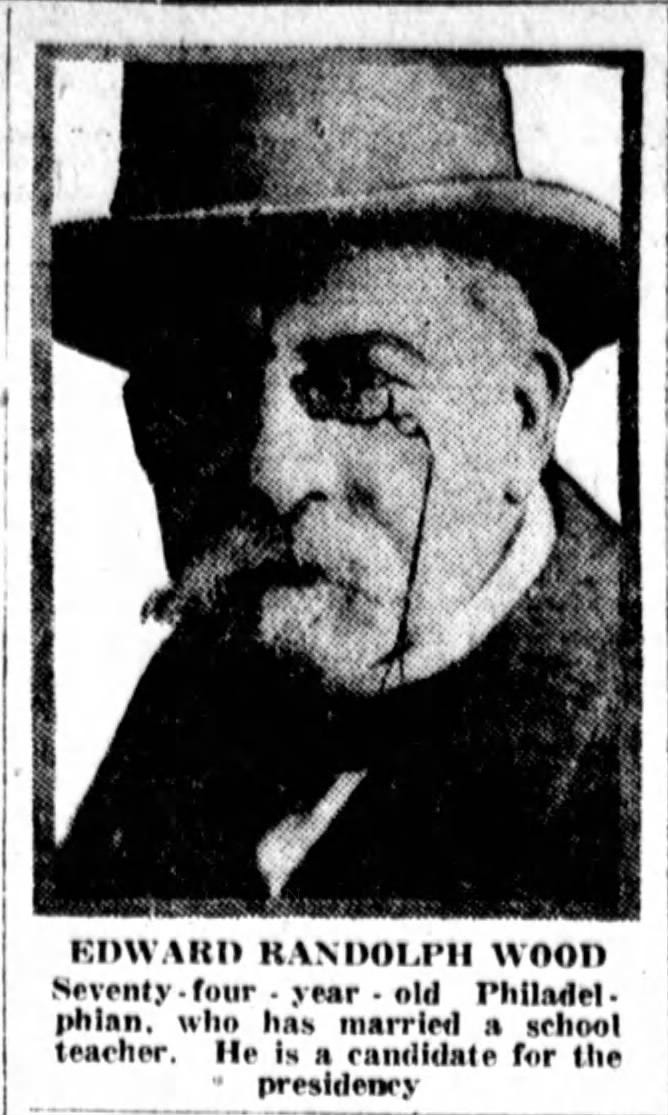
I don’t know how close Wood and Addicks were, but the usually lowkey Wood, well into his seventies in the 1910s, suddenly pulled an Addicks, launching a series of sudden and exceedingly unlikely bids for high public office. Perhaps he was inspired by his neighbor, notwithstanding the ignominious downfall. Wood—listing his address as 245—threw his hat into the ring for Pennsylvania Governor in 1914 and as a Republican candidate for President of the United States in both 1912 and 1920.
The somewhat inexplicable decision seems a bit less weird in our current age of octogenarian national political leaders, but the national press treated Wood’s sudden visibility with bemusement, as they had with Addicks.
From what I can tell, Wood was far more interested in shaping the GOP than in actively pursuing the presidency. A believer in protective tariffs and the power of private enterprise, one of his popular slogans, uttered during far-flung campaign adventures for the 1916 race, was “Elect a business man president.” He was incensed with the Republicans who bolted the Party to support the comparatively progressive Teddy Roosevelt during his rebellious 1912 bid, calling them “traitors to their country.” 3
As if the specter of a monocled, conservative Republican suddenly springing forth from 245 South 17th to lead a national political movement wasn’t odd enough, Wood, by this point a widower, also complicated his dreams of executive power with a controversial lovematch. In the midst of his final presidential try in 1920, the 80-year-old Wood married a much younger woman She was Erma Richardson, a former Arkansan schoolteacher Wood met during his political travels. The two hid out in New Jersey, and enterprising newspeople quizzed Wood’s adult daughters, also living at 245, about the whereabouts of their smitten dad. The campaign, already scoffed at by most pundits, took on an air of tabloid steaminess.
The elegant house that had sparked Frank Miles Day’s flurry of residential Center City designs clearly carried within its walls some strange admixture of Napoleonic fever and irresistible, decidedly inconvenient romance.
And this strange brew would only intensify when 247 became a watering hole…
Thomas Hine, “Art Club Building To Be Torn Down,” Philadelphia Inquirer (PI), 2/11/1975.
“Addicks Divorce Suit,” Philadelphia Times, 11/28/1894.
“Thinks Future of Party is Rosy,” San Francisco Chronicle, 8/15/1915, and “Want Progressives Back,’ Rockford Daily Republic, 8/6/1915.
No posts
Comments
Nothing yet. Say the first thing.
Sign in to join the conversation.