
For the concluding week of POST PRESS, CAKE convened a discussion focused on the question of how vacant buildings can become catalysts for culture. This is an edited extract from that conversation, which was chaired by CAKE’s Hugh Scott Moncrieff.
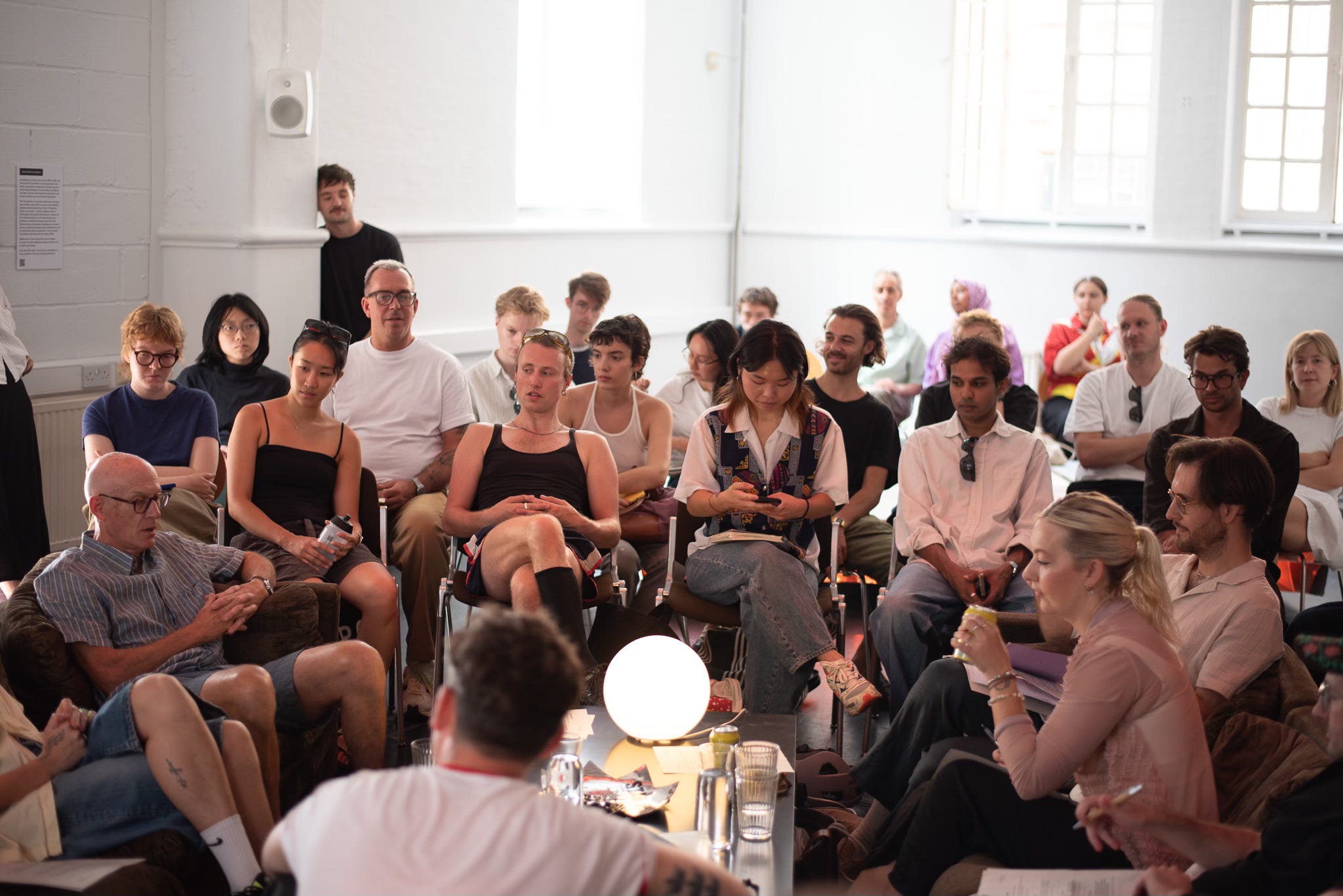
Roger Madelin, on sofa left. (Matthew Blunderfield).
Hugh Scott Moncrieff (CAKE)
The discussion today isn’t simply about unlocking vacant buildings. It’s about something broader: how cities can create the conditions for cultural production to happen in the first place. London contains an extraordinary amount of creative talent. It also contains a significant amount of temporarily vacant space. Yet access to affordable space for making, performing and experimenting continues to diminish. That suggests the challenge isn’t simply spatial; it’s also institutional, financial and political. Rather than arriving at a single answer, we hope to bring together different perspectives, and leave with a richer understanding of what it would take to build a more culturally productive city. With that, I’d like to introduce our panel. Roger Madelin was the long-time head of Argent who led the King’s Cross development, and more recently a director at British Land—one of the UK’s leading figures in urban regeneration, bringing the perspective of large-scale development and long-term placemaking. Roland Fischer-Vousden is a writer and co-founder and director of SET, transforming vacant buildings into affordable studios, art spaces and community hubs across London. Susanna Davies-Crook is a writer, curator and cultural strategist whose work spans cultural institutions, public programming and civic culture. Will Jennings is director of Hypha Studios, a charity working with developers, landlords and local authorities to transform vacant commercial buildings into free cultural spaces for artists and creative practitioners. Ali Wagner is a nightlife researcher and cultural producer whose work explores accessibility, inclusion and grassroots cultural production. Roger, let me turn to you first. Why is it often easier for buildings to remain vacant than to be temporarily occupied by cultural activity?
Roger Madelin (British Land)
I’ve closed down lots of nightclubs in my career—places like Barbarella’s—but Broad Street in Birmingham is now very famous for its nightlife. At King’s Cross, we closed things down, but I think people might say King’s Cross is now quite a good place for culture. Maybe there isn’t enough affordable space in the development and its hinterland, but we did a lot with the empty historic buildings that were available. They were semi-derelict, but before we got planning we tried to encourage activity. We had photographers, poets and an artist in residence, and we tried to accommodate anyone who came up with a good idea and had some funding. We were also approached by a lot of people who didn’t have any funding. Art and culture were part of King’s Cross before we got planning and started the development. People might say there wasn’t enough grassroots activity, which I would accept.
Canada Water became famous for Printworks, a wonderful, massive, empty industrial building that was costing £800,000 a year when I arrived. I thought it would be good to find £800,000 so that it stopped costing that money. When we met the company now called Broadwick Live, we didn’t know it was going to turn the building into one of the world’s best electronic music venues, as well as a great place for classical music, ballet, dance and other uses. We’ve spent the last six years coming up with a business plan that works. We have planning permission to bring it into the twenty-first century and add culture seven days a week. We launched it three years ago as a new building, but the funders—British Land and AustralianSuper—decided it was too risky at the time. We’ve been trying to come up with a new financial plan, which we have, but AustralianSuper don’t want to be part of it. It has been very tough because they got into development just before Russia invaded Ukraine. People tell me development has never been as hard in 40 years. Stuart Lipton told me it has never been as hard in 55 years.
The reason empty buildings stay empty is because it’s very hard to bring them back to life unless they’ve got the power and the water, or you find someone like Broadwick who are able to bring in the scale to make 6,000 people here safely occupy it. It’s just very hard. You need someone who wants to do it. Why have I always wanted to do it? Because I think it will add value, it gets people there. You want to do it because it reduces the cost of the empty building sometimes. You do it because you’re pretty confident that the place you’re trying to create will have a substantial amount of culture in it. All great cities have cultural uses embedded within them, and you can’t really create a good mixed-use new piece of city without massive amounts of diverse culture in.
I’ve stepped back a bit: I’m now a strategic adviser. I’m hanging on to Canada Water, but I’m also advising on Cambridge Airport, where there are 14 major hangars. We’re thinking seriously about art, culture and performance there, and it’s getting very exciting.
Hugh Scott Moncrieff
The point that development has never been so hard is interesting, and perhaps we’re all feeling that in one way or another. The conditions have to be right: you need actors such as Broadwick Live, or enabling institutions. That’s part of what we’re asking—who are they, and what do they need to do? At a time when it has never been so hard to develop, there is a lot of empty space because the money isn’t there for the more permanent work. On paper, that might look like a ripe environment for meanwhile occupation. Where do the barriers really sit? Is it about money?
Roland Fischer-Vousden (SET)
It’s almost always cost. When we’re offered a building, we have to look at the business rates, utilities and installation costs. Over the last ten years, we’ve delivered perhaps half a million square feet of meanwhile space. We won’t pay rent on a meanwhile building if the term is under five years. Recently we were offered around 100,000 square feet in the City of London. Even at 20% business rates, the cost would have been higher than anyone could afford in studio rent. Rates are simply too high, and utilities are increasing. Part of the reason it’s harder to use a building in the UK than in Brussels is that commercial rent is generally much higher. London may be the most expensive city in the world for commercial rent. Business rates tax the use of a building rather than the building itself, so the cost is pushed onto the occupier. That creates an economy which favours not using buildings. And electricity is also I think the highest in Europe. So that makes for an economy that essentially favours not using buildings.
Will Jennings (Hypha)
Up and down the country, there are high streets with 5, 6, 7, 10 shops all vinylled up and the knock-on effect of the landlord saving money is people not coming to the high street, not going to the cafe, not visiting another shop or another kind of third space or activity centre. So there needs to be more joined-up thinking about taking the agency away from an individual landlord or property group. We need a more collective idea of the high street, the community and the range of offers a place needs. One of Hypha’s greatest spaces is in Hillsborough, Sheffield. It’s a beautiful part of the city, but it isn’t as wealthy as some others and has social and demographic difficulties. We have a former Wilko store which we gave to artists for free. On the ground floor there’s a children’s community art space, which around 6,000 children have visited in a year. On the first floor there’s a changing exhibition in a huge exhibition space, and on the top floor there are 16 or 17 free artists’ studios. It has been there for about two years and will probably be there for another two. Because of it, the coffee shop next door is doing really well; people come into the town centre, it’s in the local press, the MP visits, and suddenly there’s an energy.
Ali Wagner
I want to pick up on what Roger and Hugh were saying. We talk about needing more Broadwick Lives and spaces for 6,000 people at Printworks, but as someone working in nightlife as a smaller, grassroots-focused promoter, I would never consider taking on one of those spaces. In my opinion, perhaps we don’t need more Broadwick Lives, because that can represent a very commercialised model of art and music. We should also look at giving space to people like me, smaller collectives and groups of artists who may not come from families with money or backgrounds that give them resources and knowledge. Responsibility sits with developers, but also with organisations such as Broadwick Live, SET and others that have this knowledge. They need to share information and help us make those changes too.
Will Jennings
To respond to that, I’ll give a nutshell account of what Hypha has done. Camilla, my colleague and our CEO, was in exactly your situation five years ago: a graduate curator who wanted to put on shows, but not in expensive white-wall galleries with all their infrastructure and networks. She wanted to use empty shops. She knocked on doors and wasn’t answered, partly because she was unknown and female. Landlords and developers also didn’t necessarily know what a curator or artist did; often they thought it sounded messy or chaotic. By setting up a charity five years ago, we have created those conditions in 70 or 80 locations across the UK, delivering around 220 exhibitions and giving free space to more than 3,000 artists for exhibitions and studios. That ranges from Edinburgh to Hastings and includes theatre groups. People apply through a free open call. We look for a good public programme, an account of how it will engage the local community, and a connection to the area.
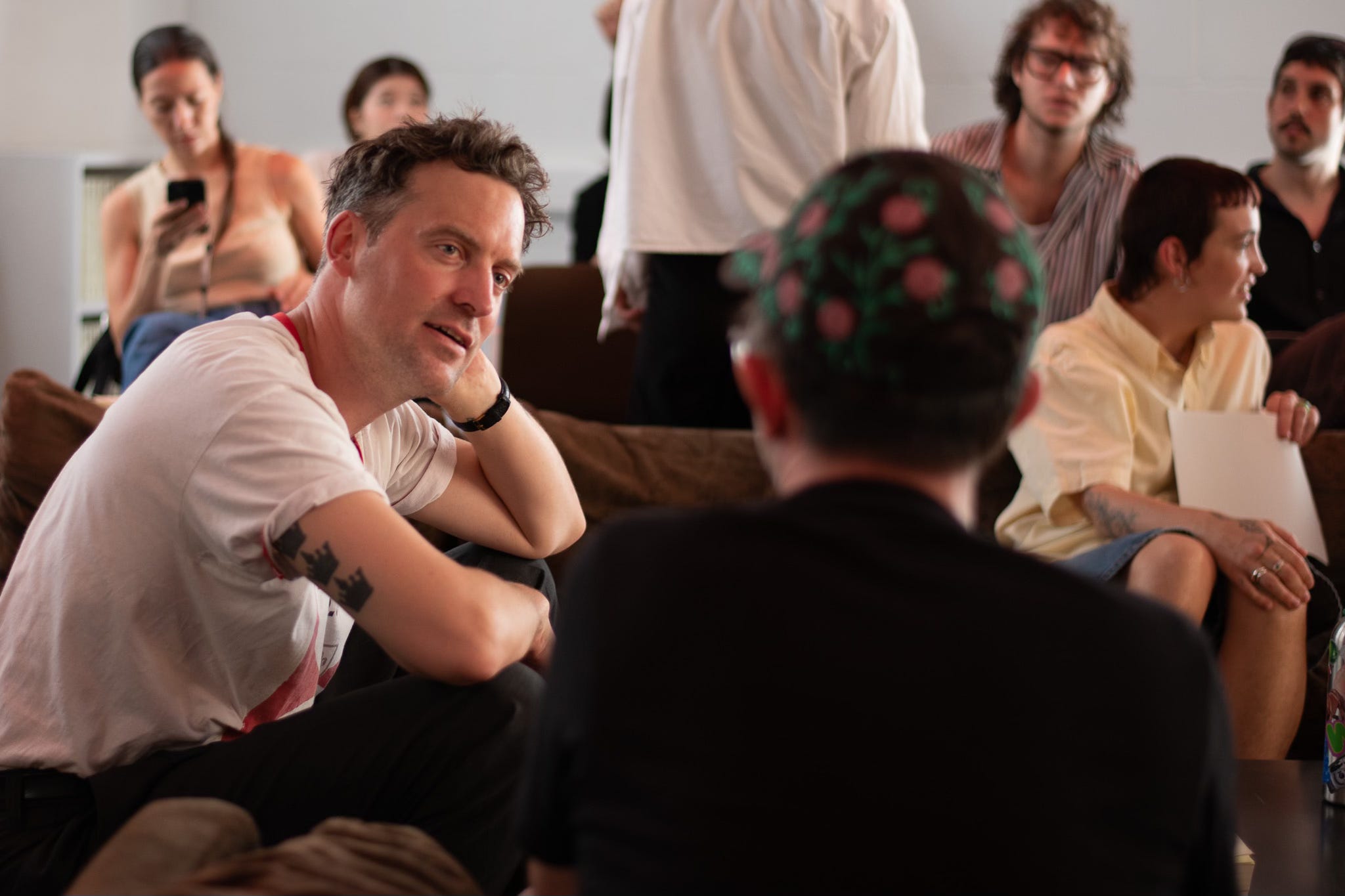
Hugh Scott Moncrieff (Matthew Blunderfield)
Hugh Scott Moncrieff
in our first four years as a studio, we’ve worked on temporary projects that were realised and on several more permanent club-space projects that did not come to fruition. In the case of the Pickle Factory in Hackney, there wasn’t really the investment, shared resource or enabling support from a grassroots point of view, and in the end it fell over. Part of our research has been into what I might call enabling organisations. Hypha may sit partly within this category. In Brussels, organisations such as Toestand, Communa and Bodies in Space act as intermediaries, brokering contracts and deals between grassroots operators and event organisers on one side, and developers, councils or private landowners on the other - essentially finding value-add on both sides of the coin. A big part of that value-add is, I believe, what Will has been talking about up in Sheffield - the regeneration of community from a grassroots level. So the new nursery actually informs a new cafe, that informs an art gallery.
Susanna Davies-Crook
I come at this as a writer and a curator, an arts journalist, and to some extent a cultural historian. I went to university in Leeds and wrote my thesis on self-organisation, cooperativism and DIY culture there, because it was absolutely an example of that. Leeds didn’t really have many institutions. It had Leeds Art Gallery and the Henry Moore Institute, and then a group of students from Leeds set up the Tetley, which became an institution and had many issues of its own. There were many relationships—this was almost 20 years ago, in 2008 or 2009—with developers, exploring what it might look like to create institutions in meanwhile spaces or in relation to development. If we look at London now, and the development of management infrastructure in the interim, it is all geared towards a reduction in risk. This reduction in risk is why we have this growth of places lthat are only able to trust organisations on the scale of Broadway.
Roger Madelin
They were small at the time. They were just two guys, not a big institution. They didn’t come in and say, we’re going to pay you rent. They just said: ‘We’ll try this and try that.’ But sometimes, from a developer’s point of view, meeting someone that’s kind of done it is helpful because they know about dealing with the local authorities and they know about the health and safety issues, which are massive.
Susanna Davies-Crook
My point is really about the ecosystem: ensuring that artists and DIY culture are part of it, and that institutions and developers create a shared platform for risk rather than concentrating it in one place. As a curator, I can speak to institutional practice. Funding cuts, neoliberalism and reduced Arts Council support have diminished venue models. We end up with a kind of ‘venue-isation’ of culture, in which curators, artists, DJs, nightlife workers, cooperatives and communities don’t get the chance simply to play, experiment or explore. We need that space for play, risk and experimentation. Institutions should support it. I think we should have more large institutions supporting artists, more artists and more local activity. Everyone has to be welcome.
Roger Madelin
From a developer’s point of view or building owner’s point of view, it’d be much nicer if you just had one organisation saying “We can guide you through the planning. We can guide you through the temporary uses. We can guide you through all the health and safety stuff.” The developer is thinking “I haven’t got the resources to explore how to make all this happen because it’s not going to make any money”.
Will Jennings
But it can make money through a different accounting mechanism. For the last year we’ve had free galleries in No. 1 Poultry. They wanted the space activated, for want of a better phrase. They wanted something at ground level because the units have been shut up since COVID. They trusted us, they’d seen us work with British Land especially at Euston Tower. I was talking to the people behind the developers and they said: “In the future we can put in some shops down here or a cafe, sure, but it’s not going to make us a huge amount of money. This is not where the money of this building is going to be. That’s in office rental above. But if we put in art galleries and something interesting on the ground level, it brings people there and the offices above are going to go for more because it’s a cool place to be.” It can still make money, but it’s money that is accounted in different ways.
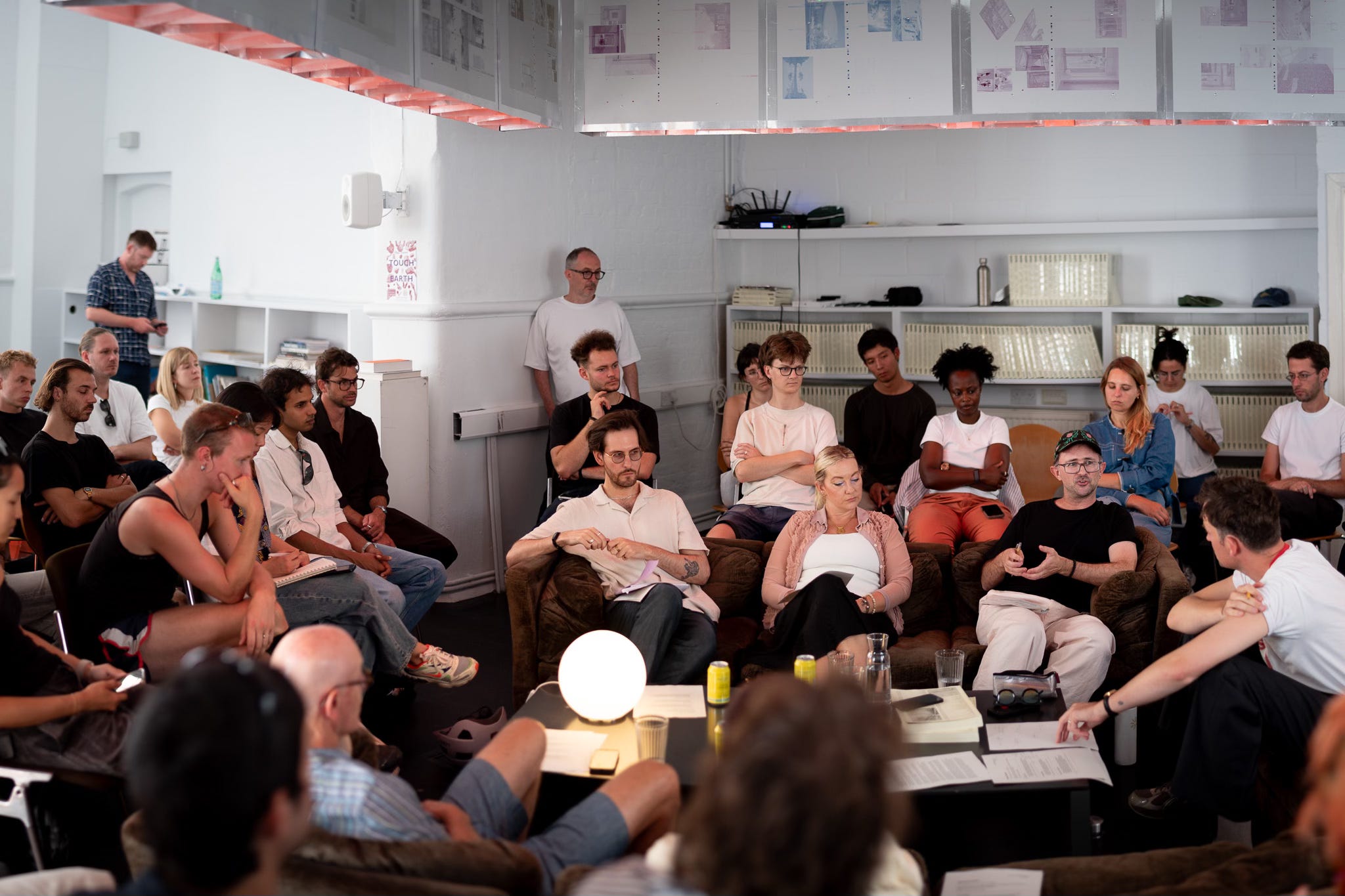
On sofa from left: Roland Fischer Vousden, Susanna Davies-Crook, Will Jennings (Matthew Blunderfield)
Roland Fischer-Vousden
Presumably it isn’t enough, because we don’t have many permanent buildings for arts occupation. Meanwhile use can save money, which is why it happens, but it doesn’t make enough for developers to want to retain it in the long term. Most of the time, when I talk to developers and say we can do a meanwhile occupation and then deliver a permanent building with genuinely affordable studios—perhaps even passing it into the hands of local people who want to run it—the response is: ‘Can you pay £30 a square foot?’ Obviously, we can’t. That sits at the core of the problem. Developments don’t end up with multipurpose uses that reflect what communities or government want, because the question is framed as ‘How do we extract as much money as possible from the land?’ rather than ‘What do we need to build to make a functioning society?’ That has to be state-led. The planning process is supposed to mediate between the developer’s aim of making money and the needs identified by communities and government, but it doesn’t work. Section 106 commitments get pushed down and down until there is no permanent space left. I think the problem isn’t so much; how do we do meanwhile? We do loads of meanwhile. We do need to pass on that information better to people coming in, and I think we could set up a school to do that. We’re going to release a pamphlet of 10 Steps to Ruining Your Life or something like that in September. But what we really need to think about is how do you move from a system that favours trying to maximise profit on land towards a system that thinks, what do we need in the country and how do we make sure that’s delivered?
Ali Wagner
I live in like one of the last few warehouses in Hackney Wick, and I look out my window and it’s literally all new builds that look identical. On the ground floors are all these vacant commercial spaces, and no one wants to rent them yet because it’s not, I guess, all developed yet. There is no green space and there’s no culture. The warehouse people are the last bit of culture left there and once we all get booted out in a year or two, I think living there is going to be totally depressing because there’s literally nothing to do.
Susanna Davies-Crook
It’s also interesting within the history of East London. Shoreditch was where the YBAs were, then it became gentrified and activity moved outwards. Gentrification has kept moving around East London, following artists until there is almost no East London left. Twenty years ago, conversations were already about how artists are used and instrumentalised in the production of capital. Institutions have a role in holding people to account—for protecting culture, supporting artists and creating an ecosystem.
Ali Wagner
Gentrification is inevitable but how can we make it better?
Roger Madelin
Well, it’s economic investment and economic activity, and it should be a good thing. In the case of Fish Island, presumably— I’m not trying to defend the developers, you know, I haven’t been down there recently— but it’s probably one-off development. Each plot has a developer, who is thinking: I need to build it, I need to make the money, I need to pay the bank back and get on to the next one. If you’re lucky enough to be looking at something like King’s Cross or Canada Water, you are curating the whole place, and affordable space should be part of that although not to the extent that it may been before development started. King’s Cross was full of quite interesting, sometimes nefarious activities in the ‘80s and ‘90s, and you wouldn’t want those to stay because they were antisocial. If you took people to Shoreditch 30 years ago, you really would have been worried for your health and well-being. There was a point when everyone said: “Oh, it’s now fantastic because it’s really cool, it’s full of artists.” And then suddenly there’s a point where they go: “Oh no, it’s been gentrified here, it’s terrible.” But it goes to the next bit of London, it moves up somewhere into Hackney, or it moves out to Stratford, or it moves out to Barking, or it moves out to Dagenham. As a free market liberal, I would say, there isn’t anything wrong with that. And developers or local authorities who are responsible for larger areas, should obviously think about the mix and the ecosystem, but allowing places to change and support more economic activity is a good thing for those communities.
Roland Fischer-Vousden
But its also displaces many communities.
Roger Madelin
People shouldn’t be kicked out of affordable housing; it is owned by the state. Look at King’s Cross and Somers Town. Around 95% of Somers Town, between Euston and King’s Cross, was affordable housing. It had very little economic activity. Many children in the schools had never known anyone with a job beyond the police or teaching. Adding economic activity and gentrifying the area—was that good? Nobody was moved out of those houses. More houses were built, bringing in other economic activity, and some were sold for millions of pounds. But social tenants weren’t kicked out and their rents didn’t go up. Other people came in and provided economic activity. That’s not a bad thing. Of course we should be building more council housing.
Roland Fischer-Vousden
But as you were saying, the activity gets displaced. So let’s say you have a community organisation who really likes using their local social centre and during the redevelopment that gets moved to Barking or Dagenham. The problem is that you can’t interrupt people’s lives and then say the activity has simply moved somewhere else and that this is good for those other people. It isn’t good for the people who were displaced. You may argue that the benefits outweigh the harm because a place becomes safer, but we have to be realistic that displacement occurs. We experience it all the time through meanwhile-use projects. When SET Woolwich had to close, around 600 artists were using the building. We’re releasing a report in September. We measured people’s mental health: it was above average while they had the studios, but when they were told the building would close, more than half fell below the clinical threshold for depression.
Roger Madelin
There’s 100 acres in Charlton that’s completely derelict. Why don’t they move there? Because it’s cheap and it’s controlled by the local authority. Your local authority should be regenerating Charlton.
Roland Fischer-Vousden
I completely agree. We tried to work with Greenwich Council to deliver some of those warehouses.
Roger Madelin
They’re amazing, aren’t they? Especially if you have a strategy to bring artists in—
Roland Fischer-Vousden
I don’t know why they don’t.
Will Jennings
I think there’s something to say there about strategy. The discussion around council housing is really important because we’re not simply failing to build enough now; we’re barely building any. That’s a huge failure of the state at national level. In this neoliberal process of drawing back the big state and devolving responsibility to smaller and smaller agents—even below local authorities, into BIDs and individual developments—we lose the larger view. Roger, you used the phrase ‘we’ve curated culture around King’s Cross’. I don’t think culture needs to be curated in that way; ‘curated’ is overused anyway. There was culture in King’s Cross, just as there was a great deal of culture across the Olympics site before the Olympics: glass manufacturers, furniture-repair businesses and so on. Now there is a very well-curated culture—the V&A, Storehouse, my university UCL and others. King’s Cross had culture too. Some of it was nefarious, but there was a huge queer cultural scene, with legal and illegal nightclubs. There is great culture there now: the Queer Britain museum, music venues and other things. But it is a different kind of culture when it is curated from the top. Culture, for me, emerges from the bottom; it isn’t placed. When it is placed, it can jar with communities. It can present itself for the day-tripper or tourist rather than the people who live there or make culture there.
Roger Madelin
But why don’t you go next door? Go to Charlton. I was completely blown away. Every time you think all of London has been gentrified, you turn a corner and think: my God, how many acres, how many buildings.
Will Jennings
There is no next door anymore.
Roger Madelin
There’s always next door. There’s always a next door.
No posts
Comments
Nothing yet. Say the first thing.
Sign in to join the conversation.