
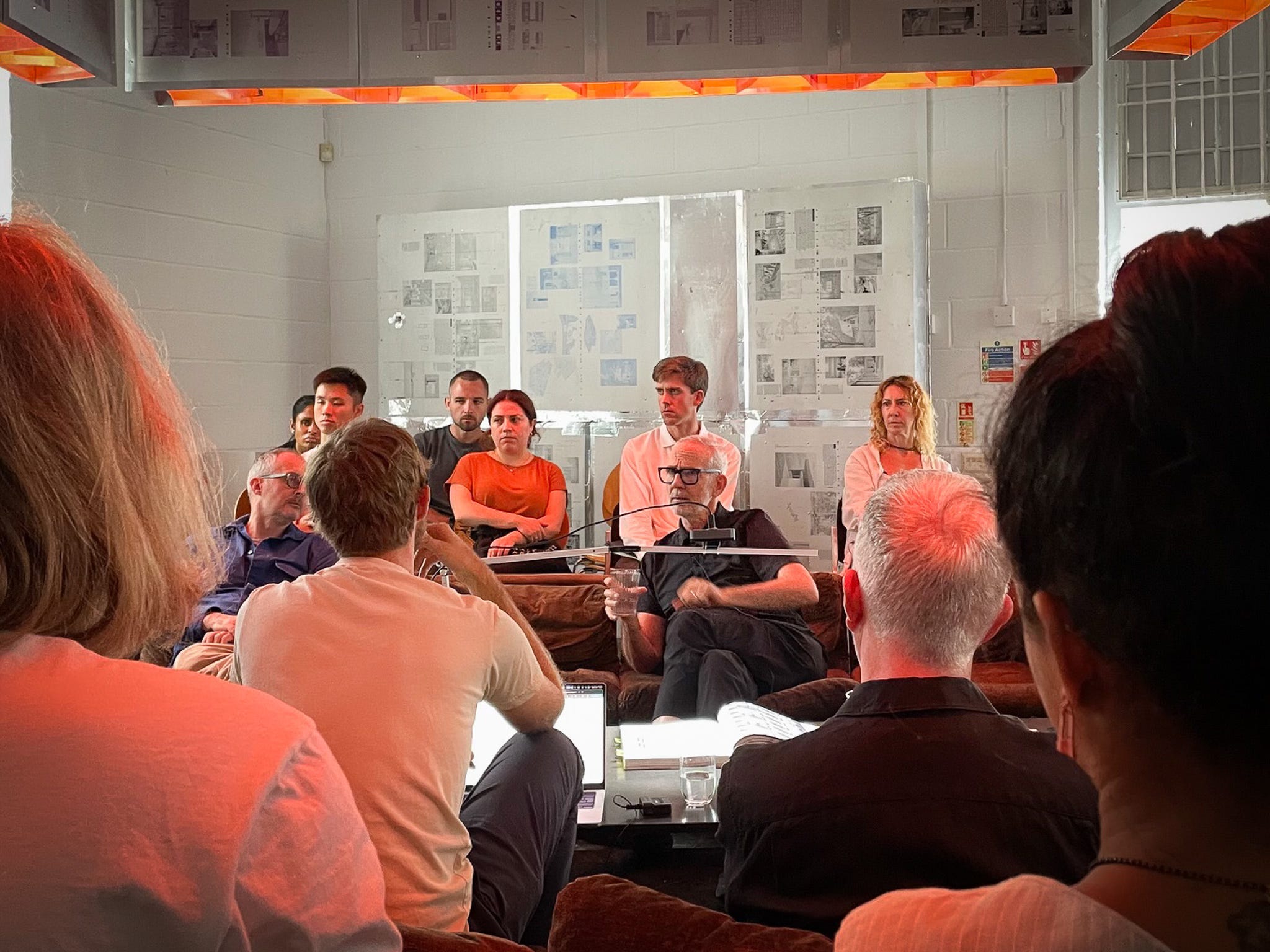
Níall McLaughlin at POST PRESS (Charlotte Goodhart)
Níall McLaughlin is this year’s recipient of the RIBA Royal Gold Medal, awarded for three decades of work ranging from a bandstand at Bexhill to the Stirling Prize-winning library at Magdalene College, Cambridge. His new book is not the monograph that usually follows. Uncle Toby’s Garden takes its title from the novel Tristram Shandy — Toby is the wounded veteran who spends his days reenacting a war on his bowling green in a pastime that is both trivial and profound — and it is organised around digressions rather than buildings. The book catalogues the practice’s open-ended processes, reframing architecture as the performances of ritual, collaboration, speculation and play.
On July 21st Níall joined Matthew Blunderfield at POST PRESS to discuss the book’s gestation. Here we present an extract of that conversation. The full interview forms the latest episode of the Architecture Foundation podcast Scaffold.
Why did Tristram Shandy become the organising principle?
I’ve loved it since I was a teenager, and as an Irish person I feel the connection between Sterne and later Irish writers is sometimes not fully understood. He was a huge influence on Joyce and Beckett — partly because of his acceptance of the absurdity of the human condition. We’re all trying for completion, all trying to create forms of order, and those forms of order can never fully be sustained. So we spend our lives, as Sterne would put it, riding our hobby horses, pursuing with more and more diligence the things we’re interested in, as ways to control the protean nature of the world and restate it in our own terms.
The wonderful absurdity of the book is that it sets out to be a biography of Tristram Shandy and ends up four days before he was born, because his desire to describe the world as comprehensively as it needs to be described takes longer than the living of the life itself. He’s always losing ground against the complexity of life. And that sense of absurdity is a form of real wisdom. Once you’re into it you realise you’re not going anywhere with this book, and therefore the only thing you need to be doing is enjoying reading it. It becomes all about getting there rather than arriving.
That helped me think about architecture, which has frequently been formulated in terms of the production of exquisite, singly-authored artefacts. It’s often seen as instrumental — that it’s for something, or at its most extreme that it can change people or change societies by being what it is. While I accept there are aspects of architecture that are like that, I want in some way to resist that formulation.
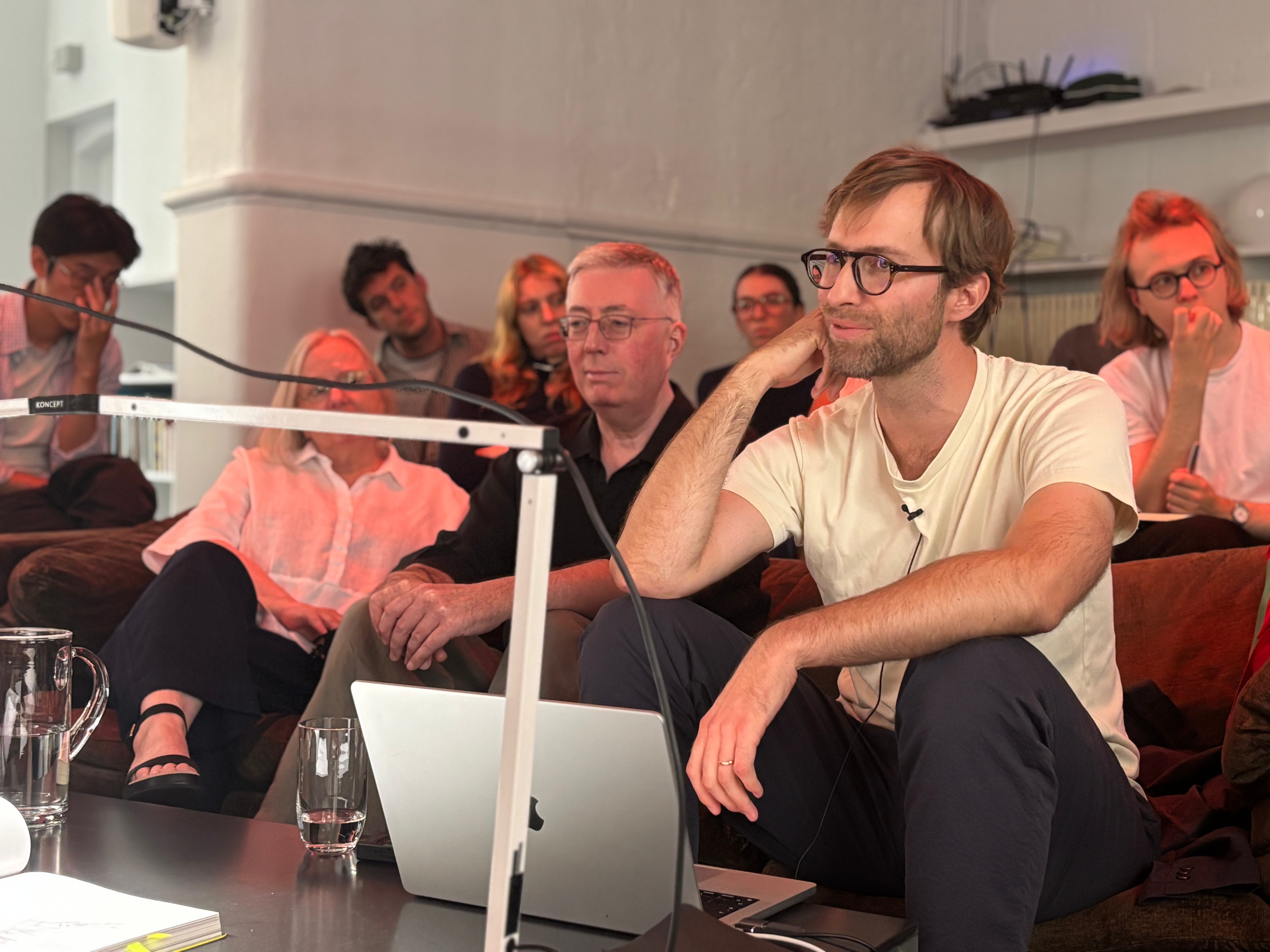
Matthew Blunderfield (Ellis Woodman)
You write that design and material practice contain “rituals, veilings and erotics.” Architects don’t tend to write this way. Can you unpack what you’re saying here?
We allow ourselves to believe we’re involved in a transparent, purposeful activity when we’re architects. But from the beginning of our education we’re brought into a way of thinking that’s highly ritualistic, guarded by its own shibboleths, and becomes to some extent the activity of an in-group who communicate through nuances — turns of line, turns of phrase, details — in which people display their virtuosity through these micro-communications within the drawing. We don’t realise we’ve been inculcated into a whole series of rituals we take for granted and think are common sense. All you’ve got to do is attempt to test them against the public, and you’re lost.
Did you say and you’re lust?
I’m glad you think I said “and you’re lust,” because you’re obviously chasing that word erotics.
I am chasing it.
I didn’t say it — but I’m very welcome to talk about my lust, if you like.
Please.
Why would these things not be described in terms of erotics? Architecture is not in that sense a chaste discipline. It has its own forms of desire within it, and those are part of how architects communicate with each other, the pleasure they take in each other’s buildings. I wouldn’t hide from it. We persuade ourselves that we’re reasonable people going about a reasonable activity on behalf of the public — which to some extent is true — but there’s a whole other thing going on that we don’t talk about very much.
The book opens with a 2012 project in Stratford. It’s built, but it isn’t quite a building — it’s a skin.
The decision was made that the Olympic Athletes’ Village should be designed in principle by the best young practitioners in the UK, to embody the cultural aspiration of architecture. On the other hand it was being developed by Lend Lease, a pretty tough major development company. I describe it as a three-legged race — that school sports game where kids have two legs tied together. It’s perfectly clear the two parties aren’t looking for the same thing, but they’ve got to hobble along together.
Lend Lease looked at these twenty-five young architects and said, we’re not going to employ all these people, it’ll be chaos. So they picked four reliable players and said: you design what they called the chassis, like the chassis of a car. Then these young architects can dress the chassis in a façade of whatever design they like — and by the way, they’ll be sub-consultants to you.
What interested me is that at the beginning of the twentieth century architects were obsessed with Taylorisation — the breaking down of making into component parts. Corbusier writes about the Delage motor car as the highest product of modern society, overseen by the architect, “the austere overseer” in his words. But if you sow the wind, you reap the whirlwind. You can Taylorise architecture too — because then a client like Lend Lease says: why would we have these architects with their strange cults and erotics and myriad interests, which are of no interest to us, overseeing the project, when we could just have a project manager?
So the chassis is by one architect, the masterplan by another, the interiors by another, the façade by an architect, the landscape by an architect. And we thought: let’s accept that notion, and see what we can make of it. Corbusier also believed the Parthenon was an ancient version of the same process, with Phidias the sculptor as his overseer — he makes this comparison between the Parthenon and the Delage. That’s where the project started.
So you go into the British Museum and scan the marbles. How do you persuade a client so concerned with efficiency to let you embark on what, from the outside, looks like a dalliance?
I’ll just remind you that dalliance is a virtue in Uncle Toby’s garden.
We’re in the office and we say, what’s the first thing we do? Let’s ring up the British Museum. So we did, and were put on to the keeper of the stones. We told him what we wanted, and there was a long pause, and he said: I guess you’ve realised we don’t have copyright on the stones. I’d never even thought about it, but I went, yes, of course, we’ve worked that out.
Ian Jenkins just said, come on in. It was one of the best nights of my life. At two in the morning I got on my bike and went down to the British Museum, where we had this fantastic group of guys from the Slade scanning the stones, in with the security guards and the cleaners. And in the middle of it Jenkins arrives, at three in the morning, in a beautiful tweed suit, and gives me the most beautiful description of the marbles in terms of music and orchestration. The carving is five deep on one side and six deep on the other, and he said you have to imagine the illusion is that the cavalry are riding through the building. It was almost like cinema.
And all through the night he was saying: Níall, you’ve got these very esoteric ideas about the meaning of this stone or that stone. The people of London don’t want that. What they want is the horses. The horses, Níall. The horses, the horses.
So he completely hobby-horsed me that night. At the end I said to the guys scanning: cut the scan, we’re changing the whole project, we’re doing the horses.
And then you had to build them.
Someone at Lend Lease had decided that as a site-wide policy they’d bring rainwater pipes down the outside of the buildings. So our lovely horses were going to have pipes running straight down in front of them. And the project managers go: site-wide policy, site-wide policy.
I heard this guy was travelling first class from Newcastle to Manchester on a certain day. So I went up to Newcastle, got onto the same train, walked past first class and went — oh, fancy seeing you here. Sat down beside him. Said, just about the rainwater pipes. By the end of the journey he’d accepted we didn’t have rainwater pipes going down our building. I said, what a coincidence to see you here, and got the train back from Manchester.
The whole thing was like a play we were all acting in. At one crit, all these cultural commentators had decided that the thing which would hold the Village together was that every building must have a base, a middle and a top. I was showing my neutral grid with the cavalry suspended in it, saying it’s really important the lattice is primary and not hierarchical. And they’re going: we understand that, Níall, but could you modulate it a bit at the bottom and a bit at the top, just as a nuance? And I’m going, it’s not a question of nuance, it’s a question of do you have it or do you not.
And suddenly the guy from Lend Lease goes: “You. Base, middle, top. Monday. Or you’re fired.”
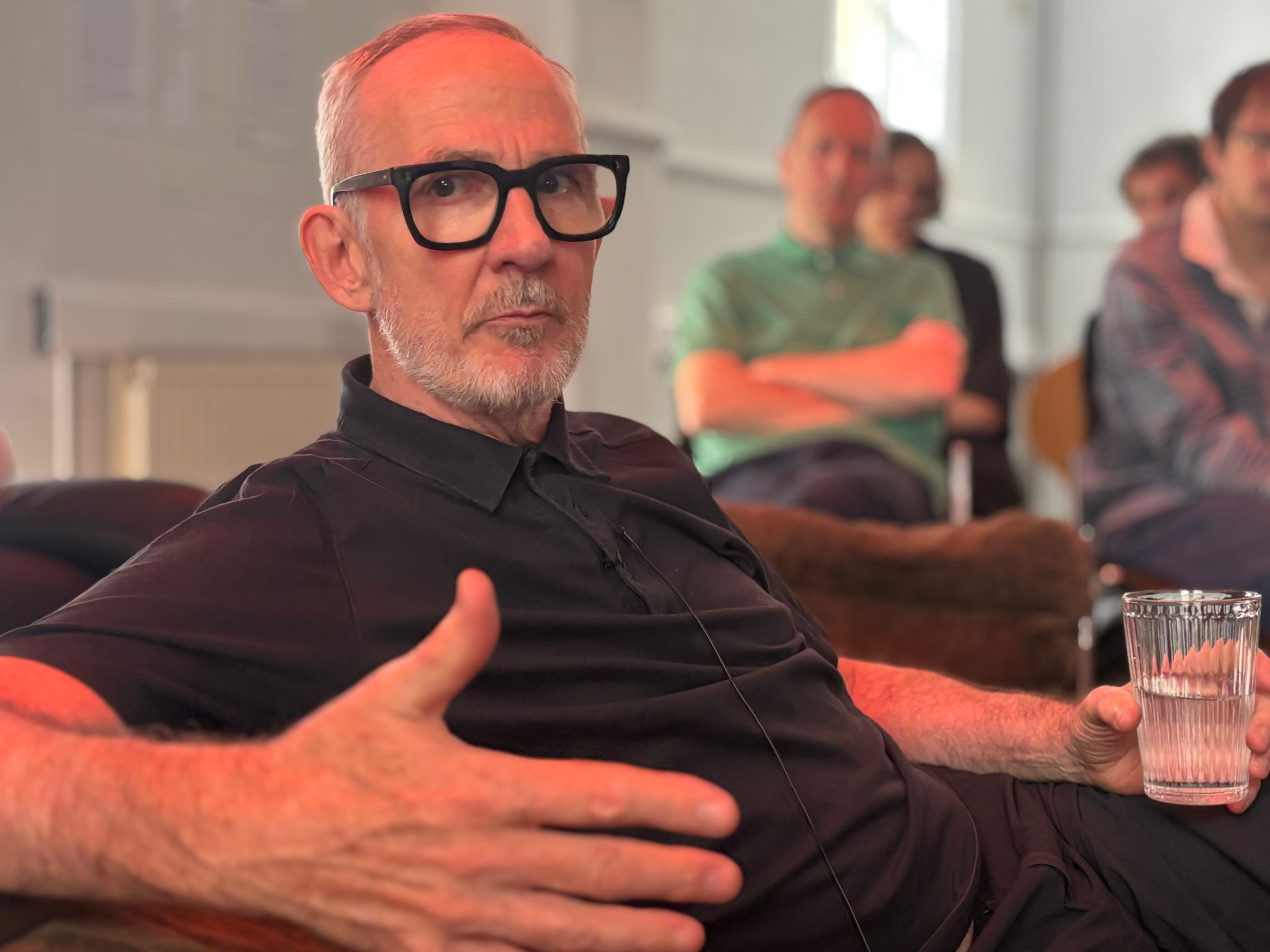
Níall McLaughlin (Ellis Woodman)
So that was the three-legged race in action. I took a deep breath and thought: we’ve got a value engineering meeting on Wednesday, so I guess we’ll have a base, middle and top for two days. We designed a very elaborate one, handed it to the quantity surveyors on Wednesday, and it was gone again by Thursday.
Part of the project was that it was a performance — standing up in front of the client going: these are the rules you set, look at us playing by them. This is a game and we’re playing it too.
The book includes a collective drawing project made in Orkney. What draws you to the neolithic?
There’s a beautiful text by the archaeologist Colin Richards, who asks why a community in the early Neolithic would spend a third of all their social and material resources dragging stones to make a circle in this marginalised place. He noticed they kept moving the stones around the circle, and he said: what you’re looking at as a fixed monument is actually more like a still from a dance. And eventually he speculates that construction had started to replace blood as a way of holding communities together.
So the purpose of the community is not to make the building; the purpose of the building is to make the community — and not just the building as a made thing, but the ritual of making it. Which means the task is not to invent new things but to take something somebody has handed you, care for it, reimagine it, and pass it on. Architecture becomes a sustained performance over time.
In the sheer breadth of work and experimentation on display, the book makes a convincing argument against the culture of specialism that abounds in architecture today.
The best chapel I ever built was my first chapel. The best library I ever built was my first library. The best dementia centre I did was my first one. We’re constantly receiving pre-application questionnaires asking how many of these things you’ve done before, and in my experience your ability might be in inverse proportion to the number you’ve done — because there’s something about doing it for the first time that you bring an intensity of imagining to. Again and again, your best shot is your first shot.
The specialism in architecture is making buildings. If you need a specialist, find one. Talk to people. Learn about it. You can spend years learning about people with dementia, or how to design a chapel for an Anglican college. I’m designing a burial ground for the Ismaili community at the moment, learning about funerals and about Shia Islam. The most beautiful thing about being an architect is that it’s a way of learning about the world.
And what you realise — to bring us back to Tristram Shandy — is that comprehensive knowledge is impossible. That’s what the book mocks. Not the idea that we should have experts, but the sense that we can know something in its entirety.
What we do is attempt to make worlds, all the time. This is the ritual of making worlds, the performance of making worlds. This is what architecture is. And for the generation in the room around me, there are going to be technologies that take away so many things we think are central to our discipline. But technology can only make better and better objects, and architecture is fundamentally not about making objects — it’s about rituals that bind communities together through processes they enact together. We need a bigger paradigm: architecture as a repertoire of performances. We’re on a hiding to nothing if that’s the way we perceive it.
Thank you so much for your time.
Thank you. Hope not too many digressions.
No posts
Comments
Nothing yet. Say the first thing.
Sign in to join the conversation.