
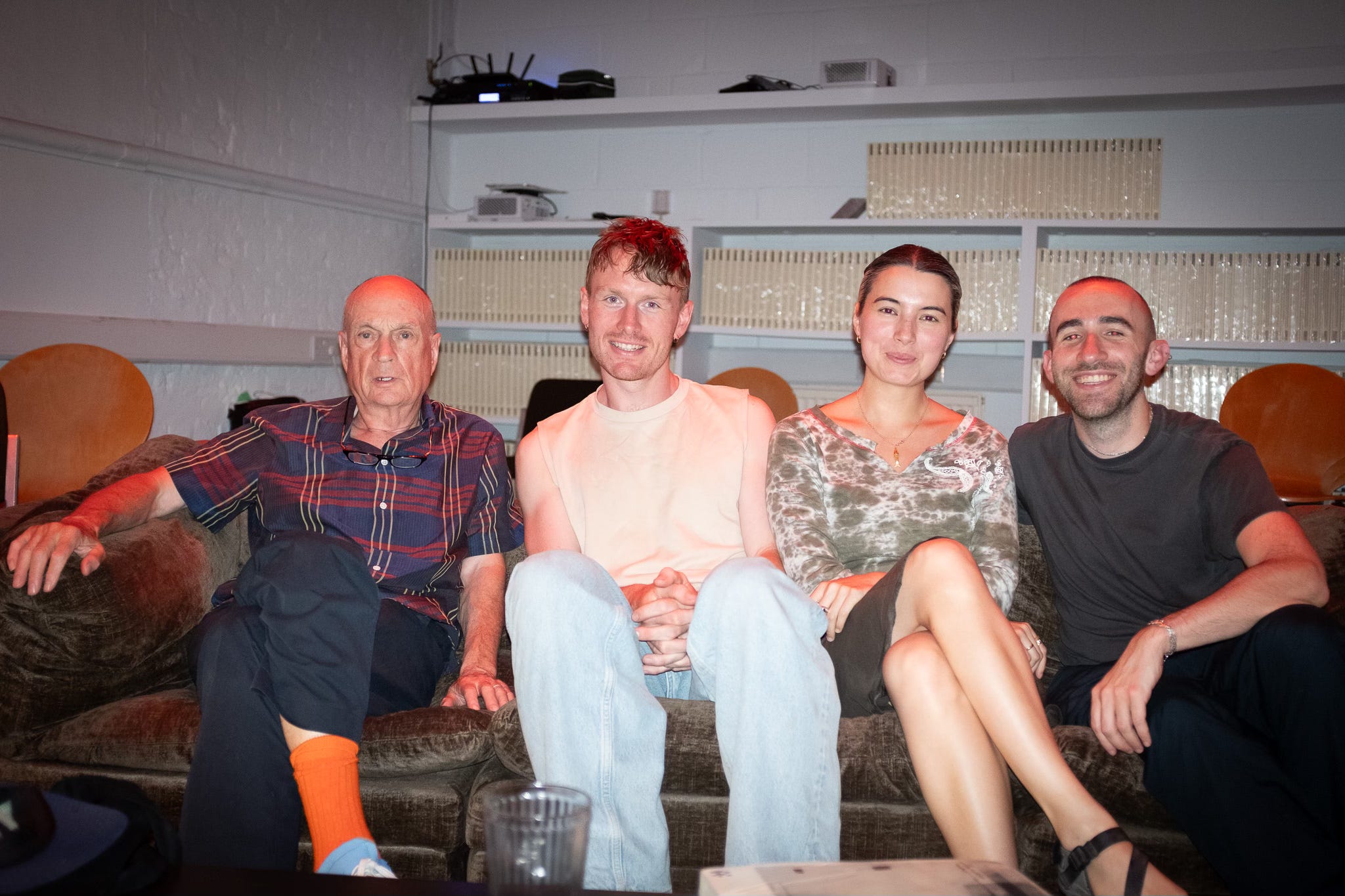
Ben Kelly with Leo Sixsmith, Sophie Mei Birkin and Ollie Brenner of _badweather (Matthew Blunderfield)
Week 5 at POST PRESS is all about performance and kicked off with an evening in which the members of _badweather spoke with the renowned designer Ben Kelly. As architects who have designed extensively for club culture _badweather were particularly keen to talk to Ben about his 1982 design for the Haçienda in Manchester. Here, we present an edited extract of his recollections of that seminal project’s gestation and thoughts about its continuing legacy.
I first went to art school in Lancaster, in the north of England, where I did a foundation course. They happened to offer an interior-design course. This was in the 1960s—I think I went to art school in 1966—and there was a great deal happening in the world. I began to understand what was going on in Italy, where young architects were doing weird and wonderful things. So I applied to the Royal College of Art. That was also a means of getting to London, which was important to me. From afar, I was aware of what was going on. I knew about David Hockney: I knew that he had peroxide-blond hair and had worn a gold lamé suit when he graduated. I thought everybody at the Royal College would look like that. I was incredibly disappointed when I arrived. They were the most boring-looking bunch of people I had ever seen. Then, one day, a group of students came into the canteen. They were from the fashion school and looked incredible—girls with shaved eyebrows. I thought, thank Christ for that. I worked across every department at the Royal College and began making things.
The first job I got was a fashion shop on Long Acre in Covent Garden. This was in 1977 before there was any fashion there, when the area was still functioning as a fruit-and-veg market. That was my starting point. The shop was called Howie, and I was able to use materials I had stored up in my head, drawing on what I knew was happening in the wider world, to make this shop selling fashionable clothes.
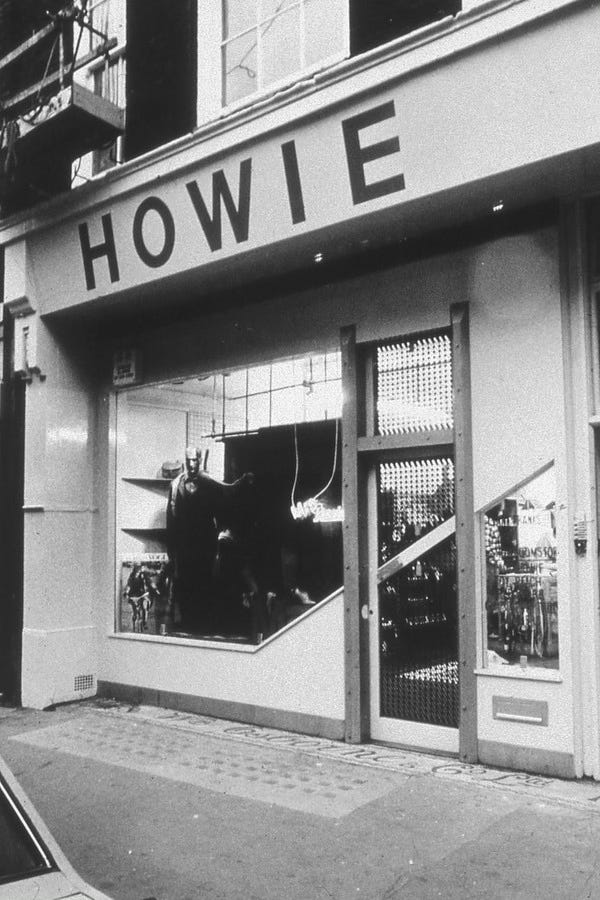
Howie (1977), London. Image courtesy of Ben Kelly Design
Peter Saville was a co-founder of Factory Records and he designed the record sleeves. He came to London and we met shortly after he arrived. He had a project to design a record sleeve for Orchestral Manoeuvres in the Dark, who had previously been on Factory. We met in a bar and he told me that he had an idea for the record sleeve, but didn’t know what to do with it. His rather strange concept was to make a sleeve using the least possible amount of cardboard. I said, “I know exactly what it should be, Peter. Walk down Long Acre and look at this shop called Howie, where I used perforated-steel panels behind the glass panels in the door. It should be a perforated sleeve.” I was interested in process. We met again a couple of days later and I brought the catalogue of APW—Associated Perforators and Weavers—which produced all these different perforated patterns. We chose one, Peter did the artwork and, lo and behold, we had this semi-transparent sleeve: an orange inner sleeve behind a blue outer. It won loads of awards. I thought, I’ll do some more of this. That was my introduction to Factory Records in Manchester.
Joy Division had made their first album and sadly, their singer, Ian Curtis, had died. The band went to New York with their manager, changed their name to New Order and visited all the groovy nightclubs in Manhattan. They came back and said, “We want one. We want our own club.” The idea was discussed among the partners of Factory Records, and they eventually found a building, which they took Peter Saville to see. I think they imagined that he was going to design it. He’s a graphic designer. He looked at it and said, “I have no idea what to do with it, but I know a man who can.” So I got on a train and went up there. They showed me around and asked, “Do you want the job?” Of course I wanted the effing job.
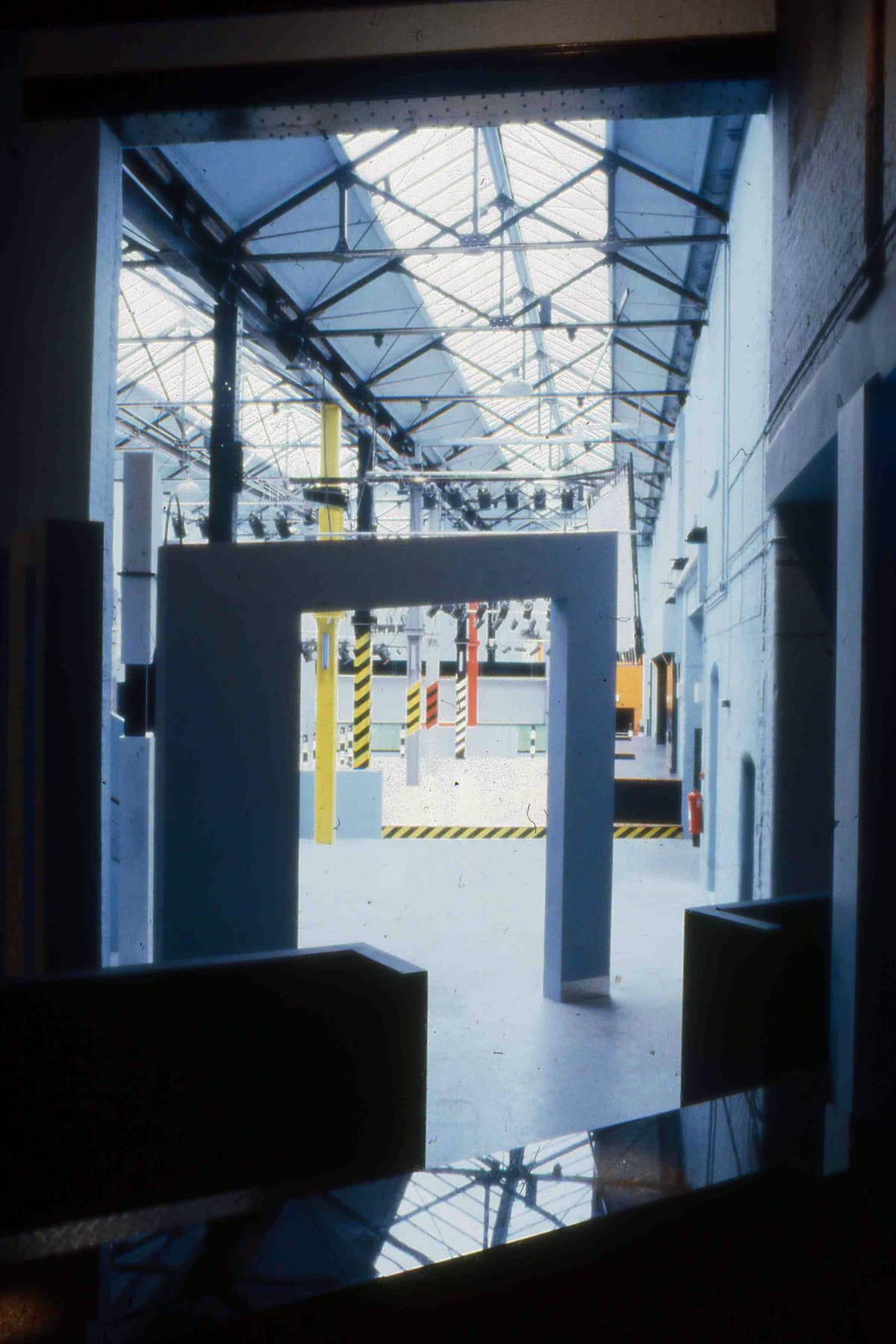
The Haçienda (1982), Manchester. Image courtesy of Ben Kelly Design.
I had never designed a nightclub and the clients had never commissioned one. There was a great deal of naivety and foolhardiness, some might say, but I really do think that was part of its strength. The more drawings we produced, the more they wanted and the more excited they became—until it was built and we realised that we had forgotten the cloakrooms and there weren’t enough toilets. It took years to become what it eventually became.
Tony Wilson, the co-founder of Factory, was an extraordinary person. He had been educated at Cambridge and was a presenter on Granada Television, so he had a day job, while running this record label from a two-bedroom flat in Didsbury. It began to have some success. New Order became successful, then Happy Mondays came along and everything went crazy. This enormous, strange thing built up. Lots of other independent record labels began opening around the country. It was an amazing period, and the key word was “independent”. Factory Records were people I ended up describing as unpaid social workers, because there was no requirement to make a profit. It was a kind of anarchy. They wanted somewhere they could go, but also somewhere the young people of Manchester could go. In one sense, the timing was just right. In another, it was terrible, because they initially opened the club every night of the week. It was a huge, cavernous space. Tony Wilson said, “Every city should have its cathedral, and this is our cathedral: a place where young people can come and do whatever they want.” He commissioned artists to make installations. There was a hairdressing salon in the basement. They staged fashion shows. It became a multipurpose space.
When I was told it was going to be called the Haçienda, I thought, what the fuck? To me, a hacienda suggested a Mexican adobe house somewhere deep in Mexico. But when it was explained to me that it came from the Situationists, I thought, this is genius.
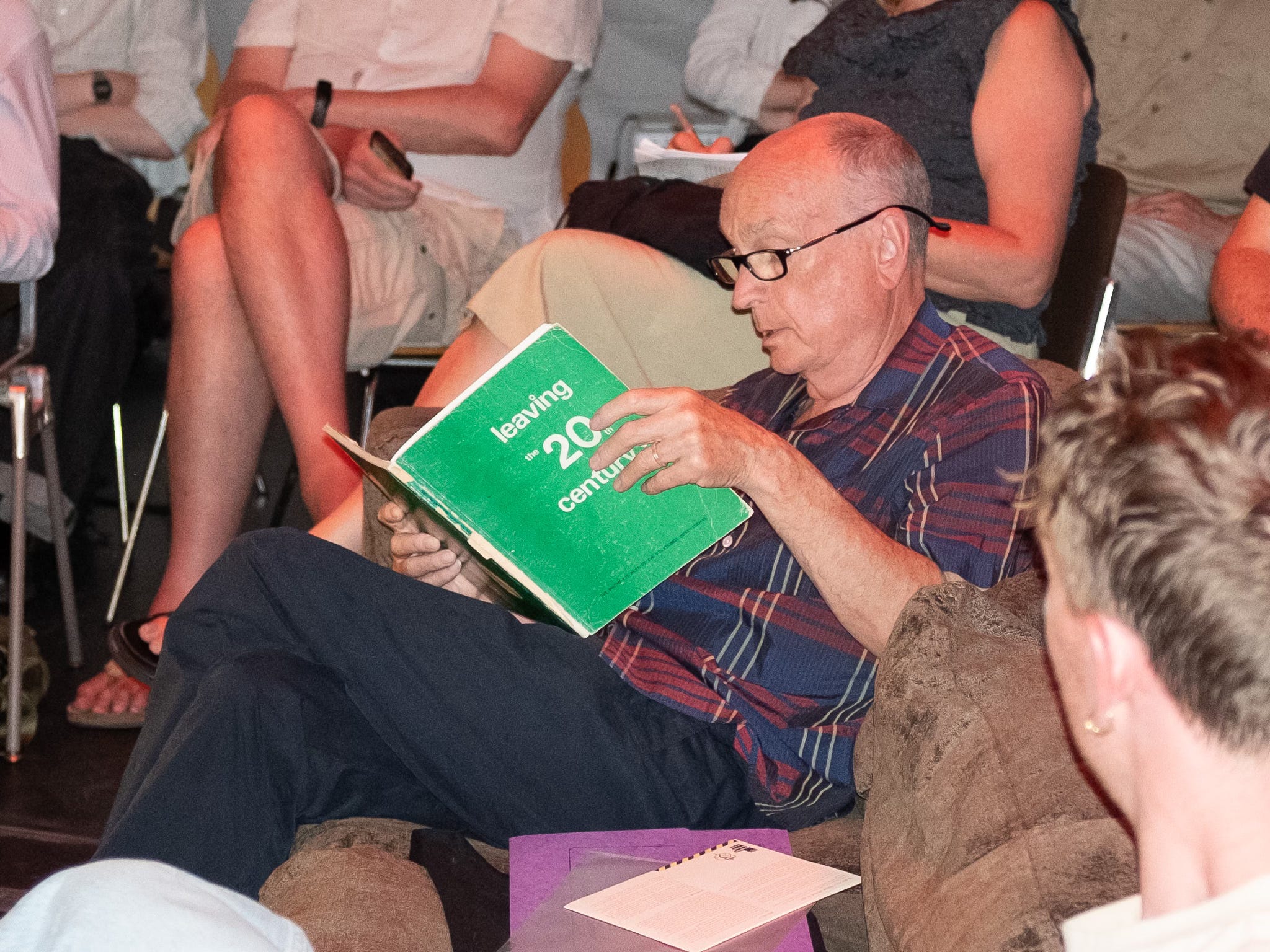
Ben Kelly at POST PRESS (Matthew Blunderfield)
I have brought proof: Leaving the 20th Century: The Incomplete Work of the Situationist International. It contains a text called “Formulary for a New Urbanism”. I’m not going to read the whole thing, although it’s interesting for architects. But the final passage ends: “You’ll never see the hacienda. It doesn’t exist. The hacienda must be built.” This was a serious political manifesto by the Situationists. Tony Wilson knew it and mentioned it to Rob Gretton, the manager of Joy Division and New Order. Rob said, “Fucking hell, that’s all right. We’ll have that.” Peter Saville then got hold of it. Being a graphic designer, he added a cedilla beneath the C. If you turn the “çi” upside down, it resembles 51, which was the Factory catalogue number for the project. Every Factory project had a catalogue number. Even the cat at the Haçienda had one.
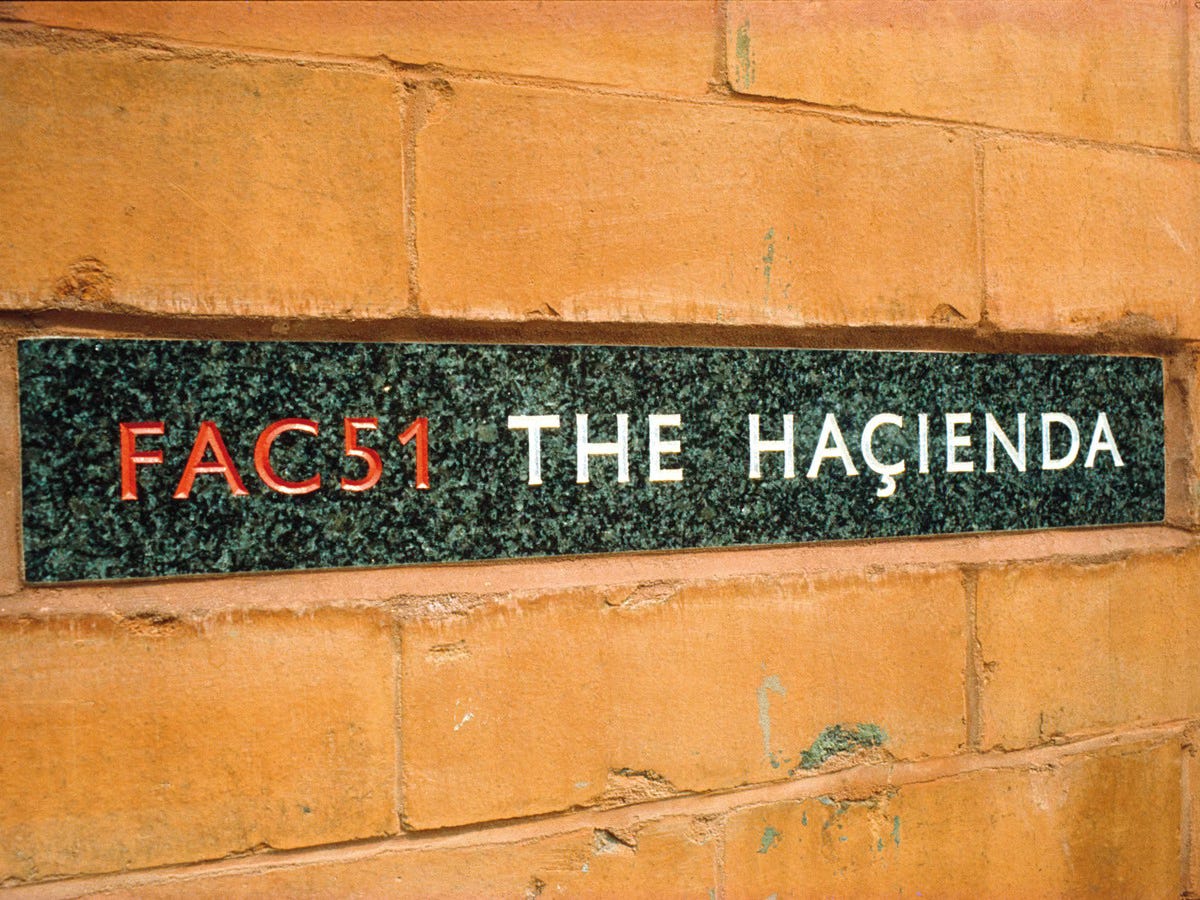
The Haçienda (1982), Manchester. Image courtesy of Ben Kelly Design
I knew there had to be some sort of sign outside the building, which stood on a dead street in a very run-down part of Manchester. I had a monumental mason hand-carve “FAC 51 Haçienda” into a small rectangular piece of granite, using typography supplied by Peter Saville. The “51” was picked out in red enamel and “Haçienda” in silver leaf. The plaque was set flush with the brickwork beside the entrance. It was tiny. People came from Japan, South America—all over the world—and couldn’t find the place. Some probably never got there because they couldn’t see the sign. But my thinking was that it was all about the journey. I had the numbers 5 and 1 cut into the second set of doors, with glass set into the openings. You first saw the little FAC 51 plaque. Then you entered a small space, went down some steps, passed through the 51 doors and descended into a larger space. From there, you passed through huge plastic curtains, like those you might see in a butcher’s shop, which were there for acoustic reasons, and entered this enormous cavern.
The building that became the Haçienda had previously been a yacht showroom and repair shop. Before that, some form of industry had taken place there, though I don’t know what, and it retained an industrial character. What first made me think about hazard markings were the structural columns supporting the roof. These huge cast-iron columns marched across the dance floor, which was raised one step above the main floor. I thought, shit, people are going to bump into these while they’re cavorting about. I should do something. It also occurred to me that the step itself was a hazard.
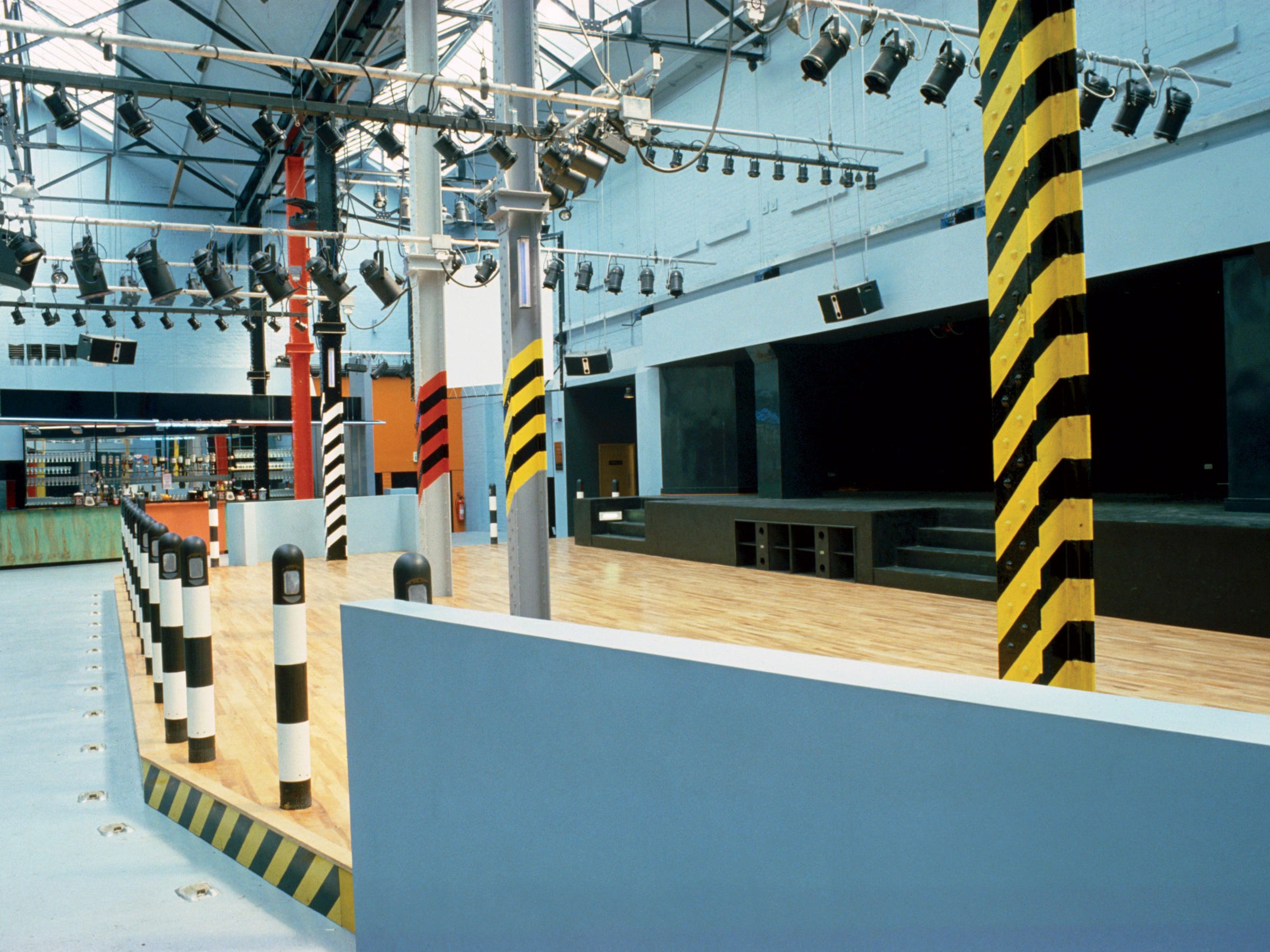
The Haçienda (1982), Manchester. Image courtesy of Ben Kelly Design
That led me to the visual language of factories and industrial buildings: pipes painted in different colours to mark what is passing through them, black-and-yellow stripes identifying hazards in the workplace. I took that language and turned it into something else, making it part of the character of the interior. I also realised that I needed to filter people on and off the dance floor. So I had the idea of using roadside bollards at one-metre centres along the edge of the dance floor. We could set proper cat’s eyes into the concrete floor in line with the bollards. I did some research and discovered that the posts were called Allegrini flexible verge posts, and cost £6.50 each. Goddamn bargain. We’ll have as many as we need. A collage of this language began to build up. There was also a balcony that was falling apart when Factory took over the building. We had to construct a new one, so an entire structural scheme was developed. I clad its supports to make them sculptural—to make a painting, or something like one—so the whole interior became a giant piece of sculpture.
The geometry of the journey to the bar took you all the way around the dance floor and past the roadside bollards. At the end was the bar, with a horizontal neon sign reading “The Kim Philby Bar”. I thought, if Tony is going to be difficult and call it the Kim Philby Bar, I’ll be difficult and make the sign impossible to read. It was mounted high up, so you had to crane your neck to see it. I remember being there when two young lads from Manchester, pints in hand, looked up and said, “What the fucking hell’s this? The Kim fucking Philby fucking Bar? What’s that?” The bar on the balcony was called Hicks, a cryptonym used by one of the Cambridge spies, and the cocktail bar in the basement was called the Gay Traitor, after Anthony Blunt, who had been the Queen’s art adviser. So you had all this dodgy political material building up into a narrative, and I loved that. Colour became part of it too. The result was a strange hybrid space that hadn’t really existed before, and it could only have happened because the client was Factory Records and the city was Manchester. I’ve often been asked whether it could have happened in London. No. It couldn’t possibly have happened in London.
Because of the record label, and because New Order and its other bands were becoming more successful, the scene changed constantly. Mike Pickering, who booked the bands and was also a DJ, had an extraordinary eye for emerging talent. He would put people on before they became stars. Madonna gave her first performance in Britain there, filmed live for television. The DJs at the Haçienda discovered music coming out of Chicago and began playing it. Ecstasy appeared and the place went crazy. Nobody bought drinks at the bar; they just bought bottles of water. You would have 2,000 people in a space intended for only 1,100 or 1,200. Drugs arrived, gangs took over the door, violence happened, the police became involved and, eventually, the club closed. But there must be thousands of people who went to the Haçienda and then went out into the world: they met someone they later married, formed a business with someone they met there, or developed projects from encounters that happened in the club. These are amazing places where people have ideas, meet one another and make things happen. The stimulation of the Haçienda made people think. And the Haçienda has been credited with helping to initiate Manchester’s regeneration. And who knows who the next prime minister will be but perhaps somebody associated with what people call “Manchesterism”. So perhaps the Haçienda will be responsible for our next prime minister.
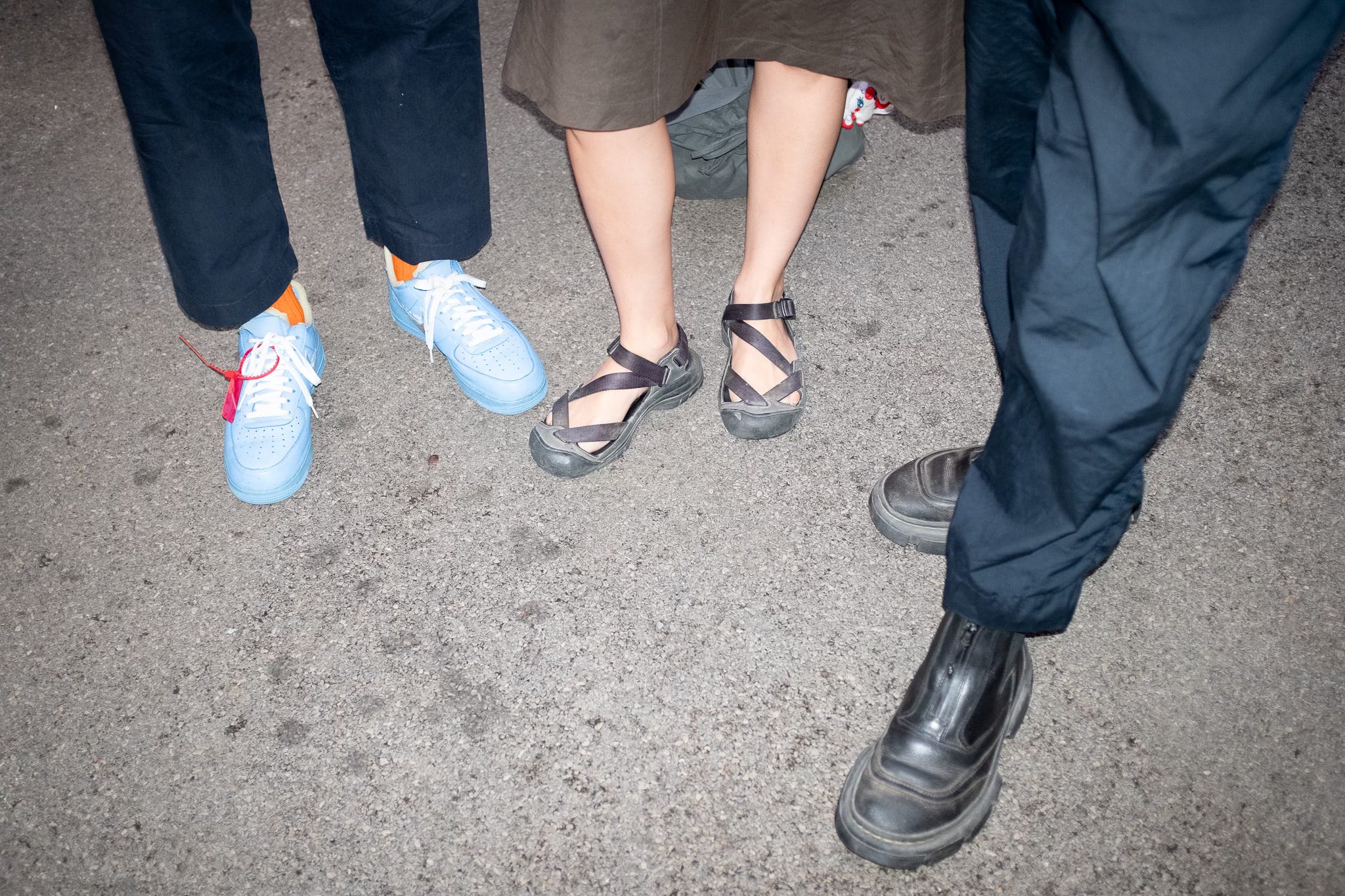
Ben Kelly in trademark orange socks and Virgil Abloh trainers with members of _badweather. (Matthew Blunderfield).
No posts
Comments
Nothing yet. Say the first thing.
Sign in to join the conversation.