
This newsletter for the week of August 10 looks at Theo Deutinger’s latest book, All About U.S.: 250 Years of the United States of America. Although this Book of the Week won’t be released until September 22 in the US, I’m featuring it this week while the events (or non-events) of last month’s semiquincentennial celebrations are still fresh in my mind. The book From the Archive is a related look back at America’s past, while the usual headlines and new releases are in between. Happy reading!

All About U.S.: 250 Years of the United States of America, by Theo Deutinger (Buy from Lars Müller Publishers / from Artbook/DAP / from Amazon / from Bookshop)
The 250th anniversary—or semiquincentennial, a word many people added to their vocabulary recently—of the signing of the Declaration of Independence came and went last month, with some larger-than-usual fireworks displays here and there, but without any really grand gestures to be found for such a substantial milestone. The official and semi-official celebrations created by Congress (America 250) and President Trump (Freedom 250) encapsulated the partisan divide the US finds itself in now; the latter’s Great American State Fair on the National Mall was plagued by sloppy construction, ill-considered circulation, shallow exhibitions, and other features that seem indicative of the administration as a whole, especially its move-fast-and-break-things approach to the infrastructure of Washington, DC and American democracy overall.
The 250th anniversary of the founding of a democracy should be a cause for patriotic celebration, but Trump’s broadening of executive powers and related “democratic backsliding” (a milder expression than others used to describe Trump 2.0) made it hard for many people, myself included, to feel good about the state of the US and gather with others to celebrate the semiquincentennial. Curiously, Theo Deutinger’s All About U.S.: 250 Years of the United States of America, which I received from Lars Müller Publishers about a month after the Fourth of July and a month ahead of its US release, made me feel a bit better about things—by seeing things in perspective and putting the blip that is Trump into a grander historical context.

Those not familiar with Deutinger, the founder and head of The Department (TD) “works in the fields of spatial science, urban planning, architecture and curation.” He is best known, at least to me, for Handbook of Tyranny, a twice-updated book (and related 2019 exhibition) that illustrates various data around methods of physical control. Published by Lars Müller Publishers in 2018 (and expanded in 2023), the book was followed by the über-minimalist Ultimate Atlas: Logbook of Spaceship Earth in 2019 and Joy and Fear: An Illustrated Report on Modernity in 2023, both building on the Tyranny template: two-page spreads with charts, maps, and/or other visualizations of data expressing change over time and around the world. Deutinger bills his latest book as “a birthday gift from Europe to the United States on the 250th anniversary of its founding,” one that “investigates the current state of the country in seven chapters from an admittedly European standpoint.”
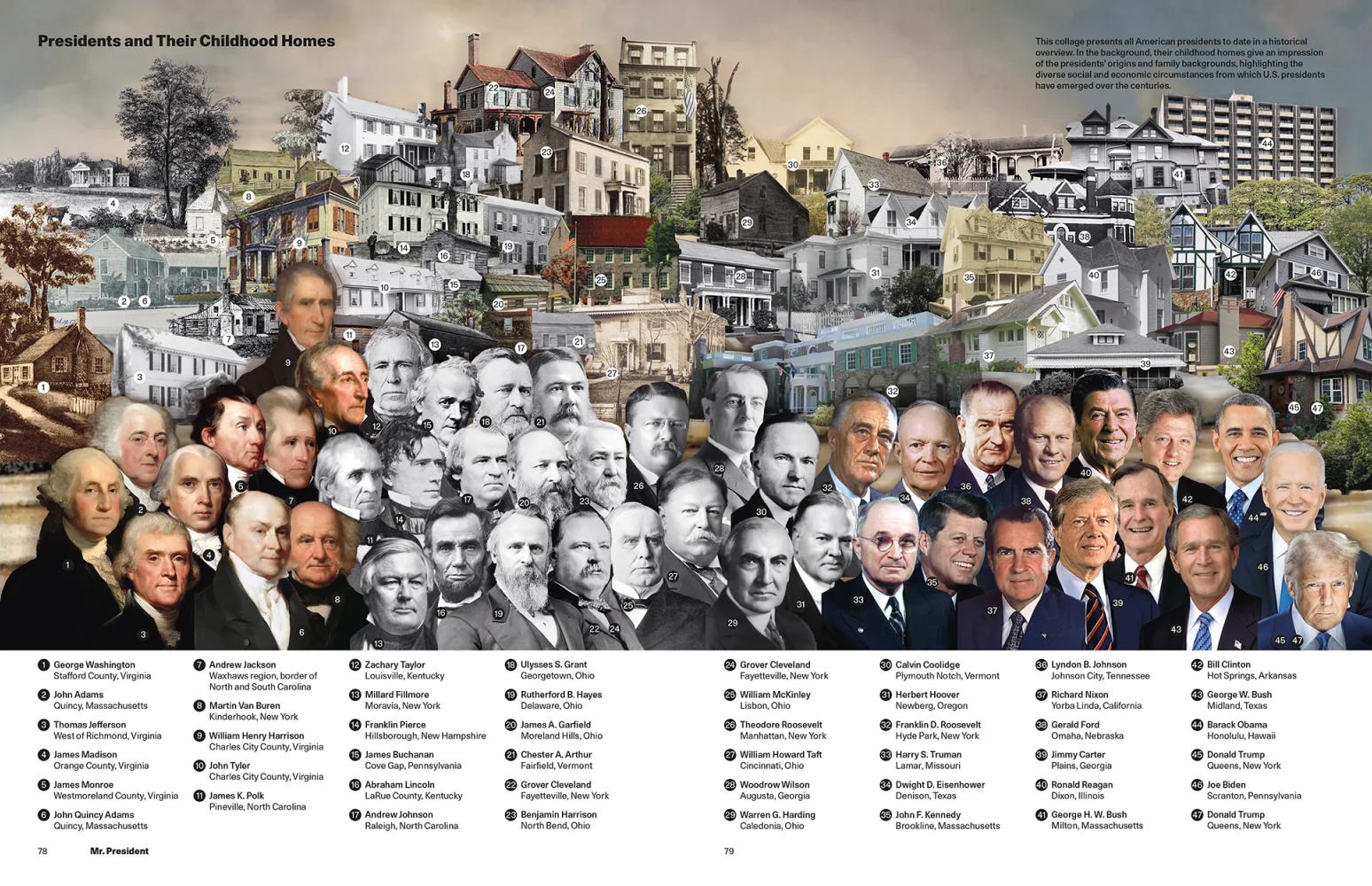
Following an introduction that lays out Deutinger’s motives for the book (“to establish common ground,” among them) and charts important “firsts” and social movements over those 250 years, the seven chapters are thematic but also take a roughly chronological view of that time period: Frontier, We the People, Mr. President, Global Policeman, Stand Your Ground, American Dream$ [sic], and Californication. Reading the short texts that preface each chapter and are keyed to the visual spreads that follow is basically like learning an alternative history of the United States—the good and the bad, the famous and the infamous, the familiar and the obscure—akin to Howard Zinn’s A People’s History of the United States (see bottom of this newsletter), but in images.

Given the focus of Handbook of Tyranny and Joy and Fear on violence, tools of destruction and killing, and means of control, it’s no surprise that Global Policeman and Stand Your Ground come across as the most thoroughly developed chapters, at least visually. One related highlight (not illustrated here, unfortunately) takes a deep look into home security across three spreads. We see how single-family houses are designed for security and surveillance, aided by cameras and other technologies. One spread even shows the possibilities of so-called concealment furniture, in which a long gun can be stored in a drawer at the back of a cabinet, for example, or a hand gun in the base of a lamp. The furnishings are depicted in a perspectival view of two rooms, accompanied by information on the weapons—it is straightforward, even dry, but it hints at how a living room or bedroom can become a weapon room in disguise.

Although the US’s military budget (now around $1 trillion!) has defined its presence on the global stage since at least World War II, the country’s impact has been as great (if not greater) through the “soft power” of cultural, business, and other non-military exports. Fittingly, the last chapter, Californication, examines this pervasiveness through, for instance, a chart of the highest-grossing films since 1915 being almost exclusively US creations (spread above) and a map of McDonald’s locations basically outlining a world map (spread below), sans post-2022 Russia and parts of Africa. Signs that US dominance in these and other spheres may be waning can be found in the Chinese fast food and coffee chains Mixue and Luckin sitting side by side on a graph with McDonald’s, Starbucks, Subway, KFC, and Domino’s Pizza. So, in a subtle way, Deutinger’s latest book conveys the impact the US has had on the rest of the world over the course of the last 250 years, just as it hints at the changing course the world may undergo in the ensuing centuries.

(In the United States; a partial, curated list)

Sverre Fehn Architecture, edited by Neven Fuchs, Aleksandra Ognjanov and Stefano Graziani (Buy from Artbook/DAP [US distributor for Walther König] / from Amazon / from Bookshop) — “Fehn received the 1997 Pritzker Prize for his ‘fascinating and exciting combination of modern forms tempered by the Scandinavian tradition.’ This comprehensive monograph presents 80 of his built and unbuilt projects, offering a more nuanced survey of his career, replete with blueprints, drawings and archival photographs.”
Regarding Paul R. Williams: A Photographer’s View of a Trailblazing Architect, by Janna Ireland (Buy from Angel City Press / from Amazon / from Bookshop) — “Known as ‘Hollywood’s Architect,’ Paul Revere Williams was a Los Angeles native who built a wildly successful and as an architect decades before the Civil Rights Movement. Artist Janna Ireland explores the work and legacy of Williams through a series of intimate black-and-white photographs.”
Full disclosure: As an Amazon Associate, AbeBooks Affiliate, and Bookshop.org Affiliate, I earn commissions from qualifying purchases made via any relevant links above and below.
“A New Biography Chronicles the Life and Career of a Groundbreaking Black Architect and Advocate”: Max Bond: The Life and Work of the People’s Architect, by Brian D. Goldstein. (Architectural Record)
Read an interview with architecture critic Mark Lamster, author of the just released Welcome to Paradox City, about “[his] hope for a downtown Dallas reset—and the one local building he’d like to see knocked down.” (D Magazine)
Paul Makovsky beautifully eulogizes Robin Middleton, the architectural historian who served as technical editor of Architectural Design, wrote books on nineteenth-century French architecture, and had a library in his East Village home that students said “felt less like entering a private residence than stepping into architecture’s collective memory.” He recently died at the age of 94. (Architect)
Heads up, architecture book buyers:
To make room for more books, William Stout Architecture Books is marking down its monographs 40% from today, August 10, until August 22. (Stout Books)
Are you a fan of Frank Lloyd Wright and have $2,000 to spend? Argosy Books recently listed all twelve volumes in GA’s exhaustive Frank Lloyd Wright Monograph, featuring texts by Bruce Brooks Pfeiffer and photographs by Yukio Futagawa. (Argosy Books)
Howard Zinn’s A People’s History of the United States: 1492–Present was first published in 1980. By the time I read and reviewed the book on my blog, in 2005, the book was on its fifth edition; today, sixteen years after Zinn died at the age of 87, the book is in its sixth edition, done in 2015. As mentioned atop this newsletter, Theo Deutinger’s All About U.S. often had me thinking of Zinn’s alternative history of the United States. Below is my 2005 review of that classic book.
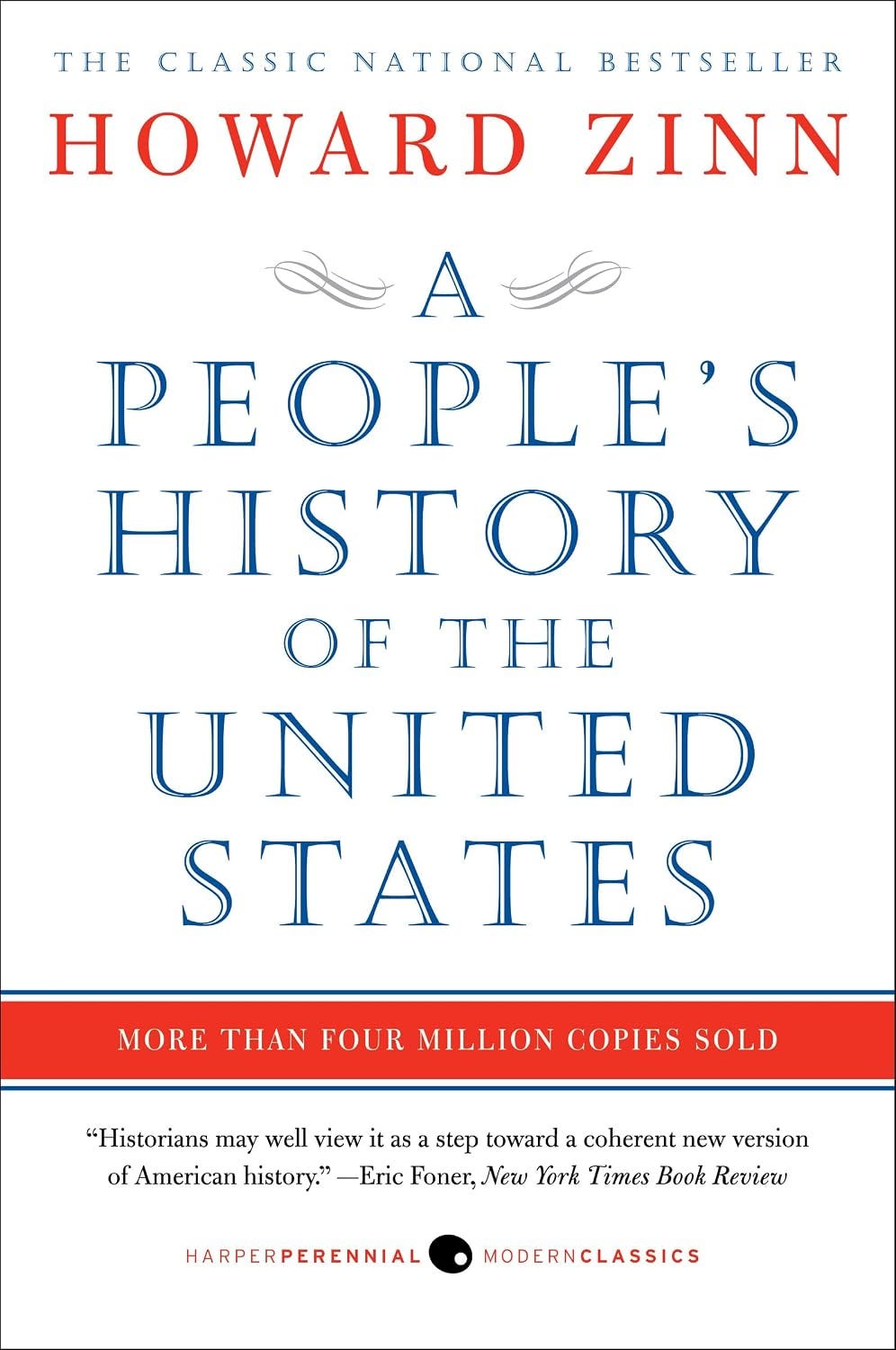
Late in Howard Zinn’s immensely popular “alternative history” of the United States, the historian clarifies his intentions in writing the book, the “prospect—for the first time in the nation’s history—of a population united for fundamental change.” Leading up to his hope for “the coming revolt of the guards,” Zinn acts like a deprogrammer, breaking down what most Americans have learned about their country only to build it back up with the truth as told by the people, the other 99% of the country without power and riches. Where most textbooks and histories center on the presidents and others as “saviors,” the author looks to the unspoken: Native Americans, slaves, women, those that were treated unjustly, and those that revolted against these supposed saviors. It’s an illuminating yet unsettling book, one that should be required reading in the US as early as high school, if not for those abroad.
Zinn acknowledges the fact than any history will be biased, even if it sticks to facts, because all histories must omit other facts in order to tell a story. That most histories have omitted those accounts of the people and focused instead on the white males with money and power, Zinn was driven to the enormous undertaking of shifting American history’s focus. Starting with Columbus’s “discovery” of the New World, the author goes beyond the long known but played-down bad acts of the sailor to give us detailed accounts of the genocidal violence that would continue for hundreds of years. It is these first-hand accounts of various atrocities that make up a lot of the book, giving it a powerful weight but also making the flow a bit choppy at times. Continuing through slavery, the rise of unions, women’s equal rights, Zinn keeps the focus on people’s stories, though his coverage of the 1960s and 70s takes aim at the country’s leaders and their drastic acts, shifting this focus ever-so-slightly before it returns in the greedy decade that followed. The newest edition adds a couple chapters on the Clinton presidency and the 2000 election, further proof that the country’s history of violence and greed is alive and well, a breeding ground for Zinn’s “coming revolt of the guards.”
Thank you for subscribing to A Weekly Dose of Architecture Books. If you have any comments or questions, or if you have your own book that you want to see in this newsletter, please respond to this email, or comment below if you’re reading this online. All content is freely available, but paid subscriptions that enable this newsletter to continue are welcome — thank you!
— John Hill
No posts
Comments
Nothing yet. Say the first thing.
Sign in to join the conversation.