
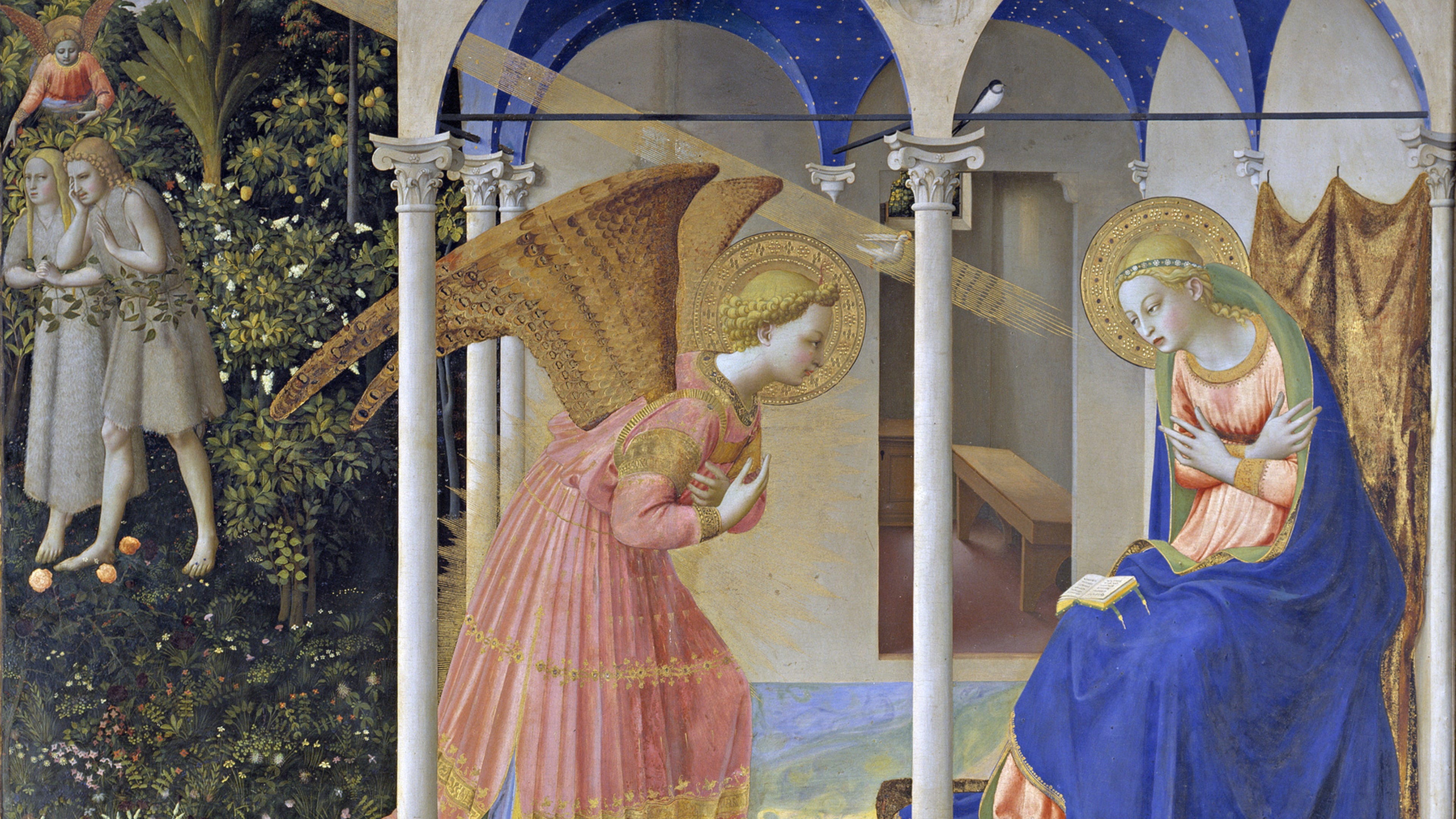
Anyone who tries to think about fear will quickly become frustrated with how little thinking can be done on the topic itself. As fear is a feeling, not a thought. It emerges without permission. When we feel fear we are pulled back into our ancestral history where earthquakes were prophecies and lightning bolts, as Giambattisa Vico the Italian philosopher theorised, spawned myth. Here we witness a difficult fact, that since the dawn of humanity fear has been tied to the divine itself. Which is why approaching sacred work—beginning to write a novel, founding a handmade furniture boutique, sharing an EP publicly, returning to university to study 16th century literature, can pulsate tremors of anxiety throughout our body.

The Assyriologist Robert H. Pfeiffer points out, ‘The earliest term for religion in biblical Hebrew, and indeed in Semitic languages in general, is ‘the fear of God’. It is no wonder then that as one approaches sacred work they simultaneously want to run away from it. They both desire and fear the divine. This tension causes a civil war to erupt within and one is asked to choose sides. Most people take flight and never look back, hiding as Jonah did. Swallowed up by the safety of salaries, social and parental obedience, and a psyche heavily guarded to ward off any signs of disruption. The fear was too much and the imaginal encounter with what could possibly be one’s sacred work is imbued with too much potential for ruin like a late Rothko painting.
Why step towards sacred work when we can turn our backs to it and ignore it like a shadow? In focusing on the fear rather than the divine, those who are called lose their way. But we shouldn’t condemn those who have lost their way and avoid their sacred work. For there are strong and compelling reasons to run. Because if the divine began as chaos, as Hesiod’s Greek poem entitled Theogony tells us, then facing sacred work is to face the original conditions of fear itself. Which is why overcoming this fear requires more than words of encouragement.
Understand that when an individual reaches out to touch sacred work they are also touching death, the unknown and the possible pain of self-destruction. The intensity of which can emerge as felt premonitions, a fear that they will not survive the work they’re called to do. An audition becomes a possible death, a launch becomes the possible dissipation of a dream. In a way they are correct, they will not survive. Every sacred work is a rebirthing event. But not knowing what will happen makes them unsure. Will attempting sacred work doom me or purify me? This is the problem. One seeks answers before the leap when the divine answers through the leap itself.

The compelling reasons to fear one’s sacred work must be met with an overwhelming sense of trust. As fear is not the only feeling that exists and though humans have knotted fear and the divine together, they are not the same thing.
In a 2017 interview Octavia Spencer, the actress famous for starring in roles such as The Help, The Shape of Water and Self Made, spoke about her stage fright and the importance of moving past fear or one will, ‘...never accomplish anything.’ Here we can observe trust in action. She understands viscerally that there is no erasing of fear in one’s sacred work. There has to be a trust in what’s on the other side that’s powerful enough to overcome a possibly crippling anxiety.
Few have strong enough reasons which is why they run. But once these reasons are grasped, it allows an individual to both survive and reach the other side renewed. In doing sacred work one is washed over. They are provided with life vitality, inherent worth and the substance for meaning. Which is there for us all, if only we trust in the divine more than we tremble before it.
Joel Siaosi Uili is a philosopher whose primary specialisation is vocation. He is also the founder of The Career Archetypes, educating and writing on the topic of vocations and calling.
In next week’s article we will be looking at how to transcend fear in the vocation. If you’d like to receive the next part of this article, simply upgrade below.
Get paid to write for the Career Archetypes! We are looking for writing on vocation, craft and calling. Cut off date is August 15th 2026, five days left to submit! For more information click here.

If you have ever asked yourself, ‘What am I meant to do with my life?’ but have no answer, then you may want to consider the Career Archetypes Membership. We’ll help you with things like:
How to name your archetype
How to identify your temptation paths
How to blend your multiple interests into a focused path
Overcoming the psychological hurdles of the vocatio
Exchanging sacred work for financial resources with integrity
Maintaining connection with your vocation while at ‘day jobs’
Connecting with others pursuing their vocation
And more
Comments
Nothing yet. Say the first thing.
Sign in to join the conversation.