
Dear all,
One of the questions I ask most often about digital assets is simple: where is value actually accruing?
For years, investors focused on tokens, prices, and trading activity. Increasingly, however, the more interesting opportunities are emerging one layer below the assets themselves — the infrastructure that enables markets to function.
This week’s developments all point in that direction. Coinbase is steadily becoming a diversified financial marketplace rather than simply a crypto exchange. BNY Mellon is building the operational rails for tokenized funds. And Franklin Templeton is asking whether blockchain networks, not just AI companies, could become part of the infrastructure powering the next generation of artificial intelligence.
The investment debate is gradually shifting from what digital assets are worth to what role they play in the financial system.
Upcoming Economic Indicators to watch out for this week
Advanced Micro Devices Quarterly Earnings - Tuesday 08/04
SpaceX Quarterly Earnings - Tuesday 08/04
U.S. ADP Employment Report - Wednesday 08/05
U.S. Nonfarm Payrolls Report - Friday 08/07
This week’s deep dives
👇 Coinbase’s earnings reveal something bigger than crypto trading
This week’s market briefing
📈 Morgan Stanley expands crypto offerings with ETFs and staking
Morgan Stanley has launched low-cost exchange-traded products (ETPs) providing exposure to staked Ethereum and Solana, charging a 0.14% fee and making them available across its network of 16,000 financial advisers. Coming just weeks after the firm’s expansion of spot crypto trading through E*TRADE, the move signals that staking is increasingly being incorporated into mainstream wealth management rather than treated as a niche crypto strategy.
🪙 Demand for tokenized stocks accelerates
Despite broader weakness across digital assets, tokenized equities continue to gain traction. According to RWA.xyz, the number of onchain tokenized equity holders has reached a record 759,000, up 92% over the past 30 days and 522% year-to-date. Much of that growth is being driven by demand for trading outside traditional market hours, with Jupiter, the largest onchain equities platform, reporting 360% year-to-date growth in off-market monthly trading volume. Chip and memory stocks remain the most actively traded tokenized assets, reinforcing the view that tokenization is increasingly expanding when investors can access public markets, rather than simply changing how they own them.
🏦 BNY Mellon builds tokenization infrastructure
BNY Mellon has launched a Digital Transfer Agency that records fund ownership and transactions on blockchain while remaining compatible with existing fund administration systems. The platform supports both tokenized and traditional funds across multiple blockchains, enabling faster settlements and the issuance or redemption of fund shares using fiat currency or stablecoins. Early adopters include BNY Investments, Baillie Gifford, and BlackRock, underscoring that the next phase of tokenization is shifting from pilot projects toward the institutional infrastructure needed to manage tokenized funds at scale.
🏛️ The clock is ticking on CLARITY
The Digital Asset Market Clarity Act remains held back by negotiations over ethics rules for government officials with ties to the digital asset industry. According to CoinDesk, Senators Thom Tillis and Ruben Gallego are working on revised language in hopes of reaching a bipartisan compromise before the Senate’s August recess. While industry participants see the ethics provisions as the final major hurdle, prediction markets currently assign only around a 30% probability that the legislation will pass this year. Should the Clarity act not pass before the August recess, this will not stop innovation or the crypto market, the CFTC and SEC will create a sound regulatory framework for market participants. See SEC comments
💰 Bitcoin ETFs post first monthly inflow since April
U.S. spot Bitcoin ETFs returned to net inflows in July, attracting $172.4 million after nearly $7 billion in combined outflows over May and June, according to SoSoValue data. The recovery, however, was tempered by a $265.4 million outflow on the final trading day of the month, leaving Bitcoin ETFs with $5.3 billion in net outflows year-to-date. In contrast, spot Ether ETFs extended their inflow streak to four consecutive weeks, adding $365.2 million in July, suggesting institutional demand is broadening beyond Bitcoin even as overall digital asset allocations remain measured.
Deep Dive: Coinbase’s earnings reveal something bigger than crypto trading
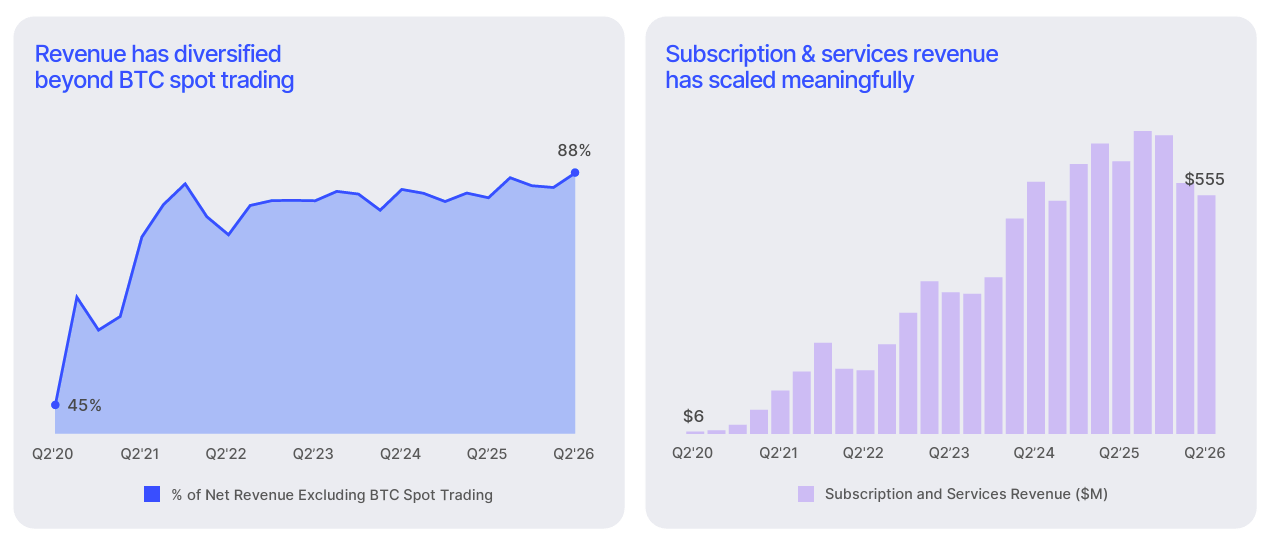
Coinbase’s second-quarter earnings disappointed Wall Street. Revenue declined, profitability missed expectations, and the stock sold off after the release.
However, beneath the earnings miss, Coinbase is steadily transforming its business away from dependence on volatile spot crypto trading and toward a broader financial marketplace spanning derivatives, prediction markets, stablecoins, institutional services, custody, and blockchain infrastructure.
The evolution reflects a broader shift taking place across digital assets. As institutional participation grows, the industry’s largest companies are increasingly competing on the breadth of financial products they offer, not simply on crypto trading volumes.
The “everything exchange” is beginning to take shape
Coinbase generated approximately $1.2 billion in net revenue during the second quarter, broadly in line with expectations but down 19% year over year. The company reported a GAAP net loss of $359 million, while transaction revenue and subscription and services revenue both came in below consensus.
Yet operationally, Coinbase continued gaining market share. The company captured a record 10.3% of global crypto trading volume, up from 9.1% in the previous quarter despite softer trading activity across the broader industry. It marked the third consecutive quarter of market share gains.
More importantly, the composition of that business continues to change. Prediction markets more than doubled revenue during the quarter, surpassing $100 million on an annualized basis. Newly launched binary contracts significantly increased both daily traders and trading activity, highlighting growing demand for event-driven financial products alongside traditional crypto markets.
Coinbase also disclosed that 88% of net revenue now comes from businesses other than spot Bitcoin trading — a striking figure for a company that, only a few years ago, was viewed primarily as a retail crypto exchange.
Institutions are reshaping the crypto exchange model
Coinbase’s diversification reflects a broader shift in digital asset markets. As institutional participation grows, exchanges are competing on much more than trading volumes. Large investors increasingly require derivatives, custody, financing, staking, stablecoin infrastructure, and tokenization capabilities alongside spot markets. Coinbase is building across each of those areas, making the company less dependent on crypto trading cycles and more aligned with the infrastructure institutions need to participate in digital assets.
Coinbase is far from alone. Across the industry, leading exchanges are expanding well beyond spot trading. CME has built one of the world’s largest regulated crypto derivatives franchises, Kraken has expanded into equities and payments, Robinhood is integrating tokenized assets into its broader brokerage platform, and Binance continues to invest heavily in payments, stablecoins, and institutional services.
Bottom line: Coinbase’s earnings may have disappointed, but its business model continues to evolve. With 88% of revenue now coming from sources other than spot Bitcoin trading, the company is steadily positioning itself as diversified digital market infrastructure rather than simply a crypto exchange. For institutional investors, that’s the more important metric to watch, because the long-term opportunity increasingly depends on the expansion of digital capital markets, not just the next crypto bull cycle.
Coming this October
My new book, Digital Assets and Crypto for Investors, is now available for preorder. Drawing on more than 20 years of experience across traditional and digital finance, it provides a practical framework for evaluating digital assets, managing risk, and building a diversified portfolio. Preorder your copy on Barnes & Noble and Amazon.
Arche Capital Substack is a reader-supported publication. To receive new posts and support my work, consider becoming a free or paid subscriber.
Comments
Nothing yet. Say the first thing.
Sign in to join the conversation.