
Dear all,
For most of financial history, the identity of the customer was taken for granted: it was a person or an institution acting through people.
Our infrastructure reflects that assumption. Markets have opening hours. Payments move through systems designed around business days. Accounts require human authorization. Even much of today’s digital finance is essentially old financial architecture with a faster interface.
AI agents challenge that model in a way I think the market is only beginning to appreciate.
Software that can independently purchase data, rent computing power, or pay another piece of software doesn’t care that it’s Sunday, that a bank is closed, or that settlement takes two days. It needs money that can move at the same speed—and with the same programmability—as the software itself.
That makes several developments this week look different when viewed together. Wells Fargo is preparing tokenized deposits that can move outside conventional payment windows. BlackRock is making money market fund shares transferable between approved wallets around the clock. BNY is bringing staking inside its institutional custody framework. Western Union is connecting stablecoins to payment infrastructure already used around the world.
None of these initiatives were built primarily for AI agents. But collectively, they are pushing finance toward an architecture that looks considerably more compatible with them.
That’s what makes the convergence of AI and digital assets so interesting to me. We’ve spent years asking how blockchain might change the way people transact. We may soon have to ask a much stranger question: What does a financial system look like when some of its most active customers aren’t human?
Vanessa Grellet, Managing Partner, Arche Capital
Upcoming Economic Indicators to watch out for this week
CoreWeave Quarterly Earnings - Tuesday 08/11
Super Micro Computer Quarterly Earnings - Tuesday 08/11
U.S. July CPI Report - Wednesday 08/12
Figure Technology Solutions Quarterly Earnings - Wednesday 08/12
U.S. July PPI Report - Thursday 08/13
Bullish Quarterly Earnings - Thursday 08/13
Gemini Quarterly Earnings - Thursday 08/13
This week’s deep dives
👇 Agentic AI may be blockchain’s next chapter—but investors still need to know which blockchain
👇 Bittensor’s market-driven model is facing a governance test
Nexr week will be dedicated to the Ethereum EIP 8363 discussions
This week’s market briefing
⚖️ Clarity Act Vote Pushed back to September
The U.S. Senate has delayed a floor vote on the Clarity Act, the bipartisan crypto market-structure bill formally known as the Digital Asset Market Clarity Act, until after its August recess. Senate Majority Leader John Thune confirmed that Democrats blocked a procedural vote before lawmakers left Washington, citing unresolved differences over ethics rules, illicit-finance provisions, and related issues. Thune stated the legislation will be “queued up first thing” when the Senate returns in mid-September, and he subsequently filed a cloture motion that positions an initial procedural vote for around September 15. The delay compresses the remaining legislative window ahead of the November midterms, leaving only a few weeks for negotiators to secure the 60 votes needed to advance the bill.
🔗 BlackRock expands tokenized money market funds in Europe on Ethereum
BlackRock is bringing tokenization to select European money market funds, launching digital share classes through JPMorgan’s Kinexys platform. The new structure covers funds denominated in U.S. dollars, euros, and British pounds and sits within BlackRock’s $311 billion Institutional Cash Series business. Eligible investors can hold fund shares as digital tokens and transfer them between approved wallets around the clock. The move could broaden how money market funds are used across digital financial markets, particularly as corporate treasurers explore tokenized cash and financial institutions look for assets that can move more easily and serve as collateral.
🏦 BNY brings institutional staking into its custody platform
BNY is expanding its digital asset custody offering through a partnership with Galaxy that will allow eligible institutional clients to stake supported proof-of-stake assets without moving them outside BNY’s custody framework. Galaxy will provide the staking infrastructure and serve as a design partner for BNY’s broader digital asset platform, with the companies also looking to integrate custody, staking, reporting, and tax services into a more unified offering. The move reflects a broader shift among traditional financial institutions from simply safeguarding digital assets toward providing the infrastructure needed to participate in onchain markets within established institutional controls.
⚖️ CME challenge puts crypto market structure back in focus
The SEC has paused Nasdaq PHLX’s planned launch of cash-settled Bitcoin index options following a challenge from CME Group. The dispute centers on whether direct Bitcoin derivatives should fall under SEC securities rules or CFTC oversight of commodity derivatives. CME argues that the decision could have broader consequences, potentially opening the door for securities exchanges to list similar products tied to commodities such as gold and oil. The challenge highlights the jurisdictional questions that remain as traditional exchanges expand into digital assets, underscoring the importance of efforts such as the CLARITY Act to establish clearer boundaries between the SEC and CFTC.
💵 Wells Fargo to bring tokenized deposits to corporate payments
Wells Fargo is preparing to bring blockchain infrastructure into its corporate payments business, with a tokenized deposit service expected to debut this fall, according to The Wall Street Journal. The initial rollout will focus on dollar- and sterling-denominated cross-border transactions, giving commercial clients the ability to move and settle bank money outside conventional payment windows and incorporate programmable features into treasury workflows. More important than the product itself is what it signals: large banks are increasingly treating tokenization as an upgrade to core financial infrastructure rather than a standalone digital asset experiment. With additional currencies and jurisdictions expected to follow, Wells Fargo is effectively positioning tokenized commercial bank money as another potential rail for institutional payments.
🌎 Western Union puts stablecoins on familiar payment rails
Western Union is pushing stablecoins closer to everyday financial use with Stablecard, a new wallet and Visa card developed with payments infrastructure provider Rain. The product connects Western Union’s remittance network with USDPT, a dollar-backed stablecoin issued by Anchorage Digital Bank on Solana, allowing customers to receive transfers into a digital dollar balance and spend those funds through the existing Visa network. Stablecard is launching across 37 markets, with more than 60 targeted by year-end. For Western Union, the strategic opportunity extends beyond faster cross-border transfers: in markets where local currencies are volatile, the company can offer recipients a way to retain funds in dollar-denominated form without sacrificing everyday usability.
Deep dive: Agentic AI may be blockchain’s next chapter—but investors still need to know which blockchain
Franklin Templeton recently argued that agentic AI—the next generation of autonomous software capable of transacting on behalf of users—could become blockchain’s “killer use case.” The paper makes a compelling observation: if AI agents increasingly buy data, pay for APIs, rent compute, and settle transactions without human intervention, today’s payment infrastructure may prove inadequate. Public blockchains, stablecoins, and programmable payments could provide a more efficient financial rail for machine-to-machine commerce.
The thesis is directionally persuasive. But it also highlights a broader challenge emerging across institutional digital asset research. It is no longer enough to argue that blockchain will benefit from AI. The more important investment question is where that value will accrue, and that requires a much more granular analysis than treating blockchain as a single, homogeneous asset class.
As institutional investors begin evaluating digital assets through the lens of AI infrastructure, understanding the difference between technological possibility and investable reality becomes increasingly important.
The question is whether AI agents will use blockchains
Franklin Templeton correctly identifies a genuine structural shift. Agentic AI introduces an entirely new category of economic participant: software capable of making decisions, holding assets, and executing transactions autonomously. Traditional payment rails, built around banks, card networks, and human users, were never designed for billions of automated, low-value transactions occurring between machines.
Blockchain networks, stablecoins, and programmable payment protocols solve many of these problems. The report also highlights x402, the emerging open protocol designed to enable native payments over HTTP, alongside initiatives from Visa and Stripe that seek to modernize digital commerce.
The technology is increasingly converging toward a future where autonomous software can transact directly with other software.
But identifying a technological trend is only the beginning of an investment thesis.
Institutional investors do not allocate capital to “blockchain” as a category. They allocate capital to specific networks, protocols, companies, and assets. That distinction becomes particularly important in the context of agentic AI, where developer activity and ecosystem adoption remain highly concentrated rather than evenly distributed.
Today, much of the experimentation around AI agents, stablecoin payments, and x402-enabled applications is occurring within specific ecosystems—not uniformly across every blockchain. The report acknowledges x402 as an important development but stops short of examining the infrastructure surrounding it, including the networks attracting developers and applications building around autonomous commerce.
That omission matters because infrastructure rarely wins on technical specifications alone. It wins because developers build on it, users adopt it, and network effects emerge over time.
It is not even clear that AI agents need blockchain at all.
Why should AI agents use blockchain?
The paper makes a strong case that blockchain will become the default infrastructure for agentic AI. Yet many of its central assumptions remain speculative and sit at odds with how AI systems are actually being built and deployed today.
The largest leap is the assumption that agents will primarily transact on-chain. In practice, the large majority of production AI agents continue to operate through REST APIs, the Model Context Protocol, OAuth, enterprise identity systems, cloud billing arrangements, Stripe, and the marketplaces of AWS, GCP, and Azure. Agents from OpenAI, Anthropic, Cursor, or GitHub Copilot have no inherent need for a blockchain, in present-day production systems, to call an API, consume compute, retrieve data, authenticate themselves, or pay for SaaS services. While experimental protocols such as x402 have begun enabling native stablecoin payments over HTTP and have processed tens to hundreds of millions of mostly sub-dollar transactions, absolute volumes remain modest relative to overall AI spending, and independent analyses have noted that a meaningful share of early activity includes self-dealing or low-value experimentation. The paper posits a broad migration onto crypto rails without explaining why the incumbents that already dominate these workflows would abandon systems that function at enterprise scale.
A related confusion runs through the analysis: the tendency to treat autonomous agents as if they were necessarily crypto-native agents. An AI agent requires identity, permissions, payment capability, and audit logs. None of these requirements inherently demands blockchain. Traditional infrastructure already delivers them through OAuth, API keys, enterprise IAM, AWS IAM, Microsoft Entra, Google Identity, and Stripe APIs. Blockchain is one possible implementation, not a prerequisite.
The paper also largely overlooks where enterprise AI spending is actually concentrated. Most large enterprises building agents today rely on Microsoft Copilot (now exceeding 30 million paid seats), Azure AI and Foundry, Google Vertex, Amazon Bedrock, Salesforce Agentforce, ServiceNow, or SAP Joule. These systems run almost entirely on conventional cloud infrastructure. Relatively few production enterprise deployments settle core transactions on public blockchains.
The claim that machine-to-machine payments require crypto because credit-card rails are too expensive is similarly overstated for the bulk of activity. Alternatives already exist in the form of prepaid enterprise billing, API credits, monthly net settlement, cloud billing, internal ledgers, and bank payment APIs. Stablecoin rails can be more efficient for true micropayments below typical card fee floors, and Visa and others have acknowledged a hybrid future in which cards handle larger proxy transactions while stablecoins suit machine-native micro-commerce. The further inference that such activity will therefore drive broad appreciation in altcoins is not demonstrated.
Identity and auditability receive similar treatment. The paper presents decentralized identity as a necessary solution, yet agent identity today is handled at scale through enterprise PKI, certificates, OAuth, JWTs, hardware security modules, and cloud identity providers. Likewise, while blockchain’s immutable ledgers sound attractive in theory, large enterprises frequently cannot place sensitive information on public chains because of privacy rules, GDPR, confidentiality obligations, and regulatory constraints. Most AI audit logs continue to reside inside Datadog, Splunk, Snowflake, and enterprise SIEMs.
Finally, the payment model itself appears unrealistic when applied universally. The paper envisions every inference, API call, and compute request settling individually on-chain. In practice, systems batch requests because batching is dramatically cheaper. The internet itself rarely settles every interaction as a discrete transaction. Technical possibility is not the same as economic inevitability. The infrastructure that ultimately wins is usually the cheapest, the easiest to adopt, and the best integrated with existing workflows—not necessarily the most decentralized.
This is not to say blockchain has no role. The paper is strongest when it points to genuine niches: decentralized GPU marketplaces such as Akash, Aethir, and Render; verifiable execution; decentralized data marketplaces; tokenized incentive networks; permissionless financial agents; autonomous on-chain trading systems; and DeFi-native AI. These are real and growing use cases. For the majority of AI agents, however, traditional rails are likely to remain dominant. Those applications derive far more value from cloud infrastructure, enterprise identity, existing payment systems, and compliance tooling than from public blockchains.
Infrastructure alone does not determine where value accrues
Perhaps the paper’s biggest weakness is that it blurs the distinction between blockchain adoption and investment returns.
History offers countless examples of transformative infrastructure that created enormous economic activity without generating equal returns for every participant. The internet reshaped commerce, but value accrued unevenly across browsers, telecom providers, cloud infrastructure, software platforms, and marketplaces. AI itself has produced similar dynamics, with semiconductors, hyperscalers, and application companies capturing different portions of the value chain.
Blockchain is unlikely to be different.
If AI agents become meaningful economic participants, investors will eventually need to answer far more specific questions than whether blockchain benefits.
Which networks capture transaction fees?
Which ecosystems attract developers?
Which protocols become the default payment layer?
Which companies monetize agent infrastructure?
Which digital assets actually appreciate as usage grows?
These are ultimately the questions that determine investment outcomes.
Franklin Templeton’s paper begins this conversation but leaves those questions largely unexplored. Rather than examining competitive dynamics between blockchain ecosystems or identifying where agentic activity is already emerging, the report treats blockchain infrastructure as a largely interchangeable settlement layer.
That may be appropriate for explaining the technology. It is less useful for constructing an investment portfolio.
Bottom line: Franklin Templeton deserves credit for reframing agentic AI as a potential driver of blockchain adoption rather than simply another AI application. The report advances an important institutional conversation by recognizing that autonomous software may require a new financial infrastructure built around programmable payments and digital assets. But the next phase of institutional research must move beyond asking whether AI agents will use blockchains. The more relevant question for investors is which networks, protocols, and companies are already emerging as the financial infrastructure for autonomous commerce.
Deep dive: Bittensor’s market-driven model is facing a governance test
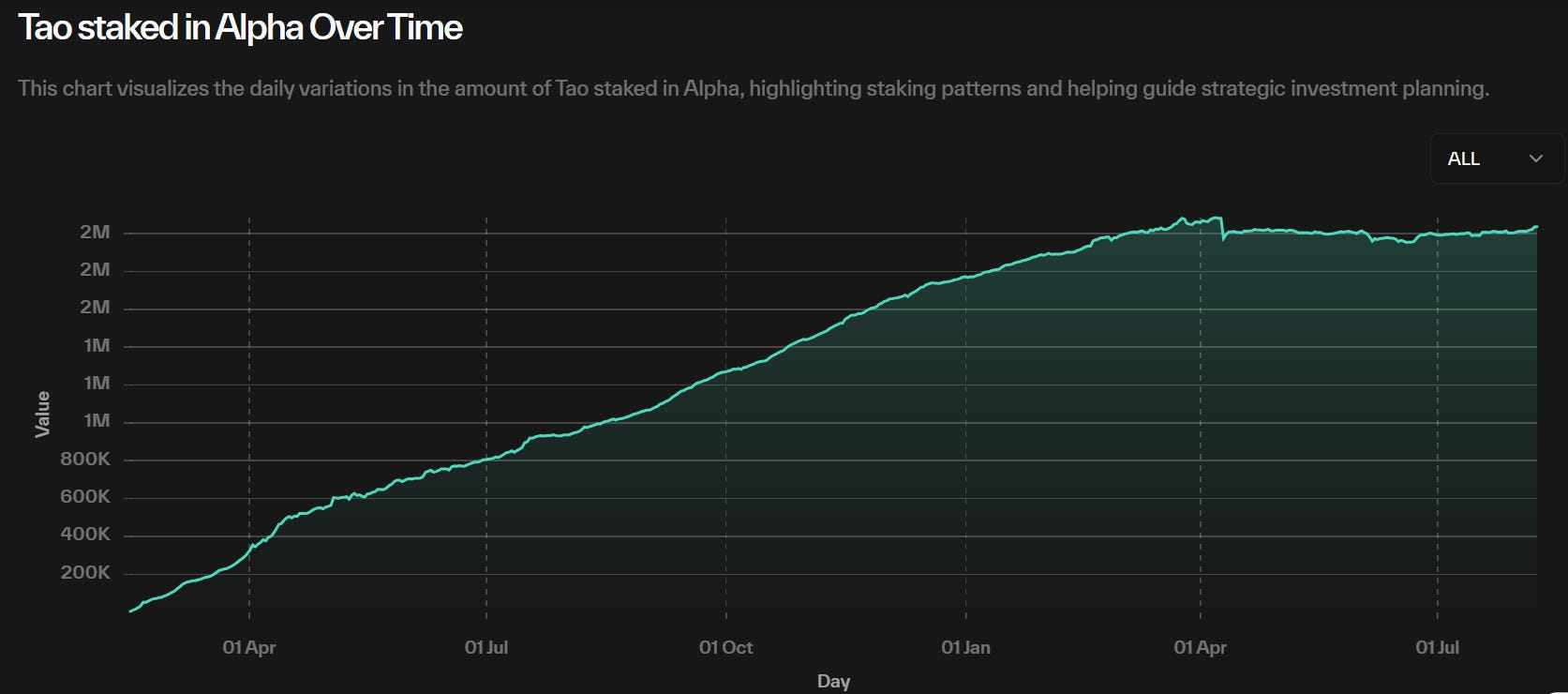
Bittensor has emerged as one of the most closely watched attempts to build a decentralized market for artificial intelligence. Rather than relying on a single company to develop and control AI models, Bittensor uses its TAO token to incentivize independent teams to provide models, compute, data and other AI services through specialized networks known as subnets. The broader thesis is that open competition can direct capital and rewards toward useful AI infrastructure without a centralized platform deciding which projects win.
That thesis is now facing an important test.
Recent Bittensor upgrades have made market prices increasingly important to how capital moves through the network. In July, the v431 upgrade tied subnet emissions more directly to the moving-average price of each subnet’s alpha token. The subsequent v440 upgrade went further, concentrating a larger share of emissions among the highest-ranked subnets. The goal is to reward projects attracting genuine demand and reduce capital flowing to weaker or inactive networks.
However, the same market logic also determines which projects can remain on Bittensor at all. With the network currently capped at 128 subnets, the arrival of a new project can trigger the removal of the lowest-priced eligible subnet. That has sparked a growing debate among builders and investors over whether Bittensor’s competitive model is becoming too dependent on short-term market signals, particularly as its economic rules continue to evolve.
Bittensor is turning price into a survival mechanism
The case for Bittensor’s approach is that network capacity is scarce, and projects should not receive permanent access simply because they arrived early. Once a subnet’s four-month immunity period expires, a sufficiently weak alpha-token price can eventually put it at risk of deregistration.
That creates a form of automated creative destruction. Subnets that attract capital and demand survive, while weaker projects make room for new competitors. Combined with recent changes to emissions, Bittensor is effectively using markets to decide where both network rewards and scarce capacity should flow.
The complication is that price and fundamental value are not always the same thing, particularly in newer and relatively illiquid markets. A team can still be developing useful technology while its token trades near the bottom of the rankings. At the same time, speculative demand can support projects whose underlying products remain unproven.
For investors, this creates an unusually powerful feedback loop. Price influences emissions, emissions influence project economics, and price can ultimately influence whether the project remains on the network at all.
The bigger institutional question is rule stability
The backlash is therefore about more than whether underperforming subnets should be removed. It is also about whether builders and investors can confidently underwrite projects when the economic framework itself is changing quickly.
That concern has become more visible following criticism from Bittensor-focused investor Mark Creaser, who has argued that repeated changes to emissions and subnet economics make long-term capital allocation increasingly difficult. It also echoes the governance concerns raised when Covenant AI left the ecosystem earlier this year, criticizing the degree of centralized influence over Bittensor’s direction.
There is a legitimate counterargument. Decentralized AI remains experimental, and Bittensor may need to change incentives quickly when they produce unintended behavior. Protecting existing projects from competition could preserve inefficient subsidies and weaken the market mechanism that makes Bittensor distinctive in the first place.
For institutional investors, however, there is an important distinction between economic risk and governance risk. While investors can price the possibility that a subnet fails to attract users or capital, it’s harder to price the possibility that the rules governing its economics will change materially after capital has already been committed.
Bottom line: Bittensor’s willingness to let markets determine which AI projects receive capital, emissions, and ultimately network capacity is central to its value proposition. But market discipline alone does not make a market investable. As Bittensor pushes further toward automated competition, its challenge will be balancing that experimentation with enough rule stability for serious builders and long-term capital to participate with confidence.
Coming this October
My new book, Digital Assets and Crypto for Investors, is now available for preorder. Drawing on more than 20 years of experience across traditional and digital finance, it provides a practical framework for evaluating digital assets, managing risk, and building a diversified portfolio. Preorder your copy on Barnes & Noble and Amazon.
No posts
Comments
Nothing yet. Say the first thing.
Sign in to join the conversation.