
A hiring decision at Vanguard. An allocation recommendation from Wells Fargo. A consultation paper from European regulators. None of these moves markets overnight, but each says something about how traditional finance is adapting to digital assets and where institutional capital is likely to flow over time.
As part of my weekly newsletter series, I’ll bring together those signals to help separate structural shifts from short-term noise. Some will be regulatory. Others will be strategic or market-driven. My goal is to provide a clear institutional perspective on the developments shaping digital assets, along with the broader context and implications that often get lost in the daily news cycle.
Thank you for reading, and welcome to the first edition.
Vanessa Grellet, Managing Partner, Arche Capital
Upcoming Economic Indicators to watch out for this week
June CPI Inflation data - Tuesday 07/14
June PPI Inflation data - Wednesday 07/15
June Retail Sales data & Philly Fed Manufacturing Index - Thursday 07/16
July MI Inflation Expectations data & Consumer Sentiment data - Friday 07/17
This week’s market briefing
🏛️ CLARITY Act vote nears critical window
Time is running short for the House to advance the Digital Asset Market Clarity Act before Congress breaks for its summer recess. Lawmakers recently released an updated version of the bill with more than 70 pages of amendments, though negotiations continue over a Democratic proposal that would bar senior government officials from maintaining business ties to the digital asset industry. If lawmakers reach an agreement, the bill could advance to the Senate as early as July 20.
👥 Vanguard continues digital assets hiring push
Vanguard’s search for a Head of Digital Assets remains active, underscoring a notable shift for the $11 trillion asset manager after years of resisting digital asset investment products. The executive will be responsible for shaping the firm’s digital asset strategy, making the still-open role one of the clearest signals yet that Vanguard is building long-term capabilities in blockchain and tokenized finance.
📊 MiCA implementation puts non-euro stablecoins under scrutiny
The European Union is already weighing revisions to its landmark Markets in Crypto-Assets (MiCA) framework as regulators turn their attention to the treatment of non-euro stablecoins following the passage of the US GENIUS Act. While MiCA’s licensing regime for crypto-asset service providers took effect on July 1, the European Commission has opened a consultation that runs through Aug. 31 on potential changes affecting stablecoins and decentralized finance. The review comes as the euro-denominated stablecoin market has expanded 128% over the past year to nearly $700 million.
⚖️ BlackRock earnings could offer digital asset clues
BlackRock reports second-quarter earnings on July 15, with investors watching whether management provides fresh commentary on institutional demand for digital assets and tokenization. The world’s largest asset manager reported $130 billion in net inflows during the first quarter, driven largely by its iShares ETF business, and net income of $2.21 billion, or $14.06 per share. While the company does not typically break out results for individual products, analysts will be listening for any discussion of its digital asset strategy following the rapid growth of the iShares Bitcoin Trust (IBIT) and the BlackRock USD Institutional Digital Liquidity Fund (BUIDL), the largest tokenized Treasury fund.
₿ Bitcoin adoption thesis faces another market test
Last week, Bernstein cautiously reiterated its $150,000 year-end Bitcoin price target, arguing that regulatory progress, stablecoin legislation, and expanding institutional market infrastructure continue to strengthen the long-term investment case. That thesis will face another test this week as Bitcoin attempts to stabilize around the $60,000 level while onchain data continues to show accumulation by large holders even as spot ETFs have recorded sustained net outflows.
Wall Street’s digital asset debate has shifted from ‘if’ to ‘how much’
Wells Fargo has become the latest financial institution to endorse modest digital asset allocations for investors, reinforcing a broader shift across Wall Street. Rather than debating whether Bitcoin and digital assets belong in diversified portfolios, the conversation among large asset managers is increasingly focused on how much exposure investors should hold—and under what risk parameters.
The recommendation is notable given Wells Fargo’s historically cautious stance toward digital assets. Like several of its peers, the bank has gradually expanded its digital asset capabilities over the past two years, including offering access to spot Bitcoin ETFs and exploring stablecoin-related infrastructure, reflecting the growing institutionalization of the asset class.
Small allocations, measurable impact
In a recent research note, Wells Fargo portfolio strategists Brian Rehling and Mason Mendez argued that allocations of roughly 2% to 3% to digital assets can improve portfolio diversification despite the sector’s elevated volatility. The recommendation closely mirrors Fidelity Digital Assets’ guidance earlier this year, which concluded that allocations of 1% to 5% may be appropriate, depending on an investor’s objectives and risk tolerance.
The reasoning is increasingly rooted in portfolio construction rather than directional crypto bets. Because Bitcoin has historically exhibited relatively low correlations with stocks and bonds, even small allocations have, in several historical studies, improved risk-adjusted returns and shifted the efficient frontier higher.
“In some historical portfolio studies, small allocations to Bitcoin or broader digital assets improved risk-adjusted returns... without materially changing the core stock-and-bond allocation,” the Wells Fargo strategists wrote.
The convergence of recommendations from two of the largest wealth managers is significant. Institutional research is increasingly treating Bitcoin as another alternative asset alongside private credit, commodities, and real estate—not as a speculative outlier.
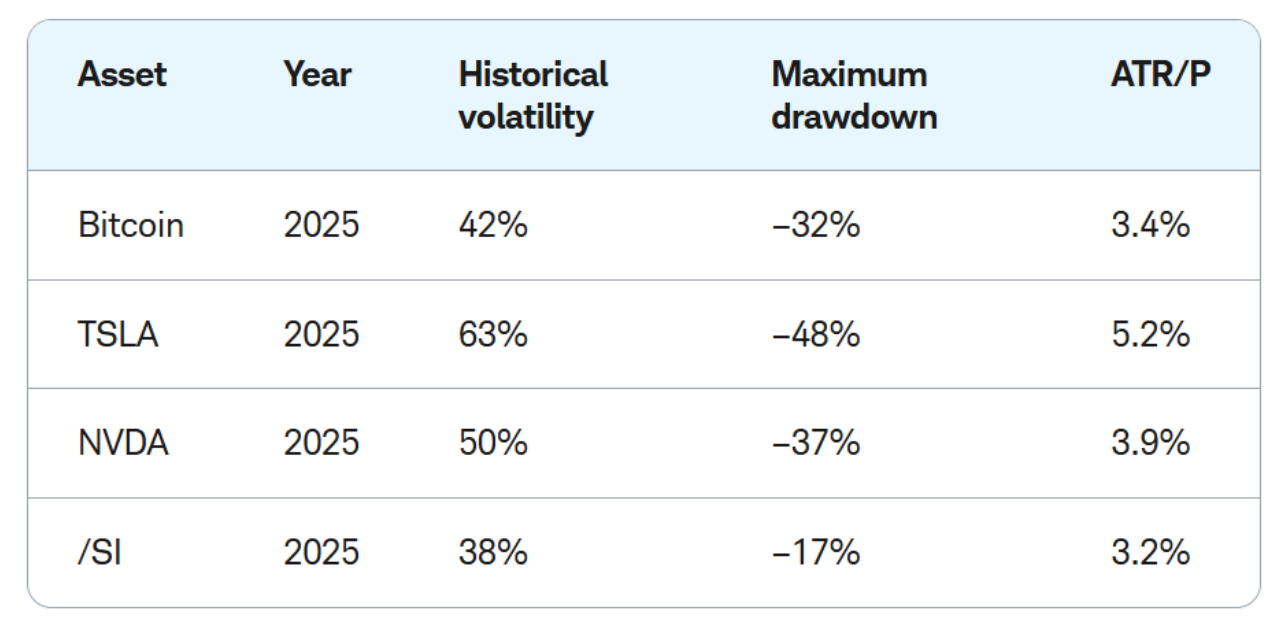
Source Charles Schwab article
The volatility argument is evolving
The biggest objection to portfolio allocations has traditionally been Bitcoin’s volatility. That argument is becoming more nuanced.
Separate research from Charles Schwab found Bitcoin’s realized volatility has fallen sharply as market infrastructure has matured. During 2025, Bitcoin’s volatility was lower than Tesla’s and Nvidia’s and approached silver’s. While Bitcoin remains capable of sharp drawdowns, Schwab noted its largest decline during 2025 was 32%, compared with 48% for Tesla and 37% for Nvidia.
Wells Fargo reached a similar conclusion, arguing that digital asset markets have become structurally more resilient as liquidity, institutional custody, regulated investment vehicles, and trading infrastructure have expanded. In other words, Bitcoin isn’t becoming a low-volatility asset—it is becoming a more investable one.
Bottom line: The significance of Wells Fargo’s recommendation isn’t the suggested allocation itself—it’s the growing consensus emerging across Wall Street. As BlackRock, Fidelity, and now Wells Fargo increasingly frame Bitcoin as a portfolio construction tool rather than a speculative trade, institutional investors are gaining a more standardized framework for incorporating digital assets into diversified portfolios. The debate is steadily shifting from whether crypto deserves a seat at the investment committee table to how large that allocation should be.
Coming this October
My new book, Digital Assets and Crypto for Investors: Your Practical Guide to Building a Diversified Portfolio, published by Wiley, is now available for preorder on Barnes & Noble and Amazon. Drawing on more than two decades across Wall Street, venture capital, and digital assets, the book provides a practical framework for understanding digital assets, evaluating risk, and integrating crypto into diversified portfolios. The foreword is written by former CFTC Chairman J. Christopher Giancarlo, widely known as “Crypto Dad,” who helped shape the regulatory conversation around digital assets in the United States.
Comments
Nothing yet. Say the first thing.
Sign in to join the conversation.