
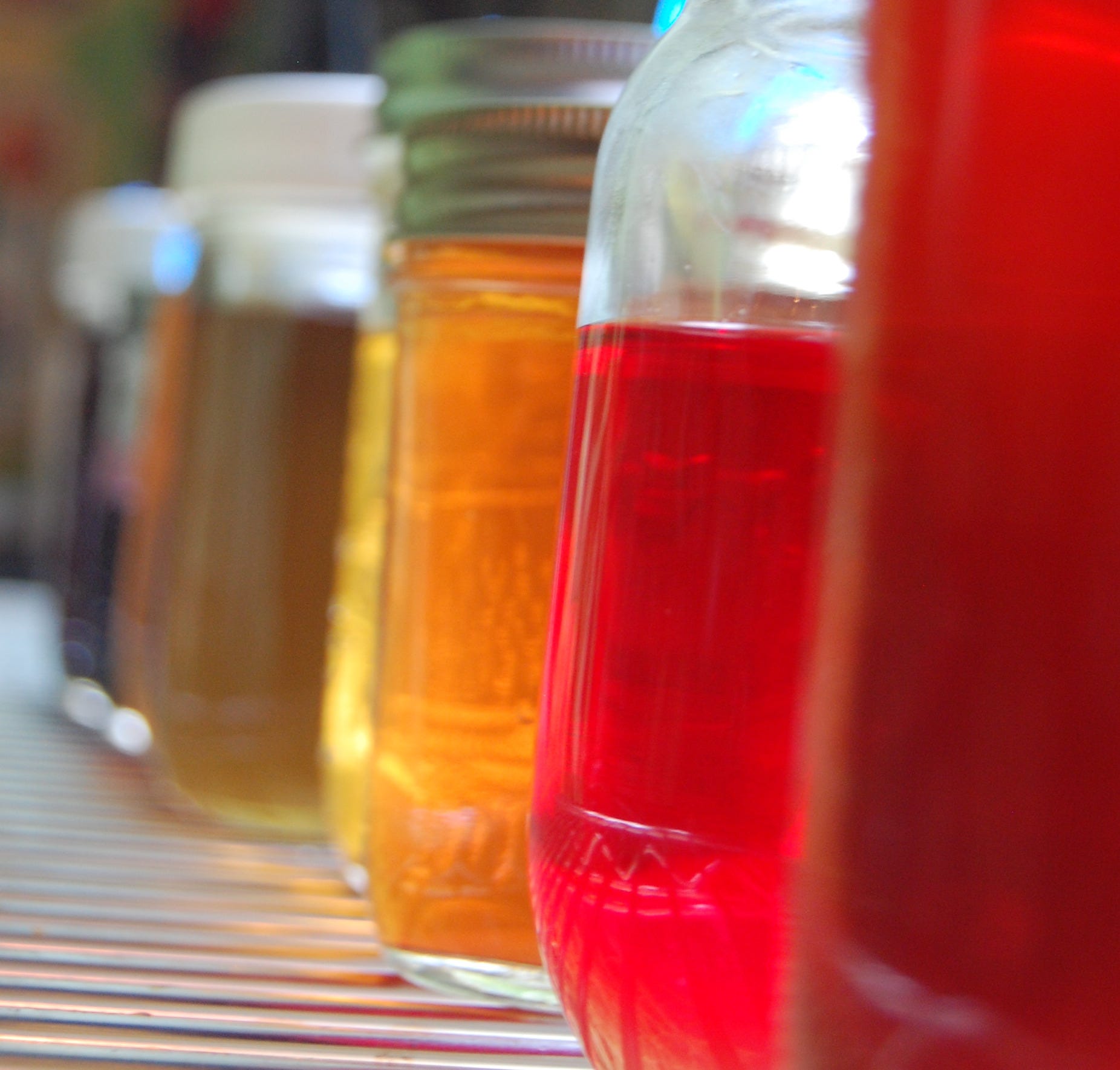
James Green, in the Herbal Medicine Makers Handbook writes: “Herbal tinctures are alcoholic or water-alcohol solutions prepared from fresh or dried botanicals. It is believed by many that alcohol is a better solvent than water for extracting plant constituents and that a mixture of alcohol and water will dissolve nearly all the desired constituents of a plant, while at the same time acting as a highly efficient preservative.”
And this is true, alcohol and water both extract different components from a plant, (as does oil/fat). I usually prefer to use fresh plant material as much as I can, capturing that vital, living energy adds a potency to the final product that I really like. BUT, you can 100% use dried materials as well. Just note that they absorb more of the alcohol and will EXPAND, so you won’t want to fill your jar up so full.
A good rule of thumb: use half the amount of dried herb to fresh and double the amount of fresh to dried. 1 cup fresh = ½ cup dried.
The folk tincture method was mentioned in the last essay, and that is what I use for personal use tinctures nowadays. But it’s also important to know how and why you’d want to formulate a standard tincture. And this is how I measured when I sold tinctures at market. One that can be ‘replicated’. I put air quotes on this because truly, each batch of tincture will be slightly different, even if all the measurements are the same. It depends on the soil, the air, the water and minerals, etc. that were taken up by the plants…so many of variables that it’s impossible to exactly repeat a specific blend. For the home herbalist, the maceration technique (rather than the percolation one) is what we’ll focus on.
When you are selling a tincture via a farmers’ market or online sales, it’s important to state the tincture strength. This is often listed as 1:5 for dried herbs (1:10 for super potent herbs) and 1:2 for fresh herbs. This is a weight to volume measurement. For example, 1 oz herb to 5 oz alcohol.
Let’s use Holy Basil as our example. First, measure out 1 oz of dried Holy Basil. Combine it with 5 oz of alcohol—usually that alcohol is recommended to be 190-ish proof…
For fresh Holy Basil, take 1 oz plant material and combine with 2 oz alcohol.
What I found when first starting out, is that you need a LOT more plant that you think, in order to make those ratios. Oftentimes, grinding or blending it up is the only way to get the plant to be under the menstruum (alcohol in this case). Menstruum is the substance that is drawing out the medicine—examples include water, oil, alcohol or vinegar. The marc is the plant material.
For beginners, and for personal use, the folk method is effective and easy to do. You can leave the flowers/leaves/roots whole, but I do find it’s better to chop or cut them up some so they are not sticking up above the liquid. This goes for all tinctures, apple cider vinegar infusions included. When exposed to air, plant matter can brown and mold can begin if there’s moisture remaining. That’s the purpose of the shaking too, gets the plant covered again if sticking out just a wee bit. Cutting, grinding or blending the herbs exposes more of the plant to the menstruum, making it that much easier to pull out its medicinal constituents.
Ideally, you’re using a high proof alcohol, 190 proof is often recommended. Most of us have easy access to 90/100 proof. I’m a big fan of using what you have and starting where you are. Now that I live in Idaho, the closest place to get Everclear (190 proof) is Wyoming—a 2 hour+ drive away. And getting high-quality, organic grain alcohol from Oregon is an even longer drive. I could get it shipped to me (if I fill out lots of Idaho State forms saying what I’m going to do with it & submit to paying an almost $200 S&H fee)…Soooo, the organic vodka at 90 proof at the liquor store is just going to have to do. And it does.
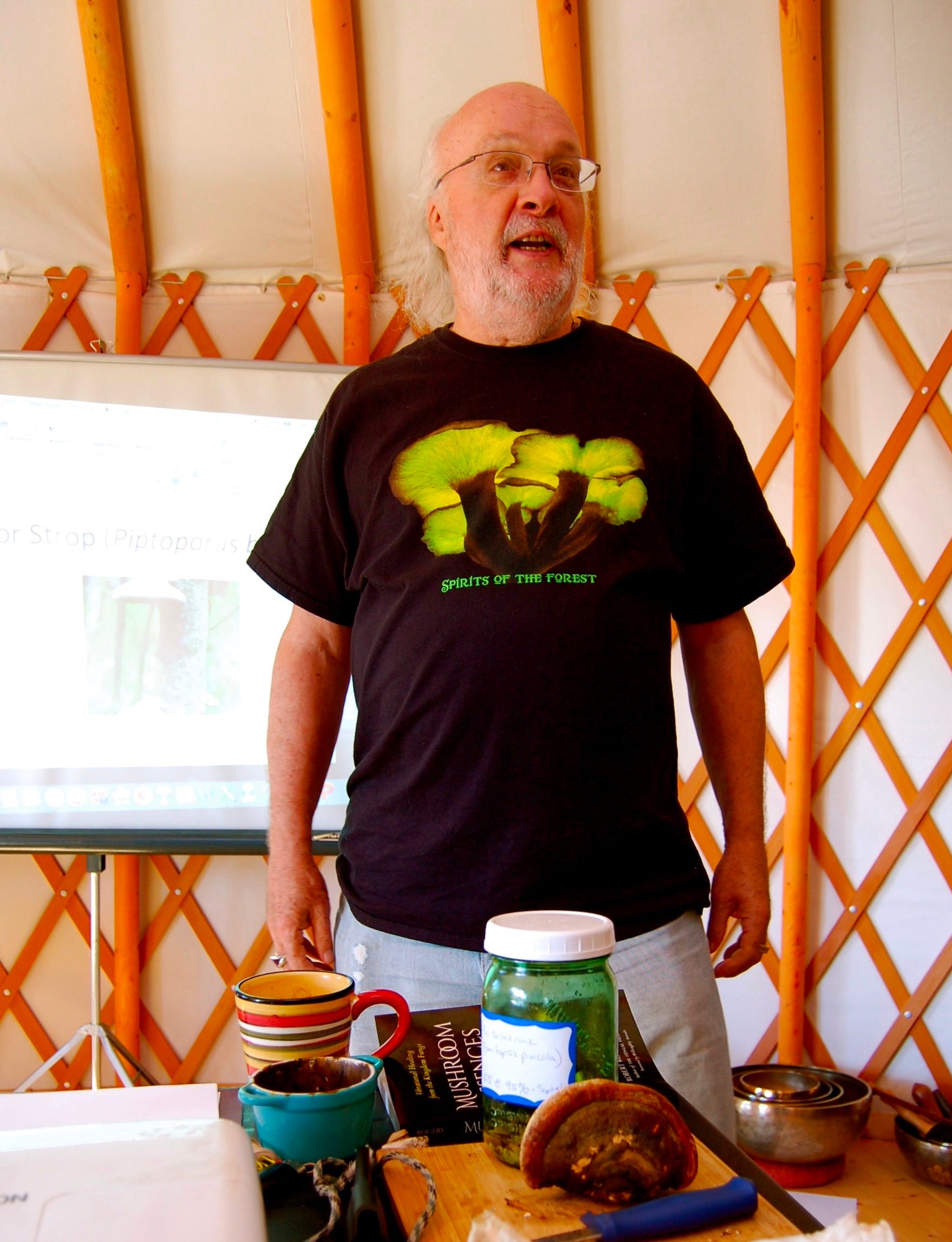
Back in 2016 I had the wonderful opportunity to attend a weekend workshop at Yukon herbalist, Beverley Gray’s land, where she hosted Robert Dale Rogers, a well-known herbalist and medicinal mushroom expert. (I love his mushroom books, especially The Fungal Pharmacy, so good!) During his talk, he mentioned Everclear, and how he’d wondered if it was produced using GMO (genetically modified organism) corn. So, Robert contacted the company. No word. So, he tried again. And again, and again. He never did hear back from them as of that weekend. Since then, I’ve been hesitant to recommend or use Everclear…as I do not want to put GMO’s into my medicines…a recent search did not clear this question up either.
I’ve found it interesting how many times I’ve seen folks say or write that their tinctures have gone moldy from using 90 proof alcohol. Well, I’ve been using that for decades now, and have yet to have a moldy tincture…Follow good hygiene, use sterilized containers, and process in a timely fashion, and you should be good to go. However, when in doubt, throw it out!
Okay, so you’ve got your plant. Again, fresh Holy Basil leaves & flowers and you want to tincture them. Fill a jar full of the plant—chop it up if you want. Pack it in. Pour alcohol over – the clear alcohols like vodka, grain, etc. generally work best, but brandy works as well. I avoid gin, flavored vodkas and other alcohol that carries a strong flavor, although technically you could use it.
As always, there’s nuance, for example, if you’re making an infused date and vanilla bean infused rum for example, then you’d want that sweetness and flavor from the rum.
Make sure to get all the air bubbles out. I like to use a chopstick specially for that purpose—insert the chopstick to the bottom and gently move about. A clean butter knife also works. Be sure to fill the alcohol so it covers the herb. (It’s best to use a small jar if you have a small amount of plant material. It would be silly to use a tablespoon of herb to a quart of alcohol—you’re not making medicine that way!) When you have a lot of space/air above your mixture, that’s inviting trouble—make sure the alcohol is covering the herb and that the mixture is close to the top. Change jars if need be.
Cap, shake, label and store in a place where you’ll remember to agitate every few days. Keep it out of direct sun and widely fluctuating temps. (If you forget to shake for a week, that’s usually okay, start again.) Plastic, leak-proof caps are ideal. Using the metal canning jar lids directly against the alcohol can cause a reaction. If using metal lids, I suggest a parchment paper barrier. Saving those plastic mayo lids can be useful for tincture making!
In a few days check the level of alcohol. The plant matter, even fresh, will absorb some of the alcohol and you may need (probably will need) to top it off.
A note on quantity. If you’re just beginning to make tinctures, I recommend not starting off by making a big ‘ole quart jar—unless of course, you already purchase and use that amount. I suggest starting out with an 8 oz -- 4 oz jar and see where that takes you.
For dried Holy Basil…grinding it really does yield a more potent brew. By doing so, you create more surface area of the plant and the alcohol has more area from which to pull the goodness from. I didn’t do this for a number of years, didn’t like the idea of using an electric gadget to make my medicines. Now, I often do grind or powder my dried plant materials, not always, it does depend. Flavor and scent can be greatly increased by exposing more of the plant (the marc) to the menstruum (the solvent).
Steep and shake anywhere from 2 weeks to 6-8 weeks. Much past that and you really don’t gain much more potency and the flavor tends to turn. Some blends I do let go longer, like Cottonwood bud and Pine resin tinctures. A little extra time is beneficial there. Strain those in 6-12 months.
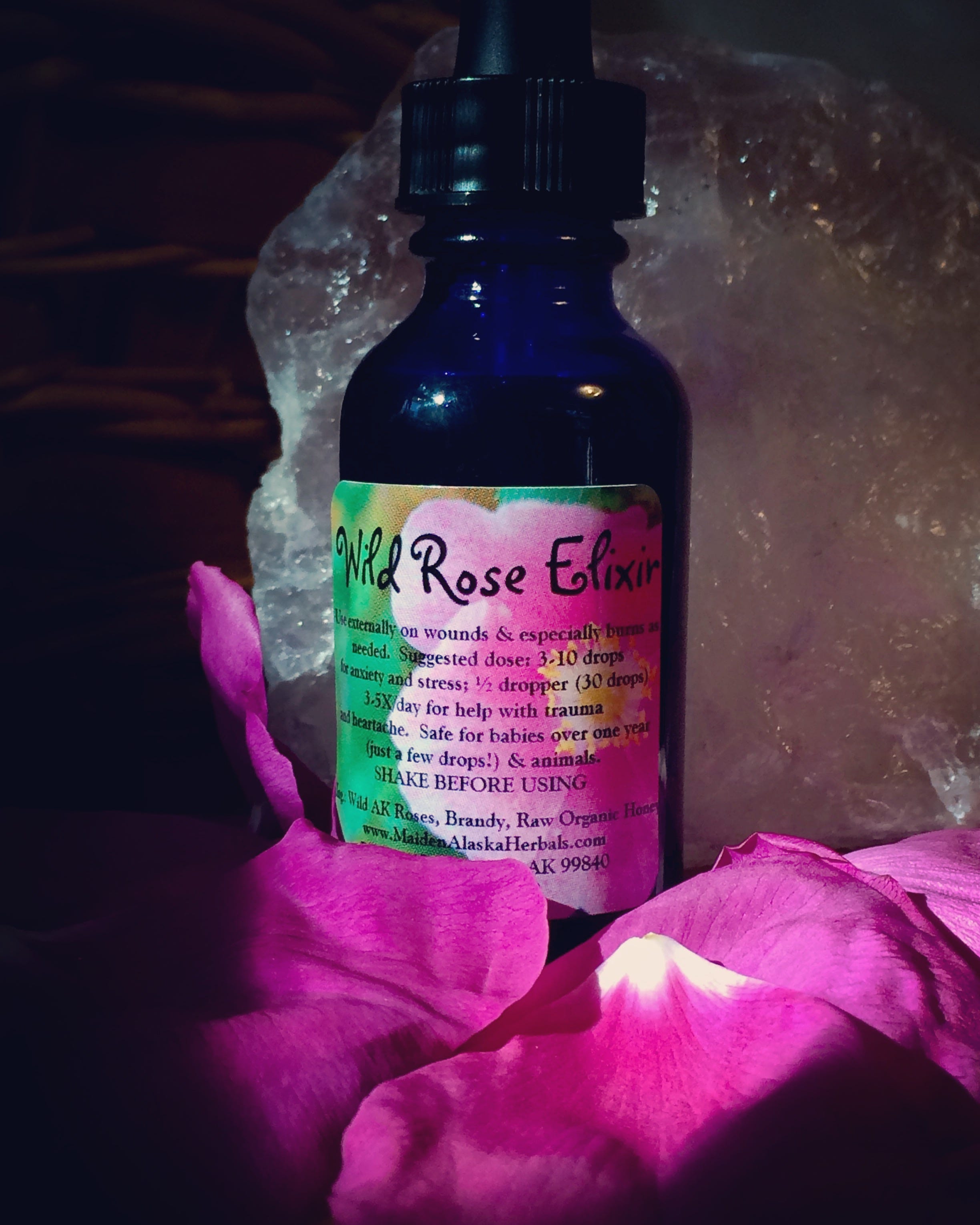
The following Wild Rose Elixir recipe is something I used to make and sell at the artisan market I helped found in Skagway, Alaska. Nowadays, I make it rather sporadically as the wild Roses here are pretty far from my beaten pathways. And the ones I’ve planted have yet to bloom in profusion. But I share a story & recipe here, in case it might help you or a loved one…
It was a day in May when his helicopter crashed into the mountains. A very fine fellow now gone. I knew him best from working at a natural foods store where he’d come in for groceries every Tuesday, and a kind and pleasant chat was always had. He was well-loved by the community, and his dear partner had been my son’s kindergarten teacher. Theirs was a sweet love affair of the golden years. Suffice to say, she was devastated. Even though death is as much of life as birth is, it feels like we are so ill equipped to handle it. Especially when the leaving is traumatically, unexpectedly sudden.
What to say to the one who still remains? How to help? How to support? These were the questions running through my mind when I was in the garden after I heard the shocking, sad news.
Now my questions weren’t answered then, but came through weeks later when the wild Roses began to bloom—a little earlier than normal that year. Rose being helpful for softening the heart when grief has hardened it. Rose for when the organ beating inside no longer plays music. A wild Rose elixir, that is what I could make for her.
WILD ROSE ELIXIR
Ingredients:
Fresh or dried* Rose petals
Honey
Brandy
Gather wild Roses when the dew is gone, before or after the heat of the day. Leave at least one petal per bloom for the bees to find the flower and the hip to continue to form.
Fill a pint jar with fresh petals.
Gently.
*If using dried petals, fill jar halfway.
Add 1/3 cup brandy.
Add 2/3 cup honey.
Stir carefully to remove air bubbles.
Let steep 4-6 weeks, shaking gently every few days. Keep in mind the person you’re aiming to help, infuse the medicine with good will and intention.
Strain and label.
Use when going through despondent and desolate times, 1-3 dropper-fulls, 1-5 X per day. Can also be used in drop doses as one does Bach’s Rescue Remedy for children. This remedy is quite sweet, the ratio of brandy to honey can be altered based on taste preference. I’ve found that brandy is the best alcohol for this elixir, it’s flavor just seems to be the smoothest. This remedy can also be used for anxiety and depression. It can even be used to help external wounds heal.
Now, some of you reading know that I no longer drink alcohol. Haven’t for over 9 years now. It is a rather curious thing that I can still utilize my alcohol-based tinctures without issue—somehow that works for me. If, however, you are alcohol free and you don’t currently use tinctures, I wouldn’t recommend starting, just in case that triggers a relapse…apple cider vinegar infusions and glycerin extractions are an option there. And of course, teas and capsules as well!
Blooms & Blessings,
Emily
Comments
Nothing yet. Say the first thing.
Sign in to join the conversation.