
This is the first of a series of podcast episodes that are live recordings from last season’s Psychedelic Salon, hosted by me and in collaboration with Town Hall Seattle. As I revisit each of these evenings, I’m simultaneously curating next season’s program, which kicks off on October 8th with a conversation on the surprising history of LSD in Seattle. Stay tuned for more.
Beginning with today’s episode, you can expect a live recording of last season’s Salons with light edits and additional narrative context every two weeks. I’m releasing these in anticipation of what is certain to be another incredible year for this in-person, scientifically sound yet soulful series. Thanks to each of you who has supported the Salon's expansion into what it's become for the Seattle psychedelic community and beyond.
In fact, when the featured guest in today’s episode, Dr. Nathan Sackett, first appeared at the Salon nearly two years ago, there were a dozen people in attendance; when today’s episode was recorded, there were hundreds in the live audience. The interest in psychedelics and psychedelic-assisted therapy continues to rise, as does the need for harm-reduction education at the core of my work.
Again, thanks to each of you who forward these emails to other curious minds, who reach out to me directly to show support, and to paid subscribers of this Substack who help keep it going.
Enjoy the episode, and please tap the heart below, leave a comment, or share a review wherever you listen to podcasts!
Take care,
April
🔵 Episode Summary
The conversation about psychedelics as addiction treatment is moving faster than the research. Dr. Nathan Sackett is trying to close that gap. Founding director of the Center for Novel Therapeutics at the University of Washington, Sackett is an addiction psychiatrist who still sees patients — which matters, because every study his center runs is rooted in clinical reality, not advocacy optics. In this live recording from the Psychedelic Salon at Town Hall Seattle, we cover what the evidence actually supports, what compounds carry genuine risk, and why the most important variable in treatment outcomes may not be the drug at all. If you've been following psychedelic news and want a clearer picture of what's real, this is the conversation.
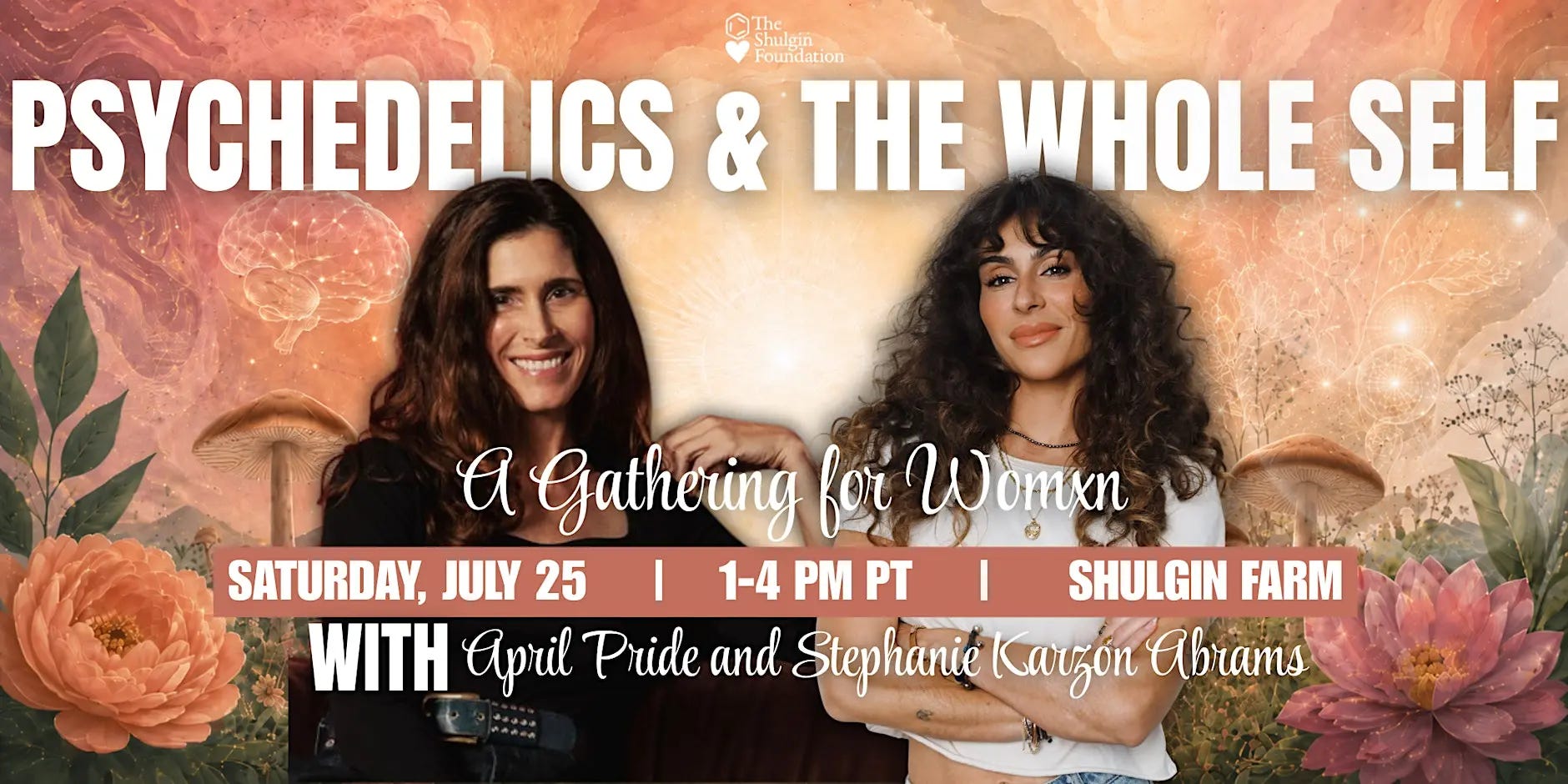
Join Steph K and April for this curated experience at Shulgin Farm, home to the chemistry lab of Sasha Shulgin, who held a DEA-exempt license and first synthesized MDMA. Also at the farm, Sasha’s wife Ann developed protocols for integration with MDMA et al., psychedelic compounds created in the lab. A historic setting to welcome 50 people for this womxn-focused event, ideal for practitioners and anyone navigating the presence or absence of female hormones.
🔵 Key Takeaways
Psilocybin works as an accelerant, not a cure. It amplifies therapeutic work already in progress — which means the therapeutic work has to be there first.
Ibogaine’s cardiac risk is real and cannot be fully predicted even in pre-screened patients. Clinical monitoring with a cardiologist present is not optional — it is the protocol.
Ketamine is habit-forming in a way classic psychedelics are not. Since the pandemic, Dr. Sackett has seen a meaningful rise in ketamine use disorder in his clinical practice.
The variation in long-term outcomes across psilocybin trials may have more to do with integration therapy than with the drug. The field does not yet have standardized integration protocols.
Kratom is available at corner stores and gas stations nationwide and contains a compound with opiate-like properties roughly ten times more potent than morphine. It is undersupported in the research literature and underrecognized as a dependence risk.
🔵 Featured Guest
Dr. Nathan Sackett is an addiction psychiatrist and the founding director of the Center for Novel Therapeutics at the University of Washington, where he leads clinical research at the intersection of psychedelic-assisted therapy, trauma, and substance use disorder. He sees patients in both an addictions clinic and UW’s Psychedelic Education and Harm Reduction Clinic.
Dr. Sackett on LinkedIn | Center for Novel Therapeutics, University of Washington
🔵 Episode FAQs
Is psilocybin effective for addiction treatment? Early-phase research suggests psilocybin may reduce alcohol use and improve outcomes for people with co-occurring PTSD and alcohol use disorder, particularly when paired with psychotherapy and integration support. No phase-3 results have been published for addiction specifically. Dr. Sackett’s UW trial is among the first to study psilocybin in a high-risk population — people with multiple diagnoses — previously excluded from clinical research.
What is the cardiac risk of ibogaine? Ibogaine extends the QTc interval, a measure of cardiac conduction. This can trigger a life-threatening arrhythmia called torsades de pointes. The risk is present even in pre-screened, otherwise healthy patients. Clinical ibogaine protocols require a baseline EKG, thorough cardiac history, and continuous monitoring with a cardiologist present during the session. Ibogaine or iboga products available outside clinical settings carry this risk without those safeguards.
Is ketamine addictive? Unlike classic psychedelics, ketamine does have habit-forming potential. It acts on dopamine reward circuits in a way that produces psychological dependence. Dr. Sackett has observed increasing ketamine use disorder in his clinical practice since the pandemic. The widespread availability of ketamine through telehealth and at-home delivery has outpaced the safety and integration protocols that structure clinical use.
What is kratom and is it dangerous? Kratom is a plant-derived product available at gas stations and convenience stores across the United States. It contains a compound called 7-hydroxymitragynine, which acts on opiate receptors and is estimated to be roughly ten times more potent than morphine by some measures. Kratom dependence produces withdrawal symptoms similar to opiate withdrawal. Drug interaction data is limited. Erowid (erowid.org) maintains a user-reported database that includes some kratom interaction reports, but formal clinical literature on kratom-drug interactions remains sparse.
Why was MDMA not approved by the FDA for PTSD? The FDA declined to approve MDMA-assisted therapy for PTSD in 2024 following concerns about gaps and inconsistencies in trial data, including boundary violations by therapists in some MAPS-sponsored trials that were not initially reported. The underlying issue is structural: the FDA regulates drugs, not therapy, and MDMA-assisted therapy is a protocol in which the therapeutic container likely accounts for a significant portion of outcomes. Pharmaceutical development incentives push toward removing the therapy component. Trials are being redesigned for resubmission.
What does integration therapy actually mean in a psychedelic trial? Integration therapy refers to the therapeutic work that follows a psychedelic session — processing what emerged during the experience, identifying patterns, and translating insight into behavioral change. In most clinical protocols, the medicine session itself involves minimal verbal therapy; the therapist is present but largely non-directive. The integration sessions afterward are where most of the psychological work happens. Research suggests outcomes are better when the therapeutic relationship is strong and integration is ongoing. Protocols vary significantly across sites, and standardization remains an open research question.
🔵 Additional Resources
Episode 46: Cultivating the Witness with Natasha Lannerd — on metacognition, integration, and the internal observer that makes psychedelic work stick
Episode 117: Ibogaine Treatment at Beond — a conversation with the co-founders of the Mexico-based clinic whose cardiac data Dr. Sackett is currently studying
Ask April: What Trump’s Psychedelic Order Actually Changes — on the executive order, fast-tracked FDA review, and what access will actually cost patients
🔵 Timestamps
[00:00] Welcome and standard disclaimer
[00:00] Intro: Dr. Sackett’s origin story — clinical disillusionment, a patient who’d been to a retreat, and how that led to building UW’s Center for Novel Therapeutics
[00:04] Why the center’s name doesn’t include the word “psychedelic” — and why that was a deliberate political and scientific choice
[00:05] The study no pharma company would fund: psilocybin for co-occurring PTSD and alcohol use disorder
[00:07] Why psilocybin over ketamine — metacognition, intensity, and the diversity of themes that come up during the experience
[00:08] April’s bridge: metacognition, the default mode network, and the practice of cultivating the witness
[00:09] Ketamine: legal, widely available, genuinely useful for some — and increasingly implicated in use disorder since the pandemic
[00:11] The Psychedelic Education and Harm Reduction Clinic at UW: what a risk triage consult actually looks like
[00:13] Benzos and alcohol use disorder since the pandemic — and why women are prescribed benzos at twice the rate of men
[00:14] April’s bridge: benzo pharmacology, cognitive risk in older women, the Ashton Manual, and who to contact before tapering
[00:14] Ibogaine: mechanism, cardiac risk, and the ethics of risk tolerance when the disease itself is fatal
[00:18] April’s bridge: QTc interval, torsades de pointes, and why cardiac screening is the difference between a high-risk intervention with oversight and a dangerous one without it
[00:19] Ayahuasca and polysubstance use — why DMT’s unusual craving-reduction profile makes it a candidate for trans-diagnostic research
[00:20] Cannabis as a case study: what legalization revealed about the gap between adoption and safety data, and whether psychedelics are on the same trajectory
[00:25] State psilocybin programs: Oregon’s safety data, New Mexico’s prescribed access model, and what happens to state programs once FDA approval arrives
[00:28] Synthetic psilocybin vs. whole-plant extraction — and why onset, duration, and clinical experience may differ between the two
[00:29] April’s bridge: the entourage effect, Filament Health, and what we still don’t know about whole-plant vs. isolated compound delivery
[00:30] The current UW trial: veterans and first responders with PTSD and alcohol use disorder, a single dose, and what the results look like so far
[00:32] The real cost of running a psychedelic trial: $2.5 million, 1,000 people screened for 12 participants, and the funding crisis threatening to stop this research before it reaches the people who need it
[00:34] Psychosis and psychedelics: screening practices, genetic load, and why European researchers are beginning to study this in populations previously excluded from trials
[00:36] Integration variability: whether differences in long-term outcomes across trials reflect the drug or the therapy model
[00:37] MDMA and the FDA: what actually happened, why the boundary violations mattered, and why the agency’s hesitation was not irrational
[00:40] Which psychedelics for which disorders — and why MDMA and psilocybin may be suited for meaningfully different indications
[00:41] Psilocybin vs. ayahuasca vs. ibogaine: mechanism, receptor profile, and experiential differences explained for a general audience
[00:42] What psychedelic-assisted psychotherapy actually looks like: prep sessions, the medicine session, integration, and the role of the therapist
[00:44] Psilocybin for ADHD and depression: where the pipeline stands and what “mainstream” means when FDA approval is roughly 18 months away
[00:46] Safeguards for people in recovery: expectation management, the role of abstinence-based traditions, and why psychedelics are not a way to sidestep behavioral work
[00:47] Seattle NTC clinical trial site — open for enrollment; link in show notes
[00:48] Fentanyl, street-level opiate use, and what it would take to bring these interventions to people without housing or stable income
[00:49] Integrating psychedelic therapy into abstinence-based recovery culture — and why pitting the two against each other serves no one
[00:50] Kratom use disorder, ibogaine for kratom withdrawal, and the opiate pharmacology of a plant you can buy at any gas station right now
[00:52] April on kratom: what she’s observed since 2007 and what the popular podcast conversation gets wrong
[00:52] Kratom and serotonin syndrome: what trusted sources exist, what Erowid covers, and where the drug interaction literature actually runs out
[00:54] MDMA for relational trauma: why Dr. Sackett is drawn to psilocybin for the PTSD-alcohol intersection and where MDMA research goes from here
[00:55] Outro: accelerant, not cure — what that distinction requires of us, of the field, and of the funding structures keeping this research alive
🔵 Transcript
[00:00:00] April Pride, host: Hey, this is April, and this show, discusses psychedelics. It’s intended for audiences 21 and over. Also, I am not a medical expert. If you are looking to engage with psychedelic substances, please consult your physician before doing so
[00:00:25]
[00:00:25] April Pride, host: Welcome back to the show. This is your host, April Pride. Today’s episode is a live recording from a recent season of the Psychedelic Salon, a monthly conversation series here in Seattle, and co-produced with Town Hall Seattle. We are in a particular moment. The federal government is accelerating psychedelic drug review, state psilocybin programs are running, Ibogaine Research is named by executive order and being federally funded, and on the ground in clinics and emergency rooms, outpatient offices, the reality is a lot messier and more complicated than a than any headline is telling you.
[00:01:04] My guest for this salon on psychedelics and substance use is Dr. Nathan Sackett. He is the founding director of the Center for Novel Therapeutics at the University of Washington. An addiction psychiatrist who still sees patients, he’s a clinician and someone who deliberately did not put the word psychedelic in his center’s name because he’s focused on creating better outcomes, and psychedelics are a frontier he wants to explore more to shape how this historically restricted group of drugs may transform the field of psychiatry and addiction.
[00:01:37] But novel means new, and while psychedelics are what’s new today, he is open to other interventions as
[00:01:48] Science catches up to one of society’s greatest afflictions, nathan has been a guest at the salon twice. As you’ll hear in the recording, there were eight people the last time he was at a salon, and on the night that we recorded this, there were hundreds of people in the audience.
[00:02:05] I’m grateful to Nathan for sharing his expertise, his knowledge, and his frustrations on working at the frontier of psychedelic medicine. He leads from clinical reality, not from advocacy of optics. Dr. Sackett works with populations who have historically been excluded from clinical trials because they are considered too high risk.
[00:02:28] What he says about what’s working, what we don’t know, and what could go wrong is exactly the kind of clear-eyed perspective this conversation needs more of. We cover a lot of ground here, psilocybin versus ketamine, ibogaine’s cardiac risk and why that risk exists in direct proportion to how serious the disease is, ayahuasca’s unusual profile for polysubstance use, the MDMA FDA
[00:02:52] decision, kratom and what you probably don’t know about what you can buy at any corner store right now, the funding crisis that’s threatening to slow this research down before it gets where it needs to go, and the integration question, whether the variation in long-term outcomes we’re seeing across trials has more to do with the therapy than the drug.
[00:03:12] Our next season begins on October 8th here in Seattle at Town Hall, or you can live stream from wherever you may be perched.
[00:03:20] Stay tuned for more information and how to grab tickets for a series pass. I hope you enjoy today’s episode
[00:03:26] Hello. Welcome to Psychedelic Salon. For those of you who have not joined us, psychedelic Salon is a conversation series where we talk about the intersection of psychedelics, culture, science, and personal transformation. we invite clinicians and researchers and community voices to talk about where this field is headed and how it can help us personally.
[00:03:54] And tonight we are here to talk about addiction. substance use disorder affects tens of millions of Americans, and it is been researched. We’ve had treatment programs for decades, and still recovery is very difficult for many. the relapse rate is very high, and the tools that we have don’t work for a lot of people.
[00:04:20] So psychedelics is something that feels very promising because. Research has shown that it can help to loosen the grip of rigid thought patterns that keep us in the throes of our addiction. So that’s what we’re here to talk about tonight, is really what the research is saying and the difference psychedelic medicines and how they help people to gain control over their own patterns and their behaviors.
[00:04:52] tonight.
[00:04:53] We are here with Dr. Nathan Sackett, he is the founding director of the Center of Novel Therapeutics at the University of Washington. And I’d like to start our conversation by hearing from him how he came to this work and how he got the approval of every single dean at the University of Washington to start the center.
[00:05:14] Dr. Nathan Sackett: Thanks for the introduction. It’s a pleasure to be here with you all tonight. so my journey, like so many sort of evolved out of my own clinical experience.
[00:05:23] I was in residency in, adult psychiatry here at the University of Washington and was feeling pretty disillusioned and frustrated by the limits of a lot of our treatments. And then occasionally I would see a patient who would describe going to some retreat and suddenly things were better. And that really captivated my, curiosity And that sort of led me down the rabbit hole to realize that for some people it seems that engaging in psychedelic assisted psychotherapy is an incredibly transformative and powerful experience.
[00:05:56] And once I started to see that in patients and I started to read more about it and become more excited about it, I felt like I had to be engaged in that world if I was gonna continue in this work. And so that’s really what started this journey. in terms of the process of getting the kind of political buy-in, that was a challenge.
[00:06:18] it was a long process and, it took a lot of. convincing over a number of years to get the buy-in that I needed. I think ultimately what shifted, some of the policy folks and administrators at the University of Washington was realizing that I was going about this from the perspective of really wanting to understand, if it worked, if it was safe, and for who it worked best for.
[00:06:45] I wasn’t trying to, proselytize. I didn’t see myself necessarily as an advocate, although I certainly have become one over the years. and I think that really helped foster the political support that I needed to start this work. and that was just, we only became approved as a center in 2023.
[00:07:05] and so it’s been, a wild ride since then. in one of our early conversations, I remember you saying that you didn’t lead with psychedelics. You led with trauma, with addiction, right? With indications. That was a big piece. I purposely didn’t put the word psychedelic in the title of the center.
[00:07:26] I was very focused on the idea that I wanted to find treatments that were helpful for addiction. And if psychedelics were that treatment, then great. But if I saw other studies that showed it wasn’t helpful, then I would pivot. The main goal really, I always say I’m a clinician first and foremost, and the main goal that I have in all of this work is to find treatments, and I want more options for my patients.
[00:07:50] And I tried to make that as clear as possible, and that seemed to foster more buy-in from folks.
[00:07:56] April Pride, host: I had the privilege of working on. The Center’s brand, your messaging. And there was something that was uncovered that I think is really important that you all are doing that no other research institutions doing, at least in the us And that is not just looking at psychedelics for trauma or psychedelics for addiction, but how those three dance.
[00:08:18] So two indications.
[00:08:20] Can you explain a little bit?
[00:08:21] Dr. Nathan Sackett: Yeah. One of our biggest projects is a clinical trial that looks specifically at, the use of psilocybin or magic mushrooms, for folks with both PTSD and alcohol use disorder. and this really emerged out of, realizing that if.
[00:08:36] you look at most of the clinical studies to date, they have a very specific and narrow indication. and that makes sense from a scientific integrity perspective. You want to try to simplify and identify, exactly what’s happening to the best of your ability. But of course, clinically that’s not what we’re seeing.
[00:08:51] I don’t know any of my patients who just have a struggle with say, a single substance and that’s it, and the rest of their life is great, right? Most folks have, depression or anxiety or trauma or the list goes on and on. And so I really wanted to be involved in a study that started to move a little bit closer to what I was seeing in clinical practice.
[00:09:10] Pharma was never gonna fund a study like this because you’re not gonna get FDA approval for two indications at the same time. So I wanted to use this opportunity, to do a study that was a little bit more controversial, but I think was gonna highlight, and provide more real world data.
[00:09:28] And so that, that’s what we’ve been working on. And I remember asking
[00:09:33] why psilocybin? Why not just ketamine? It’s legal. You don’t have to jump through as many hoops. I’ll start out with why psilocybin. I think just from the sort of highest level, what I have seen clinically is that psilocybin seems to provide a powerful opportunity for folks to see their life from a different perspective.
[00:09:52] It allows them an opportunity to use their metacognition, if you will, step out of their own story, their own looping about their past and envision a future that seems different. and to me that was really powerful because it spanned the biologic components of the pharmacology with the psychological components.
[00:10:10] There’s power in the intensity of that experience. And for a lot of folks who struggle with addiction and trauma and a lot of other things, the cycle that they get in can be so demoralizing and so frustrating that, I was drawn to the intensity of the experience. .
[00:10:26] Ketamine has potential for a lot of different things. but, there’s something that’s more captivating to me about the experience that people have on psilocybin. The intensity, the broad nature of themes that come up for people is super powerful.
[00:10:42] So for trauma, for example, you can imagine that, some of the core difficulty that occurs for folks with trauma is, intense avoidance.
[00:10:54] And the main treatment for that in the sort of standard care is exposure therapy, right? Retraining your brain that the experience is no longer a threat and, creating sort of new pathways. I feel like, psilocybin specifically has the opportunity to provide that sort of exposure in a way that is very unique in that it can span everything from recollection of really bad experiences, childhood trauma or war trauma,
[00:11:22] but it can also bring up lots of good things from one’s past as well. Strong sense of love and connection and joy. And there’s something about that sort of diversity of themes, for lack of a better word that comes up that I think is really interesting from a psychotherapeutic perspective. And, I was really drawn to that.
[00:11:41] I can remember the moment in training when I was learning how to do psychotherapy and I was sitting with a patient and I remember thinking to myself. This would be way more interesting if she was on psilocybin. And really that is truly the honest reason of why we ended up doing this study is ‘cause I was like, this would be way more fun if we were doing this in the setting of psychedelics.
[00:12:01]
[00:12:01] April Pride, host: I love this word metacognition, and it’s come up in so much of my reading in the last six months, but not until just before this conversation with Dr. Sackett did I connect this with the practice of cultivating the witness, which we talked about in a previous episode of this podcast, number 46, with Natasha Lanner,
[00:12:21] Okay, back to metacognition. It means the ability, it means the ability to observe your own thinking, to step outside of the loop you’re in and see it from above. For people in the grip of addiction, that loop has often been running for years, sometimes decades.
[00:12:37] The thought pattern that says, “I need this to cope,” runs below the level of conscious choice. What psilocybin seems to do, based on current evidence, is temporarily loosen the default mode network, the brain system that generates and maintains your habitual self-narrative. It doesn’t erase the loop. It creates enough distance from it that a person can see it for what it is.
[00:12:59] That is not a cure. It’s an opening. What happens in that opening with a therapist in integration in the weeks and months after is where the actual work lives.
[00:13:08] Personally, all I think about is my thinking, and I think benefits of this has its limits
[00:13:14]
[00:13:19] April Pride, host: I wanna go back to ketamine. Because ketamine is legal. There are clinics everywhere. You can have ketamine shipped directly to your house and micro doses and low doses.
[00:13:31] And now you can even self administer a shot of ketamine ketamine is not a classic psychedelic but it is the only psychedelic that does have a habit forming potential. So what are we doing?
[00:13:49] Dr. Nathan Sackett: It’s a good question. I think about this question a lot. as an addiction psychiatrist who studies psychedelics, I often think of myself as someone who I just study drug use. Some of that drug use is helpful and some of that drug use is harmful. And, I think with ketamine, it’s very interesting because I think it spans the whole spectrum.
[00:14:08] But in some ways you can think about, that’s true of all of the drugs that are really powerful. Fentanyl is profoundly powerful and helpful after you have surgery or you have cancer, it can be tremendously helpful, but it’s not so helpful if you’re using it outside of the hospital in an unregulated environment.
[00:14:23] Ketamine falls in a similar camp in that it clearly has lots of potential. We haven’t quite figured out how to best utilize that potential. And I certainly will say, and this is purely anecdotal, I’m sorry for you ketamine, lovers in the audience. but , since the pandemic, I’ve certainly seen a lot more ketamine use disorder in my practice.
[00:14:42] it certainly is rewarding and I’ve certainly encountered that increasing over time and it does worry me a little bit. it’s rewarding To the brains. Their brains, it feels good. That does worry me. on the flip side, I’ve also seen it be really helpful for people.
[00:14:57] I’ve seen it be helpful for folks who have chronic pain and depression, who use it at low doses. It reduces their need for pain meds. So I don’t want to demonize it because I do think there’s a role for it. but I also think that in our current healthcare system. I do worry about, the misaligned incentives out there.
[00:15:15] whereas you can go to some random clinic and get an infusion and, there’ll be zero prep, zero integration. I don’t love that personally. I wouldn’t want that for me or my family members. Are the people that are finding relief for pain or for depression, are they the same clients or patients that you have that are finding themselves abusing it?
[00:15:37] I don’t have a large enough sample to really say. Just anecdotally in my clinical practice, no. It’s hard to know. At some point some person may have been getting benefit and then they overused it and it became problematic.
[00:15:51] So it depends on where in their use pattern that I see them. But I would say that for most folks who I see struggling with ketamine, they’re also struggling with lots of other substances. It’s not just an isolated ketamine use disorder. Yeah. Yeah. I’m I am not in private practice. I’m in practice at the university, but I work in the outpatient world and I see patients. Yeah. And I do, I have two clinics. I have an addictions clinic, and then I have a clinic called the Psychedelic Education and Harm Reduction Clinic, where we see folks.
[00:16:17] Who are interested in learning more about psychedelics and have questions and want to know whether they should taper off their meds, is it safe for them? and we do a consult model where we do a risk triage and give them some resources about, the best sort of therapy that might be helpful based on the current evidence.
[00:16:33] that’s, for me personally, it’s really important that I both maintain clinical practice and research. I feel like that’s really important to stay grounded in that. And I would say every project that we’re engaged in is rooted in some patient that I’ve seen and, to me that’s really motivating and important.
[00:16:49] April Pride, host: What else have you seen with your patients since the pandemic?
[00:16:52] Dr. Nathan Sackett: Certainly alcohol use disorder around the pandemic I think really became more challenging for folks, which makes sense.
[00:17:00] It’s was a huge cultural stressor. People were stuck at home with their kids or their spouse that they didn’t like. There was increased financial stress. All the stressors were just turned up. And so I hear the story often, which is, I was drinking an amount before I was coping okay.
[00:17:14] And then the pandemic hit, I had a lot more free time. I had more stress, and suddenly I realized it, was causing some difficulty interpersonally or at work or my health. And then the pandemic, as it wind down, they tried to get back to their life and they were starting to notice more and more problems.
[00:17:31] And then they came and saw me. So certainly I would say I’ve seen a lot more alcohol. use disorder since the pandemic and benzos as well. benzodiazepines, Xanax, Valium, that class of medication, is very challenging to stop. And pharmacologically, it’s like the pill version of alcohol.
[00:17:51] So it’s not surprising that I’m seeing that as well.
[00:17:53] But that’s another area that I’ve also seen more of,
[00:17:57] April Pride, host: more women that are having issues with benzos. I know they’re, they are prescribed at a much higher rate than men.
[00:18:03] Are you seeing that they are having more challenges with them?
[00:18:07] Dr. Nathan Sackett: I can’t tell you based on my panel, the gender split, but that’s an interesting question.
[00:18:12]
[00:18:12] April Pride, host: On the topic of benzodiazepines, women are prescribed benzos at roughly twice the rate of men. They’re also more likely to be prescribed them for longer durations. To repeat the pharmacology Dr. Sackett described, benzos act on the GABA receptors the way alcohol does, producing sedation, anxiety reduction, and physical dependence.
[00:18:33] The withdrawal can be medically serious, including seizure risk.
[00:18:37] It’s also associated with cognitive changes that can look like early dementia in older women. If you or someone you love is on a benzo and wondering about tapering, that is a conversation that requires a prescriber. There are now more licensed medical providers doing med checks before psychedelic journeys, and I can refer you to a person that’s right for you.
[00:18:56] You can email me at april@aprilpride.com, I’ll link to my email in the show notes. Do not do it alone. The Ashton Manual is a widely referenced guide to benzo tapering. It’s available free online and worth having in hand before any conversation with your doctor.
[00:19:12] Also, my two-part conversation with Christian Rasmussen covers his benzo withdrawal and how Amanita muscaria helped him.
[00:19:20] I’ll link to these episodes in the show notes
[00:19:22] Dr. Nathan Sackett: I’d like to talk about Ibogaine. Ibogaine is really everywhere right now in terms of being used for substance use. And you were explaining that it’s now going to be, I guess permitted in Colorado.
[00:19:36] So what are you seeing? You are also looking at data that was provided to you by a clinic that’s in Mexico, to potentially design a study here at the center around Ibogaine for substance use. Anything that’s come out of the data that you’ve been reviewing. So for those of you who don’t know, ‘cause ibogaine is less, but it’s, from a tree bark, from a shrub in West Africa, it’s, administered orally.
[00:20:01] It’s a unique compound. The psychedelic experience lasts a lot longer than a lot of the other compounds. Sometimes people will have experiences that last up to 24 hours. and it has very unique pharmacology in that it seems to attenuate, opiate withdrawal, which is unique.
[00:20:17] Along with that, it also, causes some changes in the cardiac conduction of the heart, and it increases what’s called the QTC interval, which is a measurement of cardiac conduction.
[00:20:28] And a lot of drugs do that. That’s not an uncommon thing, but it definitely does it in a way that can lead to a fatal arrhythmia. iboga was experimented within the sixties and seventies and, there was a brief period where the National Institute of Health provided some funding to study this in humans.
[00:20:47] and there was a death, in the mid nineties and that stopped all of the research. and since then it’s continued. as with all the psychedelics, there’s a large sort of underground culture grew around it, and periodically there are still deaths related to that. and so we’ve been analyzing, cardiac data from a clinic.
[00:21:06] And the question that comes up for me often is, We’re dealing right now with the opiate use disorder and the sort of the repercussions of that, which are quite profound. Patients are dying left and right. And so it begs this question of how much risk are we willing to tolerate when we’re dealing with such a severe pathology?
[00:21:26] And I certainly don’t have the answer to that. I feel like that’s above my pay grade. That’s like a bigger policy question. but in the data that we’re looking at, it’s administered in a inpatient setting with continuous cardiac monitoring with a cardiologist there. and so that’s helpful. but it does worry me at times that people may not take the risk seriously enough.
[00:21:50] I also think with Ibogaine, what’s really interesting is it can help attenuate withdrawal and help people get off of opiates, which is a hard thing to do. But as with all psychedelics, we really need aftercare and we need support after that.
[00:22:04] One of the challenges with doing a study with opiate use disorder is the current standard of treatment is opiate replacement therapy, methadone or buprenorphine, which are lifesaving medications compared to using fentanyl on the streets, it’s a stable source. It allows you to functionally stabilize to get back to your life or get back to a life.
[00:22:26] but ethically, you can’t withhold standard of care that has a mortality benefit to try new treatment. that’s not gonna fly. So how do we integrate this treatment into current standard of care and what does that look like? And that’s something that we’re trying to wrestle with right now.
[00:22:42] I don’t have the answer to that, but we’ve been doing a lot of thinking about that. I interviewed the founders of this clinic. the Ibogaine Clinic that’s it’s called Beyond in Mexico. And the next day I got a newsletter about all of the Iboga is the plant that Ibogaine Derive is derived from.
[00:23:04] That’s available recreationally that’s being sold at doses that are recreational doses. Are people, can they have cardiac? they can have a cardiac issues, yeah. Yeah. Absolutely. Yeah. I would not recommend recreationally using Ibogaine. yeah. I would not do that.
[00:23:20] April Pride, host: The cardiac risk Dr. Sackett mentioned is substantive and cannot be predicted among a healthy pre-screened patient population. The QTc interval is a measure of how long it takes the heart’s ventricles to reset between beats. When ibogaine extends that interval significantly, the heart becomes vulnerable to
[00:23:39] a life-threatening arrhythmia. This is why every serious ibogaine protocol includes a baseline EKG, cardiac screening, and continuous monitoring during the session. The clinical setting Nathan is reviewing data from, Beond in Mexico, operates with a cardiologist present for that reason. People pursuing ibogaine outside of that level of oversight are running a genuine cardiac risk.
[00:24:05] The iboga plant available in some supplement and ceremonial markets contains the same active compound. I wanna be direct. If you or someone you love is considering ibogaine for opiate use disorder, the cardiac screening is not optional. It is the difference between a high-risk intervention with clinical support and a dangerous one without it.
[00:24:25] Check out episode number 117 of this podcast to learn more about ibogaine treatment from the co-founders of Beond, the Mexican clinic
[00:24:32] From which Dr. Sackett’s center is studying data
[00:24:35]
[00:24:40] April Pride, host: what other psychedelics are you considering for upcoming trials?
[00:24:46] Dr. Nathan Sackett: I’m particularly interested in ayahuasca. Okay. Ayahuasca, I think. The active component of ayahuasca is DMT. It’s a brew that’s mixed with a vine to reduce its, breakdown in the body and allows it to last for a number of hours and it can be absorbed orally.
[00:25:02] it is a unique compound in that, it seems particularly for alcohol use, but for other substance use disorders as well, to really reduce people’s cravings quite intensely. And that is something that I’ve been very interested in. and I’m hoping that right now we’re collecting data from an ayahuasca retreat center in Costa Rica called Saara.
[00:25:25] And we’re analyzing a bunch of data from people who go there. And we’re hoping to use some of that data to design some sort of study where we can follow people longitudinally and see, how that changes people’s relationship with substance use thereafter. that’s probably one of the things that I’m more excited about right now.
[00:25:41] Ibogaine also helps to reduce cravings. Are, is it, does it, is the mechanism of action different for ayahuasca or We don’t know. We don’t know. They’re pharmacologically different, but in terms of the mechanism that leads to reduction in craving, we really don’t know at this point.
[00:25:56] But I’d be curious to find out. And I’d also be interested with ayahuasca in particular, one of the indications that I really want to explore is polysubstance use. Again, none of my patients are just using a single substance that doesn’t really happen. So I would be interested to see if there’s some sort of trans diagnostic utility and using something like Ayahuasca for folks who are struggling with a variety of different compounds.
[00:26:19] And I suspect strongly that it would be helpful again, when it’s paired with the right therapy and aftercare. And again, there’s lots and lots of questions that still need to be answered, but that’s the hope.
[00:26:30] April Pride, host: The New York Times just came back the editorial board and said that they were reconsidering their support of legalization of cannabis after, now that it’s been legal for 10 years and we’re seeing more a higher rate of cannabis use disorder.
[00:26:45] that was something that you and I connected on a few years ago. Do you feel like there could be a similar trajectory with the, it feels flippant discussion around psychedelics being a panacea for so much. Are you concerned?
[00:27:04] Dr. Nathan Sackett: Yeah, I think cannabis is an interesting sort of case study of all of this where if you look at cannabis legalization, it initially started out as a medical model, if you remember that people who had, glaucoma or cancer could get a card and then it somehow slithered its way into a recreational use.
[00:27:23] all of which is fine. and yet despite that, we are certainly seeing more problems related to high potency, cannabis. and I certainly have seen increases in numbers of, kids who have been using high potency, products and ended up in the emergency room. and so certainly that has left, I think, a bad taste in a lot of people’s mouths.
[00:27:45] you don’t know what you don’t know. And I think that some of the hesitancy among my colleagues, is rooted in what they’ve experienced with cannabis. similarly with opiates too. I know a lot of physicians who are older than me. including my chair who tells me this story about how he was told if he wasn’t prescribing opiates to everyone who described having any pain on the pain scale, then he was being a terrible doctor.
[00:28:09] and we all know where that got us, right? So I think there’s legitimate concern from a lot of folks that, are we being too cavalier? Is there, are there unknown risks? Which I can appreciate. I think they’re important questions to ask. I think that my current read on the data is that, and obviously I’m biased, right?
[00:28:31] I’m a doc, so I’m very biased. I look at it through the lens of a medical intervention. But I do think I would like to see psychedelics utilized in a clinical environment. And I do worry at times about, I guess what I don’t wanna see is I don’t wanna see. People buying, ibogaine or psilocybin at a corner store?
[00:28:54] Not right now anyway, because I feel like we’re still at a point where if there’s a few bad outcomes that could significantly change the trajectory of this work right now, it still feels a little bit tenuous. And so I certainly am someone who’s advocating for making sure that we know what we’re getting into and making sure that we are doing this thoughtfully and that we’re doing this, with some sort of plan.
[00:29:18] But, there are, so many questions that we need to answer and that’s challenging ‘cause we’re also facing a lot of desperation for a lot of people. And the sort of hope that psychedelics seem to provide for a lot of people is palpable and exciting. And, there’s a long ways to go before this is ready.
[00:29:37] I think for prime time,
[00:29:38] April Pride, host: But it doesn’t matter. People may be not be getting it at a corner store, but they’re finding medicine. They’re not necessarily getting the education that they need that goes with it. maybe asking Chat GPT
[00:29:47] this also has happened with cannabis where it just became legal. We had no research to understand what high potency THC was doing to the human brain. Yeah. And that it would create more of an opportunity for a habit forming Behavior. So what do you do in this in-between period? Because there is a message that’s not getting out there.
[00:30:09] Not that I think psilocybin is habit forming. We know that’s not gonna be an issue. but for A-C-O-D-M-T, there’s stuff that’s out there that is causing a lot of problems, including death.
[00:30:20] Dr. Nathan Sackett: I certainly think. there are some compounds that seem to lend themselves to creating more problems for people.
[00:30:28] M-D-M-A-I, is certainly, can be problematic and different derivatives of MDA for some people can be challenging. Different ethyl amines can cause some overuse syndromes, I would say. but, feels so good.
[00:30:42] Yeah, that’s fair. Look, I’m of two minds with all of this as a human, do I think say cannabis should be illegal? No, I think that’s ridiculous. Do I think psilocybin should be illegal and that you should go to jail if you go pick a cubensis that’s growing in every park in Seattle?
[00:30:56] Absolutely not. That’s ridiculous. And like total waste of taxpayer money And when I put on my doctor hat, I have to say something different, You have to use it in a controlled environment And I do think that, and when you’re talking about therapeutic use, I do think there’s value in approaching it with some thoughtfulness and having some structure around it.
[00:31:17] but it’s a confusing question, I would say. And I think that there will be, as there has been in the last couple years, some casualties as we’re trying to figure this out.
[00:31:27] April Pride, host: So we have Oregon and we have Colorado right now and Iowa, New Mexico.
[00:31:33] There are states that are legalizing psilocybin. Do you think that there’s a state that seems to be approaching it in a way that is lending itself not just to be, the safest but the most realistic.
[00:31:48] Dr. Nathan Sackett: It’s hard to say ‘cause I think, psychedelics captures people’s imaginations for different reasons.
[00:31:53] I think for me, as an addiction doc. The thing that excites me the most is using it therapeutically for folks struggling with addiction. And so with that in mind, New Mexico has a model that I think is really interesting where it’s essentially can be prescribed by a provider. And it, they essentially, the legislation basically says that the Department of Health has to set up the infrastructure, but it has to be provided or prescribed by a licensed person.
[00:32:18] I think that’s an interesting model and makes sense if I’m wearing that hat. I think Oregon’s model looks at it from a different angle. They look at it more as, access is the primary goal you could debate that a little bit, Oregon provides an interesting case study from a safety perspective because now we’ve got a lot of doses that have been administered and we can track the sort of bad outcomes and.
[00:32:40] This was already known, but clinically we’re seeing very few bad outcomes relative to the number of doses used in the state of Oregon. So that’s great. What would a bad outcome look like? Yeah. So for psilocybin, most, so there’s been a handful of ER visits related to psilocybin use most often due to panic attacks.
[00:32:59] That’s the primary concern. While they’re sitting in a service center Yeah. With the facilitator, they end up at the er. Yeah. Yeah. ‘cause they’re having a profound panic attack. Now that’s very rare. I’m gonna misquote the numbers, but I think, there’s been like 24,000 doses administered
[00:33:13] A dozen or so cases. So very rare comparatively. but, that’s the bad outcome is essentially, anxiety and a panic attack. So I think that’s an interesting model. And I think Oregon’s data, they just got a large grant to collect more data, and that’ll be really telling and helpful.
[00:33:29] in terms of other state programs, I feel somewhat conflicted about state programs being developed. mainly because, could you imagine a state program that was set up for say, chemotherapy? Like it would be, that would be absurd. and yet some, for some reason, we feel like this is something that sort of sidesteps, or it.
[00:33:52] Doesn’t necessarily take it as seriously, perhaps as it should. I don’t know. I’m still trying to wrestle with these different state programs. I know in Washington there’s been a big push to create a program and honestly, especially with the phase three data that recently came out with Compass, it’s likely gonna be rescheduled and probably legalized here soon.
[00:34:11] And so I wonder about the fate of these state programs once it’s FDA approved and what that’s gonna look like. it’ll be an interesting couple of years for sure.
[00:34:20] April Pride, host: Your research, are you using a synthetic derivative like compasses?
[00:34:25] Dr. Nathan Sackett: No. We’re, so just for context, ‘cause this is a question I always get is how do you measure, how, what are you giving?
[00:34:31] What does that look like? so psilocybin, if you take a mushroom and dry it, about one to 2% of that has psilocybin in it. you can extract that and, you can either synthesize it artificially or you can extract it from the whole plant. There’s a company that we’re using out of Canada called Filament Health that extracts it from the whole plant.
[00:34:52] And we use the natural alkaloid and we give equivalent to 25 milligrams, which is essentially, three and a half to five grams of a dried mushroom. So it’s a what one would consider, a fairly, heroic dose. but what’s interesting is. There is a unique difference, and this is just my opinion, so don’t quote me on this, but there is a difference in people’s response to the isolated psilocybin versus the whole mushroom.
[00:35:20] It seems like when we give just the active psilocybin, it almost, without a doubt, it comes on much faster and plateaus very quickly, and then metabolizes out very quickly. And it’s almost four hours on the dot. It’s remarkable compared to someone who eats the whole mushroom where there’s a bunch of other alkaloids in there, there’s, the chitin, there’s other proteins
[00:35:45] it’s that it seems to be a slower onset and then a slower off ramp. so it’s an interesting difference and I do wonder about the difference in clinical utility between the two.
[00:35:55]
[00:35:55] April Pride, host: what Dr. Sackett is describing here is what some researchers call the entourage effect, the idea that the whole plant delivers something different than the isolated compound. We see this discussion in cannabis research too, where the combination of cannabinoids and terpenes appears to produce different outcomes than isolated THC or CBD alone.
[00:36:16] For psilocybin, the picture is less studied. Filament Health, which Dr. Sackett’s center uses, extracts from the whole plant rather than synthesizing psilocybin from scratch, which means trace alkaloids may be present alongside psilocybin. Whether those compounds contribute to clinical effect is still genuinely unknown.
[00:36:34] This is one of many questions the field has not yet answered, and it is a meaningful one when evaluating trial results across different compounds and delivery methods Some research does suggest that there is more benefit when working with a whole plant formulation, working with a whole plant extraction versus an isolated synthetic compound
[00:37:02] Before we get to audience questions, I’d like you to
[00:37:04] talk about the trial that you’re currently recruiting.
[00:37:06] Dr. Nathan Sackett: We’re doing a trial for veterans and first responders with PTSD and alcohol use disorder. And I think the thing that’s most interesting about our study, at least interesting to me, maybe not to you all, but is that we’re administering it in like a busy outpatient clinic on Roosevelt.
[00:37:21] not like these fancy retreats that are all yoga and, nice lights. it’s like my office with a chair and a couch in it. it’s not fancy at all. And honestly, I was quite nervous about that. I was like, oh my gosh, are we doing this whole trial a disservice because the set and setting, it’s not ideal.
[00:37:37] despite. The location that we are in, the results so far have been amazing. we have about 12 people in the trial right now. and every single person has had a profoundly powerful experience. they’ve had one dose, just a single dose with therapy before and after.
[00:37:52] will that translate into reduction in PTSD symptoms and alcohol use, to be determined? the few cases, so far people have reported reduction in alcohol use and PTSD symptoms. We will see, we’re gonna track them for the next six months to see how that sustains.
[00:38:09] Will we receive another dose? Nope. Just a single dose. Okay. Does that seem right? It’s a safety study, not an efficacy study. If we were designing an efficacy study. there’s been about three other studies done on psilocybin for alcohol use and two of them did a two dose paradigm and they showed positive effects and the one that used a single dose didn’t show any effect.
[00:38:33] It does seem the story on the streets anyway is that for folks who are struggling with substance use, it does seem like multiple doses is more powerful and perhaps more clinically effective than a single dose. But because this is a safety study, really we’re asking the question, can we give psilocybin in the clinic to people who traditionally would been excluded from every study because they’re too high risk.
[00:38:55] ‘cause they have multiple pathologies and they’re at very high risk for bad outcomes. Because of that, we were limited to just do a single study. That and the finances of it, it’s incredibly expensive to do these studies the clinician in me would love to design a study that has multiple dosing and therapy for six months multiple times a week.
[00:39:13] April Pride, host: And, but the budget did not allow that. So can you
[00:39:16] talk a little bit more about the cost of running these trials and the current climate for funding ?
[00:39:23] Dr. Nathan Sackett: Yeah. the cost is insane. it’s about two and a half million dollars. Millions of dollars. Most of that cost is due to the intense amount of regulatory burden going on, getting approval from the DEA and the FDA and the Department of Health.
[00:39:39] it is insane, as someone who hates doing their taxes. doing like FDA paperwork is my kryptonite, I’m not gonna lie. it’s totally maddening and it almost took me out a number of times. it’s very expensive, mainly ‘cause of the regulatory burden, also because of the screening process.
[00:39:55] We’ve probably screened a thousand people for 12 so far. It’s very expensive and very difficult and we have multiple screening visits. We have to get labs and EKGs and full physical exam and detailed psychiatric history and family history so that makes these studies very expensive.
[00:40:11] Then more broadly, the funding world right now is rough.
[00:40:16] The funding situation is definitely challenging. culturally at the University of Washington, the morale is quite low since a lot of people will randomly wake up to an email that their lab or their study that they’ve been working on for years just lost all their funding overnight.
[00:40:33] And that’s it. They’re done. Their work is gone. so that breeds a very toxic and challenging, situation. I would say I’m fortunate from a funding perspective in that most of my funding comes both from philanthropy and from the state. which is good and bad.
[00:40:48] The good news is I can tolerate the wing nuttery that is happening in the federal government right now. The bad news is that it requires me to ask lots of people for money all the time because it is incredibly expensive to do this work. We’re asking you for money right now. I’m asking you for money right now.
[00:41:01] Right now, all of you. So if any of you wanna repent and, I can sell you peace and harmony and happiness if you write me a check, the more zeros, the more likely heaven is in your future. , This stuff is expensive. And it’s hard. And when you’re asking questions that don’t provide financial incentive, like when you’re not working for a pharma company, I should say, the barriers are quite high and it requires a tremendous amount of, persistence.
[00:41:27] April Pride, host: we’re gonna get to audience questions,
[00:41:28] can you speak to, people who might have the overlap of trauma and psychosis in terms of psychedelics because of the complications with that?
[00:41:36] Dr. Nathan Sackett: So the issue around psychosis and psychedelics is a very fascinating one. what’s interesting about psychosis, and this is again just my opinion, so take it with a grain of salt. Can you define psychosis please? Can I define psychosis? Because there’s a range, psychosis is a range of symptoms.
[00:41:51] In the broadest terms, psychosis can be thought of as a break from reality, internal disorganization, disorganized speech, disorganized thought. But you’re right it exists on a spectrum, but pretty much all psychopathology ends in psychosis. So what’s interesting about that question is that it really it begs the question around when is the best time to intervene?
[00:42:15] Because, depression, anxiety, trauma, PTSD, everything, when in its extreme form will often end in a psychotic state. And as it pertains to psychedelics, the concern around psychosis is that. There are some people who carry a strong genetic load for say, schizophrenia or bipolar disorder, and if they experiment with psychedelics or if they have any really stressful experience that can trigger the expression of a psychotic illness.
[00:42:45] Because of that, We have been screening out people with psychosis and so we don’t have a lot of good data. That said, in Europe, there are a couple of groups who are starting to examine this in more detail and administer psychedelics to people who have psychotic illnesses to start to better understand if there’s a role for psychedelics and folks who experience psychosis.
[00:43:11] it’s a very active area and that’s a long-winded answer to your question to say we don’t know.
[00:43:17] Most psilocybin trials report strong outcomes at six to 12 months, but integration protocols vary widely across research sites and aren’t yet standardized.
[00:43:27] Audience: Do you think some of the varibility we see in treatment durability could be driven by differences in integration models rather than the drug itself? And is anyone currently collecting comparative data on integration protocols to understand how much they influence long-term outcomes?
[00:43:44] Dr. Nathan Sackett: That is a great question.
[00:43:46] Yes. The short answer is yes. Look, this is just my view around integration. It’s no different than any other therapy. You see a wide variety of outcomes in therapy because you’re dealing with humans, and humans are intrinsically confusing and complicated. The same thing is true in integration therapy.
[00:44:05] Some integration therapy is gonna be amazing because of the relationship, because of the personality structure of the therapist and the participant. There’s a bunch of different factors. Certainly the integration therapy is a big factor. there’s a group in Montreal doing some really interesting work at different integration models, and trying to better understand, and study that with a little more specificity.
[00:44:27] And so I’m hoping that we get more data here soon. But it’s safe to say that with all of these interventions, the outcomes are gonna be better if you have good psychotherapy. That’s probably true of every intervention in psychiatry. If you have a therapist that you like and you guys are doing good work, then you’re gonna probably get better faster with or without the drugs.
[00:44:47] Yeah, that’s my opinion on that.
[00:44:49] Audience: I was wondering if you could address the MDMA or ecstasy with PTSD? I thought it was getting close to, FDA approval and then they pulled it.
[00:45:00] Dr. Nathan Sackett: You’re asking about MDMA and the FDA approval process that got pulled. we were very close to approval for MDMA for PTSD. MDMA has, I think, a very strong potential to really help people who struggle with PTS. The challenge that came up around the FDA approval process was complicated.
[00:45:19] And this is a gross oversimplification, and probably some of you, or many of you in the room know more about it than I do. But my understanding is that there was essentially some findings when they started to analyze the data where there was, some missing data, some gaps. and I think the bigger question that came up for the FDA is not designed to regulate therapy.
[00:45:38] this intervention used a form of therapy and the FDA didn’t really quite know what to do with that. similarly, you’re dealing with a traumatized patient population. You’re giving them a compound that makes them susceptible to boundary violations and it turns out in some of these trials, there were some boundary violations that weren’t reported initially that came out after the fact.
[00:46:00] So it undermines some of the credibility of some of the studies. They are now redoing some of those studies and, there’s a hope that it’ll be, reevaluated. that’s where we’re at.
[00:46:10] I wanna say something just because you just said when people are doing work with their therapist, good work will come out of that.
[00:46:16] Yet the FDA does not regulate therapy and they’re trying to take the therapy out of psychedelic therapy and just regulate the medicine. What’s going on? Yeah, to me that’s just a function of there’s no infrastructure or standard model of how would one regulate psychotherapy given the dynamic nature?
[00:46:36] I don’t know what that would look like. but I think because of the limitations of the regulatory status, most pharma companies . Are trying to, to essentially reduce the impact of the psychotherapy, which is a shame. .
[00:46:48] Audience: Hi. you’ve discussed a lot of different psychedelics today. Do you see foresee a future where different people in different situations are being prescribed different psychedelics, or do you think we’re gonna find that one specific psychedelic works best for a lot of different clinical applications?
[00:47:06] Dr. Nathan Sackett: I suspect that there’s going to be a range of different compounds that are gonna be better suited for certain disorders for different reasons. For example, MDMA, if you think or conceptualize, PTSD as one of the unintended outcomes of PTSD is a difficulty with feeling joy or pleasure, and people will often describe feeling hollow and empty and, apathetic.
[00:47:28] I think MDMA has a real opportunity to allow people to feel joy and pleasure And the whole spectrum of emotions that generally they don’t feel. And so I think M-D-M-A-I think is particularly well suited for something like PTSD, whereas psilocybin, at least where the evidence stands currently, it seems like it’s well suited for depression, the ruminative depression that people struggle with.
[00:47:48] I see a world where there’s going to be a range of different psychedelics that hopefully will also be studied with a range of different psychotherapies and other aftercare programs. I use the word psychotherapy broadly. It could be peer-based groups, it could be, group therapy work.
[00:48:04] It could be, a variety of things. But I do think that combination, I think there’ll be a number of them based on different indications.
[00:48:09] I don’t really understand the difference between ayahuasca and psilocybin.
[00:48:14] Audience: And you mentioned another counterpart from Africa. How does that affect our bodies and is there a plus or minus to those? So the first question is the difference between, ayahuasca and psilocybin?
[00:48:27] Dr. Nathan Sackett: Yes. So psilocybin is derived from a mushroom,
[00:48:29] Ayahuasca is a combination of, a plant that has a chemical called DMT in it, which is also closely related to psilocybin, and another vine that allows that DMT to be absorbed in the body. From an experiential perspective, they’re not profoundly different.
[00:48:47] the altered state that one enters with ayahuasca and psilocybin, you could say they approximate each other certain ways. there’s definitely differences in terms of the experience, but they both act on similar receptors in the brain. a specific serotonin receptor that then have downstream effects.
[00:49:05] the third one we mentioned was, ibogaine, which is an alkaloid from a plant out of West Africa that’s not as popular in kind of mainstream culture right now. it has a totally different pharmacology than ayahuasca and psilocybin. That pharmacology is still being explored.
[00:49:22] We don’t really know why it does what it does, ‘cause it doesn’t seem to act on serotonin receptors, which is interesting. More to come on that.
[00:49:30] ,
[00:49:30] Audience: In listening to what you were saying at first I thought that these sessions were just providing the medication and now I’m getting the sense that during the session something like psychotherapy is going on and that I think of PTSD and addiction as being very different in terms of how you would do psychotherapy.
[00:49:51] What you were thinking is about what’s happening with the therapy, with the medication.
[00:49:57] Dr. Nathan Sackett: That’s a great question. So just to clarify, when we’re talking about the use of these compounds, we’re talking about it in the context of psychedelic assisted psychotherapy, which most traditionally looks like. You go, you have a therapist and you meet with them like you would any other therapist, and you meet them a number of times weekly to get to know each other, build trust, build rapport, talk about whatever problems or concerns one has.
[00:50:18] Then you go into the medicine session where that same therapist and in a clinical trial you have two therapists, who they administer the compound. The patient puts on an eye mask and headphones. There’s not a whole lot of therapy going on with psilocybin specifically. it’s a little bit of a misnomer and in the room, the therapists are there, but there’s not a whole lot of major dialogue going on.
[00:50:40] There might be some towards the tail end, which can be very fruitful, psycho therapeutically. But the real work is in the integration therapy afterwards. And the way that I conceptualize it is there’s something I think really powerful about having this unique and, sometimes scary, sometimes overwhelming experience with your therapist in the room.
[00:51:01] And then afterwards you got through it together and it bonds you in a unique and powerful way. And then you do the therapy afterwards for integration and integration therapy is just a fancy way of saying what the hell just happened? And what do you, how do you make sense of all of that?
[00:51:13] And how can you, in any of the lessons that perhaps came up for you, how can you translate that into meaningful behavioral change or whatever it is that you’re trying to address? Is what you’re saying, you help guide the person in a being an observer of their own experience? Yeah. and there’s a lot of debate around the psychotherapeutic approach and what’s the best approach.
[00:51:32] And just like in the field of psychotherapy, there’s huge debates about what’s the best approach for what person. The same exists in this space. I would say the psychotherapy that we’re administering is based on historical psychotherapy techniques. that’s really based on MDMA psychotherapy, which is more about it’s low impact therapy.
[00:51:53] It’s about going internally, reflecting. it’s not super directive. it’s pretty hands off, and driven. The themes that come up are really driven by the participant, if that makes sense. But that’s not necessarily like the best way. I think there’s still a lot to be learned about what’s the best combination and what that looks like.
[00:52:12] Audience: Can talk a little bit more about using psilocybin to treat other mental health challenges like A DHD and depression and whether we’re approaching a point where it’s becoming more mainstream or is that quite a ways off?
[00:52:26] Dr. Nathan Sackett: For psilocybin, it depends on what it is that you see as mainstream. I guess I think of mainstream as FDA approval, which, we are approaching a period where it looks like compass.
[00:52:38] will probably be FDA approved in the next, year and a half, for depression, most likely. A DHD there’s not a lot of studies to my knowledge looking at psilocybin for A DHD, but I can imagine a day where I’m sure there’ll be lots more to come. but I would say depression is probably the indication that is the farthest along.
[00:52:57] In terms of the pipeline, is it years away or, probably about a year and a half I would say. Don’t quote me on that but yes, probably somewhere around that time. Okay, thank you. There is a pharma company looking at LSD for a ADHD, pretty sure, Definium, I think they’re doing also, for generalized anxiety disorder.
[00:53:15] there’s a few other indications. They’re in phase two studies. I am familiar with that. It, that’s shocking to me that LSD has made it this far in the pipeline, given the duration. Eight hours. That’s a long time. Yeah. But they’re Frankensteining all of these compounds you don’t even hallucinate.
[00:53:30] What safeguards do you think are necessary when introducing psychedelics to people with a history of addiction or with long-term sobriety? I think that, that’s a great question. it’s very captivating for people who struggle with addiction to feel excited at the idea that, a drug got me into this problem and a drug is gonna cure me of this problem.
[00:53:49] I think the safeguard that is gonna be necessary is for people to really understand the role that psychedelics play in treatment. I think that if you look at kind of mainstream media or read the New York Times a lot, it sounds as if psychedelics are curing everything under the sun.
[00:54:04] And I spend most of my time telling people, particularly those who are interested in using it for substance use disorders, that is not the case at all. To me, I see psychedelics as a sort of accelerant. They amplify the therapeutic work. If you have a therapist and if you are engaged in sort of recovery activities, then psychedelics may increase your motivation and they may allow you to further engage in that work.
[00:54:29] But if you don’t have that work around you, then it’s recreational use, which again, that’s fine, but let’s call it what it is. Let’s not say it’s therapeutic when it’s recreational. In terms of safeguards, I think that expectation management is key and that psychedelics aren’t gonna allow you to sidestep putting in the work, right?
[00:54:50] Addiction is a behavioral syndrome that evolves over many years, and it takes a long time to change those behaviors. And psychedelics may allow you to feel. Profoundly excited for those changes, but you still gotta put in the time and the work. I think that’s probably the biggest safeguard that I would advocate for.
[00:55:11] , You mentioned some of these pharmaceutical companies that are doing psychedelic trials. there are sites in Seattle, Washington. I work at one of the clinical trial sites.
[00:55:20] Audience: we work with a lot of these studies, so if you have anyone in your life that is looking for a medical, environment to undergo some of the psychedelic assistance, in what they’re dealing with, you can find us at seattle ntc.com/research. And we have lots of studies, we’re all fighting the same fight here.
[00:55:39] Dr. Nathan Sackett: So absolutely. I refer folks to you guys all the time. likewise, Seattle, NTC does great work and, they have lots of clinical trials going on, and , it’s run by a really great group of folks that I trust deeply who do really good care. Yeah, I send you guys people all the time.
[00:55:54] Audience: Little Saigon 12th and Jackson, fentanyl. Seattle. How do you see psychedelic supporting people on the streets?
[00:56:01] Dr. Nathan Sackett: I don’t know. That’s a huge question.
[00:56:03] We gotta first figure out like how to use these compounds. How, when to use these compounds for who to use these compounds under what circumstances. Throwing in the variable of, homelessness and social inequity and poverty complicates things tremendously.
[00:56:18] But I will say this as someone who works at Harborview, I hope that we can evolve a culture of research and clinical care where we can start to do these clinical studies in environments that are more accessible to a wider swath of people. I think that’s the fantasy that I have. but, it’s challenging.
[00:56:38] These interventions are expensive and time consuming, so getting people who have the availability to come in for these interventions is challenging, especially if you are distracted with lots of other stressors. I hope that someday it’ll be helpful for folks who are struggling with opiate use on the street.
[00:56:57] but I think it’s gonna be more than psychedelics that are gonna be needed to help a lot of folks.
[00:57:01] April Pride, host: Many people exploring psychedelics for addiction recovery come from the abstinence based traditions while others don’t. How do you think the field can responsibly integrate psychedelic therapy without dismissing the value of long-term sobriety to people whose safety depends on it?
[00:57:14] Dr. Nathan Sackett: One of my pet peeves is when proponents of psychedelics, use the failings of our system as their primary evidence of why we should be doing psychedelics. In my opinion, again, as a doc, obviously I’m biased.
[00:57:27] We need to find ways to integrate psychedelics and its care into broader treatment paradigms. And, I think it’s gonna look very different depending on the culture and the blend there.
[00:57:39] April Pride, host: Many people who have moved away from opioids are now using kratom as a harm reduction tool for those considering ibogaine treatment, what do clinicians or researchers currently understand about treating kratom dependence with ibogaine, if any?
[00:57:55] Dr. Nathan Sackett: We’re analyzing data right now looking specifically at using iboga for kratom use disorder. Do you all know what kratom is? So kratom is a, a plant derived from Southeast Asia that in its native form has a, Small amount of a compound called seven Hydroxy Methazine, which is essentially an opiate.
[00:58:16] the problem is it’s been manufactured and it is non-regulated, and at the rate of it being manufactured changes the harvesting practices where there’s a higher percentage of this opiate in Kratom. You can go to any corner store right now and go buy cra It’s a concentrated form and it will have a, a certain amount of opiate in there and it’s problematic.
[00:58:38] I’m all for harm reduction and I don’t believe in criminalizing things. I don’t love the fact that my 14-year-old can walk into a gas station and buy something like seven Hydroxy, which has a potency that is 10 times higher than morphine. and it’s legal and it’s available all over the place.
[00:58:55] It is profoundly problematic. and the withdrawal is bad and I’m seeing more and more, kratom a use disorder. In terms of using ibogaine, in this cohort that we’ve looked at, it seems like IBOGAINE is helpful for the acute withdrawal as it would be expected given its opiate properties. but again, the challenge with Kratom, similar to alcohol is the access.
[00:59:17] It’s really hard when it’s so widely available to support people in remaining abstinent from it. so the short answer is yes. Could ibogaine be helpful? Yes. But long-term recovery, I think you’re gonna need a lot of support, to keep your goals.
[00:59:33] And a couple months ago the column was on kratom and we went through what it is. And last week there was a, very popular podcast in psychedelics. And the podcaster had his friend on who is the founder of a kratom beverage called New Brew. And they made it sound like it was no big deal.
[00:59:53] And it’s a plant-based beverage that you can enjoy to replace alcohol. And that is simply something you should look into because I don’t know that’s totally true.
[01:00:03] Audience: continuing the kratom conversation, one of the things I’ve heard about Kratom is that it’s more problematic in some ways than other opiates because it, hits like multiple receptors, not just an opiate receptor in your brain.
[01:00:15] And I’m curious, that probably has interactions with other substances, but it’s hard to find information about that. So what are trusted sources you could go to, to find out, is serotonin syndrome a risk when you’re mixing kratom and Ibogaine?
[01:00:28] Dr. Nathan Sackett: That’s a very good question. in terms of trusted, there’s not a lot of, I don’t know of any specific source off the top of my head of a place to go to look at something like kratom. Erowid would have, Erowid , blue Light, those, user forms are always, an interesting source of information.
[01:00:46] Some good, some bad. unfortunately, I can’t think of anything specific, that would address that beyond just the normal user forums that probably a lot of us already go to. If you’re not familiar with Eid, E-R-O-W-I-D, you might wanna start there. It’s a good place to start.
[01:01:01] There’s not a lot of drug interaction studies on kratom. And so I know that I’ve looked at the literature and a lot of it’s just like single case reports and there’s not a lot of good reviews as far as I know.
[01:01:15] I’m sorry I can’t be more helpful. Thank you for asking about kratom. It’s some I’ve known about since 2007, and my friends, all of us were introduced at the same time. It, I cannot, I’m not an opiate person, does not work with my system. but a lot of my friends still drink the tea every single day.
[01:01:32] And when they have to visit a country where it’s not legal, it’s really hard for them to come off of it.
[01:01:36] We understand that addiction is often rooted in trauma, which typically occurs in relationship. MDMA is a more relational medicine. Why are you not working with this to help with relational trauma?
[01:01:47] How are you working with trauma with psilocybin? I would love to work with MDMA. I think, at this point, the thing about psilocybin that I find interesting is it’s trans diagnostic potential. And I wanted to explore that. And there’s not been a lot of research to look at psilocybin for PTSD.
[01:02:03] There was just this study that was published a couple of months ago of about 20 patients who received psilocybin for PTSD. That was the first published study that was done. and it was a pretty uncharted territory from a research perspective, and I was particularly interested in the alcohol PTSD.
[01:02:23] Dysfunctional relationship that occurs. and I felt like the data was quite compelling for alcohol use disorder and I wondered if that would extend into PTSD. That’s really what drew me to that combination. Moving forward, I think MDMA is a super powerful and interesting compound and has a lot of potential.
[01:02:40] And, for whatever reason, I find myself drawn more, to psilocybin, ayahuasca and ibogaine. I don’t really know why I want to be totally honest. I’ll have to think about that.
[01:02:52] April Pride, host: What I keep returning to after this conversation is a word Dr. Sackett used early on, accelerant. Not cure, not miracle, accelerant. Psychedelics in his framing amplify the therapeutic work, which means the therapeutic work has to be there to amplify. The distinction is doing
[01:03:11] We are in a moment of enormous hope and legitimate risk, and both are real at the same time. The research is promising for treatment-resistant populations, people for whom alcohol use disorder and PTSD have shown up together, people who have run out of other options. The data coming out of places like Dr.
[01:03:30] Saikiet, like the Center for Novel Therapeutics at University of Washington, even in its early form, is meaningful, and the funding crisis he describes is also real. Studies that take years to build and millions of dollars to run are being defunded overnight
[01:03:45] which narrows people’s recovery options while the conversation about psychedelics grows louder There are compounds in this space that carry genuine risk. Ibogaine’s cardiac profile, ketamine’s habit-forming potential, the kratom picture that most people still don’t understand. And there are populations, people with psychosis history, people in active withdrawal from benzos or alcohol, people on certain medications for whom the screening conversation is not bureaucratic noise Broom screening is not negotiable.
[01:04:19] It is the difference between a meaningful intervention and a dangerous one
[01:04:23] I’m not a clinician. I am not a clinician, as I’ve said. What I have is 11 years of watching two emerging regulated markets take shape, and the pattern I recognize is this: education amost always lags adoption, and the people who get hurt in the gap are usually not the ones driving the conversation. If you found this conversation useful, Dr.
[01:04:45] Sackett’s Center for Novel Therapeutics at the University of Washington is actively recruiting, and philanthropy, not federal funding, is currently keeping the research alive. I will link to the center in the show notes. If you like this episode, please share it with a friend
[01:05:04] I’m April Pride, and this was brought to you in service of harm reduction. The Psychedelic Salon continues again beginning October 8th, and I’ll see you. And throughout the summer and leading up to our first salon of this season, we are going to
[01:05:23] Beginning with this episode and through to the beginning of our next season, every other week you can expect another live recording of last season’s Salon. Stay tuned, and please
[01:05:37] Follow me on Substack at aprilpride.substack.com. I will link to it in the show notes. In addition to podcasts like this, I also send out emails with deeper dives into the audience Q&A for each salon
Comments
Nothing yet. Say the first thing.
Sign in to join the conversation.