
👋 Welcome to today’s edition of Build & lead (formerly the CTO blueprint), a newsletter by Appolica. Every two weeks, we dive deep into the tech, product, and leadership challenges that keep founders up at night.

I’ve been building startups with Appolica for the past 10 years, angel investing since 2020, and co-founded a venture studio just a year ago. I’ve been involved with venture building (we didn’t call it like this back then) for the better part of my career, and I’d like to share everything I’ve learned about building startups, as well as patterns (and anti-patterns) I’ve observed along the way.
Disclaimer 1: This piece covers our unique experience as a company - both the things that worked and didn’t work for us. However, this doesn’t mean they are absolute truth and might not apply to every startup.
Disclamer 2: We believe successful startups are those that execute fast. To us, speed is everything.
Having a product with many features doesn’t mean you have traction. Traction is about real users who actively use (and get value from) your product - even if this value comes from just one or two core features.
Founders often build extensive feature sets without validating if anyone actually needs them. Instead, they should focus on getting their core offering into customers’ hands as quickly as possible (whatever this may look technology-wise).
It’s easy for founders to obsess over the big milestones:
"Build a product with X features.”
“Reach 1M users.”
“Get to $15M ARR in Y months.”
These results are great but are often the outcome of many (tiny) steps.
The problem? Fixating on how far you are from your goal can be discouraging. That’s natural, but the path to growth is to care exclusively about small improvements and constant iteration.
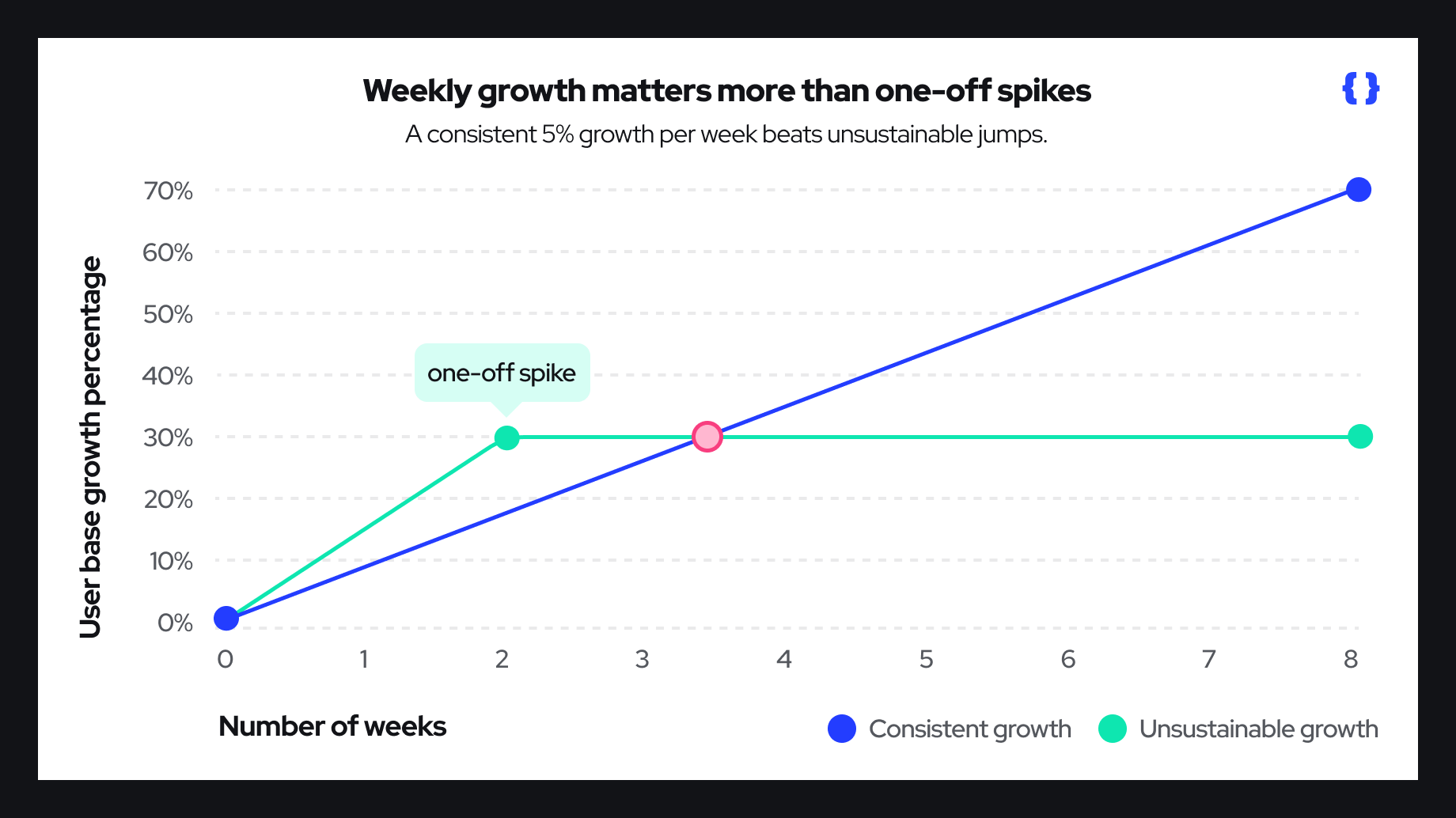
I believe in focusing on one metric at a time. Run small experiments to move that number. Ship quickly, gather data, learn, iterate. If the experiment works, keep going. If it fails, figure out why and try again.
For example, a 5% user growth week-over-week is way more significant than making a dramatic jump once (and never repeating it again).
True power lies in compounding growth.
Ten years ago creating a logo, a website, or a pitch deck took significant effort. Today, it can be done in hours. This is a huge opportunity.
Successful startups use this to their advantage by rapidly testing new ideas. They deliver an MVP within weeks, then keep shipping new features and improvements every week. The faster you learn, the closer you get to product-market fit.
Many founders believe they’ve nailed the perfect solution. The reality is that only 5–10% of those ideas actually work. The rest will end up in the trash.
Until you find a product that customers genuinely love, don’t worry about scalability or complicated features. Deliver value in the fastest, scrappiest way possible -sometimes, that might be sending a PDF instead of building a fancy dashboard.
When adoption kicks in, you’ll have plenty of time to rebuild for scale and tidy up the technical details. For now, lean into the scrappy stuff. Do things that don’t scale (à la Paul Graham).
Fear holds a lot of founders back - fear of failing, looking foolish, or wasting someone’s time. This fear is dangerous because it pulls us away from the only thing that matters: moving fast and learning from mistakes.
Succesful founders don’t get stuck in “what if?” mode. They launch, and adapt on the go. That focus on action and iteration is what sets them apart.
Early on, it feels like everything is urgent. But most tasks are distractions. Only a few truly move the needle.
The best founders keep their clear vision in mind while ruthlessly prioritize the next step. They don’t get distracted by what might happen next quarter. They focus on the most important thing right now, solve it, and move on. On repeat.
What drives a founder matters more than anything. Some want to prove people wrong. Others have a personal pain they can’t ignore. Whatever the reason, when the “why” is strong enough, it carries them through anything.
Founders who treat their startup like a mission, not just a business, almost never fail. Why? Because they refuse to quit.
Insider knowledge can help you spot problems quickly, but it also introduces biases. We’ve seen plenty of successful founders who knew close to nothing about their target industry at first.
However, they were eager to learn, got direct access to customers, and brought a fresh perspective that challenges the status quo. Often, that outsider point of view unlocks ideas that an industry veteran would never consider.
Before they hit product-market fit, founders must do it all: build, sell, support customers, manage finances, etc. You can’t outsource discovery and learning in the early days.
Bringing in agencies or external specialists too early usually backfires - they simply can’t match the founder’s context, passion, or vision.
A common example: Founders hire a salesperson before refining their messaging or defining their target audience. That salesperson won’t fix your funnel for you; you need to know what works first, then scale from there.
Many founders avoid speaking to customers until they feel their product is “ready”. This is a huge mistake. The best products are shaped by constant, direct customer feedback.
If you’re not regularly engaging with potential customers or buyers, don’t build anything. Ease of access to customers and frequent conversations strongly correlate with startup success.
It’s easy to obsess over building more features instead of growing your user base (especially within tech startups). But growth is the real proof that:
your solution is solving a real, pressing problem.
your sales or distribution channels work.
you have momentum.
you’re building a product that people actually want.
According to Paul Graham, a good weekly growth rate in an early-stage startup is 5–7%. Anything over 10% is exceptional. If you’re only hitting 1%, chances are you haven’t figured things out yet.
Yes, investors may care about profitability and break-even points, but that doesn’t mean you should ignore growth. Growth is the lifeblood that validates your idea.
Even when things go wrong, the most successful founders still feel excited—almost playful—about the process. Every challenge is a puzzle to solve, every roadblock a chance to learn something new.
That sense of fun and exploration is a strong indicator you’re solving a problem you genuinely care about. Keep going.
I hope these insights help you move faster, stay focused, and build something that genuinely makes a difference.
We’d love to keep the conversation going. If this piece resonates with your own journey—or contradicts it—let us know.
Got feedback or just want to get in touch? Reply to this email and we’ll get back to you.
Want to see more of us? Have a look at our LinkedIn account. Interested in what we do? Visit appolica.com.
Thanks for reading & until next time.
Best,
Martin & the Appolica team
Comments
Nothing yet. Say the first thing.
Sign in to join the conversation.