
Let’s be clear, self-defense is not about brawling. It’s about preventing confrontation and staying safe. There’s nothing to gain and everything to lose by getting pulled into unnecessary fights. So remember this; avoidance is your best self-defense tool.
I have written in previous articles that having a static high guard doesn’t always translate well to real-world situations. Why? To reiterate, either you are so close that both hands should be working, or you are far enough apart from your assailant that you should be escaping.
Standing with a high guard while someone approaches is unrealistic. You’re not sparring, waiting for an assailant to throw a strike while you stand there with your hands up.
However, there is a strategy that we can utilize if immediate escape is not on the cards. This strategy is called the “fence”.
The fence has been used and promoted in practical self-defense for decades, particularly through the work of Geoff Thompson and Peter Consterdine, and later by instructors such as Iain Abernethy.
I have used it too, including in the self-defense courses I taught many years ago.
But the fence is often misunderstood.
People sometimes see the hands held in front of the body and assume that their position is the important part. They see a shape and think the shape itself is the method.
It isn’t.
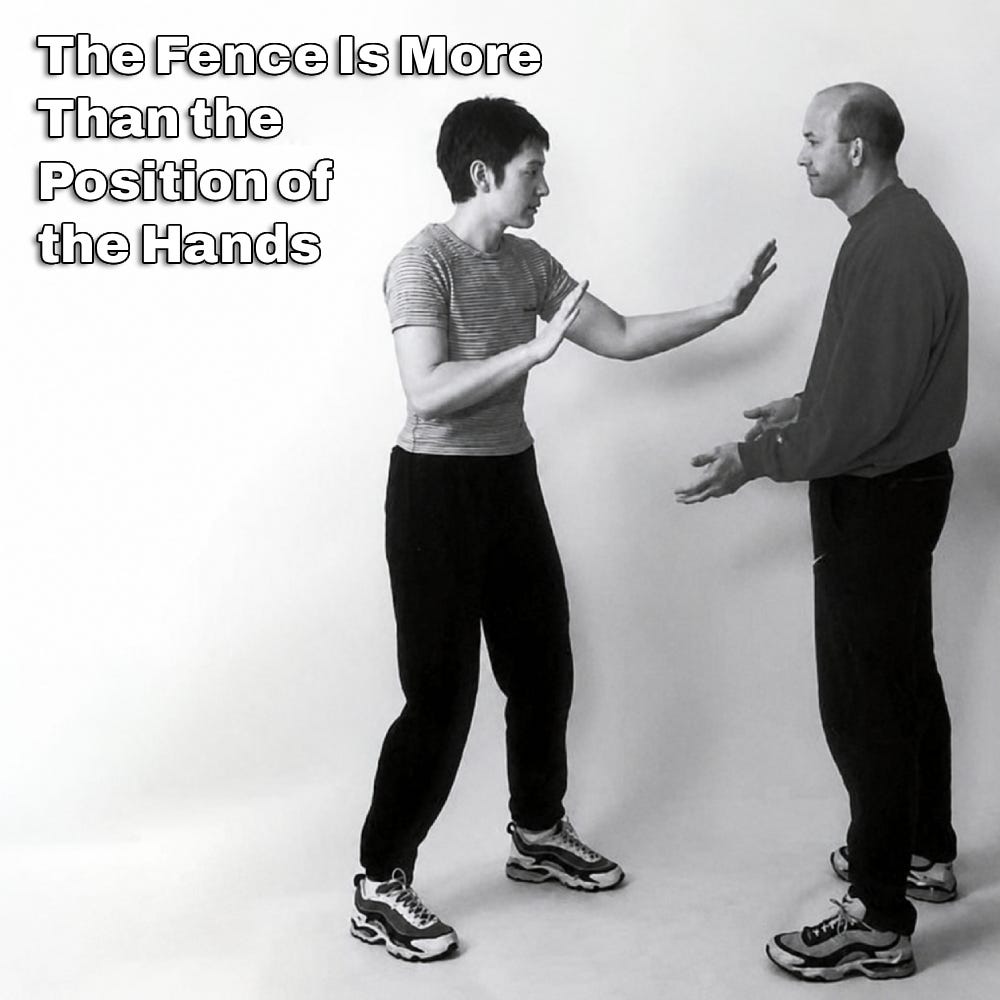
The fence is not simply another guard. It establishes a psychological and physical boundary between you and a potential threat, while placing you in a better position to respond if that boundary is ignored.
It involves distance, movement, verbal communication, awareness, judgement and the ability to recognize when a situation is changing.
The primary purpose of the fence is to create a safe zone around yourself. By assuming a non-threatening yet assertive posture, you create a visual, verbal and physical barrier while making it more difficult for someone to get close enough to initiate an assault.
Unlike a static high guard, your arms may be outstretched, with the palms facing the potential threat. But this does not mean standing frozen in one particular position.
The hands should look natural.
They may move while you speak, perhaps emphasizing your words. They may briefly touch or frame against someone attempting to move closer. Their position will change according to the distance and the behavior of the person in front of you.
The important point is not that the hands remain in a perfect fence position. It is that they are available.
If someone ignores your verbal warnings and continues to close the distance, you are already in a better position to respond.
Your response to someone aggressively closing on you to the point that they can touch you, or you can touch them, may have to become physical. Of course, the level of force used is entirely dependent upon the circumstances.
However, and this is vitally important, the fence should never become fixed or static. You should be moving, talking and trying to de-escalate while maintaining sufficient distance.
Both hands should be working.
There are several reasons that I think the fence is important and remains a viable strategy in self-defense.
It establishes a boundary, an imaginary fence, hence the name, between the assailant and me.
But it also gives me information.
If someone respects the boundary, the situation may still be controlled verbally.
If they ignore it, push through it, slap the hands away or continue to close the distance, then their behavior is telling me something.
The fence does not make the decision for us, but it can help us recognize that a decision may need to be made.
An important part of this strategy, if you have no choice but to use force, is verbal distraction or questioning.
Exploiting an attacker’s hesitation with a question can create a window for preemptive action, giving you the opportunity to escape. Clear and firm commands such as “back off” or “stay there” also show that you have established a boundary and expect it to be respected.
The words, the hands and the movement all have to work together.
Remove the distance management, verbal interaction, awareness and intention to escape, and the fence can quickly become nothing more than another static guard.
It may look different, but the same problem remains.
Awareness, avoidance and de-escalation should always remain the priorities. But if immediate escape isn’t possible, the fence can provide a proactive means of protecting yourself while you continue looking for a way out.
The fence is simple in appearance.
But its value has never been simply where the hands are placed.
Its value is in what those hands allow you to do.
No posts
Comments
Nothing yet. Say the first thing.
Sign in to join the conversation.