
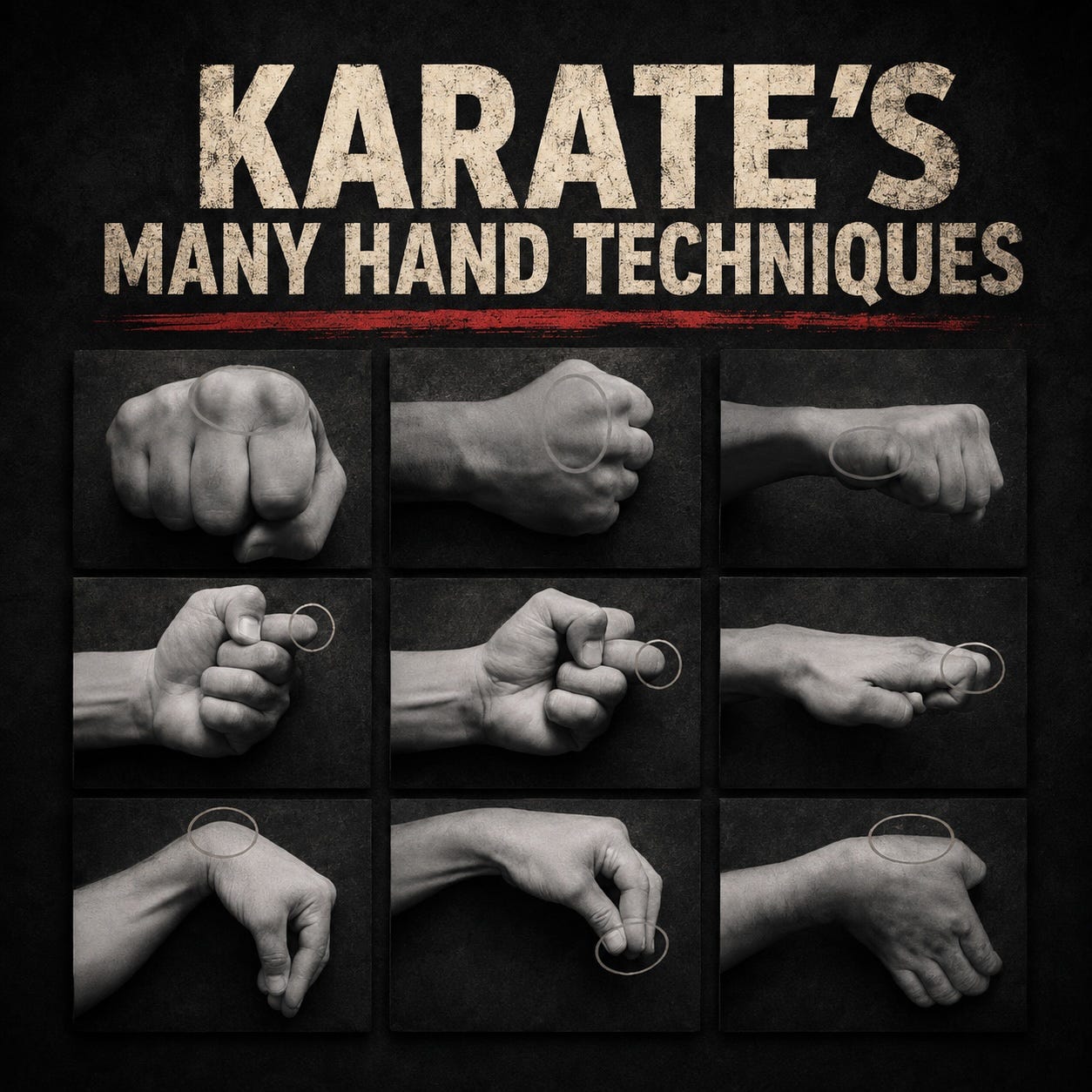
Karate has accumulated a remarkable number of techniques, each with its own label.
Different types of fist formations, extended knuckles, spear hands, ridge hands, crane hands, bear hands, hooking hands, and many others are often presented together in charts, as though each were a distinct weapon with a particular use.
I saw one of those charts shared recently on social media. It was simply described as karate’s hand techniques, each with its own purpose.
I am sure many of you have practiced them yourselves.
Some are required for gradings. You learned how to form the hand correctly, where it was supposed to strike, and how it should be demonstrated.
However, I have always questioned how many of them anyone would actually use against someone genuinely trying to hurt them.
That is the important distinction.
A real confrontation can be wild and uncontrolled. People don’t remain still, and fine precision is difficult enough even before fear, adrenaline, and confusion are added.
Under those conditions, simple and robust actions are more likely to be the better option.
We may name techniques for teaching purposes, but the name should not turn them into fixed methods with only one use. The body must still adapt to what is happening.
That does not mean an unusual hand position could never appear. A hooked or extended hand may emerge naturally while gripping, pressing, clearing, or controlling.
But that is different from treating the shape itself as a separate technique.
The hand position may be the result of the action rather than its purpose.
When the use of these techniques seems to depend on excessive precision or cooperation, it may be the interpretation, rather than the hand position, that deserves reexamining.
This becomes especially interesting when we consider that I have heard Okinawan teachers say they did not traditionally have names for all these things.
Perhaps the hand simply did what was needed.
Today, social media reinforces the idea that there are 101 techniques. A neat chart looks informative. It can be understood quickly, shared easily, and repeated without much examination.
Too often, students are not taught that the hand, and in fact the whole body, should adapt to what is needed.
Perhaps the better question is not whether a technique has a name, appears in a syllabus, or can be demonstrated correctly.
It is whether it remains available when the situation becomes uncontrolled and the body has to adapt.
No posts
Comments
Nothing yet. Say the first thing.
Sign in to join the conversation.