
In a sport like heavyweight boxing there are certainly scenarios where carrying extra body fat can be beneficial, but there is a delicate balance between muscle, fat and fitness.
If you want to become a good runner, carrying extra body fat is of no use whatsoever because that additional weight doesn’t translate into performance. In boxing it can, at least to a point. Being heavier may help if that weight can be used effectively, but simply carrying more fat doesn’t automatically mean someone will punch harder.
So extra weight can be useful. But, of course, there is a trade-off: fitness and agility. If you’re carrying extra body fat then you have more weight to move around, and that takes more energy.
Before a fight, boxers go into training camps where the aim is usually to lose fat mass, improve conditioning and, where possible, maintain or increase muscle mass. To tone up, basically. But as long as an athlete is fit enough to handle the extra weight, being heavier is not necessarily a problem.
If you have the ability to produce speed, your punching power is going to be much better than if you are simply heavy and slow. And if your fitness levels are already good, losing an extra 15 pounds of fat may not suddenly make you a better fighter.
But here’s the problem.
I had to point out to a student a while ago that he really needed to lose some weight. He was gassing out in continuous sparring and two-person drills, and had to take breaks to catch his breath pretty often.
I said to him, if you had to fight out in the real world, how do you think you would fare?
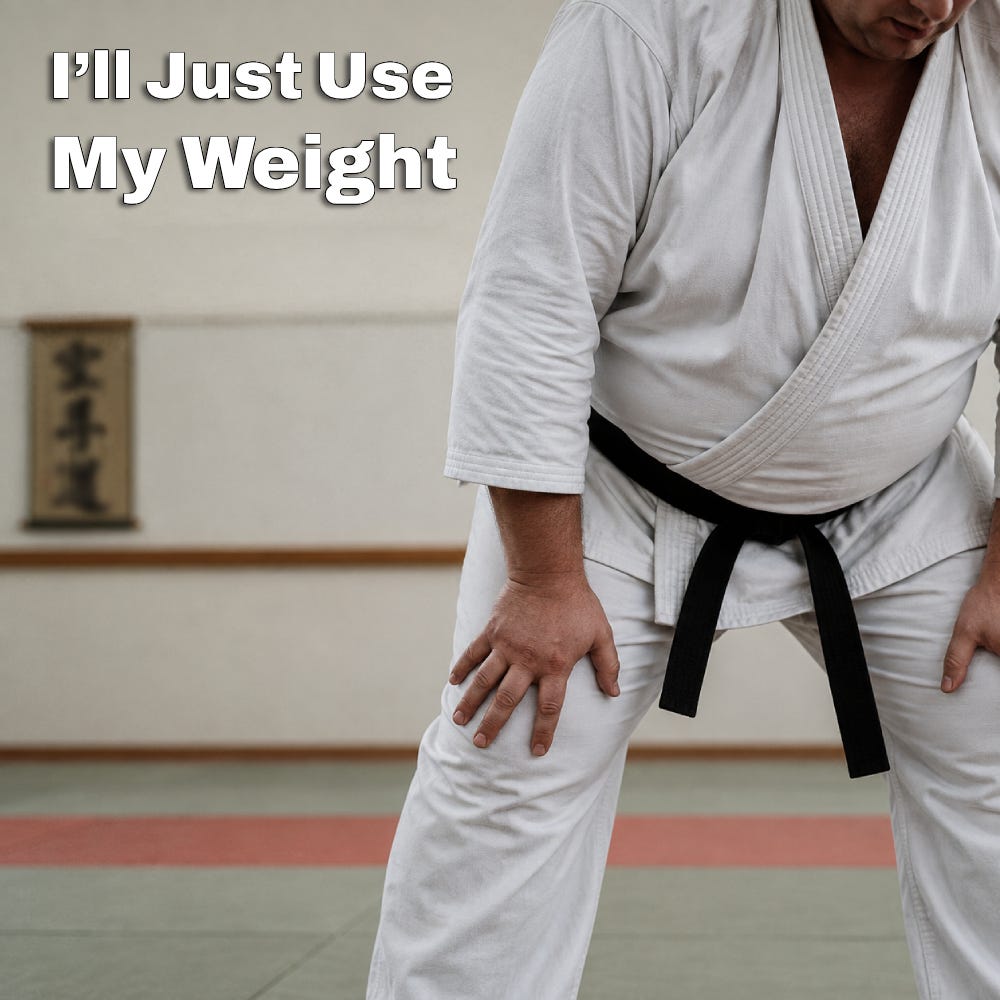
He said, “I will just use my weight.”
He believed that in the realities of an attack outside of the dojo he would be able to end things quickly enough that he wouldn’t gas out. His weight, he thought, would make up for the lack of fitness.
That is quite an assumption to make.
A violent encounter may be over in seconds. Or it may not. The first thing you try might fail. There may be more than one person. You may have to get away, get back to your feet, protect somebody else, or simply keep going when you are already exhausted.
A lot of what you see in sport martial arts, squaring off, hands up in a guard, testing distance and so on, isn’t real. Anyone who has squared up to someone at a distance has moved into something different from the kind of self-protection problem I usually talk about. If an escape is possible, you need to take it.
Lacking the physical conditioning for a prolonged fight can put someone at a disadvantage, affecting strength, speed and overall resilience.
Exercise science teaches a principle called SAID, which stands for “specific adaptation to imposed demands.” Basically, we adapt to what we repeatedly ask our bodies to do.
If training is always short bursts followed by a break, then prolonged physical effort may come as a shock when it happens for real.
A few decades ago, when I was young (and handsome), I used to run marathons and compete at karate tournaments internationally. I was pretty fit.
Out for a run one evening I unfortunately got myself into an altercation.
The toll on my system was not what I expected considering my fitness level. Struggling for breath would be an understatement. I was gasping.
I had assumed that because I was fit, I would cope with that side of things reasonably well if it ever happened. I didn’t.
You cannot train for every scenario, but you can prepare in a way that makes sense. Fitness will not guarantee that you cope well with violence, but poor fitness is another problem you really do not need.
If you train for the possibility that you may have to physically protect yourself or somebody else, prepare yourself as well as you reasonably can.
Don’t rely on luck, or on your weight.
Comments
Nothing yet. Say the first thing.
Sign in to join the conversation.