
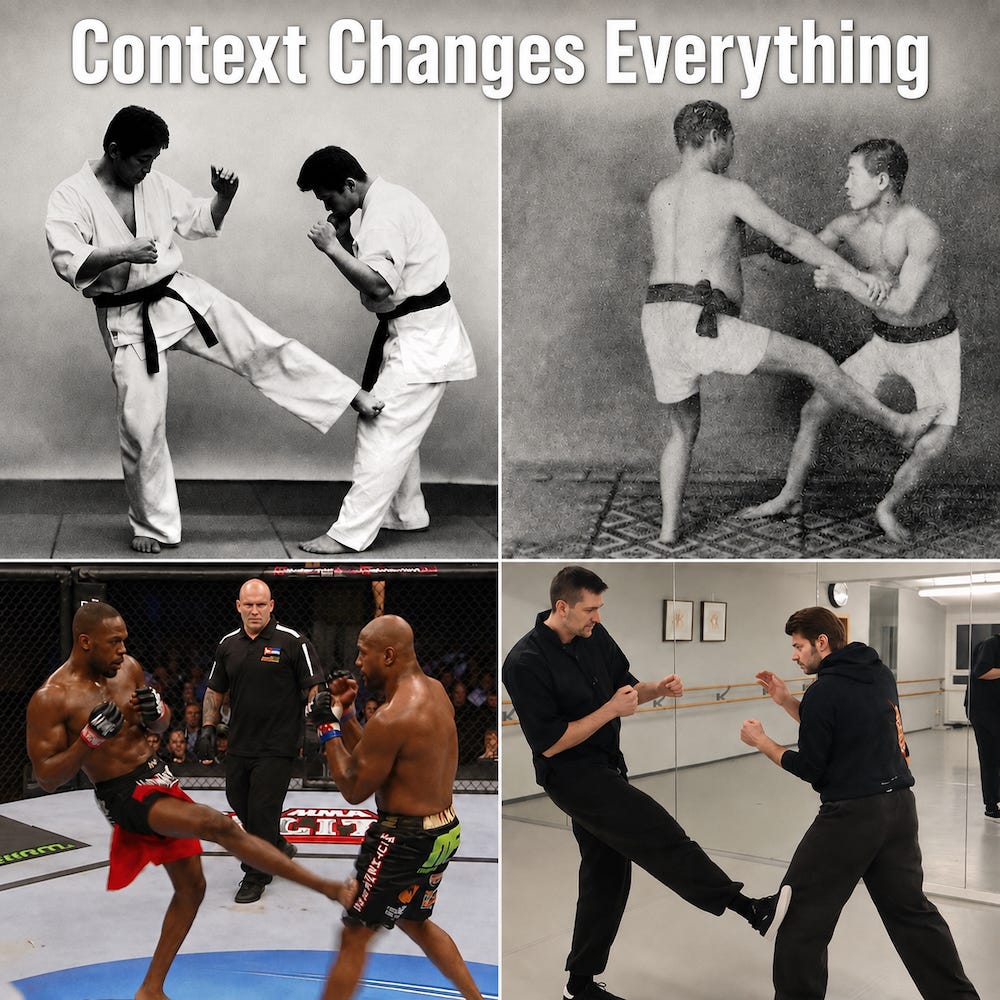
We are often very quick to decide whether something in martial arts is good or bad.
A stance looks too long, a guard looks too low. A technique seems unrealistic. There’s too much cooperation, or perhaps too much resistance. If that movement works in competition, it is useless for self-protection. Well, this is traditional, so it must have survived because it works.
But none of those judgments mean very much until we understand the context. And I say that as someone who has been guilty of doing exactly that myself, looking at something and judging it before giving enough thought to the context in which it was being used.
Before deciding whether something works, we need to ask: works for what?
That question changes quite a lot.
If two people are preparing for a competitive match, there are rules, expectations and agreed boundaries. Both know that something is about to happen and are prepared to engage. There may be rounds, weight divisions, referees and prohibited techniques.
That is a context.
If someone is practicing a two-person drill in the dojo, the context may be completely different. The purpose might simply be to understand a movement, develop timing, improve balance or learn how to control another person’s limb. Cooperation may be necessary because the student is still learning.
That does not make the drill unrealistic. It simply means realism is not its purpose at that moment.
Later, resistance may need to increase because the purpose of the training has changed.
Self-protection outside of the dojo introduces another context again.
There may be no warning, no agreement to participate and no reason to assume the other person will behave like someone from the dojo or a competitive opponent. The objective may not be to win anything at all. It may simply be to create an opportunity to disengage and get away.
That changes what matters.
We see someone doing something differently and immediately judge it according to our own assumptions.
If I am looking at a method from a self-protection perspective, I may see obvious problems in something designed for competition. But that doesn’t necessarily mean the competitive method is poor. It may be very good at solving the problem it was designed to solve.
The contexts overlap, but they are not identical. The same applies to traditional practice.
The number of years something has been practiced is not evidence of effectiveness. A movement may have historical value, cultural value, physical value or educational value without necessarily being the best answer to a modern self-protection problem.
That doesn’t make it worthless. It simply means we should be clear about what we are asking it to do.
Even within a single training session, context changes.
When somebody first learns a movement, I may want very little resistance. If I immediately try to prevent everything they are doing, they may never get the opportunity to understand the movement in the first place.
Once they understand it, however, continuing with exactly the same level of cooperation tells us very little. And again, I’m not simply talking about doing the movement harder and faster. Resistance has to challenge what the person is actually trying to achieve.
The question changes from:
Can you perform the movement?
to:
Can you make it work when the other person is no longer helping you?
Both stages matter. They simply have different purposes.
Perhaps this is why arguments about martial arts so often go nowhere. People may be discussing the same movement while imagining completely different situations.
One person is thinking about competition. Another is thinking about kata, or some kind of consensual fight. Another is thinking about an unexpected assault, while someone else may simply be interested in preserving the practice exactly as they were taught it.
None of those contexts are automatically wrong.
But if we don’t establish which one we are talking about, we can spend a very long time arguing about answers to different questions.
Context does not excuse poor training, and it should not be used to avoid testing what we do.
Quite the opposite.
Understanding the context gives us a better way to test it. If it is intended to develop a particular attribute, see whether that attribute actually improves.
Not because one context is superior to another, but because claims should match practice.
So when I see a stance, a guard, a technique or a training method that looks unusual, I try not to begin with:
Would I do that?
A better question is:
What are they trying to achieve?
Only then can we begin to decide whether the method makes sense.
Context tells us what it is for.
And without knowing that, it is very difficult to decide whether anything works at all.
No posts
Comments
Nothing yet. Say the first thing.
Sign in to join the conversation.