

There is a strange kind of confidence inside modern security programs. Confidence built on visibility rather than control.
Dashboards fill with vulnerabilities discovered. Remediation numbers climb quarter after quarter. Organizations slowly begin believing that seeing more risk automatically means reducing more risk.
But most breaches do not happen because vulnerabilities are invisible.
They were already known. Already detected. Already sitting somewhere inside a backlog.
The real problem is not discovery. It is prioritization.
And the 2023 MOVEit breach exposed that gap perfectly.
When the vulnerability in MOVEit Transfer surfaced, it did not initially look extraordinary. SQL injection flaws are hardly rare in cybersecurity.
But MOVEit sat deep inside enterprise workflows across governments, financial institutions, and global enterprises. It was trusted, operationally critical, and directly exposed to the internet.
Attackers quickly realized three things:
The system was reachable
The exploit was executable
The attack could scale
At that point, the vulnerability stopped being a bug and became a weapon.Because vulnerabilities become dangerous only when exploitability meets exposure.
Security teams are exceptionally good at finding vulnerabilities.
Attackers are exceptionally good at ignoring most of them.
That is the disconnect.
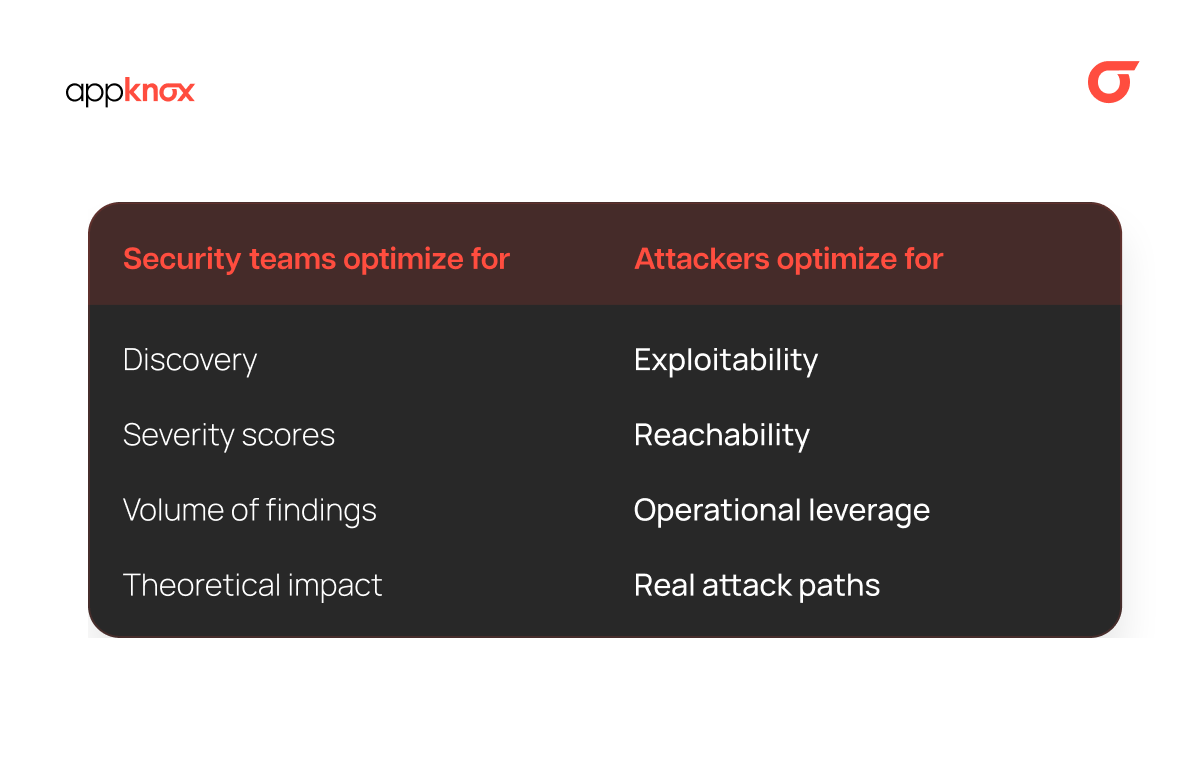
Most organizations still prioritize risk using static severity models like CVSS. But severity only measures theoretical impact. It does not measure whether attackers can realistically weaponize the vulnerability in your environment.
A critical vulnerability buried deep inside an isolated system may never become an incident.
Meanwhile, a medium-severity flaw exposed to the internet may represent an immediate risk.
That is why vulnerability volume keeps increasing while real prioritization keeps breaking down.
The modern security problem is no longer visibility. It is interpretation.
The more useful question today is no longer: “What vulnerabilities exist?”
It is: “Which vulnerabilities are actually likely to become attacks?”
That shift changes everything.
Exposure matters more than volume. Runtime behavior matters more than static severity. Exploitability matters more than theoretical risk.
Because attackers do not exploit everything. They exploit what works.
For years, application security focused heavily on detection:
Find the vulnerability. Assign severity. Push remediation.
But modern environments now generate more findings than teams can realistically operationalize. The next evolution in AppSec is not more visibility. It is exploitability intelligence.
That is why the Appknox team built KnoxIQ.
KnoxIQ is not another vulnerability discovery engine. It is an exploitability intelligence layer designed to answer a far more important question:
Which vulnerabilities are actually likely to become attacks?
KnoxIQ focuses on runtime exploitability, exposure, reachability, and real-world attack feasibility to help teams identify the smaller subset of weaknesses attackers are most likely to weaponize first.
KnoxIQ focuses on:
Runtime exploitability
Exposure
Reachability
Real-world attack feasibility
to help teams identify the smaller subset of weaknesses attackers are most likely to weaponize first.
Because attackers do not think in CVSS scores.They think in exploit paths.
Security teams are still optimizing for discovery. Attackers are optimizing for exploitability. Increasingly, the difference between the two is what determines who moves first.
Request early access to the KnoxIQ beta →
8.5 billion executions. Thousands of crashes. Only two real vulnerabilities. Why are most security signals still noise?
More findings. More alerts. More dashboards. Why more findings still do not mean more security.
Comments
Nothing yet. Say the first thing.
Sign in to join the conversation.